
The right moment for a design freeze is when your evidence supports the next commitment, not when a calendar says so. A prototype run needs only the geometry you are testing locked. A production release needs much more: materials, tolerances, purchased parts and a controlled revision. If you are about to send a part to a machine shop, the freeze is the point where a drawing stops being a draft and becomes an order. At Flying Chip Factory, the machinist who designs and builds our parts also handles your questions directly, so that decision gets made with someone who will cut the metal.
TL;DR
- A design freeze is a binding decision that defines the product, its parts or its parameters, so later work can proceed on that basis (Design Society).
- Freeze on readiness, not on a date: what you must lock depends on whether the next step is a prototype or a production release.
- Freeze connected parts together, and freeze expensive, highly connected parts earlier.
- After the freeze, every change gets an impact assessment before anyone cuts new metal.
- Parts with outside constraints, such as a bike's frame or a bought-in fastener, should be locked early because everything else has to fit them.
What a design freeze means
Researchers at the Design Society describe a freeze as a binding decision that defines a whole product, or some of its parts or parameters, and lets later design work continue on that basis (Eger, Eckert and Clarkson, 2005). Think of it as a line in the sand. Everything before it is exploration. Everything after it is built on top of it.
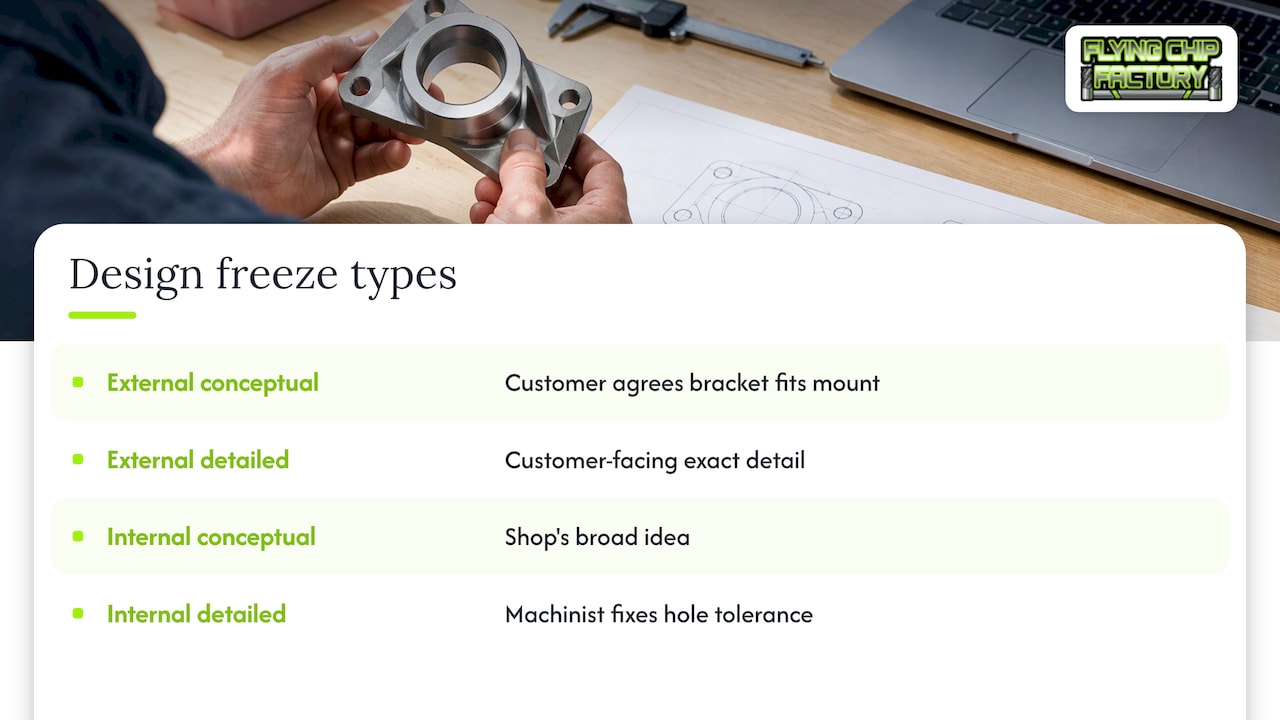
The same paper describes four kinds: external conceptual, external detailed, internal conceptual and internal detailed. In plain terms, you may freeze what is promised to the customer or what is decided inside the shop, and you may freeze the broad idea or the exact detail. A customer agreeing that a bracket must fit a certain mount is an external conceptual freeze. The machinist fixing a hole position to a tolerance is an internal detailed one.
In an idealized sequence, the specification freezes before conceptual design, conceptual design comes before detailed design, and the whole design freezes before manufacturing. Real projects loop back across those stages, which is why timing matters.
What goes into the freeze
What you lock depends on the product and the stage. A guide from Whistle Design lists the possible baseline: requirements, CAD, drawings, materials, processes, purchased components, supplier information, assembly, performance, safety, compliance, test results and revision information. Prototype tooling may need only limited geometry. A manufacturing release needs broader approved information.
For a machined part, the working version of that list looks like this:
| Item | What to lock | Why it matters at the machine |
|---|---|---|
| Geometry | Final CAD model and revision letter | Programming and fixturing follow the model |
| Drawing | Dimensions, tolerances, datums, surface finish | The print is what the part is inspected against |
| Material | Alloy and temper or grade | Changes cutting strategy and strength |
| Finish | Anodize, coating or none | Affects final dimensions |
| Interfaces | Mating parts, fasteners, bolt patterns | A wrong interface means a part that does not fit |
| Quantity | Prototype, short run or repeat order | Sets how much process development is worthwhile |
A clean print is half the freeze. Our guide to CNC drawing standards covers what belongs on it, and the GD&T datum checks show how to confirm that the features you are freezing actually relate to each other the way the assembly needs.
How to tell the design is ready
The Whistle Design guide offers readiness indicators that translate well to small-batch machining:
- Clear, measurable requirements. You can say how the part is judged: fits this mount, carries this load, clears this swing arm.
- Appropriate test evidence. A prototype has been fitted or loaded in a way that matches the next step.
- Manufacturing and assembly review. Someone who will cut and assemble it has looked at it.
- Resolved critical interfaces. The places where this part meets others are settled.
- A controlled revision. One named version is the version.
- Visible residual risks. Anything still uncertain is written down, owned or accepted.
That third item is where a shop earns its keep. A machinist can tell you that an internal corner needs a radius a standard end mill can cut, or that a thin wall will chatter. Catching that before the freeze costs a conversation. Catching it after costs a remake. Our rapid CNC prototyping guide shows how production-intent prototypes in a few days feed this review, and prototype testing with probing shows how to turn a prototype into measured evidence instead of an impression.
Before you approve a manufacturing freeze, run through the information and readiness checks one more time. Fabrication for purpose-built performance is a useful framing of why the paperwork matters as much as the metal.
Freeze dependent parts together
A 2024 study by Lim, Kang, Lee and Hong on modular product development proposes freezing dependent tasks together to avoid unfreezing and restarting work later, and demonstrates the idea on a formula car (Seoul National University). Locking dependent items at the same time can reduce design iterations. Ignoring dependencies risks reopening work you thought was settled.
A simple example: a bracket, the bolts that hold it and the plate it bolts to. If you freeze the bracket but leave the plate open, a plate change forces a bracket change. Freeze the group, or at least freeze the interface between them first.
Risks of freezing too early or too late
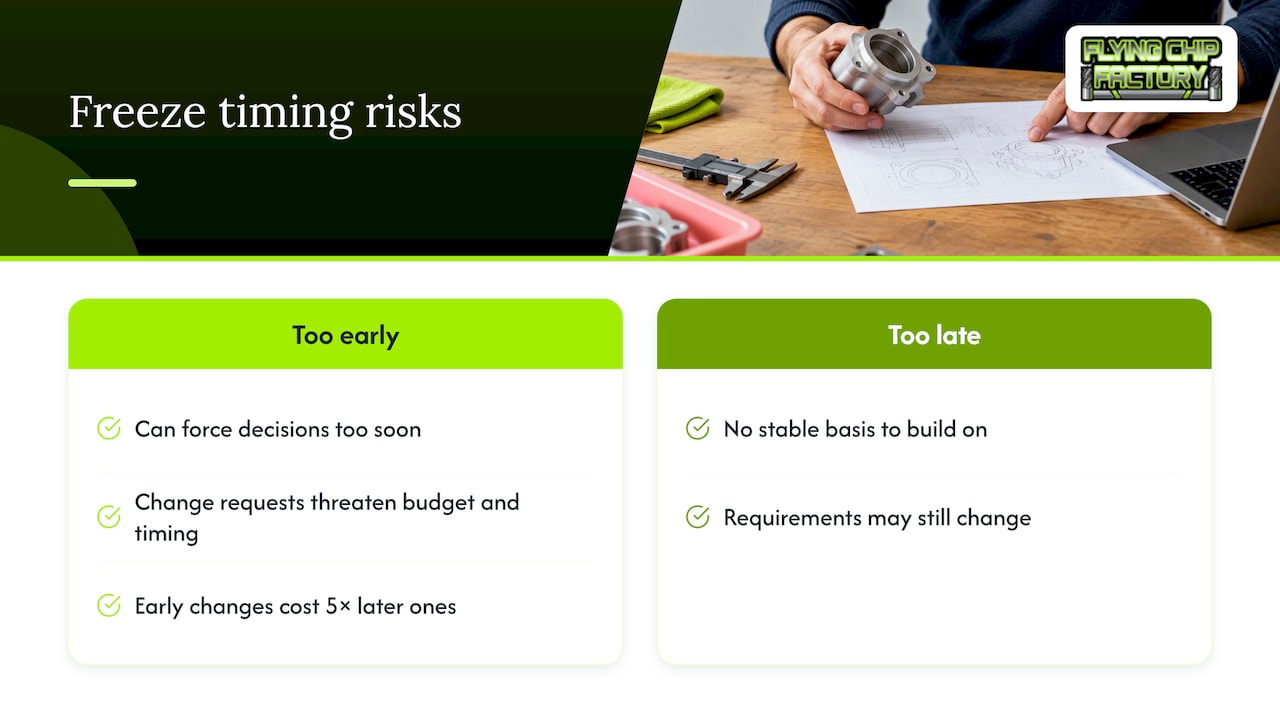
Too early. Peterson, Paasch, Ge and Dietterich note that an early freeze can structure iterative work and push changes to a future generation, but can also force a decision before enough information exists. Uncertain requirements can justify waiting (Oregon State University, 2007). An engine case in the Design Society literature shows the cost: crankshaft and connecting-rod designs were frozen before most other engine parts had started, and when engine requirements changed, the resulting change requests threatened budget and manufacturing timing (Eger, Eckert and Clarkson, 2007).
Too late. Waiting leaves nothing stable to build on. The Oregon State paper also points out that highly connected and expensive components are good candidates for earlier freezing, and that a freeze does not guarantee requirements never change.
One more data point on cost: a 2017 study of aerospace programs found that changes to early design decisions cost five times more than changes to later ones, mainly because early decisions could not be judged until later testing (Tan, Otto and Wood). That is aerospace, not a small shop, but the lesson carries: the sooner you can test a decision, the sooner you know whether to freeze it.
Constraints decide what you freeze first
A design constraint is something fixed that limits what the rest of the design can do. The Design Society change study gives a clean example: a bought-in standard component is defined early and limits the changes available to everything around it (Eger, Eckert and Clarkson, 2007).
For a machined accessory, that component is usually the vehicle. A bolt-on part for an existing motorcycle has a frame, a mounting hole and a fastener size it cannot change. Those become the first things you lock, and the new part is designed to them. A part that must fit a 1 1/8-inch handlebar clamp or a specific bolt pattern has its interface frozen by the world before you draw a line.
Changing a design after the freeze
A freeze does not ban changes. It makes them deliberate. The Design Society work says post-freeze changes are hard to judge when you do not understand how components interact and what development state each is in, and that approval may need a project manager or change committee (2007 study).
The Whistle Design guide recommends starting each change with an impact assessment. Ask:
- Why is the change needed?
- Which parts and suppliers does it touch?
- Does earlier test data still apply?
- Are safety or compliance questions affected?
- What happens to tooling, ordered material and packaging?
- What are the cost and schedule effects, and who approves?
Our engineering change control guide walks through running this step by step. If the part is headed for a customer program with formal approval, the Level 3 PPAP guide shows how a frozen design is documented for submission.
Freezing timing by project type
| Project | Freeze early | Keep open longer |
|---|---|---|
| One-off prototype | Interfaces and critical dimensions | Cosmetic features, edge breaks |
| Fixture or bracket | Datums and mounting points | Lightening cuts, finish |
| Short production run | Full print, material, finish, tolerances | Packaging, labeling |
| Replacement part from a worn sample | Fit-critical features once measured | Non-functional details |
If you have a worn part but no drawing, reverse engineering without drawings explains how to capture intent and fit so there is something solid to freeze. Tight tolerances raise the stakes of the freeze, since a changed callout can mean a new setup. See our tight tolerance machining guide before you lock numbers you cannot afford to revisit.
Our perspective
We design and machine our own parts, and the E2 Kickstand is the clearest example of why freeze timing matters. A bolt-on stand for the KTM SX-E 2, GASGAS MC-E 2 and Husqvarna EE 2 starts with the bike: the mounting points are fixed, so we lock the interface first and let everything else follow.
Because the same shop designs, machines and ships the part, the person who understands the cut is in the room when the design gets frozen. There is no relay of messages through intermediaries. Questions and revisions go straight to the machinist who builds the product.
That is the advice we would give any engineer: freeze when a machinist has looked at the print and the interfaces are settled, not before. A short conversation at that point is cheaper than any remake after it.
Drake
Bring your part to the machinist
If you have a part approaching its freeze, we offer prototype machining, short-run production, and fixtures, brackets and support parts, with direct access to the machinist for fast iteration. Send the print and the questions you have before you lock the design, and we will work through them with you at Flying Chip Factory. Pricing for these services is quoted per project, and our machining RFQ checklist lists what to send.
Riders with a KTM SX-E 2, GASGAS MC-E 2 or Husqvarna EE 2 can see one of our finished, frozen designs in the E2 Kickstand, listed at $100-105.
FAQ
What is a design freeze in product development?
It is a binding decision that defines a product, its parts or its parameters so later work can build on it. It can cover customer-facing requirements or internal details, and it can be conceptual or detailed.
When should you set a design freeze?
Set it when the evidence supports the next commitment. Prototype tooling needs less locked down than a production release. Look for measurable requirements, test evidence, a manufacturing review, resolved interfaces and a controlled revision.
Can you change a design after the freeze?
Yes, but each change should start with an impact assessment covering reason, affected parts, test validity, tooling, materials, cost, schedule and approvers. Some changes need sign-off from a project manager or change committee.
Which parts should be frozen first?
Parts that are highly connected to others, expensive to change, or defined by an outside constraint such as a bought-in component or the vehicle they bolt to. Dependent parts are best frozen together.
Sources
- The role of design freeze in product development, Design Society
- Design Freeze: Avoid Costly Changes Before Manufacture, Whistle Design
- An effective design freeze strategy for establishing design rules, Seoul National University
- Engineering change analysis during ongoing product development, Design Society
- Product innovation for interdisciplinary design under changing requirements, Oregon State University
- A comparison of design decisions made early and late in development, Design Society