
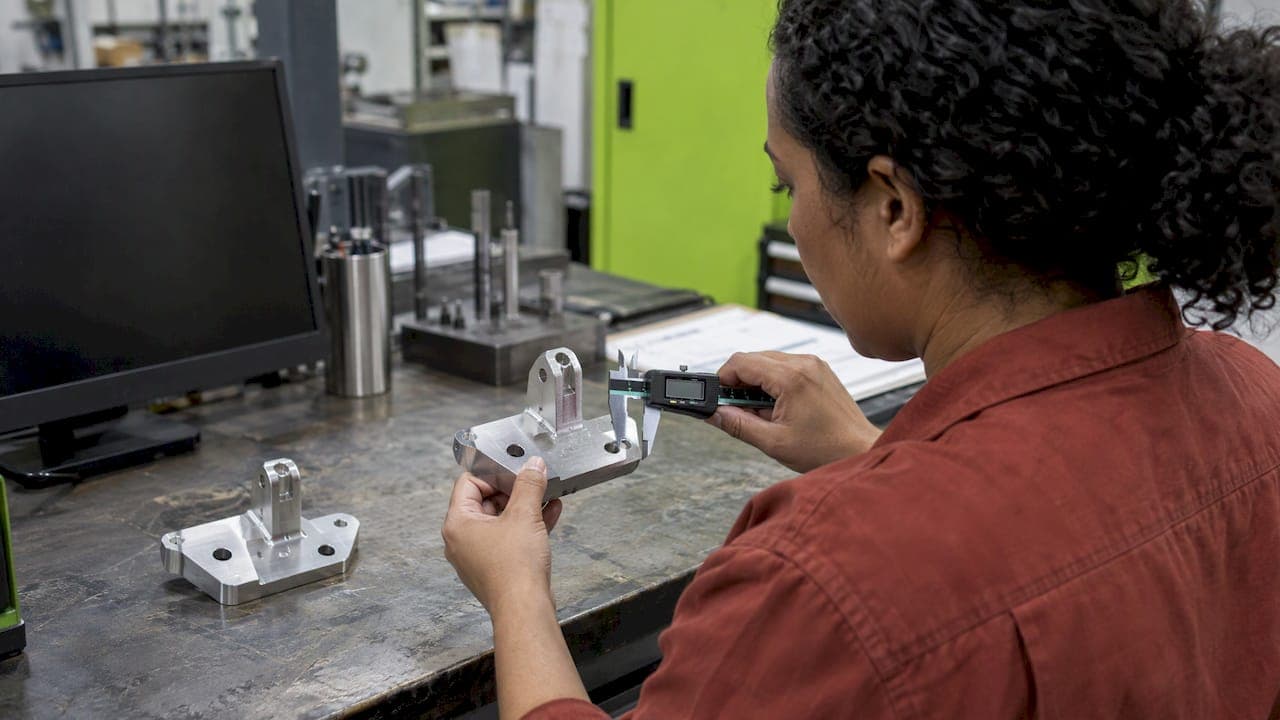
Engineering change control is the discipline of proposing, reviewing, approving, implementing and documenting every change to a product design, a process or its documentation, so nobody builds from an outdated drawing. In practice it comes down to one rule: no change reaches the shop floor until the right people have approved it and the paperwork matches the part. This guide walks through the steps, the ECR, ECN and ECO documents, and how a small machining operation can run the process without a heavyweight software stack.
TL;DR
- Engineering change control is a structured way to identify, document, evaluate and implement changes so they do not harm the finished product, as Autodesk describes it.
- The core flow is the same everywhere: request, impact analysis, approval, implementation, documentation update, validation, closure.
- An ECR asks for a change, an approved ECO or ECN authorizes and announces it, and nothing is released until the revision record matches what is being built.
- Scale the process to the risk: a cosmetic tweak needs one reviewer, a change to a fit or a safety feature needs more.
- In a small shop, the best control is a short written form, a revision letter on every drawing and a machinist who is in the loop.
What engineering change control actually covers
Every physical product changes. A hole moves 0.020 inch because an assembly interfered. A material is swapped because a supplier ran out. A fillet radius grows because a tool kept chattering. Engineering change control is what keeps those edits from turning into scrap, rework or a part that no longer fits what it mounts to.
The scope is wider than the drawing. ETH Zurich's teaching material describes engineering change control as coordinating the production or modification of blueprints, bills of material, routing sheets and related documentation, with stepwise release to production. So the "change" is not only the geometry. It is the model, the print, the BOM, the machining program, the inspection plan and the instructions the operator reads.
The terms "change control" and "change management" are used almost interchangeably in search results. Control usually refers to the gatekeeping mechanics (who may change what, and who signs). Management is the broader umbrella that includes planning, communication and review of lessons learned. For a small team the distinction matters less than the habit.
Two reasons to bother:
- Consistency and quality. A documented process ensures a change does not quietly degrade the product.
- Compliance and traceability. Autodesk notes that thorough documentation and validation support compliance with regulatory requirements and industry standards. Customers in automotive, aerospace and medical supply chains will ask to see this trail.
ECR, ECN and ECO: what each document does
The acronyms trip up almost everyone, partly because companies use them differently. The common thread is that a request, an authorization and a notification are three separate events.
| Document | Full name | What it does | Changes the part? |
|---|---|---|---|
| ECR | Engineering change request | Proposes a change and justifies it | No |
| ECO | Engineering change order | The approved version, with execution instructions | Authorizes it |
| ECN | Engineering change notice | Tells affected people the approved change is taking effect | Announces it |
The definitions below come from vendors' documentation, and they agree on the essentials:
- The Aras documentation states that an ECR requests a change but does not itself change the item, while an ECN authorizes changes to items based on an approved ECR and notifies the affected users.
- PTC explains that an ECR establishes agreement on the business and technical justification so stakeholders can decide whether to proceed, whereas an ECN defines the detailed implementation work needed to update product and process deliverables.
- Wrike's breakdown treats the ECR as the proposal, the ECO as the approved version with execution instructions, and the ECN as the notification that the approved change is taking effect.
In a ten-person company, you do not need all three as separate forms. One "change request" form that turns into the work order once signed covers the same ground. What you cannot skip is the order of events: propose, evaluate, approve, then implement.
The steps of an engineering change control procedure
Published procedures vary in how many boxes they draw. PTC's 2024 overview uses five broad stages: identify the problem or opportunity, pursue a formal change, identify the cause, propose a solution and implement the approved one. Dassault Systèmes condenses it to change request, impact analysis, approval workflow and change order, with actions assigned and the release recorded for traceability. Arena lists issue scoping, ECR creation, ECR review, ECO creation, ECO review, approval notification and implementation.
Merged into one practical sequence, it looks like this:
- Identify the change. Describe what is wrong or what could be better, and which part, revision and process it touches.
- Evaluate the impact. Autodesk's process covers cost, schedule, resources, feasibility and risk. Add fit, function and interchangeability with parts already in the field.
- Obtain approvals. The people who own design, manufacturing and quality sign, or reject with a reason.
- Implement. Update the model, drawing, program, fixtures and inspection plan, and build or modify the part.
- Update documentation and communicate. Everyone using the old revision learns the new one exists.
- Validate. Confirm the changed part does what the change intended.
- Close the request. Record the effective date and evidence.
- Review lessons learned. Ask whether the same issue could have been caught earlier.
Rough-cut release versus detailed release
One idea from the ETH Zurich material is worth borrowing, especially for prototype work. It separates rough-cut release, based on preliminary drawings and rough BOMs and routings, from detailed production release, where complete blueprints, BOMs, routing sheets and numerical-control programs exist. Professor Paul Schönsleben presents stepwise release as valuable for simultaneous engineering: provisional data can start procurement and production of lower-level items while detailed design continues, as long as the later detailed release completes the documentation.

For a machine shop, that translates directly: you can order stock and start roughing a prototype before every tolerance is final, as long as everyone knows the print is not yet released and the change history will be closed out before production quantities run.
What a good change request contains
A vague request is the most common reason a change goes sideways. NORA's PLM guide says an ECR should capture the proposed change, the business justification, the expected benefits, the affected products and an initial risk assessment. eLeaP's 2026 guide adds the reason, the current revision, supporting evidence and the requestor.
A one-page template that covers all of that:
- Request number and date.
- Requestor and who is affected.
- Part number and current revision.
- Problem statement. What is happening, with a measurement or photo if there is one.
- Proposed change. Exact dimensions, materials, finishes or process steps.
- Reason and expected benefit. Cost, quality, lead time, fit or safety.
- Affected items. Mating parts, fixtures, programs, inventory, open orders.
- Risk level. Low, medium or high, with one line explaining why.
- Supporting evidence. Inspection data, test results, customer feedback.
Run a where-used search early
TechTarget advises that the lead engineer perform a where-used search in the ERP or PLM system as soon as a possible change is identified. Then examine on-hand and on-order inventory, planned activity and customer orders for affected parts and higher-level products. In a shop without ERP, the same job is done with a spreadsheet of part numbers, a look at the rack, and a check of open quotes.
Who reviews and approves
Larger organizations use a change review board or change control board. According to NORA's guide, engineering, product management, manufacturing, quality, procurement and supply chain stakeholders may all take part. A published supplier procedure from Access Business Group shows how formal it can get: the completed request goes to a board coordinator, who assigns an ECR number and links the record to the affected item. Reviewers examine it, ask questions and form an approve or reject opinion before the meeting, and a unanimous board decision is required for an ECR to become an ECN.
Most teams will not need that machinery. eLeaP's point is the useful one: review depth and required approvals should depend on the scope and risk of the change, and role-based approvals preserve accountability. A sensible tiering for a small shop:
| Change type | Example | Who signs |
|---|---|---|
| Low risk | Title block fix, note clarification | Design owner |
| Medium risk | Tolerance change on a non-critical feature, new finish | Design owner and machinist |
| High risk | Change to a mating feature, material or load-bearing geometry | Design owner, machinist, quality lead and the customer |
Dassault Systèmes makes a point that matters for small teams too: linking the request to product data lets reviewers assess the same configuration context instead of reconstructing decisions from email threads. Even without PLM software, one shared folder per part number with the request, the old print and the new print beats a chain of messages.
Implementing, documenting and verifying the change
Approval is not completion. After sign-off, PTC says the ECN defines the implementation plan, including the relevant CAD, BOM, manufacturing-process planning and technical-publication updates. The updated product and process data is then reviewed and validated, and released to the enterprise and, where appropriate, to downstream systems such as ERP and MES.
The Access Business Group procedure illustrates why approval and release should be separate steps: a supplier signature or an initial ECN approval indicates feasibility or authorization to initiate, not completion. The same procedure allows the board to request first-article inspection results, process-capability studies or test data as completion evidence before production release.
The work usually touches more than the drawing. Arena notes that implementation may require sourcing parts, updating SOPs, work instructions and routings, and making changes on the factory floor or through field rework. eLeaP lists specifications, BOMs, work instructions, inspection criteria, processes, software and supplier requirements, with training for the people affected.
A closure checklist
Per the same eLeaP guide, closure should confirm document revisions, training completion, implementation evidence and the effective date, and a change should not close before every required activity is done. In a machine shop that translates to:
- The new revision letter is on the model, the print and the program.
- The old revision is marked obsolete at the machine and in the folder.
- The first piece off the new revision is inspected and the result is saved. If you run in-process checks, our piece on three in-process inspection modes for short-run shops shows where those measurements fit.
- Inventory made to the old revision is reworked, scrapped or deliberately kept, with the decision written down.
- The requestor is told the change is live.
For customers that need formal proof of a stable process, a documented change history is also a building block of a submission package. Our walkthrough of Level 3 PPAP for machining shops covers how revision control feeds into that paperwork.
Risks and common process problems
The most expensive changes are the ones made after production has started. TechTarget notes that post-production changes are more disruptive and require earlier, more intensive coordination with purchasing, inventory, production, finance, sales and service, especially when driven by safety, regulatory or recall requirements. Its perspective is that the earlier you map affected items, inventory, orders and downstream products, the better you can justify a voluntary change or estimate the total cost of a mandatory one.
Problems we see repeatedly in machining and product work:
- Verbal changes. A phone call changes a dimension and the print never follows.
- Two live revisions. The machinist has Rev B in the program and the inspector has Rev C on paper.
- Approval without impact analysis. Someone signs without knowing a fixture or a gauge depends on the old geometry.
- No closure. The change is done but never recorded, so the next person repeats the question.
- Same process for every change. Heavy review for a note edit trains people to bypass the process. Tiering by risk avoids that.
When a part has no usable drawing at all, you cannot control changes against a baseline that does not exist. In that case, build the baseline first. Our article on reverse engineering without drawings explains how to capture intent and fit so Revision A is trustworthy.
Change control in a small CNC shop
Small shops have an advantage: the distance between the person who proposes a change and the person who cuts it is short. That makes the process faster, and it also makes it easy to skip the paperwork because "everyone knows." A lightweight version that works:
- One change request form, one number sequence.
- A revision letter on every model, print and CNC program.
- One folder per part with a change log listing request number, date, what changed and why.
- First-article inspection after every released change.
- A short monthly look at open requests so none linger.
Customers who send work out for prototypes can make this smoother by asking the right questions before the quote. We collected 12 questions engineers should ask a machine shop before quoting, several of which concern how revisions are handled. And for prototype iteration, where changes arrive daily, see how rapid CNC prototyping and probing-based prototype testing keep revisions tight without slowing the loop.
Perspective
We design and machine our own parts in Athens, Alabama, and we also machine parts for other people's projects. That puts us on both sides of every change request: the person who wants to improve a design and the person who has to cut it.
Our view is that change control works best when the machinist who builds the part is part of the conversation from the first request. A hole location that looks fine in CAD can be awkward to fixture, and a tolerance that looks tight on paper can be cheap or costly depending on the setup. When questions go straight to the person at the machine, with no sales intermediary in between, a revision gets resolved in a short exchange instead of a round of emails.
That is how we approach our own product line, such as the bolt-on E2 Kickstand, and how we handle customer prototypes and short runs. Write the change down, agree on the revision, inspect the first piece, and keep the history. It is not glamorous, but it is what keeps a part fitting the next time it is made.
Drake
Get a part changed, revised or made
If you have a design that needs a revision, a fixture that has to match a new part version, or a short run that must follow a controlled print, we can talk it through directly with the machinist who will cut it. See what we offer for prototype machining, short-run production, and fixtures and brackets, and send us the part number and revision you are working from.
If you ride an electric mini bike, our E2 Kickstand for the KTM SX-E 2, GASGAS MC-E 2 and Husqvarna EE 2 is a CNC-machined, bolt-on part priced at $100-105. For more on how we think about parts for these bikes, read our guide to aftermarket parts for the SX-E 2.
FAQ
What are the steps of a change control procedure?
Identify the change, evaluate its impact on cost, schedule, resources, feasibility and risk, obtain approvals, implement it, update and communicate the documentation, validate the result, close the request and review lessons learned. That is the sequence Autodesk lays out. Other published procedures use fewer or more boxes, but the order of request, review, approval and implementation is constant.
What is the difference between an ECR and an ECN?
An ECR is the request: it proposes a change and gives the justification, but it does not alter the item. An ECN comes after approval and authorizes the change, notifies affected users and describes the implementation work, as Aras documents. Some companies also use an ECO as the approved order with execution instructions.
Does a small shop need PLM software for change control?
Not to start. The principles are the same at any size: a written request, a risk-based review, a signed approval, a revision letter and a closure record. A shared folder per part and a change log can do the job. Software becomes useful when many people, products or customers make the manual log hard to trust.
When is a change too small to need approval?
Most teams treat purely editorial fixes, such as a typo in a note, as low risk with a single sign-off. Anything that touches fit, function, material, a mating part or a safety feature deserves a full review. The risk-based tiering in the table above is a reasonable starting point to adapt to your own products.
Sources
- Engineering Change Management, Autodesk
- 5.4.2 Release Control and Engineering Change Control, ETH Zurich
- What Is an Engineering Change Notice?, PTC
- Engineering Change Management Process Overview, PTC
- Engineering change approvals, Wrike
- Change Control Process: From Request to Implementation, Dassault Systèmes
- Engineering Change Control (ECC) Definition, Arena
- Engineering Change Management Guide, NORA PLM
- Engineering Change Control: Build a Reliable QMS Process, eLeaP
- Engineering Change Procedure, Access Business Group
- Why is engineering change control important to manufacturers?, TechTarget