
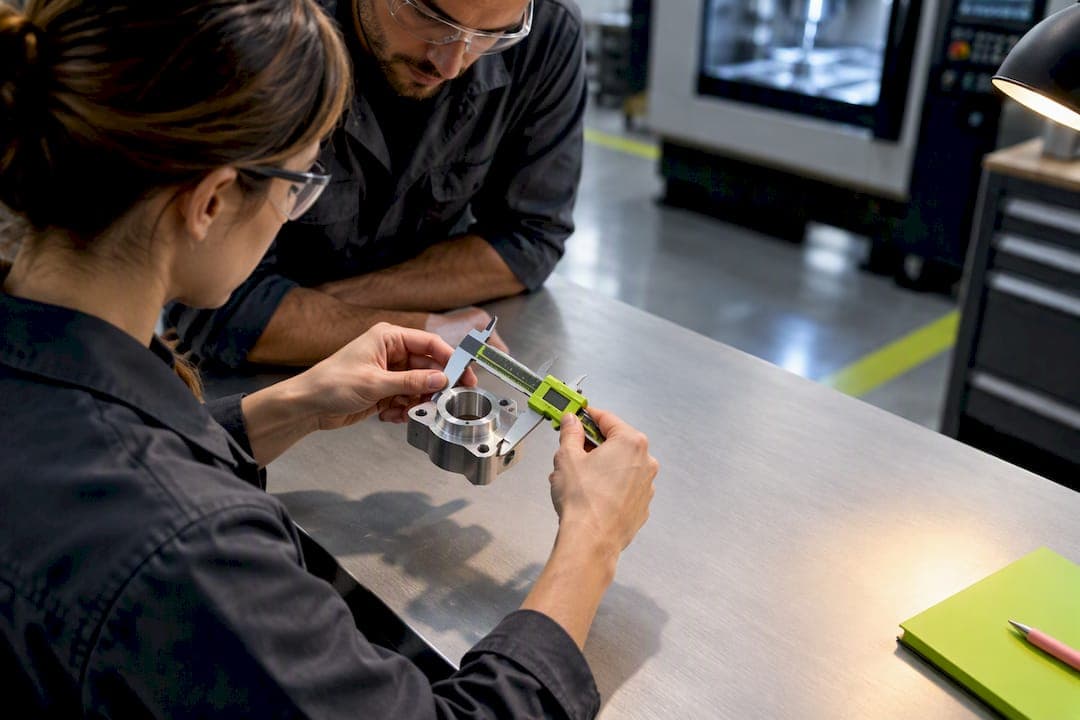
The questions that decide whether a shop can handle your prototype come down to five things: what tolerances they can actually hold, how they manage outsourced processes, what quality documentation they can produce, how honest their lead times are, and whether you can talk directly to the person running the machine. Some shops build their process around direct communication between engineers and the machinist handling their jobs.
TL;DR:
- Shops that provide detailed, verifiable answers on tolerances, inspection reports, and vendor qualifications indicate a controlled process suitable for tight-tolerance prototypes.
- Standardizing drawings with ASME Y14.5 GD&T, CAD, STEP, and explicit surface finish and inspection notes reduces quoting errors and rework.
- Demand written confirmation of quality management scope, including for outsourced processes, to ensure consistent inspection and acceptance criteria.
- Expect detailed, itemized quotes breaking out setup, machining, material, finishing, and inspection costs to accurately assess total expenses.
- Direct communication with the machinist accelerates issue resolution, minimizes delays, and improves prototype accuracy by eliminating layers of support.
1. Priority list: the 12 essential machine shop questions to ask
Start every RFQ or intro call with these, roughly in order of impact on prototype success:
- What materials and finishes do you machine in-house, and which finishing steps get sent out?
- What tolerances can you hold on this part, and do you inspect to ASME Y14.5 geometric callouts?
- Do you have a CMM on site, and can you share a sample inspection report?
- What is the scope of your quality management system, and is it documented?
- How do you qualify and monitor outsourced vendors for processes like anodizing, plating, or heat treat?
- What is your realistic lead time for a first article versus a repeat order?
- Is there a minimum order quantity or minimum charge, and how does it scale with volume?
- What tooling costs are included in the quote, and do they carry over to future orders?
- Can you run a first article inspection (FAI) or sample part before full production?
- How many machines do you have in each category, and what is your current backlog?
- What is your policy on design revisions after a quote is accepted?
- Who is my direct point of contact, and how do you handle IP and drawing confidentiality?
A shop that answers all twelve without hedging is usually one that runs a controlled process rather than an improvised one. The material and finishing question matters early because a shop that farms out every finishing step adds handoffs, and every handoff is a place where a part can get lost, delayed, or damaged. The tolerance and GD&T question separates shops that read drawings from shops that eyeball them. Lead time answers matter less for their number than for their specificity: a shop that says "two to three weeks depending on material availability and current queue" is telling you more than one that says "fast turnaround."
2. How to interpret a shop's answers: red flags and good answers
A good answer is specific, verifiable, and tied to a process or document, while a red flag is vague, unverifiable, or evasive about who actually does the work.
- Strong answer: "We hold plus or minus 0.0005 inches on this feature using our Haas VF-2, and here's a CMM report from a similar part."
- Strong answer: "Anodizing goes to a qualified vendor we've audited, and we do incoming inspection on color and coating thickness before shipping."
- Red flag: "We can usually turn it around pretty quick" with no date, no queue explanation, and no willingness to commit in writing.
- Red flag: refusal to name which processes are outsourced or to describe how those vendors are qualified.
- Red flag: no inspection records exist for previous jobs of similar tolerance.
Verification takes minutes, not weeks. Ask for the scope of their documented quality management information, a sample FAI or CMM report, and a one-paragraph production plan for your specific part. A shop with real process control produces these without delay because the documents already exist.
Pro Tip: Ask for a CMM report on a part with similar tolerances before you send your drawing. If they can't produce one, treat every tolerance claim on your job as unverified.

3. Drawings, GD&T, and data formats you must standardize before quoting
Standardize your drawing package before you send the first RFQ, and ambiguity in tolerancing is the single biggest source of quoting errors and rework. ASME Y14.5 exists specifically to remove that ambiguity, and asking whether a shop reads and inspects to it tells you a lot about how they'll handle a tight-tolerance feature.
Send these with every RFQ:
- Native CAD file plus a neutral STEP file for machine programming.
- A 2D PDF drawing with GD&T callouts, even when the model carries the primary tolerance data.
- A note on which datums are critical and which features control fit or function.
- Surface finish requirements called out explicitly, not left to default.
- Inspection method expectations for critical features, especially profile and position tolerances.
Missing datums, tolerances applied inconsistently across a print, and unspecified inspection methods all add cost because the shop has to ask questions or guess. When a design is moving to model-based definition, confirm the shop can extract GD&T directly from the model rather than requiring a flattened 2D print for every revision.
4. Quality, inspection, and outsourced-process controls to demand in writing
Ask for the scope of the shop's quality management system before you ask for a quote, because a shop that can't describe its own process controls usually can't guarantee yours. ISO auditing guidance for supply chain and procurement processes treats outsourced operations as part of the shop's own quality responsibility, not something they can wave off once the part leaves the building.
For any prototype where fit or function matters, request:
- A written FAI plan describing which features get measured and how.
- A recent CMM report from a comparable part, showing actual values against tolerance.
- Documentation of how outsourced processes, like anodizing or heat treat, are qualified and monitored.
- Acceptance criteria and how concessions or corrective actions get tracked when a part is out of spec.
A shop's FAI and CMM reports are the clearest sourced evidence you'll get that a stated tolerance was actually achieved, since ISO 9001 documentation guidance requires that objective evidence be available for review, not just claimed. If the shop outsources a risky step and can't produce vendor qualification records, that's the moment to ask for a different plan, not a different price.
5. Quoting, lead times, and pricing: what an engineer should expect and question
A complete quote breaks out setup, per-part machining time, material, finishing, inspection, and tooling amortization as separate line items, and any quote that bundles all of it into one number is hiding information you need.
- Ask directly: "Can you break this quote into setup, machining, material, finishing, and inspection?"
- Expect tighter tolerances, finer surface finishes, and smaller lot sizes to raise per-part cost and lead time, since each adds setup or inspection time that doesn't scale down with quantity.
- Compare tooling costs against future runs: if tooling is a one-time charge that carries forward, later orders should cost less per part.
- Ask what a rush surcharge looks like and whether a smaller first-article quantity can shorten the initial turnaround.
A shop unwilling to itemize a quote is either not tracking its own costs closely or doesn't want you to see where the money goes. For a deeper walkthrough of how these line items interact, see this breakdown of typical CNC quote formulas.
6. Communication, revisions, and working with a shop for fast iteration
Fast iteration starts with one accountable contact, not a support queue. Confirm upfront whether that person is the machinist or a sales layer between you and the machine, and agree on how markups and change requests get communicated: e-mail with redlined PDFs, a shared CAD comment thread, or a call for anything urgent.
Get the revision policy in writing before the first part is cut: how many rounds are included, and what counts as out-of-scope and billable. A short-form sample sign-off, rather than a full FAI, can speed acceptance on low-risk features while reserving full inspection for the ones that matter. Take DFM feedback seriously when it comes from the person actually running the machine.

Why direct machinist access changes how prototypes get built
Most delays in a prototype cycle happen in the gap between a question and an answer, not in the cutting itself. When the person answering your e-mail is the same person running the machine, that gap mostly disappears. That's the structure Flying Chip Factory builds every prototype and short-run job around: no sales layer between the question and the person who can actually answer it.
— Drake
How Flying Chip Factory helps: prototype machining and short-run production
Working directly with the machinist on your job means design questions get answered by someone who understands both the part and the machine cutting it, not relayed through a sales contact who has to check with the shop floor.
Flying Chip Factory offers:
- Prototype machining for engineers and small manufacturers testing a design.
- Short-run production for parts that don't justify a full production contract yet.
- Fixtures, brackets, and support parts built to match your assembly.
- In-house parts like the E2 Kickstand for the KTM SX-E 2, GASGAS MC-E 2, and Husqvarna EE 2, built to show the same process on our own product line.
Use the twelve questions above as your pre-quote call checklist, then request a quote to talk through your prototype directly with the machinist building it.
Key standards and guidance to verify a shop's claims
When you need to check a specific claim, go straight to the source. ASME Y14.5 is the reference for GD&T interpretation and inspection. ISO guidance on outsourced processes explains what auditors expect for supplier controls under ISO 9001. For automated, shareable measurement reports, tools like QA-Report's CMM inspection software show what a standardized report should include.
Sources
- Auditing the procurement and supply chain processes (ISO TC 176 APG)
- Documented information guidance (ISO)
- Dimensioning and tolerancing | ASME Y14.5 (2018)
FAQ
What is the most important question to ask a machine shop first?
Ask what tolerances they can actually hold on your specific features and whether they inspect to ASME Y14.5 GD&T callouts. That answer determines whether the rest of the conversation, from quoting to lead time, is even relevant to your part.
How do I know if a machine shop's quality documentation is legitimate?
Ask for the scope of their quality management system and a recent CMM or FAI report on a comparable part. ISO documentation guidance expects this kind of objective evidence to exist and be available on request, so a shop that can't produce it quickly likely doesn't have it.
What should I do if a shop outsources part of the process?
Ask how they qualify and monitor that vendor, and request records for anything with real risk, like heat treat or plating. ISO auditing guidance treats outsourced steps as the prime shop's responsibility, so they should still control acceptance criteria and inspection.
How does Flying Chip Factory handle prototype and short-run jobs?
Some shops put you in direct contact with the machinist working on your part for prototype machining, short-run production, and custom fixtures or brackets. Pricing for these services is available on request through a project quote.
What file formats should I send with an RFQ?
Send your native CAD file, a neutral STEP file, and a 2D PDF drawing with GD&T callouts, even if the model carries the primary tolerance data. This combination lets the shop program from the model while still having a clear reference for inspection and quoting.