
Expect $40 to $75 an hour for 3-axis milling, $100 to $250 an hour for 5-axis or Swiss-type work, and per-part prices anywhere from $50 to $500-plus for a one-off prototype down to $5 to $60 each once you're running production volumes.
Why the spread? Material, tolerance, setup complexity, and quantity each swing the final number independently, and a quote that skips one of those variables is a quote you can't trust yet.
TL;DR:
- Per-part costs for prototypes in aluminum range from $50 to $150, while large production orders can reduce costs to $5 to $60 each via setup amortization.
- CNC machining quotes are based on a formula that includes material, cycle time, setup, tooling, and profit margin, with setup costs being the most sensitive to order size.
- Material choice significantly impacts cost, with aluminum being cheapest and machining slower, more expensive materials like titanium raising prices up to five times.
- Tight tolerances, complex geometry, and custom fixtures notably increase costs, especially when multiple setups or special tooling are required.
- Offshore machining may be cost-effective only at very high quantities, but total landed costs often outweigh initial savings due to shipping, tariffs, and inspection delays.
What CNC Machining Pricing Actually Covers
A quoted hourly rate rarely means "the machine runs, you pay this." It bundles operator labor, machine depreciation, tooling wear, and shop overhead into one number, and that bundling is exactly why two shops quoting the "same" 3-axis job can land $20 an hour apart.
Here's how the ranges typically break down by machine class:
| Machine type | Typical hourly rate | What drives the spread |
|---|---|---|
| 3-axis milling | $40–$75/hr | Shop overhead, region, machine age |
| CNC turning (lathe) | $40–$75/hr | Bar stock size, live tooling needs |
| 4-axis milling | $100–$250/hr | Extra axis programming, fixturing |
| 5-axis / Swiss-type | $100–$250/hr | Complex geometry, tight tolerances, specialized machinists |
Per-part pricing tells a different story because it folds in setup and programming, which get divided across however many parts you order. A single prototype in 6061 aluminum might run $50 to $150 depending on size and feature count. A precision part in stainless with tight tolerances can push past $500 for a one-off. Once you're ordering 250 units of a straightforward aluminum bracket, the per-part cost commonly drops to $5 to $60 because setup and programming stop being a per-part expense and become a rounding error.
What's usually baked into that hourly figure: machine time, standard tooling wear, and basic operator oversight. What's usually billed separately: CAM programming, custom fixturing, secondary finishing like anodizing or bead blasting, and third-party inspection reports. If your quote doesn't itemize those, ask. A shop quoting a flat number with no line items either has a very simple part or isn't showing you where the money goes.
The Standard CNC Cost Formula and How to Use It
Every legitimate CNC quote traces back to one formula, whether the shop shows it to you or not. The version most U.S. shops use, in some form, is:
Part price = ((Material cost × Weight) + (Cycle time × Hourly rate) + (Setup cost × Hourly rate ÷ Quantity) + (Tooling cost ÷ Quantity)) × (1 + Margin)
That formula comes from calculator tools shops build their quoting logic around, and once you understand each term, you can sanity-check any quote you receive.
- Material cost × weight. Stock price per pound, times how much material the part (plus waste) actually consumes. A part cut from a solid aluminum block wastes more material than one machined from near-net-shape stock, so geometry matters here too.
- Cycle time × hourly rate. This is machine minutes, not wall-clock time. A part that takes 12 minutes to cut on a 3-axis mill at $55/hr costs $11 in machine time alone, before anything else gets added.
- Setup cost ÷ quantity. Setup and programming can run $50 to $1,000-plus depending on complexity, and this is the single biggest lever quantity has on price. Divide $500 in setup by 1 part and you're paying $500. Divide it by 100 parts and it's $5 each.
- Tooling cost ÷ quantity. Custom fixtures or specialty cutters get amortized the same way setup does.
- Margin. Shop profit, typically layered on last.
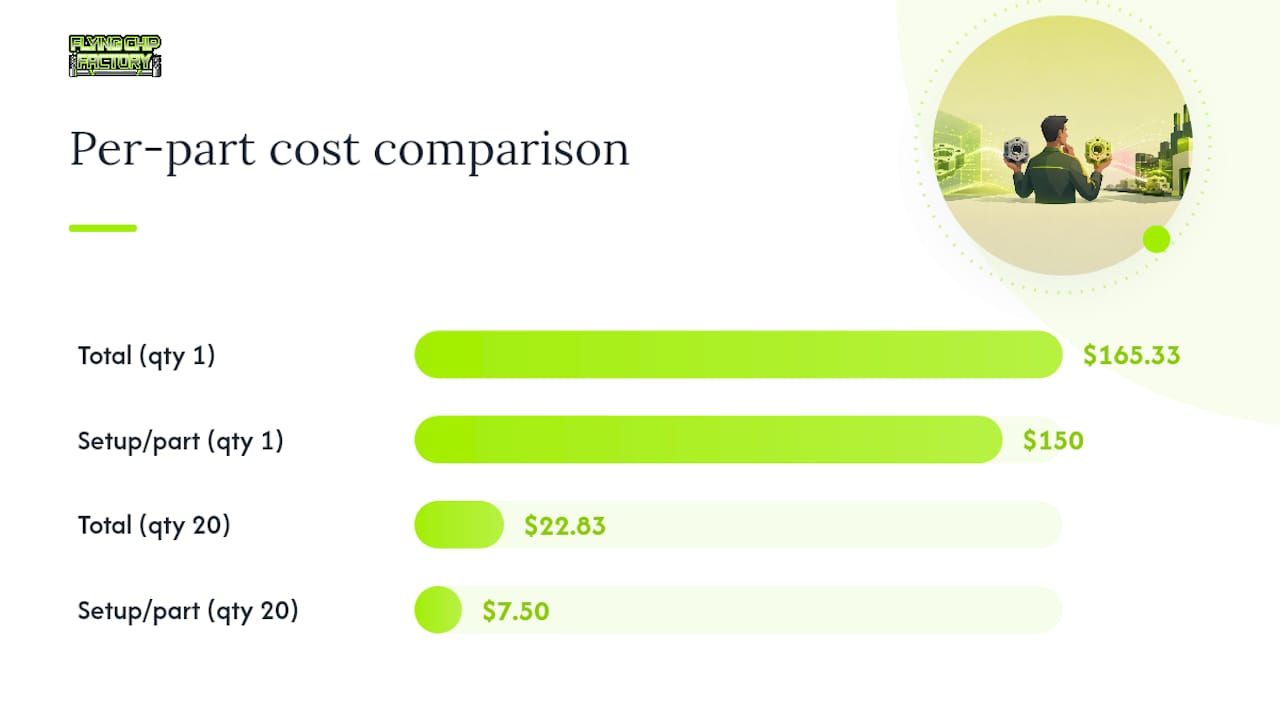
Here's a worked example. Say you need a small aluminum bracket: $8 in material, an 8-minute cycle time at $55/hr ($7.33), $150 in setup, and no special tooling, at a quantity of 1.
Statistic Callout: Setup costs of $50 to $1,000-plus mean a $150 setup charge divided across a single prototype adds $150 to that one part. Spread across a 20-piece order, it adds just $7.50 per part. That's the entire logic of "batch pricing" in one calculation.
Total before margin: $8 + $7.33 + $150 = $165.33. Order 20, and setup drops to $7.50 per unit, bringing the per-part total closer to $28. Same design, same machine, wildly different sticker price, purely because of how setup gets divided.
Estimating cycle time yourself takes some judgment. A rough rule: complex 3D contours and multiple tool changes add minutes fast, while simple pocket-and-drill geometry stays fast even on larger parts. Material waste follows a similar logic. Blocky parts cut from bar stock waste less than thin-walled parts machined from a solid billet.
What Actually Drives CNC Machining Cost Up or Down
Material choice is the first lever, and it's the one buyers underestimate most. Aluminum 6061 is generally the most cost-effective metal to machine, both because raw stock is cheaper and because it cuts fast without chewing through tooling. Stainless steel machines slower and wears tools faster, which shows up directly in cycle time and tool replacement costs. Titanium is worse on both counts, plus it requires lower cutting speeds and more frequent tool changes, which is why a titanium prototype can cost three to five times what the same geometry costs in aluminum.
Geometry and setup count matter almost as much as material. A part that can be machined complete in one setup on a 3-axis mill is cheap. A part that needs to be flipped, re-fixtured, and re-indicated to reach features on multiple faces adds labor time and risk of misalignment every time it changes position. This is where 4-axis and 5-axis machines earn their higher hourly rates: they can often hit every feature in a single setup, which sometimes offsets the higher rate entirely.
Tolerance and finish requirements act as cost multipliers, not flat add-ons. Standard tolerances around ±0.005 inches are substantially cheaper to hold than precision tolerances of ±0.001 inches or tighter, because tight tolerances demand slower feed rates, more in-process inspection, and sometimes a dedicated finishing pass. The same logic applies to surface finish specifications and coatings like hardcoat anodizing, which add both a secondary process cost and lead time.
Here's what typically pushes a quote higher, roughly in order of impact:
- Multiple setups or re-fixturing to reach different faces
- Tight tolerances (±0.001" or tighter) on more than a couple of critical features
- Exotic or hard-to-machine materials like titanium or hardened steel
- Deep pockets or thin walls that force slower feed rates
- Custom fixtures or specialty tooling with no reuse across other jobs
- Third-party inspection reports or full dimensional certification
Pro Tip: Ask your shop which specific features on your part are driving the tightest tolerance callouts. Half the time, a designer specced ±0.001" on a feature that has zero functional reason for it, and loosening just that one dimension can drop the whole quote.
Setup and programming amortization ties all of this together. A complex 5-axis part with a $600 programming cost is brutal at a quantity of 1 and reasonable at a quantity of 50. That's not a pricing trick. It's just arithmetic, and it's the reason shops always ask for your expected volume before quoting.
Real Numbers: What Parts Actually Cost at Different Volumes
Numbers land better with real scenarios attached, so here are four that map common jobs to what they actually cost.
- Single prototype, aluminum bracket. Simple 3-axis geometry, one setup, 6061 aluminum. Material runs around $8, cycle time is 10 minutes at $55/hr ($9.17), setup is $150 for a quantity of 1. Total before margin: about $167. With a 20% margin, expect roughly $200 delivered.
- 10-piece run, precision stainless bracket. Same general shape but in 303 stainless with two tight-tolerance bores (±0.001"). Material costs more per part (~$15), cycle time roughly doubles due to slower feeds (18 minutes at $65/hr = $19.50), and setup at $300 spread across 10 parts adds $30 each. Add inspection time for the critical bores. Expect $70 to $90 per part.
- 250-piece production run, aluminum housing. Same aluminum housing, quantity jumps to 250. Setup of $400 now adds just $1.60 per part. Cycle time drops slightly with optimized toolpaths (7 minutes at $55/hr = $6.42). Material stays around $10. Total lands around $18 to $22 per part before margin, which lines up with the $5 to $60 production range most shops quote for straightforward parts at scale.
- 5-axis titanium prototype. A single complex titanium bracket needing five-face access in one setup. Material alone can run $60 to $100 for a small part. Cycle time is long, 45 minutes at $180/hr ($135), because titanium demands slow feeds and frequent tool changes. Setup for a 5-axis program often runs $500 or more. Total before margin: $700 to $800-plus for one part.
The pattern across all four: material and cycle time scale with the part itself, but setup cost is the one line item quantity directly controls.
How to Actually Lower a CNC Machining Quote
Design-for-manufacturability isn't an abstract engineering principle here. It's the difference between a $200 prototype and a $90 one, and most of the savings come from a handful of repeatable changes.
- Reduce the number of setups by designing features accessible from as few sides as possible.
- Loosen tolerances on every feature that doesn't have a functional reason for tight control, and reserve ±0.001" for the two or three dimensions that actually need it.
- Avoid deep, narrow pockets and thin walls that force slow feed rates and extra passes.
- Standardize hole sizes and thread callouts to reduce tool changes during the cut.
- Specify off-the-shelf finishes where possible instead of custom coatings that require a separate vendor step.
On the procurement side, ask your shop for tooling amortization across your expected order size instead of paying full setup on every batch. Request batch pricing at two or three quantity tiers (say, 10, 50, and 250) so you can see exactly where the per-part cost breaks. And ask for time-and-materials transparency. A shop that shows you cycle time and setup cost separately is giving you leverage to redesign the expensive part, not just the total.
Pro Tip: If your part allows it, ask your machinist about high-feed cutters or climb milling strategies for the roughing pass. Both cut cycle time on straightforward geometry without touching your tolerances, and a shop that offers this proactively is usually one worth sticking with.
Small-batch buyers get the most leverage from setup amortization since it's the single biggest percentage of their per-part cost. Anyone working through a short-run production order should ask specifically how fixture and program costs get spread across the batch, because that answer varies more between shops than the hourly rate does.
When Offshore Machining Actually Saves Money
A lower hourly rate overseas looks attractive until you add everything that comes after the quote. Shipping time, customs clearance, duties, and incoming inspection all add real cost and real risk, and a low offshore rate is routinely offset by tariffs, freight, and rework once a part fails inspection and has to be redone or reshipped.
Trade policy adds another layer of uncertainty. Parts sourced under agreements like USMCA can move across North America with reduced duties, but parts from outside those agreements face tariff schedules that shift with policy and can add 10% to 25% or more to landed cost without warning.
Here's a rough way to think about total landed cost, not just quoted price:
- Offshore quote, low quantity: often loses its price advantage once you add 4 to 8 weeks of shipping time, customs fees, and the cost of holding inventory longer.
- Offshore quote, high quantity, stable design: can still win on pure unit cost if the design is finalized and tolerances are loose enough to tolerate variable QA.
- Nearshore or domestic, prototype or short-run: usually wins on total cost once you count faster iteration, no customs delay, and the ability to catch a bad part before it ships.
- Domestic, tight tolerance or safety-critical parts: almost always the better call, since rework on a failed critical part costs far more than any per-hour savings offshore offered.
For prototyping and short-run work specifically, the time value of fast iteration usually outweighs a marginally lower offshore hourly rate. A design change that takes a phone call and two days domestically can take three weeks round-trip overseas.
Working With a Machinist Directly: The Flying Chip Factory Approach
Some CNC shops run prototyping, short-run production, and fixture and replacement part fabrication out of locations in the U.S., and offer quotes that come from direct conversation with the machinist actually running the job, not a sales layer relaying questions back and forth. That matters more than it sounds like it should. When you can call the person cutting your part and ask "what if I move this feature 2 millimeters," you get an answer in minutes instead of days.
That direct-access model comes out of Flying Chip Factory's own product line. The shop designs and machines its own bolt-on E2 Kickstand for the KTM SX-E 2, GASGAS MC-E 2, and Husqvarna EE 2 electric mini dirt bikes, alongside BDE Bar Mounts, an isolated 1 1/8-inch motocross handlebar mount system built to reduce vibration and trail chatter while keeping steering feel precise. Some shops evaluate parts using an engineer's perspective to ensure they hold up, install properly, and meet quality expectations.
CNC Machining vs. Injection Molding and 3D Printing on Cost
CNC machining, injection molding, and 3D printing solve the same basic problem, turning a design into a physical part, but they hit their cost floor at completely different volumes, and picking the wrong one for your quantity is the most expensive mistake in this comparison.
3D printing wins on low-quantity cost when geometry is complex and tolerances are loose. There's no tooling, no setup amortization curve, and a one-off part can cost less than its CNC equivalent. But it loses ground fast once you need production-grade material properties, tight tolerances, or a smooth finish, since most printed parts need secondary machining or finishing to match what a CNC part delivers straight off the machine.
Injection molding flips the curve entirely. Tooling for an injection mold commonly runs into the thousands to tens of thousands of dollars before a single part gets made, which makes it a poor fit for anything under a few thousand units. Once you clear that threshold, per-part cost drops to cents or low dollars, undercutting CNC machining by a wide margin at true production scale.
CNC machining sits in the middle, and that's exactly why it dominates prototyping and short-run work. No tooling investment, tolerances tighter than most printed parts can hold, and per-part costs that make sense from a quantity of 1 up through a few thousand units, before injection molding's tooling investment starts to pay off.
An Engineer's Honest Read on CNC Pricing in 2026
Most guides on this topic treat the cost formula like a mystery to be revealed. It isn't. Every shop is running some version of material plus cycle time plus setup divided by quantity, and the real skill isn't decoding the formula, it's knowing which variable to attack for your specific job.
The conventional advice, "get three quotes and compare," misses the point entirely. Three quotes on a poorly designed part just gets you three expensive numbers. The advice that actually saves money is asking which features are driving your setup count and your tolerance callouts, then redesigning those before you shop the price around.
If you take one thing from this: quantity is the lever most engineers ignore until it's too late. A part priced for a single prototype and a part priced for a 50-piece batch aren't really the same product from a cost standpoint. Plan your volume honestly before you request a quote, and you'll get a number that actually reflects what you're building.
— Drake
Get a CNC Machining Quote Without the Runaround
Most shops make you wait on a sales rep before you ever talk to the person cutting your part. Some shops offer quote requests that go straight to the machinist working the job, so questions about tolerance, material substitutions, or setup count may get answered more quickly instead of bouncing through email chains.
To get a fast, accurate quote, send your CAD file, material spec, quantity, critical tolerances, and target delivery date. That's enough for most straightforward parts to get a same-week turnaround estimate. For jobs where you need parts in hand fast, Flying Chip Factory's rapid prototyping process can deliver production-intent parts in 2 to 3 days, and short-run orders benefit from the same direct machinist access that makes design iteration fast instead of frustrating. Visit Flying Chip Factory to submit your CAD file and get a quote started today.
Where to Check These Numbers Yourself
Cross-check any quote against real benchmarks rather than taking one shop's word for it. The Bureau of Labor Statistics publishes wage data for machinists, useful for sanity-checking labor components in a rate. The USGS aluminum statistics page tracks raw material pricing trends. For quality process standards, ISO's overview of ISO 9001 explains what certification actually verifies.
Sources
- How Much Does CNC Machining Cost in 2026? Pricing Guide
- CNC Machining Cost Calculator (2026 USA Shop Rates) - TWC Industrial Calculators
- How Much Does CNC Machining Cost? Complete 2026 Pricing Guide
- Aluminum statistics and information - USGS