
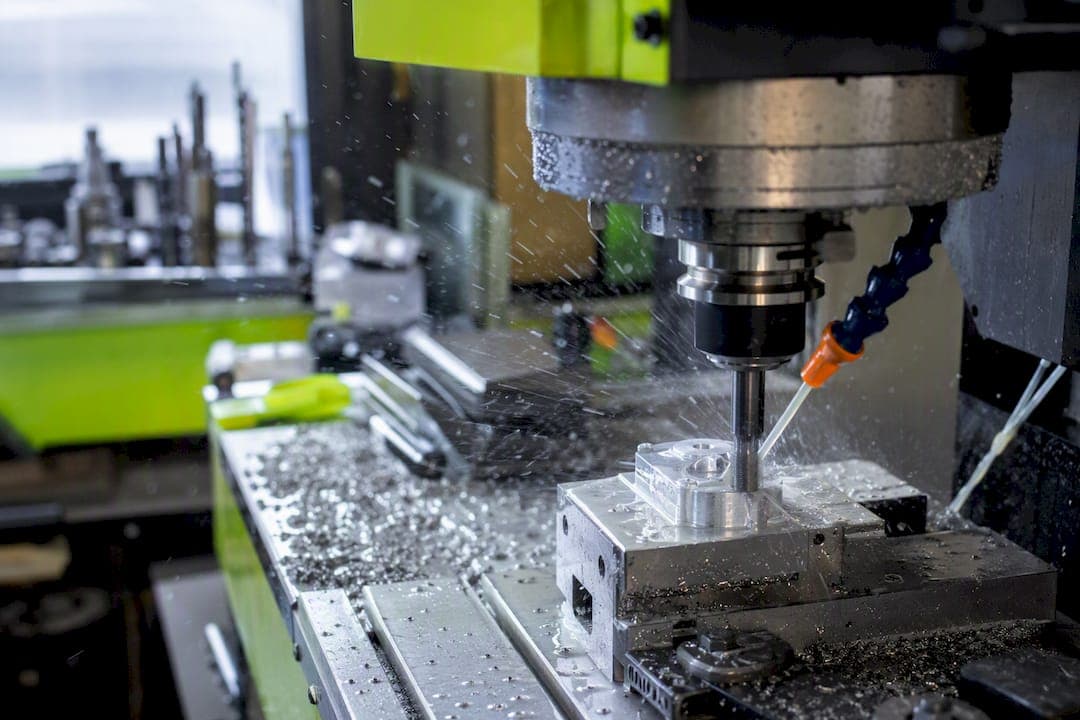
Short-run CNC production is the right call when you need 1 to 500 parts in real production material, held to tight tolerances, and delivered in days rather than the months tooling for injection molding demands. Three signals confirm it's the correct choice: you need parts in final production material (not a resin prototype), you have tolerance-critical features that a printer can't hold, or you want production-grade quality without committing to a mold. If you're at this stage, the next move is simple.
- Pull your CAD files (STEP format works best)
- Confirm your target quantity and material
- List any critical tolerances or GD&T callouts
- Send those three things to a shop for a quote
Pro Tip: Include a one-line note on intended use (prototype testing, pilot run, production part). It tells the shop how tight the fit-and-finish standard should be and speeds up the quote turnaround.
Key Takeaways
Short-run CNC production works because it eliminates tooling costs while still delivering production-grade material, tight tolerances, and fast turnaround for batches of 1 to 500 parts.
| Point | Details |
|---|---|
| Sweet spot batch size | Short-run CNC is most cost-effective for 1 to 500 parts in final production material. |
| Setup dominates small-batch cost | Programming and machine time can exceed half the total cost on runs under 50 pieces. |
| Match tolerance to inspection | Request CMM reports and FAI documentation for any tolerance-critical or regulated part. |
| Vet suppliers on communication | Prioritize DFM turnaround and direct machinist access over the lowest quoted price. |
| Flying Chip Factory as a direct option | Offers machinist-level communication and in-house parts like production kickstands as proof of process. |
What Is Short-Run CNC Production?
Short-run CNC production means machining a defined batch of parts, typically 1 to 500 pieces, directly from solid material using computer-controlled mills or lathes. It sits between one-off prototyping and full mass production. A single prototype proves a concept works. A short run proves the part is repeatable, and it gets you real, usable inventory while you decide whether volume production makes sense.
Engineers reach for this process for a few recurring reasons, especially when weighing the benefits detailed in CNC machining vs. additive manufacturing: quality aspects explained:
- Functional prototypes that need to survive actual testing, not just look right
- Pilot runs before committing to injection molding or die casting tooling
- Replacement parts for legacy equipment no longer supported by an OEM
- Limited-production runs for market testing or niche product lines
Low-volume CNC manufacturing works because it skips tooling costs entirely. You're not amortizing a $20,000 mold across a run of 50 parts. You're paying for programming, setup, and machine time only, which is why the sweet spot for cost-effectiveness tends to sit under a few hundred units.
How Long Does Short-Run CNC Machining Take?
Lead time and cost scale together, and both depend heavily on batch size and part complexity. Here's how the bands typically break down:
- 1 to 10 pieces — simple geometry ships in 3 to 7 business days; this band is dominated by programming and setup cost.
- 10 to 100 pieces — moderate complexity runs often land in the 5 to 10 day range as machine time starts to outweigh setup.
- 100 to 500 pieces — complex 5-axis work or jobs requiring full inspection documentation can stretch to 2 to 3 weeks.
The biggest cost driver in any short run is programming and setup, and it barely changes whether you order 5 parts or 50. Machine time and setup can account for over half the total run cost on smaller batches, which is exactly why unit price drops fast as quantity climbs. A shop that nests multiple parts in one fixture setup, or batches similar jobs together, passes that savings straight to you. If a supplier already stocks your material, expect the order to move 2 to 3 days faster than one requiring a special material order.
Which Materials and Tolerances Should You Expect?
Material choice drives both machinability and final part performance, and the trade-offs aren't always obvious from a datasheet.
- 6061 aluminum is the default for general-purpose parts: easy to machine, good strength-to-weight, anodizes well.
- 7075 aluminum costs more but handles higher stress loads, common in motorsport and aerospace brackets.
- 303 and 316 stainless trade machinability (303) for corrosion resistance (316) in wet or outdoor environments.
- 17-4PH stainless heat-treats to high hardness, useful for wear surfaces.
- Titanium is expensive and slow to cut but unbeatable for strength-to-weight in flight-critical parts.
- Brass machines fast and looks great, but it's soft and not structural.
- PEEK and Delrin cover high-temperature and low-friction plastic applications where metal is overkill.
CNC machining routinely holds tolerances around ±0.001 inch (±0.025 mm) on standard features across most of these materials, with surface finishes ranging from a rough 125 Ra as-milled to a mirror-like 16 Ra with secondary finishing. For anything going into a regulated assembly, request a first-article inspection (FAI) report and CMM data up front, not after the parts arrive.
How Do You Choose a Short-Run CNC Supplier?
A quote that looks cheap on price but vague on everything else usually costs you more in delays. Run every potential supplier through this checklist before you commit:
- Capability match. Ask what axes and spindle speeds their machines run, and whether their tool library covers your feature sizes (small internal radii, deep pockets, fine threads).
- DFM turnaround. A shop that reviews your files and flags manufacturability issues within a day or two is worth more than one that just quotes blind.
- MOQ policy. Confirm there's no hidden minimum order that inflates a 20-piece run into a 100-piece invoice.
- In-house inspection. Ask specifically whether CMM reports and FAI documentation are standard or an add-on cost.
- Material traceability. For any part with a safety or regulatory role, get mill certs tied to your batch, not a generic material spec sheet.
- Certifications. ISO 9001 covers general quality systems; AS9100 signals aerospace-grade process control; ISO 13485 matters if the part touches a medical device.
Red flags to walk away from fast: a quote with no line-item breakdown, no answer on lead time until after you pay a deposit, or reluctance to provide any inspection documentation at all.
Pro Tip: Ask for the DFM feedback before you finalize your quantity. A shop that catches an unmachinable internal corner on part 3 of your CAD file just saved you a scrapped batch of 50.
What Does the Ordering Workflow Look Like?
Getting from a CAD file to inspected parts in your hands follows a predictable sequence, and knowing it in advance helps you avoid surprise delays.
- File prep and quote request. Submit STEP files, quantity, material, and any critical tolerances.
- DFM review. A responsive shop flags risky features within 1 to 2 days and proposes fixes.
- Sample or FAI part. For tolerance-critical jobs, request one inspected sample before full production release.
- Production release. Once you sign off, the batch runs, often benefiting from shared setups across multiple parts.
- Inspection and documentation. CMM reports, FAI paperwork, and mill certs ship alongside the parts.
Standard tooling and material already on the shop floor speed every one of these steps. Most shops require a deposit or full payment before production release, with sample parts sometimes billed separately from the main run.
What Does a Real Short-Run Cost Breakdown Look Like?
Numbers make this concrete. A representative 50-piece run of a 6061 aluminum enclosure breaks down like this:
| Cost Item | Approximate Share |
|---|---|
| Programming and setup | Largest single line item |
| Material (6061 aluminum stock) | Moderate, scales with part volume |
| Machine time | Second-largest line item |
| Finishing (bead blast, anodize) | Smaller, optional add-on |
| Inspection (CMM spot-check) | Smaller, scales with requirements |
In one documented example, a 50-piece aluminum enclosure run totaled a few hundred dollars, landing around a moderate per-part price once programming, material, machine time, finishing, and inspection were all accounted for. Batching multiple parts into one setup, or nesting smaller pieces on a single fixture, is what pushes that per-unit number down further. Rushing the timeline works against you here: expedited service fees typically eat into any savings volume would otherwise deliver.
Why Flying Chip Factory Fits Short-Run CNC Work
Flying Chip Factory runs prototype and short-run jobs out of Athens, Alabama, with a structure built around one thing: direct access to the machinist actually cutting your part. That matters more than it sounds. When a tolerance question comes up mid-run, you're talking to the person at the machine, not a project manager relaying messages.
The shop's own product line proves the process rather than just describing it.
- CNC-machined kickstands for electric dirt bikes, including a fit-specific design for the KTM SX-E 2, designed and produced in-house
- Fixture work built alongside production jobs, so tolerance and repeatability get tested on real parts, not theoretical ones
- A focus on manufacturability feedback before a job runs, not after it fails inspection
Building our own motorcycle parts keeps us honest about tolerances and fit. A kickstand either mounts correctly or it doesn't, and that kind of feedback loop shapes how we quote and machine every customer job.
That combination, direct machinist access plus in-house parts that have to actually work, gives buyers faster iteration loops and clearer answers on what's realistic to machine.
What Short-Run CNC Actually Gets You
The conventional wisdom treats short-run CNC as a stopgap: something you tolerate until volume justifies a mold. That framing undersells it. A short run, done right, is a deliberate risk-reduction step, not a compromise. It validates your supplier, your tolerances, and your design intent before you sink capital into tooling you can't easily change.
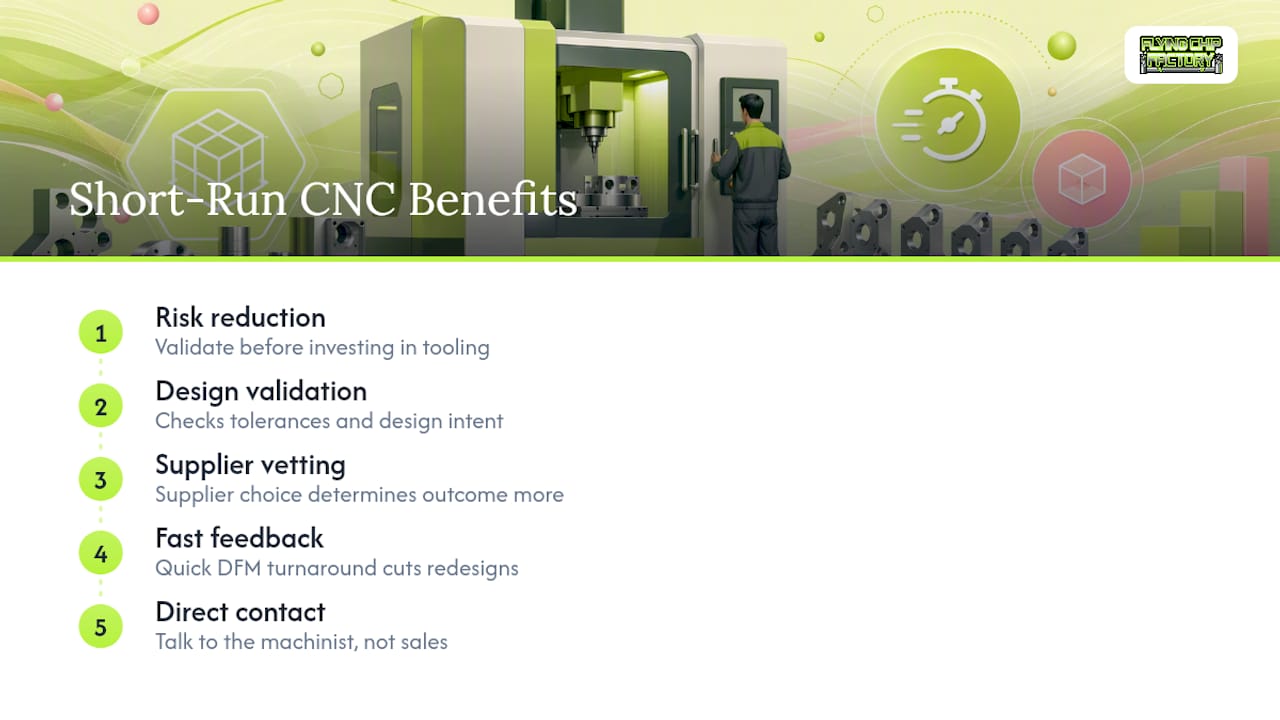
Where most guides fall short is treating supplier selection as an afterthought behind material choice and tolerance specs. In practice, the supplier relationship determines your outcome more than the spec sheet does. A shop with slow DFM turnaround will cost you more in redesign cycles than a slightly higher per-part price ever will. Ask about communication before you ask about price.
If there's one thing to prioritize first, it's this: find out who you'll actually talk to when something needs adjusting mid-run. A shop that puts you in touch with the machinist, not a sales layer, catches problems before they become scrapped parts. That single factor predicts more about your project's success than any material spec.
Get a Short-Run CNC Quote Without the Runaround
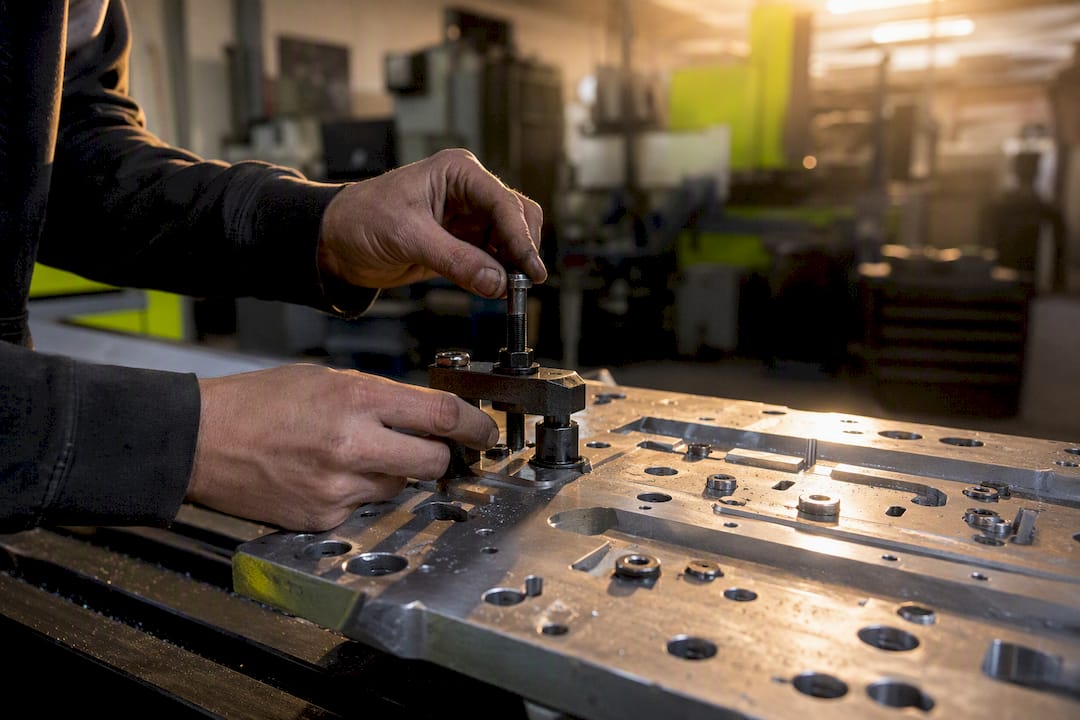
Flying Chip Factory handles exactly the work this guide covers: prototype machining, short production runs, fixtures, and replacement parts, with manufacturability feedback that comes from an actual machinist rather than a sales intermediary passing along questions. That direct line cuts the back-and-forth that typically stretches a quote-to-production timeline by days.
To get an accurate quote fast, have your STEP files, target quantity, material choice, and any critical tolerances ready before you reach out. For threaded features or fit-critical parts, check specs like NPT vs BSP thread standards ahead of time so your drawing calls out the right spec on the first pass. Ready to move on your batch? Request a quote from Flying Chip Factory and get a direct answer on lead time and cost.