

Tapping wins on speed, thread milling wins on flexibility and risk control, and the right call depends on the part in front of you. For high-volume, standard-size threads in forgiving material, tap it. For thin walls, tough alloys, oversized threads, or parts you cannot afford to scrap, thread mill it. Kennametal's shop data backs the speed gap, and it's the trade-off every machinist at Flying Chip Factory weighs before touching a drawing.
TL;DR:
- Thread milling is preferable for thin-walled, brittle, or oversized threads because it distributes load and reduces risk of tool breakage.
- Tapping remains faster and more cost-effective for high-volume, small, standard, or forgiving material parts where cycle time dominates.
- Forming taps produce stronger threads in ductile materials but are less suitable for brittle alloys like cast iron, which tend to crack instead of flow.
- For diameters above 3/4-inch or materials with limited spindle torque, thread milling better handles the increased load without risk of breakage.
- Proper setup, including rigid holders, correct pilot hole size, and coolant delivery, is crucial to prevent tool failure and ensure thread quality.
Thread Milling Vs Tapping: What Each Process Actually Does
Before comparing numbers, it helps to know what each process physically does inside the hole. Tapping cuts or forms a thread in one axial pass with a dedicated, single-purpose tool. Thread milling generates the same thread form using a small rotating cutter that follows a helical path, essentially tracing the thread geometry rather than punching it out in one shot. That mechanical difference explains almost every trade-off in this article, from cycle time to how forgiving each method is when something goes wrong.
How thread milling generates a thread
Thread milling relies on helical interpolation. The spindle spins the cutter while the machine simultaneously moves it in a circular path and feeds it downward (or upward, out of a blind hole) along the thread's helix angle. One tool traces the full thread profile over several rotations instead of forming it all at once.
Two cutter styles dominate the shop floor:
- Single-profile mills cut one groove per pass and need multiple helical passes to complete a thread. They run lighter cuts, which lowers radial load and makes them the safer choice for thin walls or long tool overhangs.
- Full-profile (multi-row) mills carry the entire thread form on the cutter body and can finish in fewer passes, trading some rigidity requirements for speed.
Machine requirements matter here. You need true 3-axis simultaneous interpolation (helical or circular interpolation capability), a spindle with reasonably tight runout, and a rigid holder, ideally a shrink-fit or hydraulic chuck rather than a standard collet. Below roughly 3/16-inch major diameter, cutters get fragile fast, and many shops default back to tapping simply because a broken 0.062-inch thread mill is nearly impossible to extract cleanly.
Cut Taps, Roll Taps, and Where Each One Belongs
Tapping is the older, faster, single-tool method, but "tapping" actually covers two mechanically different processes that behave very differently in the cut.
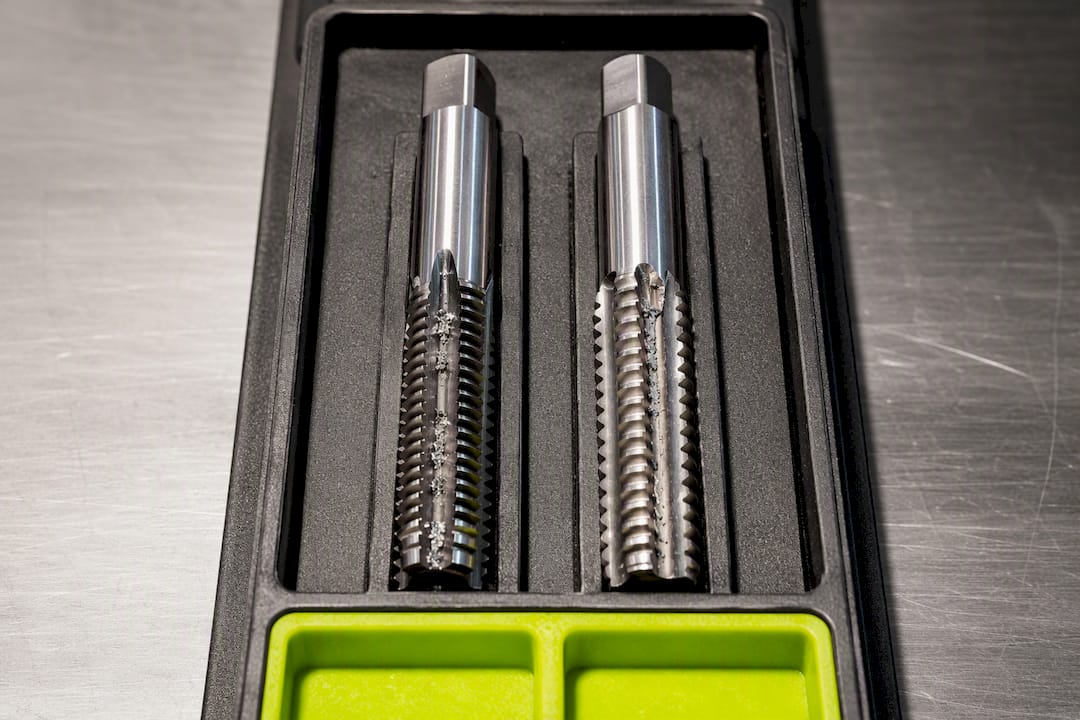
Cutting taps have flutes that shear away material as chips, the way a drill removes stock. Forming taps (also called roll taps) have no flutes at all. They displace metal outward to create the thread crest, cold-flowing the material into shape instead of cutting it. Because forming taps don't remove material, the pilot hole has to be larger than a cut-tap drill size for the same nominal thread, and getting that drill size wrong is the single most common forming-tap failure on the shop floor.
Chip evacuation splits the cutting-tap category further:
- Spiral-flute cut taps pull chips up and out, making them the right pick for blind holes where debris has nowhere else to go.
- Spiral-point cut taps push chips forward and out the bottom, which only works in through holes.
Forming taps trade flexibility for durability. Slugger Tool's data shows they produce threads significantly stronger than cut threads, with tool life lasting multiple times longer in suitable ductile materials like mild steel, aluminum, and most stainless grades. That strength gain disappears in brittle materials. Cast iron and similarly brittle alloys tend to crack rather than flow under a forming tap, so cut taps remain the correct choice there regardless of the tool-life numbers. Guhring's technical data confirms the no-chip advantage extends tool life further in blind-hole applications where debris control is already a headache.
Thread Milling Vs Tapping: The Numbers That Decide Your Process
Here's where the abstract trade-off turns into a real decision. Every axis below is one a quoting engineer or shop programmer should actually check before committing a job to one method.
| Factor | Tapping | Thread Milling |
|---|---|---|
| Cycle time | Fast: roughly 4–5 seconds for a 1/4"-20 hole | Slower: about 2× the tapping time for the same thread |
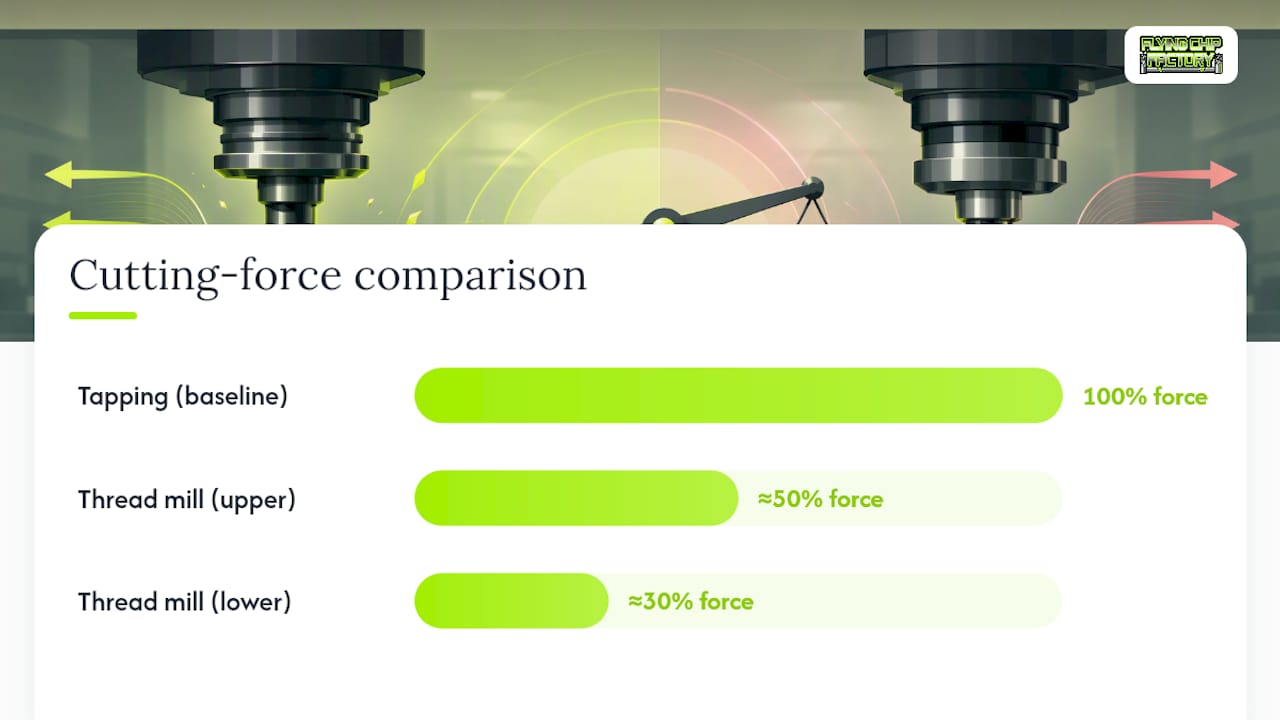
| Cutting force | Higher, single-pass axial and torque load | 50–70% lower cutting force than tapping |
| Tool life | Cut taps moderate; forming taps 3–10× longer in ductile metals | Long, since load is distributed across many light passes |
| Flexibility | One tap per size and pitch | One cutter often covers multiple diameters at the same pitch via offsets |
| Blind holes | Good with spiral-flute taps; forming taps excel, no chips | Excellent; full control over depth and chip evacuation |
| Machine torque | Limited by spindle torque at larger diameters | No single-pass torque ceiling; load spreads across passes |
| Failure risk | A broken tap in a finished part often means scrapping it | A damaged cutter edge is usually recoverable without ruining the hole |
| Chip control | Cut taps generate chips needing evacuation; forming taps produce none | Small, easily cleared chips even in tough alloys |
| Tooling cost | Cheap per tool, but a full inventory of sizes and pitches adds up | Fewer cutters needed, but each one costs more upfront |
The cycle-time gap is the number every tapping advocate leans on, and it's real. Kennametal puts a standard 1/4"-20 hole at roughly 4 to 5 seconds to tap, versus about double that for a comparable thread-milling cycle. On a 500-piece production run of a simple bracket, that difference adds up to real machine-hours saved.
The cutting-force number changes the calculus fast. MSC Direct reports thread milling cuts forces by roughly 50 to 70 percent compared to tapping. That matters enormously the moment you're threading a thin-walled aluminum housing, a long boring bar overhang, or any setup where a tap's torque spike could flex the part out of tolerance or snap a fragile feature clean off.
Diameter changes the equation again. Somewhere around 3/4-inch major diameter, many machining centers simply run out of torque to drive a tap through a full-depth thread in one pass. Thread milling sidesteps that ceiling entirely, since the load is spread across dozens of light helical passes instead of one continuous cut. That's also why oversized or nonstandard threads on castings and weldments are so often thread-milled rather than tapped, even when a suitable tap technically exists.
How to Choose Between Tapping and Thread Milling on a New Job
Run through this order every time a new part hits the quoting desk or the CAM screen. It's not a suggestion, it's the sequence that actually catches the expensive mistakes before they happen.
- Check the part's value. A $4 bracket and a $400 titanium housing do not get the same threading decision, even if the thread callout is identical.
- Check the volume. High-quantity runs of a low-value part push hard toward tapping, where per-hole speed compounds fast.
- Check the material. Brittle alloys, work-hardening stainless, and difficult titanium grades all favor thread milling's lighter, more controllable cut.
- Check the hole type. Blind holes with tight chip-clearing margins favor forming taps or thread milling over cut taps.
- Check the thread size. Anything nearing or exceeding the 3/4-inch torque threshold leans toward thread milling by default.
- Check available machine torque. If the spindle can't comfortably drive the tap at full engagement, that decision has already been made for you.
- Check tooling inventory. A shop already stocked with the right tap size will find tapping cheaper per hole; a shop running varied thread sizes gets more value from a flexible thread mill.
Red flags that should send a job straight to thread milling: thin walls, long unsupported overhangs, exotic or work-hardening alloys, and any part where a broken tap means scrapping expensive stock. Red flags that point back to tapping: small standard threads (under roughly 3/8-inch), high-volume low-value parts, and jobs where the tooling is already sitting in the drawer.
Pro Tip: When a thread mill cuts slightly undersize on a tough alloy, don't scrap the offset and start over. Adjust the cutter's radial offset in software by a few thousandths and run a second spring pass at the same programmed path. It corrects for elastic deflection without touching the tool or the program's core geometry.
Anyone specifying threads on a drawing should also lock down thread class up front. NPT and BSP callouts get confused often enough that it's worth stating explicitly which standard governs the part, and whether the fit needs to hold Class 2A commercial tolerance or the tighter Class 3A precision fit, since that single callout changes both tooling choice and inspection requirements downstream.
Shop Practices That Separate a Good Thread From a Scrapped Part
Tooling choice only gets you halfway there. Setup discipline decides whether that choice actually pays off.
- Use rigid holders. Hydraulic or shrink-fit holders reduce runout dramatically compared to standard collet chucks, which matters more for thread milling than almost any other operation because radial load control is the entire point of the process.
- Verify pilot hole size before running forming taps. A forming tap needs a specific, larger drill diameter than an equivalent cut tap. Running the wrong pilot size is the single most common cause of forming-tap failure or an out-of-tolerance thread.
- Program a spring pass on tough materials. A second identical helical pass at the same offset recovers form accuracy lost to elastic deflection in harder alloys.
- Check coolant delivery, not just coolant presence. Blind-hole tapping needs through-tool coolant or a clear evacuation path; thread milling benefits from flood coolant to keep small chips from re-cutting and marring the thread flanks.
- Confirm spindle runout before committing to small-diameter thread mills. Anything over roughly 0.0005 inch of runout on a sub 1/4-inch cutter shortens tool life fast and shows up as a rough thread flank.
Blind holes deserve their own gut check every time, since drill depth, tap length, and chip room all interact in ways that aren't obvious from the print alone; the shop's own blind-hole tapping guide walks through the drill-depth math worth double-checking before the first hole gets cut. Vibration control matters just as much on the milling side. Shops running thread mills on long-overhang setups often add damping mats under CNC equipment to cut down on chatter that would otherwise show up as a wavy thread flank on inspection.
The Bottom Line on Threading Method Selection
Three rules cover most of it: tap standard threads under 3/8-inch in forgiving materials, thread mill anything thin-walled, brittle, or over roughly 3/4-inch, and thread mill any part where a broken tool would mean scrapping expensive stock. A useful drawing note reads: "Thread mill required for M12 and larger in this material; standard tapping acceptable below M8." Thread milling costs more time per hole, but the cost of one scrapped titanium housing usually erases that savings many times over.
How Flying Chip Factory Applies This on the Shop Floor
Our shop runs CNC prototyping and short-run production, and threading choice comes up on nearly every job that includes a fastener boss. The default leans toward thread milling on high-value or fragile parts, thin-walled aluminum housings, and one-off prototypes where a broken tap would mean starting the whole part over. Standard small threads on high-volume repeat runs, brackets, mounts, and the kind of parts a customer orders fifty of at a time, still get tapped, because the speed advantage is too large to ignore at that volume.
The same logic guided the E2 Kickstand design for the KTM SX-E 2, GASGAS MC-E 2, and Husqvarna EE 2 electric mini dirt bikes: mounting threads that see repeated shock loading get evaluated the same way a customer's fixture would, checking material, load path, and salvageability before picking a method. That's also the thinking behind the metric vs imperial thread guide, written after enough customer drawings arrived with mismatched thread callouts to make the pattern worth documenting.
Why Most Shops Get This Decision Wrong
Most threading disputes in a shop aren't really about speed. They're about who bears the risk when something breaks, and that's the part conventional advice skips. A blog post that just says "tapping is faster, thread milling is more flexible" isn't wrong, but it's incomplete enough to get someone in trouble on the wrong part.
The real question is never speed versus flexibility in the abstract. It's speed versus the cost of failure on this specific part, in this specific material, at this specific volume. A cheap bracket can absorb an occasional broken tap; you re-drill, re-tap, move on, and the loss is measured in minutes. A one-off titanium prototype cannot absorb that same failure, because a broken tap seized in a blind hole often means the whole part goes in the scrap bin, along with however many hours of machine time already sunk into it.
That asymmetry is why "thread milling is slower" gets repeated so often without the second half of the sentence: slower by seconds, but with a failure mode you can usually recover from. Engineers who treat cycle time as the only variable are optimizing for the wrong risk on expensive parts. The ones who get it right treat threading method selection the same way they treat any other process decision on a critical feature, weighing the cost of failure against the cost of time, not just picking whichever tool sits closest in the drawer.
— Drake
Sources
- Machining Guide: Thread Milling vs. Tapping - Kennametal
- Thread milling vs. tapping pros & cons - MSC Direct
- Forming tap vs cutting tap — Slugger Tool