
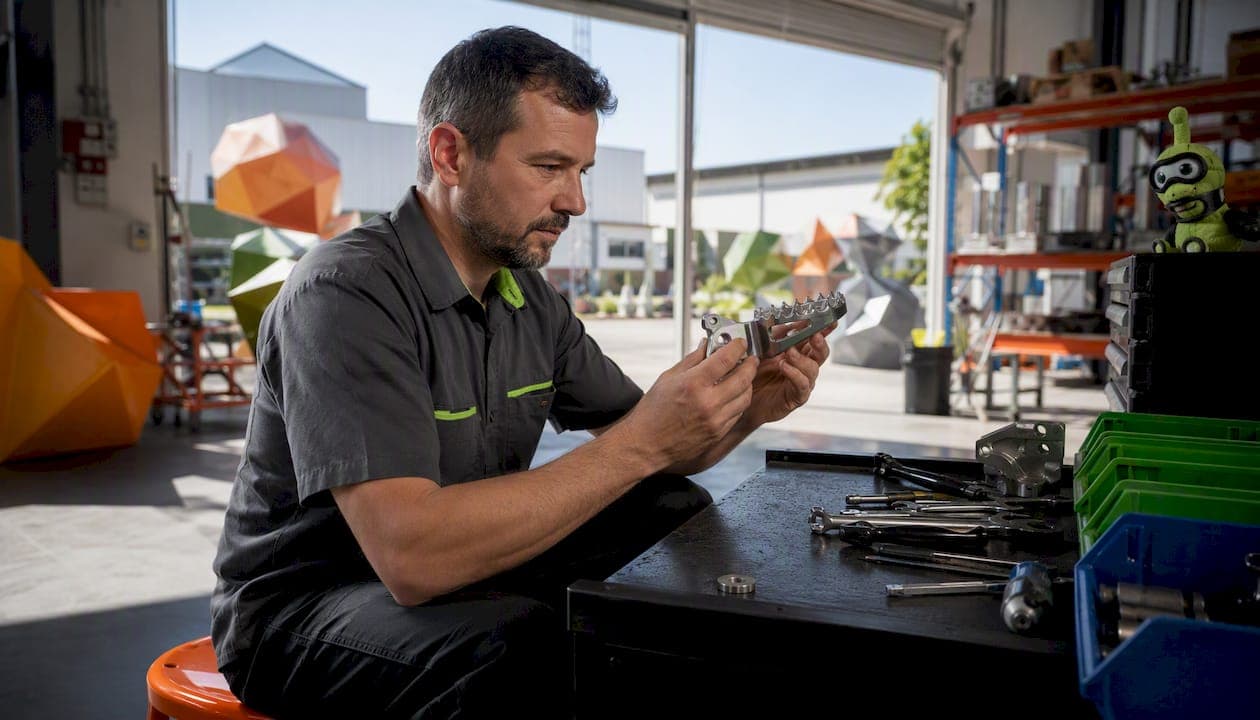
CNC aftermarket parts for the KTM SX-E 2 are available and practical to source through a US-based prototype and short-run CNC shop. The strongest option for engineers and buyers in the US is Flying Chip Factory, a CNC job shop in Athens, Alabama, with direct machinist access, short-run production capability, and an in-house line of CNC-machined motorcycle parts. If you're ready to move, here's how to start:
- Send your STEP or native CAD file, critical dimensions, functional tolerance callouts, and target finish spec to Flying Chip Factory for a kickoff quote
- Reference OEM part numbers from the KTM SX-E 2 parts catalog for mating dimensions
- Expect a manufacturability review before machining begins
Which aftermarket parts matter most for the SX-E 2?
Not every component benefits equally from CNC machining. These are the parts worth prioritizing, in order of impact:
- Kickstand — the highest-leverage upgrade for a youth electric bike. A CNC-machined kickstand offers a precise mounting interface, correct geometry for the bike's weight and center of mass, and far better durability than stamped steel.
- Footpegs — billet footpegs give youth riders a more secure platform, with grip patterns and widths tuned to smaller boot sizes.
- Heel guards — protect the rider's foot and the frame from chain contact; CNC aluminum holds tighter tolerances than cast versions and resists deformation on impact.
- Axle blocks and chain adjusters — fitment-critical parts where a few thousandths of an inch matter for chain tension and wheel alignment. CNC is the right call here.
- Skid plates — 6061-T6 or 7075 aluminum skid plates protect the battery enclosure and frame rails, which is especially relevant on an electric bike where the battery sits low.
- Brake lever and reservoir caps — ASV F4 Series levers and billet reservoir caps are common upgrades for better feel and adjustability.
- Handlebar risers — stackable riser kits adjust cockpit height for growing riders without requiring a full bar swap.
- Mounts and brackets — custom mounts for accessories, cameras, or number plates are straightforward short-run CNC jobs.
Parts like axle blocks, footpegs, and the kickstand are fitment-critical and benefit most from CNC. Cosmetic items like reservoir caps are lower-stakes but still benefit from better surface finish and corrosion resistance.
Why CNC parts outperform stock and generic replacements
Stock SX-E 2 parts are engineered to a price point and a broad fit range. CNC aftermarket parts are engineered to a specific function, rider size, and material spec.
- Tighter tolerances: CNC holds ±0.001"–0.005" on critical features. Stamped or cast OEM parts often run ±0.010" or wider, which shows up as slop in footpeg pins, axle block bores, and lever pivots.
- Repeatable fit: every part in a short run comes off the same program, same fixture, same tool path. There's no batch-to-batch variation from casting porosity or die wear.
- High-strength alloys: 7075-T6 is roughly 40% stronger than 6061-T6 at similar weight. For a youth rider's footpeg or axle block, that margin matters on hard landings.
- Tailored geometry: a CNC shop can adjust footpeg height, kickstand angle, or lever reach to match a specific rider's measurements, something OEM parts never offer.
- DFM from the start: when the shop reviews your design for manufacturability before cutting, you catch wall-thickness issues, undercuts, and poor fillet radii before they cost you a prototype.
Pro Tip: Ask your CNC shop to flag any features below 0.040" wall thickness during the DFM review. Thin walls in aluminum motorcycle parts are the most common cause of first-article failures.
For youth riders specifically, ergonomic fit isn't cosmetic. A footpeg that's 8mm too wide or a lever that requires full-hand reach can affect control and safety. CNC parts let you dial that in.
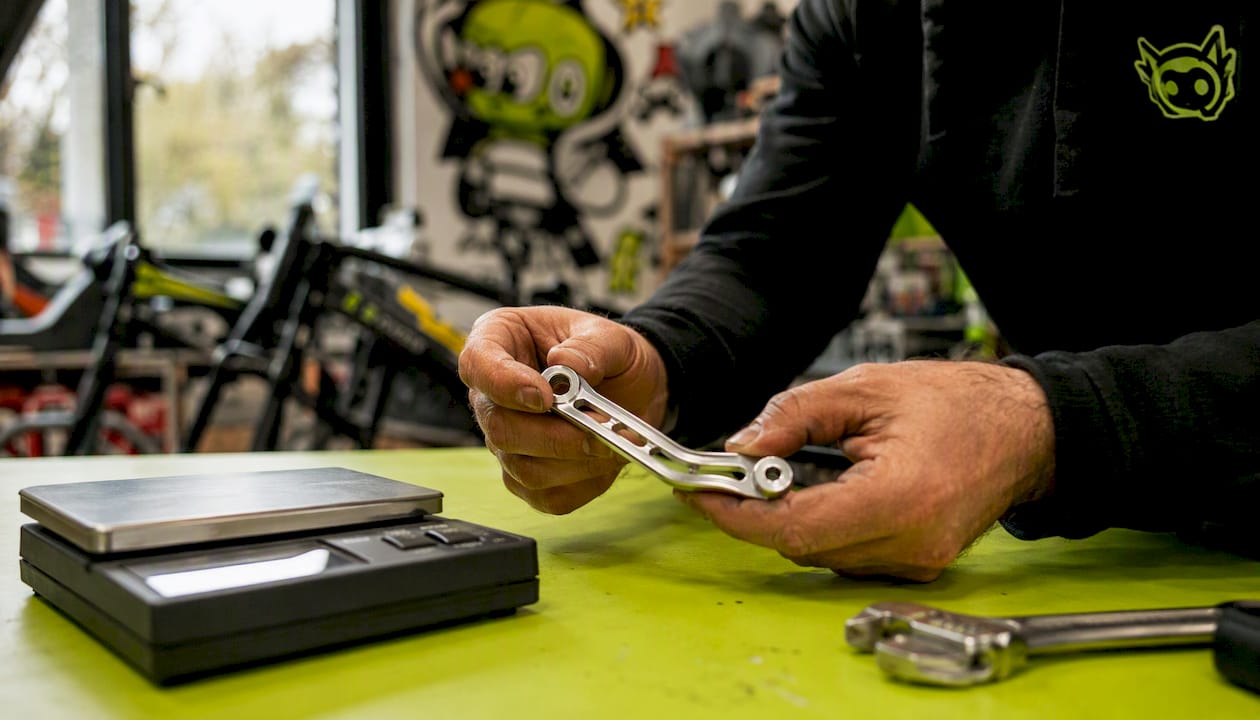
What materials and finishes should you specify?
| Material | Best use on SX-E 2 | Strength | Machinability | Corrosion resistance |
|---|---|---|---|---|
| 6061-T6 aluminum | Skid plates, mounts, risers | Good | Excellent | Moderate (anodize recommended) |
| 7075-T6 aluminum | Footpegs, axle blocks, kickstand | High | Good | Lower (hard anodize required) |
| stainless steel | Fasteners, reservoir caps | Very high | Fair | Excellent |
| stainless steel | Exposed hardware, brake fittings | Very high | Fair | Superior (marine-grade) |
A few practical notes on finishes:
- Hard anodize (Type III) is the right call for wear surfaces: footpeg bodies, axle block bores, kickstand pivot areas. It adds 0.001"–0.002" per side, so tolerance callouts need to account for it.
- Bead blast + clear coat works well for cosmetic parts like reservoir caps and mounts where wear resistance is secondary.
- Passivation for stainless fasteners removes free iron from the surface and extends corrosion life significantly, especially in wet or muddy conditions.
- Galvanic corrosion warning: aluminum and stainless in direct contact will corrode in the presence of moisture. Use an isolating washer or specify a compatible coating at the interface.
For electric bike customization, protective coatings on battery-adjacent parts like skid plates deserve extra attention. The battery enclosure on the SX-E 2 sits low and takes direct debris impact.
How does the prototyping and short-run process work?
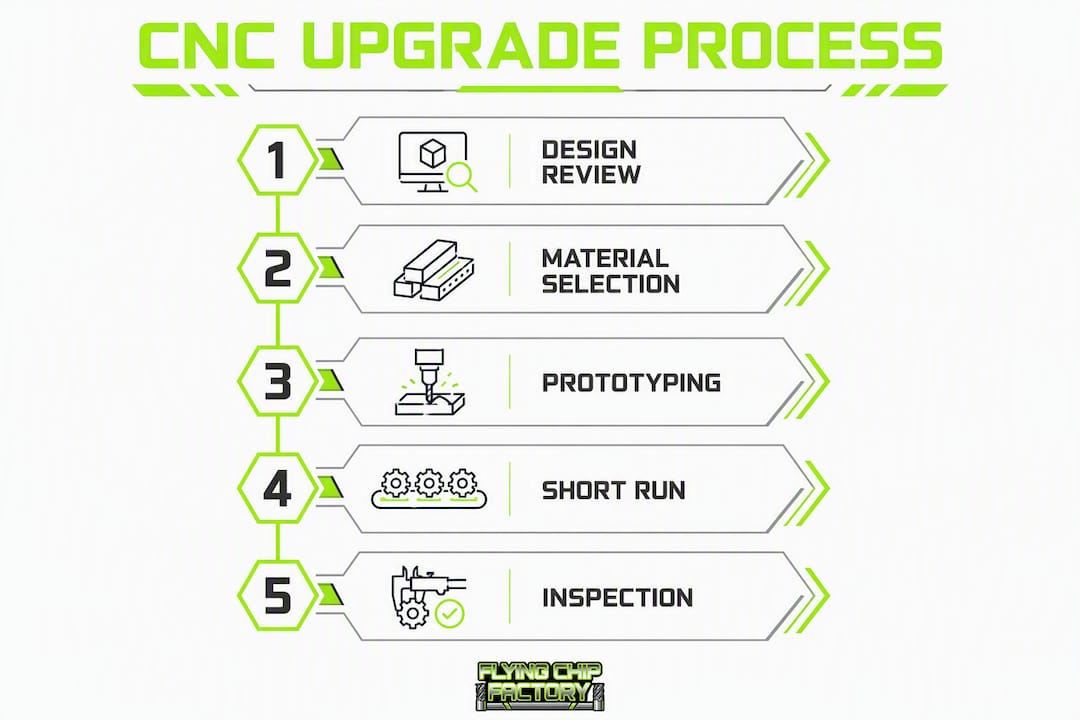
- Initial inquiry: submit your STEP file, critical dimensions, tolerance callouts, and finish spec. Flying Chip Factory reviews for completeness before quoting.
- DFM review: the machinist checks wall thickness, feature accessibility, fixturing strategy, and tolerance stack-up. You get feedback before any metal is cut.
- Prototype machining: first article is cut, deburred, and finished per spec. Typical prototype turnaround is a few business days depending on complexity.
- Fitment check and iteration: you test the prototype on the bike, note any interference or clearance issues, and send redlines. Because you're talking directly to the machinist, not a sales rep, changes get implemented in the next revision without a game of telephone.
- Short-run setup: once the prototype is signed off, the shop sets up a dedicated fixture for the production run. This locks in repeatability across the batch.
- Pilot run and QA: a small pilot batch (typically 5–10 pieces) is measured against the print before the full run proceeds.
- Final parts and finishing: parts are finished, inspected, and shipped.
Pro Tip: Sign off on a first-article inspection report before approving the short run. Ask for measured actuals on all critical dimensions, not just a pass/fail stamp.
Direct machinist access is the practical advantage here. When a question comes up mid-job, the person answering it is the person running the machine.
What to provide and expect when ordering
What to send:
- STEP or IGES file (native CAD preferred for complex parts)
- Critical dimensions and GD&T callouts for mating features
- Surface finish spec (Ra value or equivalent descriptor)
- Material and finish requirements
- Reference photos or OEM part numbers for mating interfaces
- Quantity: prototype count and anticipated short-run volume
Tolerance and cost impact: tightening a bore from ±0.005" to ±0.001" can double the machining time on that feature. Specify tight tolerances only where function requires them. Cosmetic surfaces don't need the same callout as a press-fit bore.
| Stage | Typical lead time | Ballpark per-piece cost (small parts) |
|---|---|---|
| Prototype | short turnaround time | price varies depending on complexity |
| Short run | a few weeks lead time | price varies per piece |
| Short run | several weeks lead time | price varies per piece |
These ranges reflect general CNC job shop pricing for aluminum motorcycle parts and will vary with geometry, tolerances, and finish. Get a formal quote for your specific design.
Installation, fitment checks, and U.S. safety considerations
Before installing any CNC aftermarket part on an SX-E 2:
- Trial fit without fasteners first. Check clearance on all sides before torquing anything down.
- Verify thread engagement. CNC parts machined in aluminum need at least 1.5x diameter thread engagement. Don't rely on the same thread depth as a steel OEM part.
- Use thread-locking compound (medium-strength, e.g., Loctite 243) on fasteners subject to vibration. Footpeg bolts and kickstand pivot bolts are the most common failure points.
- Check torque specs against the OEM service manual for the SX-E 2. Aftermarket parts don't change the torque spec for the mounting interface.
- Alignment shims can correct minor interference at axle block interfaces without requiring a remachine.
U.S. safety and legal note: The KTM SX-E 2 is an off-road youth electric dirt bike. Modifications to braking components, footpegs, or structural mounts may affect compliance with CPSC safety standards for youth off-road vehicles. If you intend to register or operate the bike on public roads or trails in any U.S. state, verify current state DMV rules and applicable federal regulations before modifying any safety-critical system. When in doubt, consult a licensed dealer or legal counsel familiar with your state's e-bike and off-road vehicle laws.
Why Flying Chip Factory is a strong partner for SX-E 2 projects
Flying Chip Factory's practical advantages for this type of work:
- Direct machinist access: you communicate with the person running your job, not a project manager three layers removed. This cuts iteration time on prototype revisions.
- Prototype-to-short-run continuity: the same shop that cuts your first article sets up the production fixture. No re-quoting, no re-explaining the design intent.
- In-house motorcycle parts as proof: Flying Chip Factory machines its own CNC kickstands for electric bikes. That's not a marketing claim; it means the shop has already solved the fixturing, tolerance, and finishing challenges specific to motorcycle parts.
- Manufacturability reviews included: DFM feedback comes with the quote, not as an add-on.
- QC and sample sign-off: first-article inspection before short runs proceed.
Flying Chip Factory's in-house kickstand line demonstrates that the shop thinks in production terms, not just prototype terms. A shop that sells its own parts has skin in the game on repeatability.
CNC kickstand project: scope, sequence, and outcomes
The in-house CNC kickstand for electric bikes illustrates what a typical SX-E 2 CNC project looks like end to end:
- Material selection: 6061-T6 aluminum for the main body, with hard anodize for the pivot and foot contact surfaces.
- Critical tolerances: pivot bore held to ±0.001", mounting hole pattern matched to the bike's frame interface within ±0.003".
- Prototype phase: first article cut and test-fitted on the bike. One revision to adjust the foot angle for better ground contact on uneven terrain.
- Short-run setup: dedicated fixture built after prototype sign-off. Pilot batch of 5 pieces measured against the print before full run.
- Short run: 50–200 piece batches with consistent part-to-part repeatability confirmed by spot-check CMM measurements.
- Finishing and shipping: hard anodize applied, parts inspected, and shipped with a basic warranty covering manufacturing defects.
That sequence, from first inquiry to finished short-run parts, typically runs several weeks for a part of this complexity.
Key Takeaways
CNC aftermarket parts for the SX-E 2 are best sourced through a US prototype shop with direct machinist access, starting with fitment-critical parts like the kickstand, footpegs, and axle blocks in 6061-T6 or 7075-T6 aluminum.
| Point | Details |
|---|---|
| Priority parts first | Start with kickstand, footpegs, and axle blocks — fitment-critical parts where CNC tolerances matter most. |
| Material choice | Use 6061-T6 for general parts and 7075-T6 for high-load components; always specify hard anodize on wear surfaces. |
| Quote package | Send STEP file, critical dimensions, tolerance callouts, finish spec, and OEM part numbers for mating interfaces. |
| Safety check | Verify U.S. state and CPSC rules before modifying braking or structural components on a youth off-road e-bike. |
| Flying Chip Factory | Athens, Alabama CNC shop with direct machinist access, in-house motorcycle parts, and prototype-to-short-run capability. |
Why precision matters more than people expect on youth electric bikes
Most of the conversation around youth electric bikes focuses on power and battery life. The parts conversation gets less attention, and that's where real performance and safety gains sit.
A youth rider on an SX-E 2 is working with a bike that's already engineered tightly. The frame geometry, battery placement, and suspension are tuned for a specific weight and rider size. When a footpeg is 10mm too wide or a kickstand doesn't hold the bike at the right angle, those aren't cosmetic problems. They affect how the rider interacts with the machine on every lap.
Flying Chip Factory's decision to develop an in-house kickstand for electric bikes came from exactly this kind of thinking. The OEM part works. A CNC part works better, fits more precisely, and lasts longer under real use conditions. That's the argument for CNC aftermarket parts on the SX-E 2, and it holds across every fitment-critical component on the bike.
The electric bike accessories market is growing, but most of what’s available is generic. A CNC shop that machines its own motorcycle parts and reviews your design before cutting is a different category of supplier entirely.
Get a quote from Flying Chip Factory for your SX-E 2 project
Flying Chip Factory gives engineers and buyers something most CNC shops don't: a direct line to the machinist handling your job, a DFM review before any metal is cut, and a shop that already machines its own motorcycle parts. That combination means faster iterations, fewer surprises, and parts that actually fit.
To start, send your STEP or native CAD file, critical dimensions, tolerance callouts, and target finish to Flying Chip Factory. Quotes typically turn around within a few business days. If you're not ready to quote yet, the shop can review your design for manufacturability and flag issues before you finalize the drawing. The in-house CNC kickstand for electric bikes is also available for direct order.
Request a quote or order the CNC kickstand at Flying Chip Factory's website.