
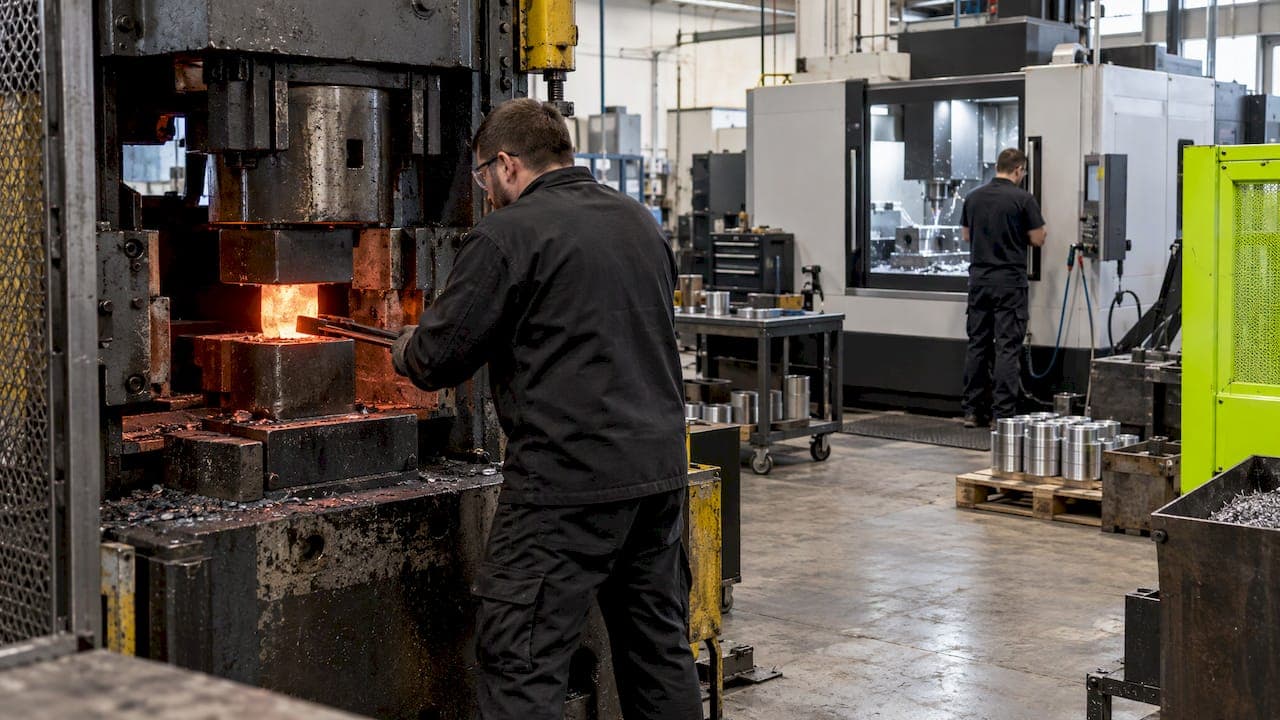
Forging shapes metal by pushing it into form with compressive force. Machining cuts material away from a solid piece until only the part remains. Forging is usually the answer for high-volume, heavily loaded parts that justify a die. Machining is usually the answer when you need tight dimensions, quick design changes or a small quantity. Many real parts use both: a forged blank, then machined where precision matters.
We run a CNC shop, so we see this question from the machining side every week. This guide covers the difference between the two processes, how they compare on strength, accuracy, waste and cost, and how to decide for your own part.
TL;DR
- Forging reshapes heated solid metal with hammers, presses or dies. Machining removes material with cutting tools such as mills and lathes.
- Forging can align grain flow to the part's shape. Machining gives you tight tolerances, fine surface finish and fast design changes with no die.
- Forging pays off at high volumes. Machining pays off for prototypes, short runs, fixtures and replacement parts.
- The two are often combined: critical features on forged parts are finish-machined.
- Pick the process from the part's load, geometry, material and quantity, in that order.
What forging and machining actually do
The two processes sit on opposite sides of a simple divide. Forging moves metal. Machining removes it.
Forging heats a piece of metal and reshapes it with compressive force, using a hammer, a press or a set of dies. The metal stays solid throughout. It flows into the shape of the die, and the internal structure follows that flow. A Forging Industry Association comparison notes that forging can orient the grain to the part's shape.
Machining is subtractive. A cutting tool removes material from a solid billet, bar or plate until the geometry you drew is all that is left. CNC machines follow a program, so the same file produces the same part again and again. The same industry comparison points out that machining bar and plate cuts across the material's existing grain pattern, rather than following it.
Casting, the third process people often ask about, pours molten metal into a mold and lets it solidify. It handles complex shapes well, but it is a different path from either forging or machining. Cast and forged blanks are frequently machined afterward for critical holes, threads, faces and finishes.
It also helps to keep "machining" separate from "fabrication." Fabrication usually means cutting, bending and joining sheet, plate or tube into assemblies. Machining removes material from a solid block to make a precise component. A shop can do both, but they are different skills.

Strength, grain flow and fatigue
This is the point where most forging vs machining arguments start, so it deserves a careful look.
The Forging Industry Association says forging often yields a grain structure oriented to the part, which it ties to strength, ductility and resistance to impact and fatigue. It adds that machined bar and plate can be more susceptible to fatigue and stress corrosion because the cut interrupts the grain pattern. That is the basis for the common claim that forged parts beat machined ones in load-bearing service.
The picture is more nuanced once you look at what machining does to a surface. A 2020 study of forged titanium Ti-6246 discs found that machining conditions, including cutting speed, affected fatigue life, and that machining increased fatigue life regardless of cutting speed. The forging texture still left some variation in fatigue behavior around the disc. In other words, the forged structure and the machined surface both matter, and a well-controlled machining step can help rather than hurt.
That is also why serious forged parts are rarely used straight from the die. Van Tyne's academic review states that a forging needing the least machining to meet the finished-part requirements generally has the best properties. The takeaway: design the forging to be close to final shape, then machine only what the function demands.
For most parts that are not under extreme cyclic load, material choice, heat treatment, surface finish and sensible design (generous radii, no sharp internal corners) decide durability more than the forming method does. A part machined from quality bar stock with well-chosen fillets and a good finish can serve for years in demanding use.

Precision, surface finish and design freedom
Machining is the more accurate process. A CNC mill or lathe can hold tight tolerances and produce fine surface finishes straight off the machine. Forging gives you a near-net shape, but forged surfaces and dimensions are looser, and the Forging Industry Association notes that bar and plate may need turning, grinding and polishing to reach the desired finish and dimensional accuracy. Forged parts that must mate with bearings, threads or seals get the same treatment.
If tolerance is your main concern, our guide to tight tolerance machining covers what is realistic and what it takes to hold it.
Design freedom favors machining too:
- No tooling to build. A change to the drawing is a change to the program. Forging means a new or modified die.
- Complex internal features. Pockets, cross holes, threads, undercuts and thin walls are routine for CNC. Forging is limited by how metal flows into the die, a constraint RoyMech's process guide describes.
- Feature-rich thin sections. Skilled programming can handle slender geometry; see our notes on thin wall machining.
- Surface treatments. Machined parts take coatings predictably. Our hardcoat anodize thickness guide shows how to specify them for aluminum parts.
Forging has its own range advantage. The same industry source says forging covers a very wide size range, from less than an inch to over 450,000 pounds in some processes. That is a reach no single machine tool matches.
Material use and waste
Machining wastes more material by design. You start from a block and cut away what is not the part, and the removed metal becomes chips. Those chips are recyclable, but the energy and machine time spent making them are real costs.
Forging is closer to net shape. The Forging Industry Association states that forgings are often near-net and generate less scrap, while machining from plate or bar can require more material and more secondary operations.
That said, scrap percentage is only one input. A thin bracket cut from plate wastes plenty of material, but if you need ten of them next week, the waste costs far less than a forging die would. The math reverses at high volumes, where saved material on every part adds up.
Cost, tooling and lead time
The cost curves of the two processes cross, and where they cross depends on quantity.
Forging carries up-front tooling: dies, plus the design work to get metal flow right. That investment is spread across the run. The Forging Industry Association's flashless connecting rod case study describes a 2.9 kg part made at 52,000,000 units a year, with a tensile strength of 1240 MPa (180,000 psi). At that scale, dies are a small fraction of the cost per part.
Machining carries little tooling, mainly fixtures and cutting tools. Cost per part is mostly machine time and material, so it stays roughly flat as quantity grows. That makes it ideal when you need one part, ten parts or a few hundred.
Lead time follows the same logic. A machined prototype can be in your hands in days. A forging has to wait for die design and manufacture. For prototyping speed, see our write-up on rapid CNC prototyping.
A rough guide:
| Situation | Usually better fit |
|---|---|
| One-off or prototype | Machining |
| 10 to a few hundred parts | Machining |
| Tens of thousands or more, with a stable design | Forging, then finish machining |
| Design still changing | Machining |
| Tight bores, threads, sealing faces | Machining (on a forged or bar blank) |
| Highly loaded part at scale, simple outer shape | Forging |
The crossover is not a fixed number. It depends on part size, material, complexity and how many machining operations the forging would still need.
Forging and machining together
The either-or framing misleads, because the two processes often serve one part.
The same connecting rod case study lists cracking and finish machining among its secondary operations after forging. The Forging Industry Association's countershaft case study shows another angle: replacing three separately forged and heavily machined pieces with a single forged countershaft cut machining and assembly costs and removed the need for keys. The reported annual volume was about 100,000 parts. The forging reduced machining, but it did not remove it.
The titanium disc in the 2020 study followed the same path: forged first, then machined to defined tolerances with rough and finish passes.
This is the real design question. Which features are formed and which are cut? Roughly:
- Let forging set the overall shape and grain flow where loads are highest.
- Let machining finish the features that need accuracy: bores, threads, flats, mounting faces.
- Keep machining allowance small but sufficient, so you do not cut deep into the forged structure.
If you want a broader framework for choosing among forming methods, this rolling versus forming comparison walks through selecting a process by required properties, geometry, material and quantity.
How to choose: five questions
Work through these in order before you request a quote.
- How many parts, over what time? Under a few hundred, start with machining. Tens of thousands with a frozen design, price a forging.
- What load does the part see? Heavy cyclic or impact loads at volume make forging attractive. Moderate loads rarely force the issue.
- What accuracy and finish do you need? Tight fits and sealing surfaces will be machined either way.
- How stable is the design? If it may change, avoid committing to dies.
- What is the material? Some alloys are far easier to machine than to forge, and vice versa. Material availability in bar, billet or plate affects lead time.
The engineering practice summarized by KEVOS follows the same logic: required properties such as strength and wear resistance must be balanced against quantity, geometry and material.
If you are buying machined parts and want the first batch to go smoothly, our procurement note on outsourcing CNC machining with a first article inspection is a useful checklist. And if your part is headed from prototype to repeat production, read about moving from prototype to production.
Perspective
Every week someone asks us whether a part "should" be forged. Our honest answer is that for the kind of parts we make, one to a few hundred pieces, with real-world fit and function checked quickly, machining is the process that lets you get it right.
A die is a commitment. A CNC program is a conversation. When a rider tells us a bracket hits the swingarm, or an engineer finds a bore is 0.005 inch off, we change the file and cut the next one. That loop, with the machinist who designs the part also running it, is the reason our parts fit the way they do.
We also respect forging. Where a part ships in the tens of thousands, forging plus finish machining is a sound path, and we are happy to machine the features that need precision. But for the parts riders and small manufacturers need now, CNC-machined parts built with care for durable construction, straightforward installation and purpose-built performance are hard to beat.
Drake
From a shop that machines motorcycle parts
Our E2 Kickstand is a good example of why short-run machining makes sense. It is a bolt-on, CNC-machined stand for the KTM SX-E 2, GASGAS MC-E 2 and Husqvarna EE 2 electric mini dirt bikes, designed as a durable alternative to the factory triangle stand. It is $100 to $105. A part for three specific models in modest quantities is exactly where a die would make little sense and a machined part makes a lot.
See the E2 Kickstand for fitment details. If you have your own part in mind, whether a prototype, a short production run, or a fixture, bracket or replacement part, send us the drawing through our CNC machining page and you will talk directly with the machinist. If you are curious about the hobby side, our guide to machining motorcycle parts is a good start. For threaded features, see thread milling vs tapping.
FAQ
What is the difference between forging and machining?
Forging reshapes heated solid metal with compressive force from hammers, presses or dies, so the grain can follow the part's shape. Machining cuts material away from a solid piece with tools like mills, lathes and drills. Forging forms the metal. Machining subtracts from it.
Is a forged part stronger than a machined part?
Forging can orient grain flow to the part, and the Forging Industry Association links that to better fatigue and impact resistance than machined bar or plate. Strength in service also depends on the alloy, heat treatment, design and surface finish. A 2020 titanium study found machining itself increased fatigue life, so careful machining is part of a strong part.
When is machining cheaper than forging?
Machining is usually cheaper for prototypes and short runs, because it needs no die. Forging tooling is a fixed up-front cost that only pays back across large volumes. The exact crossover depends on the part's size, material and how much finish machining a forging would still need.
Can a part be both forged and machined?
Yes, and it is very common. Forging provides a near-net shape with favorable grain flow, then machining finishes bores, threads and faces to tolerance. Industry case studies, such as forged connecting rods, list finish machining as a standard secondary operation.
What is the difference between casting, forging and machining?
Casting pours molten metal into a mold to solidify. Forging deforms solid metal under pressure. Machining removes material from a solid workpiece. Cast and forged blanks are often machined afterward for accuracy.
Sources
- How Forgings Compare to Other Processes, Forging Industry Association
- The effect of forging texture and machining parameters on fatigue, 2020
- Van Tyne, forging and machining requirements, 2005
- Case Study No. 10, Flashless Forged Connecting Rod
- Case Study No. 3, Countershaft
- Manufacturing Process Selection Guide, RoyMech
- Choosing a manufacturing process for metal parts, KEVOS
- Profile Rolling vs Forming: Which Process Fits Your Part