
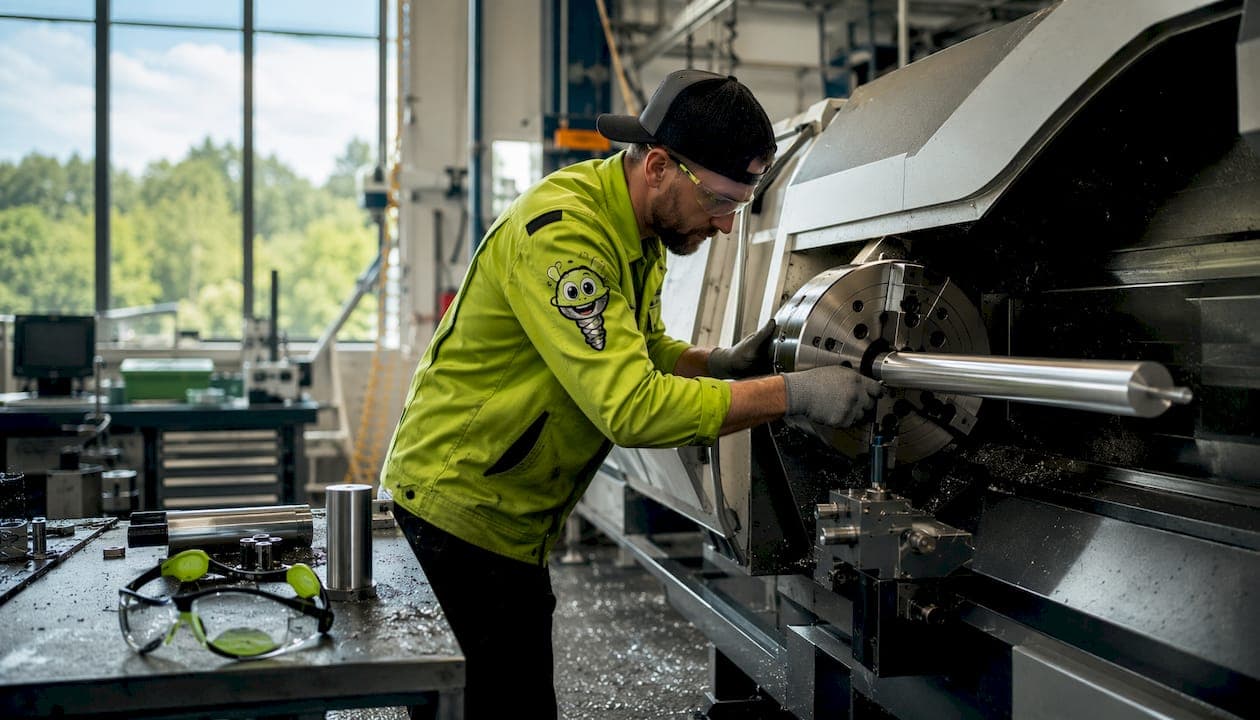
For extruded bars with heavy material removal, use 6061-T6511. For plate parts that need tight flatness, use 6061-T651. For simple thin-profile parts where distortion risk is low, standard 6061-T6 is usually fine.
- Machined extruded bar (heavy removal): T6511 — extrusion-specific stress relief keeps the part from springing after roughing cuts.
- Plate with flatness requirements: T651 — stretching after quench relieves quench stresses that would otherwise warp a plate once material is removed.
- Simple thin parts, brackets, or low-tolerance profiles: T6 — lowest cost, widest availability, acceptable distortion risk when cuts are shallow.
On interchangeability: T651 and T6511 both meet the T6 mechanical specification, so you can always substitute them upward without a drawing change. The reverse is not true. Calling out T6 on a drawing when you actually need T651 or T6511 dimensional behavior is where rework starts.
Table of Contents
- T6 vs T6511: side-by-side properties and stock forms
- How each temper is actually produced
- Residual stress, distortion, and when you can substitute tempers
- Shop-level implications: machining, welding, forming, and finishing
- How to pick the right temper: a decision checklist
- What Flying Chip Factory learned switching to T6511 on an extruded bar job
- Key Takeaways
- Why temper choice matters more on short runs
- Flying Chip Factory machines 6061 in every temper — get a quote
- Useful sources and standards
T6 vs T6511: side-by-side properties and stock forms
The three tempers share nearly identical strength numbers. The differences that matter in a shop are residual stress state, stock form, and what happens to your part after the first roughing pass.
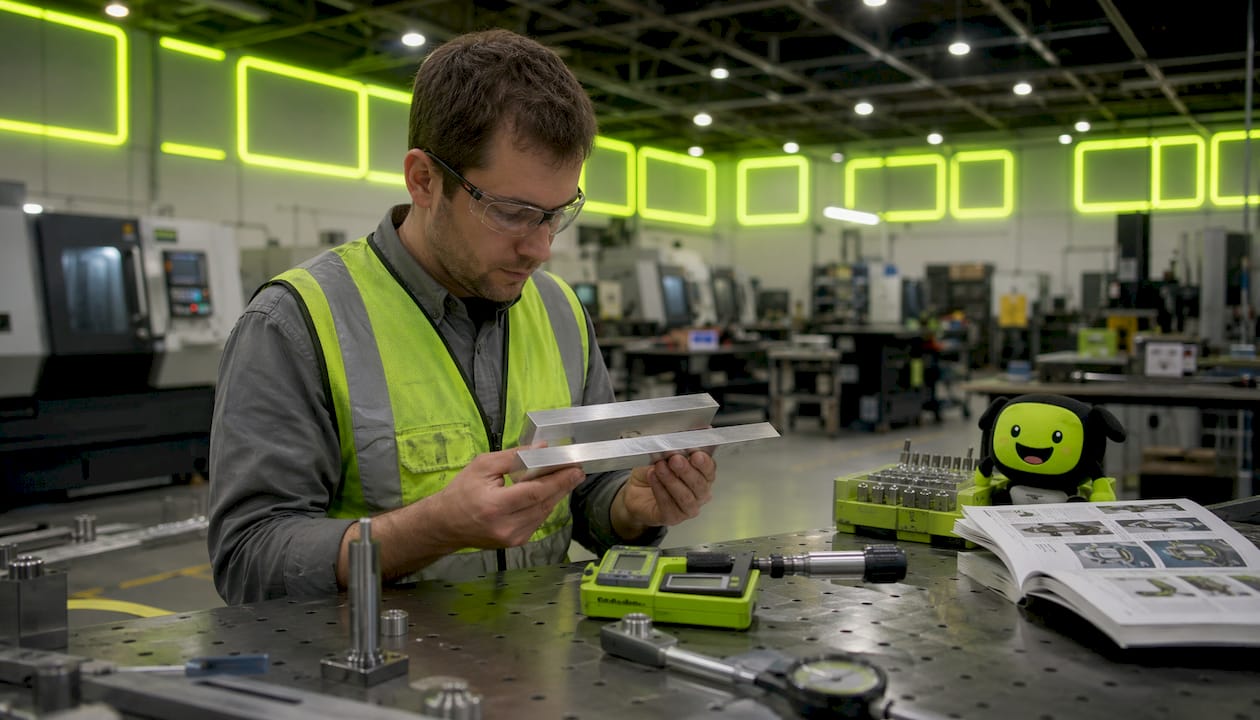
| Property | 6061-T6 | 6061-T651 | 6061-T6511 |
|---|---|---|---|
| Typical stock form | Extrusions, sheet, bar | Plate | Extruded bar, rod, tube |
| Stress-relief method | None | Stretching (plate) | Straightening / minor cold work (extrusion) |
| Yield strength | ~276 MPa (40 ksi) | ~276 MPa (40 ksi) | ~276 MPa (40 ksi) |
| Ultimate tensile strength | ~310 MPa | ~310 MPa | ~310 MPa |
| Elongation | ~12% | ~10% | ~10% |
| Dimensional stability after removal | Lower — higher distortion risk | Good for plate | Best for extruded bar |
| Machinability | Good | Good | Good; slightly more predictable |
| Welding/forming | Excellent | Excellent | Excellent |
| Typical applications | General structural, sheet metal | Tooling plate, jigs, flat parts | Machined bars, shafts, precision extrusions |
| Availability / cost | Widest stock, lowest cost | Common, modest premium | Less common, higher cost and lead time |
The yield and UTS figures are essentially identical across all three tempers — roughly 276 MPa yield and 310 MPa UTS. What separates them is not strength but stress state. A side-by-side property comparison of T6 and T6511 confirms that the two share most core mechanical values, with elongation being the metric most likely to vary slightly between them.
Key figure: T6511 and T651 carry measurably lower residual stress than T6 because of the post-aging stress-relief step — the direct cause of better dimensional stability after material removal.
How each temper is actually produced
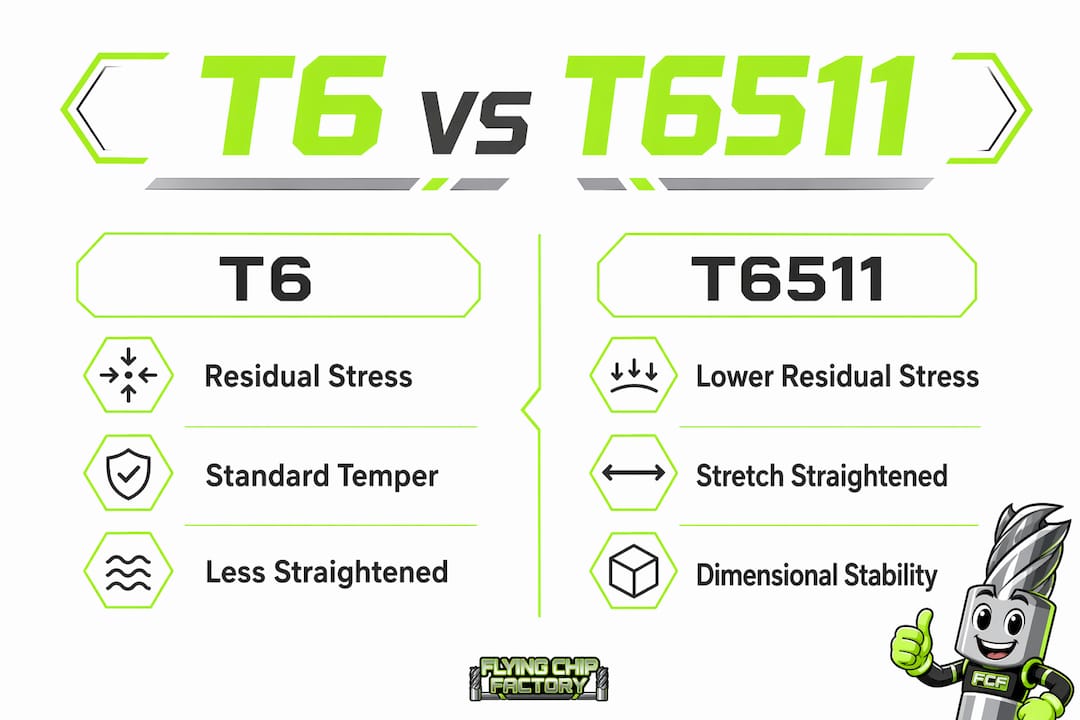
All three start the same way: solution heat treat, quench, then artificial age. The divergence happens after aging.
6061-T6 process:
- Solution heat treat (hold at ~530°C / ~985°F)
- Quench (rapid cooling — this is where residual stress is locked in)
- Artificial age (~160°C / ~320°F for several hours)
- No stress relief — ships as-aged
6061-T651 process:
- Same solution treat, quench, and artificial age as T6
- Stretching: the plate is pulled 1–3% in tension after aging to relieve quench stresses
- Applied to plate product specifically; the geometry of a flat plate makes controlled stretching practical
6061-T6511 process:
- Same solution treat, quench, and artificial age as T6
- Straightening / minor cold work after aging — the step that gives T6511 its highest dimensional uniformity among the three
- Applied to extruded shapes (bars, rods, tubes, structural profiles) where stretching a plate is not applicable
The suffix "1" in T6511 specifically indicates that the extrusion was straightened by stretching, and the second "1" indicates minor straightening was also applied. It is an extrusion-route designation. T651 is the plate-route equivalent. Both reduce residual stress compared with T6, but through slightly different mechanical means suited to their respective product forms.
Pro Tip: When writing an RFQ or engineering drawing note, specify both the alloy and the full temper designation — "6061-T6511 extruded bar" or "6061-T651 plate" — not just "6061-T6." Suppliers will default to the cheapest stocked form otherwise, and that is almost always plain T6.

Residual stress, distortion, and when you can substitute tempers
Residual stress in aluminum comes from two main sources: the quench step (rapid cooling creates a thermal gradient that locks in stress) and the forming or extrusion process itself. In T6, that stress stays locked in. When you remove material — especially asymmetrically — the stress field changes and the part moves.
Decision rules by scenario:
- T6 is acceptable when cuts are shallow (less than ~10–15% of cross-section removed), part geometry is symmetric, and tolerances are loose enough to absorb minor spring.
- T651 is preferred for plate parts where flatness is a print requirement, or where you are removing more than a third of the plate thickness. The stretching step meaningfully reduces the quench-stress gradient through the plate.
- T6511 is required (or strongly preferred) when machining extruded bar stock with significant material removal — turning down a 2-inch bar to a 1-inch shaft, for example, or milling a complex profile from an extruded blank. T6511 is specifically designed for extruded stock and delivers the highest dimensional uniformity of the three.
On substitution: T651 and T6511 both satisfy the T6 mechanical specification. You can call out T651 or T6511 on a drawing that previously said T6 without a strength-related drawing change. The reverse substitution — using T6 where T651 or T6511 was specified — risks dimensional non-conformance on any part with tight flatness or straightness requirements.
Stress-relief stretching in T651 reduces the likelihood of warping during machining compared with T6 — a direct consequence of lower through-thickness residual stress gradients left by the quench. The same principle applies to T6511 in extruded form.
Shop-level implications: machining, welding, forming, and finishing
Machining
Even with T6511 or T651 stock, residual stress is reduced, not eliminated. Experienced machinists consistently report that T6511 is easier to machine for complex geometries, but that good workholding and staged passes still matter.
Practical guidance:
- Rough first, finish second. Rough out the bulk of the material in the first operation, then re-fixture and take finishing passes. This lets the part relieve any remaining stress before you chase final dimensions.
- Symmetric cuts where possible. Removing material from one face only creates an imbalanced stress field. Alternate sides when geometry allows.
- Clamp at neutral points. Over-clamping a stress-relieved part can introduce its own distortion. Use soft jaws or fixture plates that support the part without bending it.
- Feeds and speeds: 6061 in any T6x temper machines well at high surface speeds. Carbide tooling, positive rake geometry, and flood coolant keep tool wear low and surface finish consistent.
Welding and forming
6061 welds well with common methods (MIG, TIG). Filler selection matters: 4043 is the standard choice and produces good flow, but it can reduce local ductility. ER5356 gives higher weld strength but is more crack-sensitive on 6061. Either way, welding burns out the T6 temper in the heat-affected zone. If post-weld strength is critical, plan for post-weld heat treatment or accept reduced properties near the weld.
Forming is best done in the O (annealed) temper. Cold forming T6x material is possible for gentle bends with large radii, but tight bends will crack. If your part needs both forming and machining, form first, then heat treat to T6 before machining.
Pro Tip: Call out welding intent on the drawing. A note like "weld per AWS D1.2, filler 4043, no PWHT" tells the shop exactly what to expect — and flags to the engineer that HAZ properties will be lower than the base T6 spec.
How to pick the right temper: a decision checklist
Work through these steps in order when selecting material for a new part or reviewing an RFQ.
- Identify the stock form. Is the part coming from plate or extruded bar/rod? Plate jobs default to T651. Extrusion jobs default to T6511.
- Estimate material removal. Less than ~10–15% of cross-section removed and symmetric geometry? T6 is likely fine. More than that, or asymmetric removal? Move to T651 or T6511.
- Check flatness and straightness tolerances. If the print calls out flatness tighter than ~0.005 in./ft or straightness under 0.003 in./ft on a machined surface, stress-relieved stock is worth the premium.
- Will the part be welded or formed? If yes, note it on the drawing. Welding degrades T6x properties locally; forming in T6x temper risks cracking on tight radii.
- Check delivery and cost constraints. T6 is the most available and least expensive. T651 and T6511 carry a cost premium and can have longer lead times — factor that into your schedule before specifying them on a low-tolerance part that does not need them.
- Write the full temper on the PO. "6061-T6511 extruded bar, 2.000 in. diameter" leaves no room for the distributor to substitute.
Pro Tip: Add a material note block to your drawing title block: "Material: 6061-T6511 per ASTM B221, extruded bar." ASTM B221 covers aluminum alloy extruded bars, rods, wire, profiles, and tubes — citing it alongside the temper designation gives your supplier a clear acceptance standard.
What Flying Chip Factory learned switching to T6511 on an extruded bar job
A recent prototype run at Flying Chip Factory involved a 1.75-inch diameter 6061 extruded bar being turned down to a 0.875-inch shaft with an off-center lug milled into one end. The asymmetric geometry meant roughly 50% of the cross-section was removed, and the lug created an unbalanced stress field across the finished part.
The first piece was run in T6 stock (what was on the shelf). After roughing, the shaft measured 0.004 inches of bow over 6 inches — outside the 0.002-inch straightness tolerance on the print. The fix was not a better fixturing strategy. It was switching to T6511 bar for the remaining pieces.
With T6511 stock, the same roughing pass left the shaft within 0.001 inch of straight before the finishing pass. Final parts held the 0.002-inch straightness tolerance without additional correction. Zero rework on the remaining pieces.
Shop checklist used on that job:
- Confirmed T6511 designation on the material cert before starting
- Roughed to within 0.020 inch of final diameter, then re-indicated the part
- Took two finishing passes with a sharp insert, flood coolant
- Checked straightness with a surface plate and indicator after each piece
Temper choice on that job was the single variable that moved the yield from one conforming part in three to three conforming parts in three. Good fixturing helped, but it could not compensate for the stress state locked into the T6 bar.
Pro Tip: On any first-off with more than 30% material removal from an extruded bar, check straightness or flatness after roughing — before finishing. Catching distortion at that stage costs one pass. Catching it after finishing costs a part.
Key Takeaways
For extruded bar jobs with heavy material removal, T6511 is the right call; T651 handles plate flatness requirements; and T6 covers everything else where distortion risk is low.
| Point | Details |
|---|---|
| Stock form drives temper choice | Plate jobs default to T651; extruded bar jobs default to T6511; simple parts can use T6. |
| Strength is equal across all three | Yield (~276 MPa / 40 ksi) and UTS (~310 MPa) are essentially identical for T6, T651, and T6511. |
| Stress relief is the real difference | T651 and T6511 add a stretching or straightening step that reduces residual stress and post-machining distortion. |
| Substitution only works one way | T651 and T6511 meet the T6 spec; T6 does not meet T651 or T6511 dimensional requirements. |
| Flying Chip Factory | Specializes in prototype and short-run CNC machining with direct machinist access — specify your temper and they handle the rest. |
Specify the full temper designation on every drawing and purchase order. "6061" alone is not a material specification — the temper is where the dimensional behavior lives.
Why temper choice matters more on short runs
The conventional wisdom in job shops is that material selection is the engineer's problem. Hand the machinist a bar, they make the part. That framing works fine when you are running thousands of pieces and can dial in fixturing over multiple iterations. On a prototype or a 10-piece run, you do not have that luxury.
A single rework on a short run can cost more than the premium for T6511 stock on the entire order. The math is not close. And yet, a surprising number of RFQs come in calling out "6061-T6" on extruded bar parts with 40–50% material removal and tight straightness tolerances. The engineer specified T6 because it was the default on the material dropdown, not because they evaluated the distortion risk.
What actually matters for short-run prototype work is getting the temper right before the first piece hits the spindle. That means understanding what the "511" suffix actually does to the stress state of an extrusion — not as a theoretical exercise, but as a procurement decision that happens before the job is quoted. Flying Chip Factory's direct machinist access means that conversation happens at the RFQ stage, not after the first part fails inspection.
Flying Chip Factory machines 6061 in every temper — get a quote
Skip the back-and-forth with a sales rep who has never touched a machine. Flying Chip Factory is a CNC job shop in Athens, Alabama, with direct machinist access from the first conversation. When you send an RFQ, you talk to the person running the job — which means temper questions, tolerance questions, and fixturing questions get answered before the first chip flies, not after.

The shop handles prototype machining, short-run production, and fixture work in 6061-T6, T651, and T6511. To get an accurate quote, include: stock form (plate or extruded bar), full temper designation, expected material removal, and your tightest tolerance. That information lets Flying Chip Factory quote accurately and flag any distortion risk upfront.
Request a quote or ask a technical question at Flying Chip Factory — no minimum quantities, no long lead times on short runs.
Useful sources and standards
The following sources back the technical claims in this article and are worth bookmarking for your own material selection work.
| Source | What it covers |
|---|---|
| KDM Fabrication — T6 vs T651 vs T6511 | Stock-form recommendations, cost/availability tradeoffs, stress-relief guidance |
| KDM Fabrication — T6/T651/T6511 differences | Process-level distinctions, T6511 extrusion-route description |
| Glemco — 6061-T6 datasheet | Numeric mechanical properties (UTS, yield, elongation, modulus) |
| MakeItFrom — T6 vs T6511 comparison | Side-by-side property tables across multiple metrics |
| AZoM — 6061 alloy overview | Weldability, machinability, filler selection notes |
| Engineers Edge — aluminum temper compliance forum | Community machinist experience on T6511 machinability |
| ASM MatWeb — 6061-T6/T651 datasheet | Composition, subcategory, and application notes from Alcoa/Starmet |
| NIST — Aluminum 6061-T6 (UNS AA6061) | Thermal, elastic, and cryogenic property data |
For shop-specific questions about temper selection, machining strategy, or quoting a 6061 part, contact Flying Chip Factory directly.