
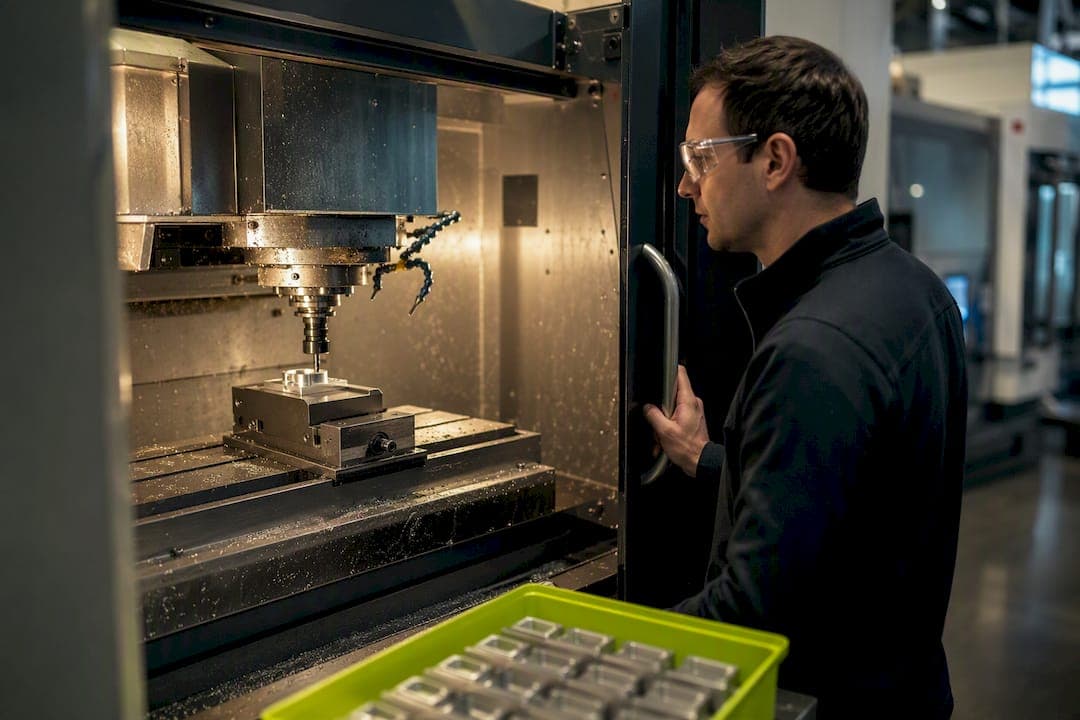
Outsourcing CNC machining is the practical choice when you need prototypes turned fast, low-volume or short-run parts, exotic materials, or 5-axis capability you don't own. The payoff is real: no capital outlay on machines, quicker iteration, and access to metrology your shop floor probably doesn't have. None of that matters if you skip supplier vetting or send an incomplete RFQ.
TL;DR:
- Outsourcing CNC machining is most beneficial when working with exotic materials, complex geometries, or short-run production, but requires thorough supplier vetting and complete RFQ packages.
- It offers advantages like cost savings from avoiding machine investments, access to expensive equipment, faster prototypes, consistent quality, and supply chain resilience, especially at higher volumes.
- Proper evaluation involves verifying a supplier’s machine capabilities, inspection practices, certifications, and sourcing a detailed RFQ with clear specifications and design for manufacturability feedback.
- Key quality control steps include a design review, first article inspection, in-process sampling, and coordinating finishing processes to prevent costly errors or delays.
- Managing risks depends on clear communication, comprehensive documentation, multiple suppliers for critical parts, and forcing an initial first article inspection before full production.
What Outsourcing CNC Machining Actually Means
Outsourcing CNC machining means handing process planning, tooling selection, programming, and inspection to a specialized partner while your team keeps design authority and final specification control. That division of labor is what separates a real manufacturing partner from a commodity parts seller who just runs your file through a machine and ships whatever comes out.
Buyers typically encounter three arrangements:
- Transactional one-off orders — single jobs quoted and produced with no ongoing commitment, common for prototypes or one-time replacement parts.
- Preferred supplier relationships — a shop you route repeat work to because they know your tolerances, your finishes, and your revision history.
- Vendor-managed inventory — the supplier holds stock and replenishes based on your consumption, useful for high-turn production parts.
Each model shifts responsibility differently. In a transactional deal, you own more of the DFM burden. In a preferred relationship, the supplier often flags design issues before you ask.
Key Benefits of Outsourcing CNC Machining
The case for outsourcing rests on five measurable advantages, and they compound when you're moving between prototype and production stages.
- Capital avoidance and labor flexibility. You skip six figures in machine tools and skip hiring cycles tied to workload swings.
- Access to equipment you'll never justify owning. A 5-axis mill or wire EDM machine that is infrequently used doesn't pencil out for most shops, but it's accessible through a supplier.
- Faster time-to-market. Pilot runs and prototypes move faster when a specialized partner already has fixtures and programs dialed in for similar geometry.
- Quality consistency. CMM-equipped suppliers with documented process controls catch drift before it reaches your assembly line.
- Supply chain resilience. Splitting work across qualified suppliers means one bottleneck doesn't stall your whole production schedule.
Outsourcing can also cut operating and investment costs through higher equipment utilization on the supplier's side and lower labor overhead on yours, though logistics and inspection costs still need to be counted in the total, not just the per-part price on the quote.
When to Outsource vs Keep Work In-House
There's no universal formula here. In-house versus outsourced decisions come down to capacity, expertise, technology, and lifecycle economics, and the right call shifts as your volumes change.
Run through this checklist before committing either way:
- Volume break-even. If a part's annual quantity justifies the capex and the machine will stay busy, in-house often wins on unit cost over time.
- Capability gaps. Outsourcing makes sense when the job needs 5-axis milling, Swiss turning, wire EDM, or large-format capacity that you don't have and won't buy for one program.
- Lead-time sensitivity. In-house wins when you need same-day turnaround on a fixture fix. Outsourcing wins when the supplier's queue is still faster than your internal backlog.
- IP and assembly timing. Sensitive geometry or tight integration windows sometimes argue for keeping control in-house, even at a cost premium.
Pro Tip: Run the break-even math on labor and machine amortization before you assume in-house is cheaper. Most teams underestimate setup time and overestimate their own machine utilization.
How to Evaluate and Choose a CNC Supplier
Picking a supplier badly costs more than picking one slowly. Ask direct questions before you ever send a drawing.
- What's on your machine list, and what's your demonstrated tolerance history on similar parts?
- Can you show sample parts or a portfolio matching my material and geometry?
- Do you have in-house CMM access, or is that outsourced too?
- Who handles surface finishing, and is it in-house or a coordinated partner?
- What certifications do you hold, and do they match my industry's requirements?
Certifications like ISO 9001, AS9100, IATF 16949, or ISO 13495 matter in regulated industries, but certifications alone don't replace demonstrated inspection practice and a track record. Ask to see actual inspection reports, not just a certificate on a wall.
A complete RFQ package should include:
- A 3D CAD model in a usable format (STEP is standard)
- A 2D drawing with critical datums and GD&T called out
- Material specification, including alloy and temper where relevant
- Quantity and whether it's a one-time build or recurring
- Surface finish and any coating requirements
- Test or inspection criteria the part must pass
A complete RFQ package with the 3D model, 2D drawing, material spec, quantity, and marked critical features prevents the change orders and delays that come from a supplier guessing at intent.
Beyond the package itself, negotiate lead-time guarantees, scrap allowance percentages, who owns custom tooling at the end of the program, and a change-control process for revisions mid-run. Skip this conversation and you'll have it later, under worse terms.
From First Article to Full Production: The Quality Control Path
A responsible supplier reviews your design for manufacturability before cutting metal, flagging tight internal radii, thin walls, or thread depths that will cause scrap. That DFM conversation should happen before the first cut, not after the first bad part.
First article inspection (FAI) comes next: the initial part gets measured against every critical dimension on your drawing, with a written report you can review before authorizing the rest of the run. Inspection capability, including CMM access, SPC data, and documented FAI, is a trust signal buyers should verify before committing to volume.
For batches beyond a handful of parts, in-process inspection and statistical process control catch drift mid-run instead of after delivery. Traceability matters too: lot numbers, material certs, and packaging that protects finish through shipping.
| Production stage | What to require | Why it matters |
|---|---|---|
| Design review | DFM feedback in writing | Catches costly geometry before cutting |
| First part | Full FAI report with measured dimensions | Confirms process matches print before scaling |
| Mid-run (batches) | SPC sampling data | Flags tool wear or drift early |
| Finishing | Coordination on anodize, plating, or heat treat | Prevents dimensional surprises after coating |
Cost and Lead-Time Drivers in a CNC Quote
Every quote breaks down into setup time, recurring cycle time, tooling amortization, and material cost, and the ratio between those changes drastically with volume. A one-off prototype eats the full setup cost. A 500-piece run spreads it thin.
Material choice moves the needle more than most buyers expect. Aluminum machines fast and cheap. Titanium and Inconel cut cycle time efficiency in half or worse, driving both machine time and tool wear costs up. Finishing and inspection add line items too. Anodize, plating, or heat treat each carry their own lead time and cost, and a tighter finish spec than the application actually needs is money spent for nothing.
The biggest cost lever is usually design, not sourcing. Relaxing nonfunctional tolerances or consolidating multiple parts into one operation typically produces the largest per-piece savings, more than negotiating harder on the quote itself.
- Setup and fixture costs get amortized across quantity, so batch size changes unit price fast.
- Machinability of the material sets your cycle time baseline before anything else.
- Tight tolerances on features that don't need them add inspection time with no functional benefit.
- Finishing and secondary operations often cost more than the machining itself on small, simple parts.
Common Risks When Outsourcing and How to Mitigate Them
Most outsourcing failures trace back to a handful of preventable mistakes.
- Misread drawings from incomplete RFQs. Require the full package, and insist on a pre-cut design review call for anything unfamiliar.
- Quality drift over a production run. Mandate FAI on every new part, plus a sampling plan and documented corrective-action process for anything that fails.
- Logistics disruption. Qualify a second supplier for critical parts and keep light safety stock on anything with a long lead time.
- IP exposure. Use an NDA before sharing files, control program ownership in the contract, and confirm the supplier uses encrypted file transfer, not email attachments.
Pro Tip: Ask a new supplier for their corrective-action process before you place the first order, not after the first bad batch. How they answer tells you more than their machine list.
Shop-Proven Workflow: How Flying Chip Factory Runs Short Runs
A shop in Athens, Alabama builds practical motorcycle parts, including bolt-on kickstands for specific electric mini dirt bikes, and runs contract prototyping and short-run jobs with a disciplined approach similar to how it handles its own products.
- Prototype first, with direct machinist feedback on anything that looks hard to hold or finish.
- First article inspection before authorizing the rest of the batch, every time.
- Short iteration cycles instead of a black-box quote-and-wait process.
- Direct communication with the person actually running the machine, not a sales layer in between.
For a deeper look at how batch sizing affects cost and timing, see the guide on short-run CNC production, and for tolerance specification, the guide on tight tolerance machining.
What Procurement Teams Should Actually Do First
Pilot outsourcing with something low-risk and high-signal: a prototype, a fixture, or an urgent replacement part. Require an FAI report on that first part before you ever commit to a production quantity, no exceptions. If the supplier balks at that request, that's the answer you needed before spending real money. Start with one part, one FAI, one honest read on how they communicate.
— Drake
How Flying Chip Factory Can Help
If you've read this far, you already know the fastest way to de-risk outsourcing is starting with a shop that answers the phone and shows you the first article before running the rest of the batch. This shop handles prototype and short-run CNC machining with direct access to the machinist running your job, not a sales rep relaying messages, which matters most when you're iterating a design in real time.
The shop's catalog of in-house motorcycle parts illustrates the process applied to a real product: design, prototype, first article inspection, then production. Fixtures, replacement parts, and short production runs typically move through the shop in days, not weeks, because there's no layer of account management between your drawing and the machine.
Send your 3D model and drawing over and get a straight answer on cost and timeline. Request a quote at the shop's website and see what a direct line to the machinist actually looks like.
Resources Worth Bookmarking
For deeper reading on supplier selection and RFQ structure, the DAXIN buyer's guide and Fictiv's outsourcing guide both cover inspection and documentation expectations in more depth. For logistics-side trade-offs when outsourcing any part of your supply chain, Shiporo's fulfillment outsourcing guide applies the same cost logic to distribution. Internally, the guides on tight tolerance machining and machining motorcycle parts walk through real shop workflows in more detail.
Sources
- Outsourcing CNC Machining: A Practical Guide for Buyers - DAXIN
- CNC Machining Outsourcing: A Comprehensive Guide (Fictiv)
- Outsourcing CNC Machining: 8 Strategic Benefits for Your Business - MS Machining
- 5 Ways Outsourcing CNC Machining Saves Costs — LinkedIn article