
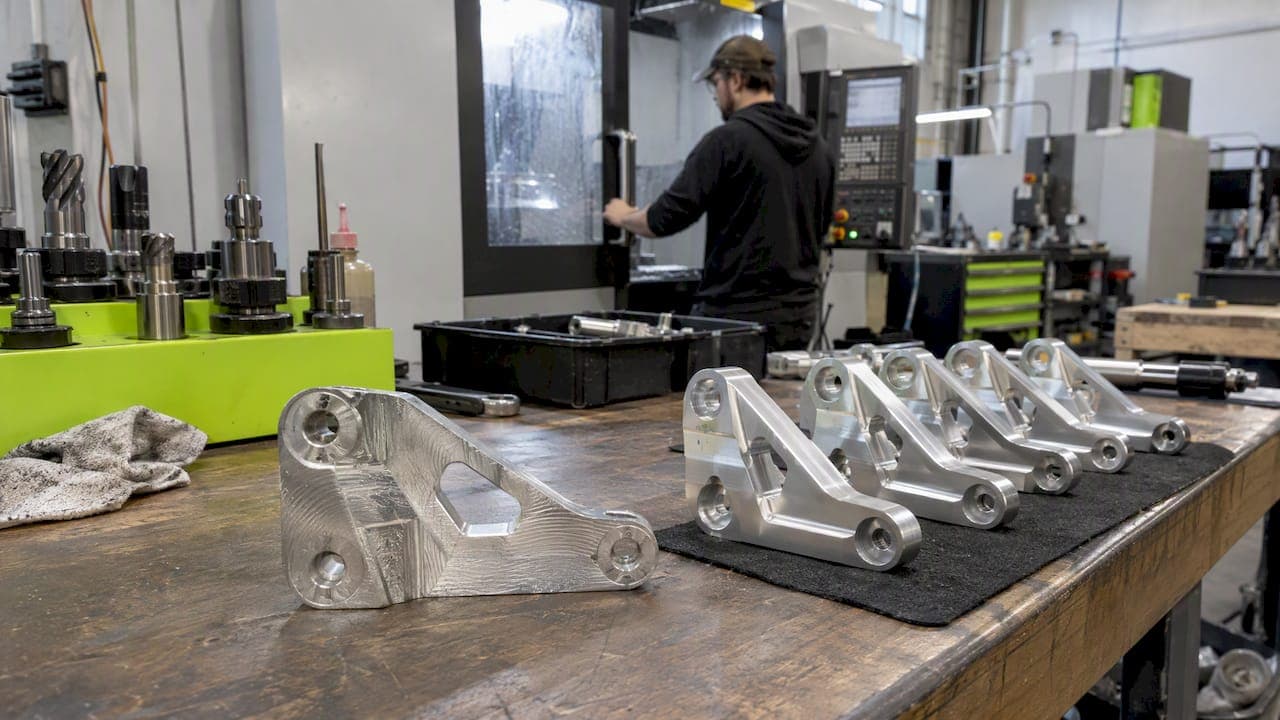
Going from prototype to production means delivering CNC parts that hold the same tolerances, fit, and durability through a short run as they did in the first machined sample. Getting there takes three things in order: communicate design intent with GD&T, plan fixturing before the first part is cut, and build a validation plan with first article inspection. A fast shop can turn a prototype in two to three days; a pilot run of production-intent parts typically takes several weeks once fixturing and inspection are locked in.
TL;DR:
- Proper GD&T communication ensures features controlling fit and function are precisely defined, reducing rework and scrap during production runs.
- Fixturing should be designed during CAD planning to minimize setups, which directly decreases cycle time and per-part costs.
- Material selection and fatigue testing, including finite element analysis, are critical to guarantee durability under vibration and impact loads for motorcycle parts.
- First article inspection should verify all critical dimensions and GD&T features before committing to batch production, not just sampling a few easy measurements.
- Short-run production typically takes several weeks from finalized fixturing and inspection, with rapid prototypes often delivered within two to three days.
What "Prototype to Production" Means in This Guide
This guide covers subtractive CNC machining of mechanical parts, not software or machine learning deployment pipelines. If you came looking for advice on scaling a trained model into a live system, this isn't that article. We're talking about the physical path a part takes from a single machined prototype to a repeatable short run, whether that's a dozen brackets or a few hundred bolt-on motorcycle components.

That distinction matters because the failure modes are different. A CNC part that passes inspection once can still fail in run three if fixturing shifts or tool wear isn't accounted for. This isn't about high-volume injection molding either, where tooling cost dominates the economics. Short-run CNC production lives in a different zone: lower volume, higher per-part attention, and tolerances that often matter more than unit cost. Typical outcomes include bolt-on motorcycle parts, custom fixtures, and small batches of brackets or support hardware built to the same spec every time.
Design for Manufacturability and GD&T That Actually Communicates Intent
A prototype that works on a bench doesn't automatically translate to a repeatable production part. The gap usually traces back to drawings that describe geometry but not intent. CNC machining delivers the surface finish and dimensional control needed for production-intent prototypes, but only if the drawing tells the machinist what actually matters.
- Treat manufacturing constraints as inputs during design, not fixes applied after the first part fails inspection.
- Use ASME Y14.5 datums, true position, and MMC or RFS callouts to control which features actually govern fit.
- Run tolerance stacks before release, then reallocate tight tolerances to fewer setups instead of spreading them everywhere.
- Hand off annotated CAD with notes on which features are assembly-critical, not just a clean model.
Shops that receive ambiguous drawings end up guessing at datums, and that guesswork shows up as scrap. A mismatch between drawing datums and fixture design creates rework that's invisible until a batch comes back out of spec. Our true position basics breakdown covers this in more depth for anyone moving past basic plus-or-minus tolerancing.
Pro Tip: Call out only the features that control fit or function with tight GD&T; loosen everything else so the shop isn't fighting unnecessary precision on surfaces nobody will ever measure.
Material Choice and Fatigue Testing for Motorcycle Parts
Motorcycle components live in a brutal environment: vibration, thermal cycling, and repeated shock loading that a single prototype test ride won't reveal. Alloy choice and process change fatigue behavior more than most designers expect, and a part machined from billet behaves differently under cyclic load than a die-cast equivalent with the same nominal dimensions.
- Run finite element analysis before committing to a batch, focusing on stress concentrations near mounting points and welds.
- Build test coupons and run accelerated fatigue tests rather than trusting a single prototype's road feel.
- Watch for failure starting at sharp internal corners; fillets and stress relief at those points are cheap insurance.
- Require batch-level or sample lifecycle testing whenever a part carries repeated vibration or impact loads.
**FEA-driven redesign can cut stress amplitudes by about 49% in motorbike sub-frame testing, which directly extends fatigue life before a part ever reaches a short production run. That kind of margin is the difference between a kickstand or bar mount that survives years of trail riding and one that cracks at a mounting boss after a season. Durability prediction methods that correlate FEM results with physical testing give a more honest read on expected service life than either method alone.
Process Planning and Fixturing for Repeatable Short Runs
Fixturing decided after the design is frozen almost always costs more than fixturing planned alongside it. Engineers often underestimate how much fixture design time matters relative to actual cycle time on the machine, and that gap shows up directly in per-part cost.
- Design fixturing at the CAD stage, not as an afterthought once the first prototype is already cut.
- Sequence operations to minimize the number of setups, since each new setup introduces a chance for datum shift.
- Use quick-change or modular fixturing for small batches so the same base plate handles multiple part revisions.
- Review fixture complexity against part volume: an elaborate fixture only pays off once run quantity justifies it.
Process planning also touches cost in ways that aren't obvious from a part print alone. Assembly and process planning can account for more than half of total cost in complex assemblies, which means the fixturing conversation deserves as much attention as the part geometry itself. Hybrid approaches that mix additive-built fixture elements with CNC sheet metal have shortened fixture lead time by roughly 92% and cost by about 65% in at least one documented case, a reminder that fixture strategy is its own design problem worth solving early.
Inspection, First Article Checks, and Quality Gates
A part isn't production-ready just because one sample measured correctly. First article inspection confirms that the process, not just a single part, produces parts within spec, and it should happen before a short run commits machine time to quantity.
- A first article inspection checks every called-out dimension and GD&T feature against the drawing, not a sampling of easy-to-measure ones.
- Set acceptance criteria with upper and lower spec limits in mind, and consider Cp or Cpk thresholds for features that repeat across a batch.
- Use CMM reports for critical features and a documented sampling plan for the rest of a short run.
- Build a corrective-action path into the quote: know in advance whether a failed feature means rework, scrap, or a second iteration.
Minor deviations on noncritical features can often be accepted with a documented waiver. A failure on a fit-critical or load-bearing feature should trigger a second iteration rather than a judgment call on the shop floor. Our short-run production guide walks through standardizing this inspection step so it doesn't become a bottleneck at the end of a run.
Timelines and Cost Drivers From Prototype to Pilot Run
A rapid shop can turn a single prototype in two to three days when drawings are clean and materials are on hand. Fixture design adds days to weeks depending on part complexity, and a full pilot run typically runs several weeks once fixturing, machining, and inspection are sequenced.
- Material and finish choice are major cost drivers, especially when a design calls for an unusual alloy or a multi-step surface treatment.
- Fewer setups and fewer fixture changes cut both lead time and per-part cost more than any single machining shortcut.
- Pre-approved materials and finishes skip a sourcing delay that otherwise stalls a quote before machining even starts.
- A single point of contact with the machinist catches design questions in hours instead of waiting on a multi-step approval chain.
Pro Tip: Ask for a quote that separates fixture cost from per-part machining cost; it makes the real cost driver obvious and easier to negotiate.
How a Small Shop Actually Handles This Transition
A prototype that starts as a sketch and a conversation moves faster than one that starts as a formal RFQ. Our own workflow runs design, direct machinist discussion, and a rapid production-intent prototype cut in the same week, which is the pace covered in our rapid CNC prototyping breakdown. Some products went through exactly this path, and others currently in development are following the same design, fixture, and fatigue-consideration sequence before any short run gets committed.
— Drake
Get a Prototype to Short-Run Quote From Flying Chip Factory
We run prototype machining, short-run production, and fixture, bracket, and support part fabrication out of one shop, which means the person answering your questions is the same person running the machine. No intermediaries, no relay through a sales layer: design questions and revision requests go straight to the machinist who built the part.
If you want a concrete example of what a production-intent part from our shop looks like, our E2 Kickstand for the KTM SX-E 2, GASGAS MC-E 2, and Husqvarna EE 2 is priced at $100 to $105 one-off and ships as a bolt-on part built to the same spec every run. For a prototype or short-run job specific to your part, reach out through our service page to get a quote started.
FAQ
What does "prototype to production" mean for CNC parts?
It means a CNC-machined prototype has been validated with GD&T, fixturing, and inspection so the same part can be produced repeatably across a short run. The focus is on process repeatability, not just a single successful sample.
How long does it take to go from prototype to a short production run?
A rapid shop can deliver a single prototype in two to three days, with fixture design adding days to weeks depending on complexity. A full pilot run generally takes several weeks once fixturing and inspection steps are finalized.
Why does GD&T matter for short-run CNC production?
GD&T standardizes how fit, form, and function get communicated between designer and machinist, which reduces ambiguity that otherwise causes rework. Without it, shops guess at which features actually control fit, and that guesswork shows up as scrap during a batch.
What testing should motorcycle components go through before a production run?
Vibration- and thermal-loaded parts should go through finite element analysis and accelerated fatigue testing before committing to batch quantities. FEA-led redesigns have reduced stress amplitudes by about 49% in documented sub-frame testing, which illustrates how much margin proper validation can add.
Does Flying Chip Factory handle both prototyping and short-run production?
Yes, we offer prototype machining, short-run production, and fixture or bracket fabrication directly through our shop. Pricing for services is quoted per job; our in-house E2 Kickstand is listed at $100 to $105 one-off on our product page.
Sources
- Application of high-speed CNC machining for prototype and production
- ASME Y14.5: Dimensioning and tolerancing
- Design and failure analysis of motorbike sub-frame using finite element analysis
- Integration of additive manufacturing and CNC sheet metal fabrication for hybrid check fixtures (MIT project)