
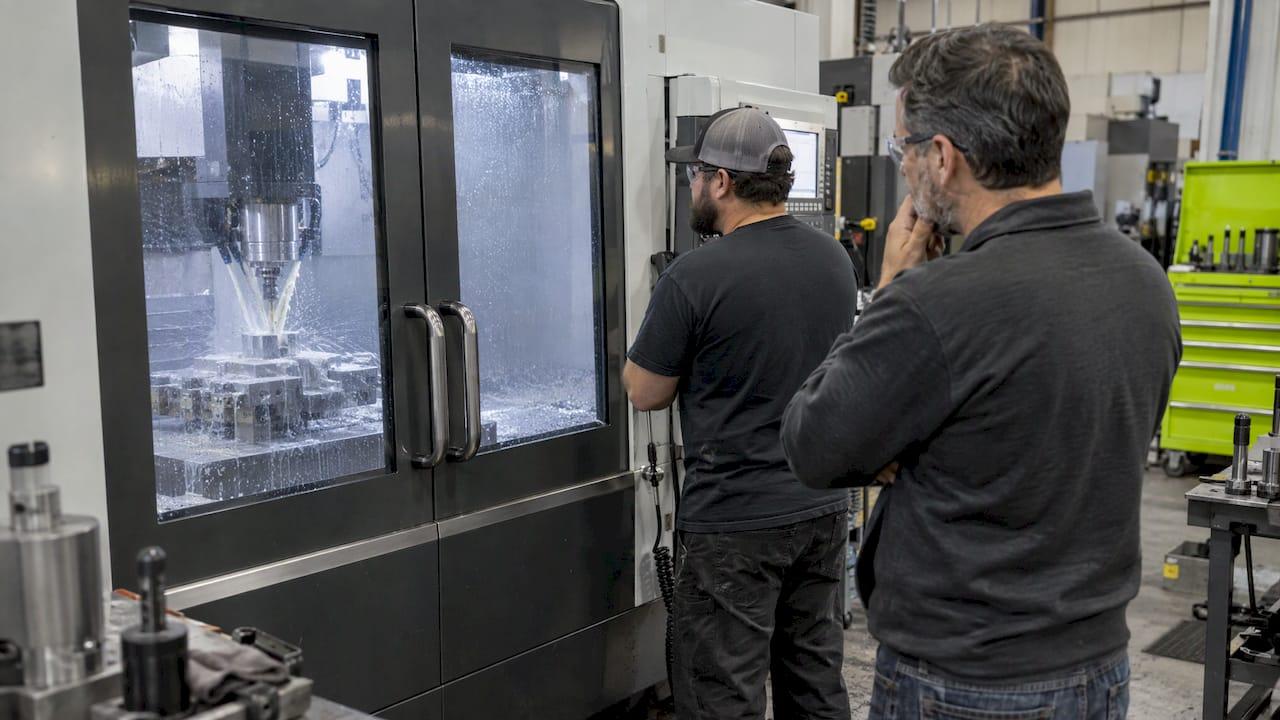
Choose the shop that can show it has made work like yours, can measure what it makes, and answers your questions directly, from the first message through the last revision. Price matters, but a cheap quote from a shop that cannot hold your tolerance or never returns your email costs more than a fair quote from one that does. We run a single CNC shop in Athens, Alabama, where the machinist who designs and builds our own parts is the person you talk to, so this guide comes from the same place you would be buying from.
TL;DR
- Start with the part, not the vendor: a drawing, a 3D model, material, quantity, finish and delivery date let any shop quote you accurately.
- Check capability against your part: comparable past work, machines that fit the part, and a way to measure every feature that matters.
- Judge communication as a manufacturing skill. Slow or vague answers during quoting predict problems during production.
- Send the same package to every shop you consider, then compare capability, quality evidence, capacity, total cost and communication side by side.
- Order a small first batch with an inspection report before you commit to a larger run.
What a machine shop actually does
A machine shop cuts parts from solid material to a drawing. Most shops specialize: according to one machine shop guide, most handle one or two of three services, which are CNC machining, sheet metal fabrication and metal finishing. CNC machining itself covers milling, turning, drilling, boring, tapping and grinding, and complex parts can need 4-axis or 5-axis machines.
That matters because "machine shop" is a wide label. A shop that rebuilds engines, a shop that makes aerospace brackets and a shop that cuts one-off prototypes all use the name. The right one for you depends on what you are making and how many.
For a motorcycle or dirt bike part, the work is usually milled or turned aluminum or steel: a bracket, a mount, a spacer, a stand. Those jobs favor a shop with real experience in rider-facing parts, where fit on the bike and durability under vibration decide whether the part is any good. If you are making your first motorcycle part, our shop-ready guide to machining motorcycle parts walks through the basics.
Start with the part, not the vendor
Before you contact anyone, get your own package in order. A shop can only quote what it can see. QuotedPart's RFQ guide lists what a shop needs to price a part:
- A drawing as a PDF, with the revision shown
- A 3D STEP model
- Material grade and form (bar, plate, billet)
- Quantity, plus any follow-on quantities you expect
- Finish type and which surfaces it applies to
- Delivery date and ship-to location
- Paperwork you need, such as material certifications, a certificate of conformance, a first article or an inspection report
A drawing carries the tolerances and the notes. A model carries the geometry. Send both when you can. If you are not sure what belongs on a print, our guide to CNC drawing standards covers it, and the machining RFQ checklist shows the full package.
A complete package also tells you something about the shops. One that comes back with specific questions about your drawing has read it. One that returns a number in ten minutes without a single question may not have.
Check capability, and read between the lines
Every shop says it can machine your part. Ask for evidence. One qualification guide boils it down to five questions a capable shop should be able to answer:
- Has it made comparable work?
- Does it own or control the processes your part needs?
- Can its equipment hold your workpiece?
- Can it measure every feature you will accept or reject on?
- Does it have capacity when your release dates arrive?
The same guide suggests asking for a redacted example in the same material family and tolerance band, plus a sample inspection report. That is a reasonable request from any serious buyer.
Match the machines to your part
Another capability checklist recommends comparing the shop's machine list with your part: the working envelope (how big a part fits), the number of axes, whether grinding or honing is available for tight finishes, spare capacity and machine age. It also suggests watching machines run real jobs rather than relying on a list.
For most small parts, the practical version is simple. Ask how many setups your part needs. Every time a part is unclamped and re-clamped, there is a chance for error. A shop with the right fixtures and axis count can often finish a part in fewer setups, which usually means better consistency.
In-house or outsourced steps
Ask which steps happen under the shop's own roof. Anodizing, plating and heat treating are often sent out. That is normal, but it adds lead time and another handoff. A shop that tells you plainly what it does itself and what it sends out is giving you information you need to plan your schedule.
Quality control should be visible
"We hold tight tolerances" is a claim. A measuring plan is evidence. The capability checklist above suggests reviewing the shop's measuring equipment, such as height gauges, micrometers, bore gauges, thread gauges, roughness testers and a coordinate measuring machine (CMM), and checking for valid calibration labels. It also gives a working rule: the measuring device should resolve about a tenth of the tolerance you are asking for. If your tolerance is 0.001 inch, the gauge should read to about 0.0001 inch.
To see how inspection fits into a job, read our overview of machined part inspection methods, timing and tools. Three questions are enough to start:
- Which features on my part will you measure, and with what?
- Do I get an inspection report, and in what format?
- What happens when a part comes out of tolerance?
The last question shows the most. A good answer is a process: the part is flagged, the cause is found, and you are told. A weak answer is a promise.
Start with a small batch
The safest way to confirm all of this is a small first order with a full dimensional report. Our guide on starting with one first article inspection when outsourcing CNC machining explains why one inspected part de-risks a larger run. If your work needs formal documentation for a customer, the Level 3 PPAP walkthrough lays out what that package contains.
Communication is a manufacturing capability
Machining questions come up mid-job. A hole may be too close to an edge. A tolerance may be tighter than the part needs. A material may be out of stock. The speed at which a shop asks and you answer decides whether the job slips by a day or by a week.
So test communication during quoting:
- How quickly did they reply, and did the reply address your part?
- Did they ask a question that shows they read the print?
- Do you reach the person who will actually program and run the machine, or a salesperson who relays messages?
That last point is where we have built our shop. At Flying Chip Factory, work and questions are handled directly by the machinist who designs and builds our products, with no sales intermediaries in between. When a revision is needed, it is a conversation with the person at the machine.
Our article of 12 machine shop questions engineers should ask before quoting gives you a longer list to bring to the call.
Lead time, minimums and pricing: what to ask
These three decide whether a quote is workable, and they are worth asking about before you send a purchase order.
Lead time. Ask for lead time from approved order to ship date, and ask what it assumes: material in stock, finishing done in-house or sent out, inspection included. A delivery date that fits no real lead time is a warning sign on either side of the table. If you need parts urgently, say so at the start. Some shops can rush a job, but the answer depends on their schedule.
Minimum quantities. Some shops only take production runs. Others take one-offs. If you need a prototype or a short run, say that in your first message so you do not spend a week waiting for a no.
Pricing. Setup and programming are fixed costs, spread over however many parts you order. One cost breakdown explains that programming can account for a large share of a very small order and a small share of a large one, which is why the price per part falls as quantity rises. Material, machining time, finish and inspection add to it. To see how a quote is built, our guide on how to reproduce a shop's CNC quote formula walks through the arithmetic, and the prototyping cost checklist applies it to small businesses.
Ask for the quote itemized when you can: setup, material, machining, finish, inspection, shipping. When two shops differ by a lot, the itemization usually shows why.
Compare shops on the same package
Send every candidate the same package. Then score each on what the qualification guide above names: process capability, quality evidence, capacity, total cost and communication. A simple table keeps you honest:
| Criterion | What to look for | Red flag |
|---|---|---|
| Process capability | Comparable work, machines that fit the part | Vague "we can do anything" |
| Quality evidence | Calibrated gauges, sample inspection report | No report offered |
| Capacity | Realistic lead time for your quantity | A date that fits no lead time |
| Total cost | Itemized setup, material, finish, inspection | One number, no breakdown |
| Communication | Specific questions, direct line to the machinist | Slow, generic replies |
The lowest price rarely wins on this table. Total cost includes rework, delays and your own time chasing answers.
Mistakes buyers make
The RFQ guide above flags several problems that cause bad quotes and bad parts:
- Sending a model with no drawing for a part with tight tolerances
- Sending a drawing with no model for a part with complex surfaces
- Calling out a tolerance far tighter than the rest of the print, which drives cost without improving function
- Specifying a material that conflicts with the finish
- Requesting a delivery date that fits no lead time
Two more come from the buying side. First, choosing on price alone, without asking for evidence of capability. Second, skipping the first small batch and ordering the full quantity on trust.
Our perspective
Most bad machining jobs go wrong in the same place: the gap between the person who wrote the drawing and the person who cut the part. Every handoff in that chain is a chance for a misunderstanding.
We run Flying Chip Factory as one shop in Athens, Alabama. The same machinist who designs and builds our own parts, including our E2 Kickstand, talks with you about yours. That gives us product knowledge from riding and real manufacturing experience from running the machines, and it lets us revise quickly because there is nobody in between.
If you are choosing a shop, look for that. Ask who you will talk to, who programs the job and who inspects it. The closer those answers are to one person, the fewer surprises you will see.
Drake
What we make and machine
We sell in two ways. For customers who need parts made, we offer prototype machining, short-run production, and fixtures, brackets and support parts, with direct access to the machinist for quick iteration. For riders, we sell parts we design and machine ourselves, such as the E2 Kickstand for the KTM SX-E 2, GASGAS MC-E 2 and Husqvarna EE 2 electric mini dirt bikes, priced at $100-$105 and designed as a bolt-on, durable alternative to the factory triangle stand.
If you have a part in mind, send your drawing, model, material, quantity and finish through our shop page and we will talk it through with you directly.
FAQ
How do I know if a machine shop can hold my tolerances?
Ask which gauges it will use for the tight features and whether they are calibrated. A common rule is that the instrument should resolve about a tenth of the tolerance. Then ask for a sample inspection report from similar work.
What should I send to get an accurate quote?
Send a drawing PDF with the revision, a 3D STEP model, material, quantity, finish, delivery date and any documentation you need. The more complete the package, the more accurate and faster the quote.
Should I order a prototype first?
Yes, for any new part. A small first batch with a dimensional report lets you check fit and function before you commit to a larger quantity. It also shows how the shop communicates when something needs adjusting.
Why do quotes for the same part differ so much?
Shops differ in machines, setup time, material sourcing, finishing and inspection. Quantity also changes the price per part because setup costs are spread over the run. Ask for an itemized quote so you can see where the difference comes from.
Sources
- What Is Machine Shop Work? A Guide for Shop Owners
- Information needed to quote a machined part from a customer
- Precision Machining Services: Qualify the Right Shop (2026)
- How do I check a factory's machining capability?
- CNC Machining Cost, Lead Times, and Quality Standards