
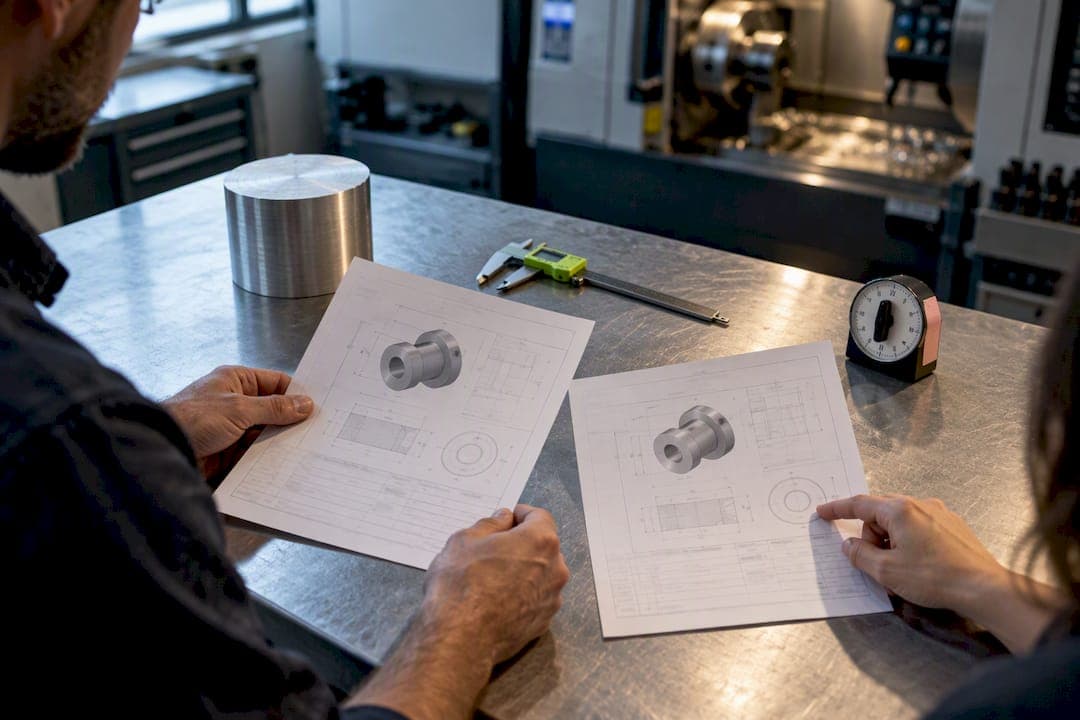
Most CNC prototype parts run somewhere between simple, low-complexity jobs and tight-tolerance, multi-axis work, with shop labor typically billed by the hour and priced per part once material, setup, and finishing get added in. Material, tolerance, geometry complexity, and how many parts you order all move that number immediately. This guide breaks down where the money goes, what changes the price fastest, and gives you a checklist and worked example so you can sanity-check any quote you receive.
TL;DR:
- Small, simple plastic parts can cost significantly less than tight-tolerance steel components due to differences in complexity and required machine setups.
- Material costs vary depending on the metal or plastic, and inefficient geometry can increase waste and overall expenses.
- Batch size greatly reduces unit cost by spreading fixed setup and programming costs across multiple parts, especially for batches of five or more.
- Requests for tighter tolerances, complex fixturing, or advanced multi-axis machines significantly increase manufacturing costs.
- Accurate quotes depend heavily on detailed specifications, including material, tolerances, and lead times, which should be clearly communicated upfront.
Typical price ranges for prototype parts and machine time
Shop hourly rates generally scale with machine capability. A basic 3-axis mill or lathe sits at the low end of the range, a 4-axis setup costs more per hour because it handles more complex geometry in fewer setups, and full 5-axis machining commands the highest rates due to the equipment and programming involved. Per-part prototype pricing follows the same logic: a small, simple part in soft plastic costs far less than a tight-tolerance bracket machined from steel.
Three scenarios illustrate the spread:
- Simple plastic bracket: A flat, low-tolerance Delrin part with two holes and one setup keeps machine time short and skips secondary finishing entirely.
- Small aluminum bracket: A bracket with a few pockets and holes, standard tolerances, and a light bead-blast finish needs modest programming time and one or two fixture setups.
- Tight-tolerance steel part: A part with sub-thousandth features, multiple setups, and a required surface finish drives up both machine hours and inspection time.
Shop rates vary widely by region, equipment age, and how full a shop's schedule already is, so two vendors quoting the same drawing can land on noticeably different numbers. That variance is normal and one reason it pays to compare the structure of a quote, not just its total.
Where the cost actually goes: material, time, setup, and finishing
A prototype quote is really several smaller costs stacked together, and understanding each one tells you where to look for savings.
- Material: Stock cost depends on the metal or plastic chosen and how much of the raw block ends up as chips instead of finished part; odd geometry that requires oversized stock wastes material and money.
- Machine time: Every minute the spindle is cutting gets billed at the shop's hourly rate, and smarter CAM toolpaths that reduce air-cutting or use higher feeds can shrink that time without changing the design.
- Setup and programming: Fixturing the part and writing the CNC program are largely fixed costs, so they hit hardest on a single prototype and lighten up as quantity grows.
- Tooling: Custom cutters, specialty tool holders, or high wear from tough materials add tooling cost that gets amortized across however many parts you order.
- Finishing: Anodizing, bead blasting, painting, or heat treating are added after machining and each is priced separately, often by a subcontractor.
A system-level cost estimation framework developed at Old Dominion University groups machining cost into four buckets: handling and setup, machining time, tool changing, and tool cost, with parametric and process-based methods used depending on how far along the design is. Cutting speed and tool life trade against each other directly, according to the same cost estimation framework: running a tool faster cuts machining time but shortens its life, so a shop optimizing for lowest cost per part won't always run the fastest possible cycle. That is one reason two shops can quote different prices on the identical drawing: they are solving for different things, one for throughput and one for cost.
How machine type, fixturing, and tolerances change the price
Not every part needs a 5-axis machine, and paying for one you don't need is the fastest way to inflate a prototype budget.
- 3-axis versus multi-axis: A part with features on one or two faces machines fine on a 3-axis mill; parts with compound angles or features on multiple sides in one setup usually justify the added cost of 4 or 5-axis work.
- Tolerances: Standard tolerances keep programming and inspection simple, but tight GD&T callouts push up cycle time, tooling wear, and inspection cost. ASME Y14.5 is the standard reference shops use to specify tolerances clearly, and using its language reduces ambiguity even though tighter tolerances still cost more than loose ones.
- Fixturing: A part that needs a custom fixture to hold it securely adds setup cost that a simpler, vise-friendly geometry avoids.
- Alternate processes: A small round part produced in volume might be cheaper on a Swiss lathe than a milling center, since turning-based processes are often faster for that geometry.
How batch size, lead time, and location shift unit cost
Setup and programming are largely fixed costs, so spreading them across more parts brings the per-part price down fast between a single prototype and a small batch, then more slowly as quantities keep climbing.
- Batch size: Ordering five or ten of the same part instead of one lets you split the fixed setup cost across all of them, dropping the effective cost per unit.
- Rush jobs: Needing parts faster than a shop's normal queue allows often triggers a rush surcharge, since it means bumping other jobs or running after hours.
- Regional rates: Labor costs and how full a shop's schedule is both shift hourly rates from one region or even one shop to the next, so identical parts can price differently depending on where they're made.
For a deeper look at how setup amortization plays out on real orders, our guide to short-run CNC production walks through the math on small batches.
Design changes that cut your prototype bill
Most of the savings in a prototype budget come from decisions made before the file ever reaches a shop, not from negotiating after the quote arrives.
- Simplify the geometry. Fewer unique features and fewer setups mean less programming time and lower risk of fixturing surprises.
- Loosen tolerances wherever function allows. Reserve tight callouts for the surfaces that actually need them and dimension the rest generously.
- Pick practical materials and standard stock sizes. A material that comes in the exact bar or plate size you need avoids paying to machine away excess stock.
- Stick to common tool sizes and avoid long, thin features. Standard drill and end mill diameters skip custom tooling charges, and slender walls or deep pockets slow the whole cycle down.
- Batch similar parts together. Grouping parts that share a fixture or material spreads setup cost across the group instead of paying it once per part.
Pro Tip: Send your shop a 3D model with critical tolerances called out and everything else left as a general tolerance note, so the machinist knows immediately what actually matters.
Our tight tolerance machining guide covers how inspection requirements scale with tolerance callouts if you want the full picture before finalizing a print.
What to send a shop for an accurate quote
A vague RFQ gets a vague quote, and the gap between an estimate and the final invoice usually traces back to missing information upfront.
- Send a STEP or IGES file, not just a PDF drawing, so the shop can extract geometry directly for programming.
- Call out material, tolerances, and finish explicitly, since assumptions here are where quotes diverge most between vendors.
- State quantity and desired lead time up front, because both change which pricing tier and schedule slot apply.
- Ask how the quote is built, specifically the machine-hour rate, setup and CAM charge, tooling amortization, finishing cost, and any per-part labor, so you can compare vendors on structure rather than just a bottom line.
- Watch for vague line items like a flat "machining" charge with no breakdown, and ask the shop to separate setup from cycle time if it isn't already split out.
Our post on outsourcing CNC machining goes further into requesting a first-article inspection on your first order from a new shop, which catches problems before a full batch runs.
A simple formula to estimate your own cost

You do not need a machinist's experience to run a sanity check on a quote. The core formula is:
(machine hours x machine rate) + material cost + (setup cost + tooling cost) / quantity + finishing cost
- Estimate machine hours from your CAM software's cycle time simulation or a rough guess based on part size and feature count.
- Get a machine rate from the shop's published range or your own quote history.
- Add material cost based on the stock size you'll actually consume, not just the finished part volume.
- Divide setup and tooling by your order quantity to see how batch size changes your per-part number.
A worked example for a small aluminum bracket:
| Cost component | Assumed value | Contribution to per-part cost |
|---|---|---|
| Machine hours | 0.75 hour per part | Multiplied by machine rate |
| Material | Aluminum bar stock | Fixed per part |
| Setup and tooling | One-time charge | Divided across quantity ordered |
| Finishing | Bead blast, per part | Fixed per part |
Run the same table with your own numbers before you accept a quote, and you will know within a reasonable margin whether the price makes sense.
How our shop quotes prototypes and where we push back
We quote prototypes with machine time and material first, setup and tooling amortized against whatever quantity you're actually ordering, finishing priced separately so it's never hidden inside a machining line item. When a print comes in with tolerances tighter than the part needs, we say so, and we'll suggest a finish swap or a looser callout if it gets you the same function for less machining time. We built our own E2 Kickstand this way, and the same logic applies to fixtures, brackets, and one-off replacement parts. Readers who want more detail on how quick-turn pricing works can check our rapid prototyping guide.
— Drake
Get a prototype or short-run quote from our shop
If you'd rather skip the guesswork and just get a number, we quote prototype machining, short-run production, and custom fixtures, brackets, and support parts directly, with no sales layer between you and the machinist doing the work. That means faster answers when you have a question mid-project and revisions that don't wait on a callback queue.
- Prototype machining: One-off parts quoted from your CAD file with material and finish specified upfront.
- Short-run production: Setup amortized across your batch size so per-part cost drops as quantity grows.
- Fixtures, brackets, and support parts: Custom-machined to your spec for production or shop use.
If you ride an electric mini dirt bike, our E2 Kickstand for the KTM SX-E 2, GASGAS MC-E 2, and Husqvarna EE 2 is a ready example of what our shop turns out, priced in the range of about one hundred US dollars for a one-off. For a prototype or short-run job of your own, start with our services page and send over your files.
Sources
Figures on cost structure come from an academic machining cost framework and ASME Y14.5 tolerancing standards, alongside shop practices from our own blog.
- Generic Cost Estimation Framework for Design and Manufacturing Evaluation (ODU thesis)
- ASME Y14.5 — Dimensioning and Tolerancing
FAQ
Why is CNC machining so expensive?
CNC machining costs reflect the machine time, programming, tooling, and material involved, plus the fact that skilled setup and inspection work take real time regardless of part size. Tight tolerances and complex geometry raise the price further because they demand more machine hours and more careful setup, as explained by ASME Y14.5 tolerancing standards.
How much does CNC machining cost per hour?
Hourly shop rates vary by machine type, with basic 3-axis work priced lower than 4-axis or 5-axis machining because of the added equipment and programming complexity. Rates also shift by region and by how busy a given shop's schedule already is, so it's worth comparing more than one quote.
Is CNC machining a dying trade?
No, CNC machining remains an active manufacturing trade, and shops continue to rely on skilled machinists for prototyping, short-run production, and custom fixture work. Demand for machinists who can program, set up, and run CNC equipment has not disappeared as the work has shifted toward more complex, multi-axis jobs.
Can a CNC machinist earn a strong income?
Machinist pay varies widely based on experience, specialization, and region, with skilled programmers and those running multi-axis equipment generally earning more than entry-level operators. Shop ownership or working in a shop that handles complex prototype and short-run work also tends to pay more than routine repetitive production.