
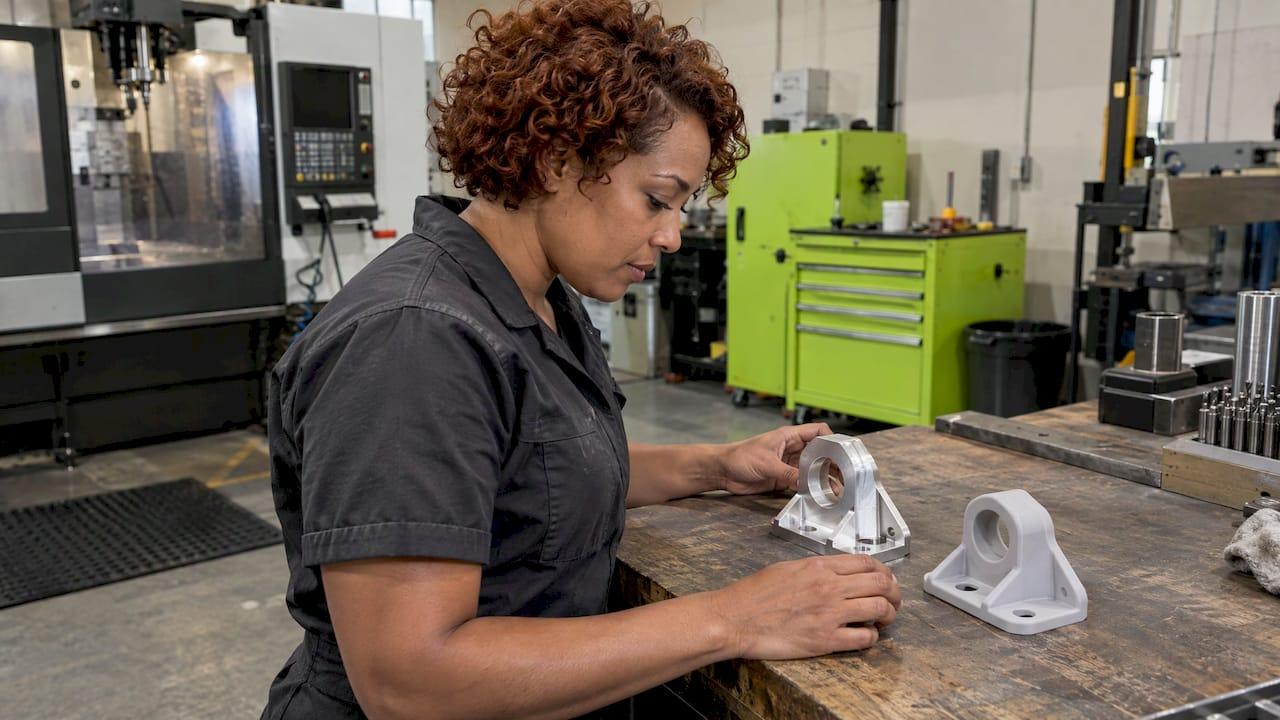
For metal parts that must be accurate, strong and ready to use, CNC machining is usually the most direct low volume method. It needs no mold or die, so the first part and the fiftieth part come from the same program and the same machine. Casting, sheet metal, 3D printing and molding each win in narrower situations, and this guide shows where one method ends and the next begins. We machine motorcycle parts and customer jobs in one shop in Athens, Alabama, so we write from the machining side of the bench.
TL;DR
- Low volume manufacturing has no official unit cutoff. It is defined by small batches, flexibility and variable demand, not by a magic number.
- The main methods are CNC machining, 3D printing, urethane casting, sheet-metal fabrication, rapid-tooled injection molding and metal casting.
- Pick by four things: material, geometry, tolerance and how many identical parts you need.
- For precise metal parts such as brackets, fixtures, mounts and replacement components, CNC machining avoids tooling cost and lets you revise the design between runs.
- Our shop machines prototypes, short runs and fixtures, with direct access to the machinist who runs the job.
What low volume manufacturing actually means
People search for a quantity: "how many is low volume?" There is no single answer. A National Academies workshop on the subject describes low-volume manufacturing through characteristics such as prototyping, customization, flexibility, agility and variable demand, rather than a fixed number of units. A part you need ten of is low volume. So is one you need five hundred of, if demand is uncertain or the design is still changing.
The term you will meet next is high-mix, low-volume, or HMLV. It means a shop making many different part numbers in small quantities. A peer-reviewed 2023 review in Applied Sciences describes HMLV as small batches of many products, varied production routes, job-shop environments and highly variable demand and cycle times. A machine shop that does a bracket on Monday, a fixture on Tuesday and a motorcycle part on Wednesday is an HMLV operation by that definition.
The tradeoff is cost per part. A 2025 engineering report from the Dutch research organization TNO notes that HMLV supports customization and responsiveness, but typically carries higher unit costs than high-volume production because of frequent changeovers and smaller economies of scale. That is the honest price of flexibility. The goal of choosing a method well is to pay for only the flexibility you actually need.

Where these methods sit in the manufacturing family tree
A university manufacturing text from Michigan State splits manufacturing into processing operations and assembly operations. Processing operations change a material's geometry, properties or appearance. Assembly operations join components together. Every method below is a processing operation, and it helps to sort them by how they make shape:
- Subtractive: material is cut away from a solid block. CNC machining is the main example.
- Additive: material is built up layer by layer from a digital file. This is 3D printing.
- Formative: material is forced into a shape using a mold, die or form. Casting, injection molding and sheet-metal bending belong here.
This matters because the shaping method decides what you pay for up front. Formative methods need a mold or die before the first part exists. Subtractive and additive methods start from a digital file, which is why they dominate when quantities are small.
The main low volume methods, one by one
CNC machining
CNC (computer numerical control) machining uses a programmed cutting tool to remove material from a solid block of metal or plastic. There is no mold to build. You supply a CAD model or drawing, the machinist programs the toolpaths and fixtures the stock, and the machine cuts the part.
Strengths:
- Real production materials. Aluminum, steel, stainless and engineering plastics behave in service the way the final part will.
- Tight tolerances and clean features. Bores, threads, flat faces and pockets come off the machine ready to fit.
- No tooling cost. You pay for programming, setup, material and machine time, so a design change means editing a file, not cutting a new mold.
- Repeatability. The same program gives you the same part on every run.
Limits to plan around: deep internal channels, enclosed cavities and undercuts are hard or impossible to reach with a cutter, and expensive material is lost as chips on very bulky parts. Per-part cost falls slowly with quantity, because every part still takes machine time.
This is the method we run. Our E2 Kickstand, a bolt-on stand for the KTM SX-E 2, GASGAS MC-E 2 and Husqvarna EE 2 electric mini dirt bikes, is CNC-machined in our Athens, Alabama shop, and it sells online for $100-105. A part like that, a load-carrying bracket-style component that has to bolt up exactly, is the kind of geometry machining handles well.
3D printing (additive manufacturing)
3D printing builds an object one layer at a time from a digital file. Its biggest advantage is geometry freedom: internal channels, lattices and organic shapes that no cutter could reach. It also has low setup cost, which makes it a natural choice for one to a few parts, fit checks and early concept models.
Where it falls behind: surface finish usually needs post-processing, printed plastics are not always a match for the final material, and tight-tolerance features such as bearing bores or threads are often finished by machining anyway. That last point is a common and sensible hybrid: print the complex shape, then machine the critical surfaces. We cover how that works in machining 3D printed parts.
Urethane (vacuum) casting
Urethane casting starts from a master pattern, often 3D printed or machined. A silicone mold is made around it, and resin is poured in to produce copies. It suits small batches of cosmetic plastic parts, such as housings and covers, where surface appearance matters. The silicone mold wears, so each mold makes only a limited number of parts. It is a poor fit for high-load, high-temperature or metal parts.
Sheet-metal fabrication
Laser cutting, bending, punching and welding turn flat sheet into enclosures, brackets, panels and frames. It needs little or no dedicated tooling for short runs, which makes it efficient for a dozen or a few hundred flat-pattern parts. It is the wrong tool for thick, blocky or intricately contoured parts, where machining from solid is simpler.
Rapid tooling and injection molding
Injection molding forces molten plastic into a metal mold. Full production tooling is expensive and slow to build. Rapid or bridge tooling, often made from aluminum with a shorter life, lowers the upfront commitment and lets you produce a limited run of production-like plastic parts. The mold still locks in your design, so a change means reworking the tool. Choose this once the design is frozen and the plastic quantity justifies it.
Metal casting
Sand, investment and die casting pour molten metal into a mold. Casting becomes attractive when a part has thin walls, hollow sections or complex shapes that would waste a great deal of material if machined from a block. The cost is the tooling and the lead time to build it, which only pays back across larger quantities. Most cast parts also still need machining on mating surfaces.
Comparing the methods at a glance
The table describes general tendencies. Exact crossover points depend on the part, the material and the shop, so treat them as a way to frame a quote request, not as a promise.
| Method | Tooling up front | Best for | Typical material | Watch out for |
|---|---|---|---|---|
| CNC machining | None | Precise metal or plastic parts, fixtures, brackets, replacements | Aluminum, steel, stainless, engineering plastics | Internal cavities, material waste on bulky parts |
| 3D printing | None | One to a few parts, complex geometry, fit checks | Plastics, some metals | Finish, tolerance, material properties |
| Urethane casting | Silicone mold | Cosmetic plastic parts in small batches | Polyurethane resins | Mold wear, load and heat limits |
| Sheet metal | Little to none | Flat-pattern brackets, panels, enclosures | Steel, aluminum, stainless sheet | Thick or contoured geometry |
| Rapid-tool molding | Aluminum or soft tool | Limited runs of production-like plastic parts | Thermoplastics | Design locked once tool is cut |
| Metal casting | Mold or die | Thin-walled or complex metal parts at higher quantity | Aluminum, iron, steel, zinc | Lead time, tooling cost, secondary machining |
How to choose: four questions
1. What material does the part have to be made from?
If the part must be metal and carry real load, the field narrows fast to CNC, sheet metal and casting. If a plastic stand-in is acceptable for the first checks, printing is cheaper. Resist testing a metal design in a different material for too long: strength, stiffness and heat behavior change, and you may validate the wrong part.
2. What does the geometry look like?
Prismatic parts, meaning blocks with pockets, holes, flats and threads, are a machinist's home territory. Parts with internal passages or lattice structures lean toward printing or casting. Flat parts that are bent into shape lean toward sheet metal. Look at your part and ask which process could physically reach every feature.

3. How tight is the tolerance, and how good must the surface be?
Tolerance is the allowed variation in a dimension. Features that must fit another part, such as a bolt hole, a bearing seat or a mounting face, are best machined. A part that is mostly cosmetic can accept a looser process. Decide which two or three dimensions truly matter and say so on the drawing. Every unnecessary tight tolerance adds cost.
4. How many, and how sure are you?
This is the question the keyword really asks. If you need five, tooling-free methods win. If you need five hundred and the design is final, the math may shift toward formed methods. If you need fifty now and are unsure about the next order, a tooling-free method keeps your risk small, because you have no mold to pay off. We go deeper on that decision in our guide to short-run CNC production.
Worked example: a bracket for a small fleet of machines
Say a small business needs 25 aluminum mounting brackets to hold a sensor on its equipment. The bracket is a block with four holes, one pocket and a tapped thread.
- 3D printing would be quick for a first fit check, but a printed plastic bracket may flex or creep under vibration.
- Sheet metal could work if the bracket can be a bent flat pattern, but this design is a thick block with a pocket.
- Casting needs a mold that costs far more than 25 parts justify.
- CNC machining cuts it from aluminum, holds the hole positions, taps the thread and needs no tooling. If the sensor changes next month, the program changes with it.
That pattern repeats for fixtures, jigs, brackets and replacement parts. When we scope these jobs, the useful questions are material, quantity, the critical dimensions and the finish. If you are preparing a request, our list of machine shop questions engineers should ask and our breakdown of how CNC machining cost is built help you compare quotes on a like-for-like basis.
From prototype to short run without changing process
A common mistake is prototyping with one process and producing with another, then discovering the production part behaves differently. When the prototype is machined from the intended material, what you test is what you will build. That shortens the path from first part to repeat order, because the program, fixtures and inspection notes already exist. We describe the sequence in prototype to production for motorcycle parts and in rapid CNC prototyping.
For a small manufacturer, a first-article inspection of a single part before releasing the full batch is a simple way to catch drawing misunderstandings early. See starting with one first article when outsourcing CNC machining.
Our perspective
We make low volume parts every day, and the lesson that holds up is simple: keep the design flexible for as long as you can afford to.
A mold or die is a commitment. It is the right commitment when the design is final and the quantity is large. Before that point, every dollar spent on tooling is a dollar that cannot go into improving the part. Machining lets a design change between one order and the next, and that is why we built our shop around it.
The E2 Kickstand is our own example. It is a CNC-machined, bolt-on part for the KTM SX-E 2, GASGAS MC-E 2 and Husqvarna EE 2, designed by riders who wanted a durable alternative to the factory triangle stand. We design it, machine it and ship it from one shop. The same approach applies when you bring us a bracket, a fixture or a prototype: you talk directly to the machinist who designs and builds the work, so questions and revisions do not pass through a sales layer.
Our BDE Bar Mounts, an isolated 1 1/8-inch handlebar-mount system we are developing to reduce vibration while keeping steering feel precise, follow the same logic. Parts like these are refined through real riding and real revisions, which is much easier when the part is machined rather than tooled.
Drake
Work with the machinist who builds the part
If your part is metal, needs to fit, and you need a handful to a few hundred of them, we can machine it. Our shop offers prototype machining, short-run production, and fixtures, brackets and support parts, and you deal directly with the machinist, not an intermediary. Send a drawing or CAD file with your material, quantity and the dimensions that matter most.
Riding a KTM SX-E 2, GASGAS MC-E 2 or Husqvarna EE 2? See the E2 Kickstand, CNC-machined in our Alabama shop and priced at $100-105.
FAQ
What is the best low volume manufacturing method for metal parts?
For most precise metal parts in small quantities, CNC machining is the best starting point. It needs no tooling, works in production metals and holds tight tolerances. Sheet metal suits flat bent parts, and casting is worth considering only when the quantity can repay the mold.
How many parts count as low volume?
There is no official number. The National Academies describes low-volume manufacturing by traits such as customization, flexibility and variable demand, not a unit count. In practice, think of it as the range where tooling would cost more than it saves, which varies by part and process.
What is high-mix, low-volume production?
It is a way of running a factory or shop that makes many different products in small batches. Research describes it as having varied routings, frequent changeovers and variable demand. A job shop that machines different customer parts every week is a typical example.
Can I prototype in one method and produce in another?
Yes, but the part may behave differently after the switch. Printing a plastic prototype and then machining or casting metal changes strength, weight and finish. Prototyping in the intended material and process reduces surprises and carries your program and inspection notes straight into production.
What should I send a machine shop to get a quote?
Send a CAD file or drawing, the material, the quantity, the dimensions with tight tolerances and any finish requirement. Say whether you expect repeat orders. That lets the machinist plan setups and fixtures for the whole run, not only the first part.
Sources
- Limited Affordable Low-Volume Manufacturing: Summary of a Workshop, National Academies
- A Review of the High-Mix, Low-Volume Manufacturing Industry, Applied Sciences, 2023
- Performance engineering of high-mix low-volume production, TNO, 2025
- Introduction and Overview of Manufacturing, Michigan State University