
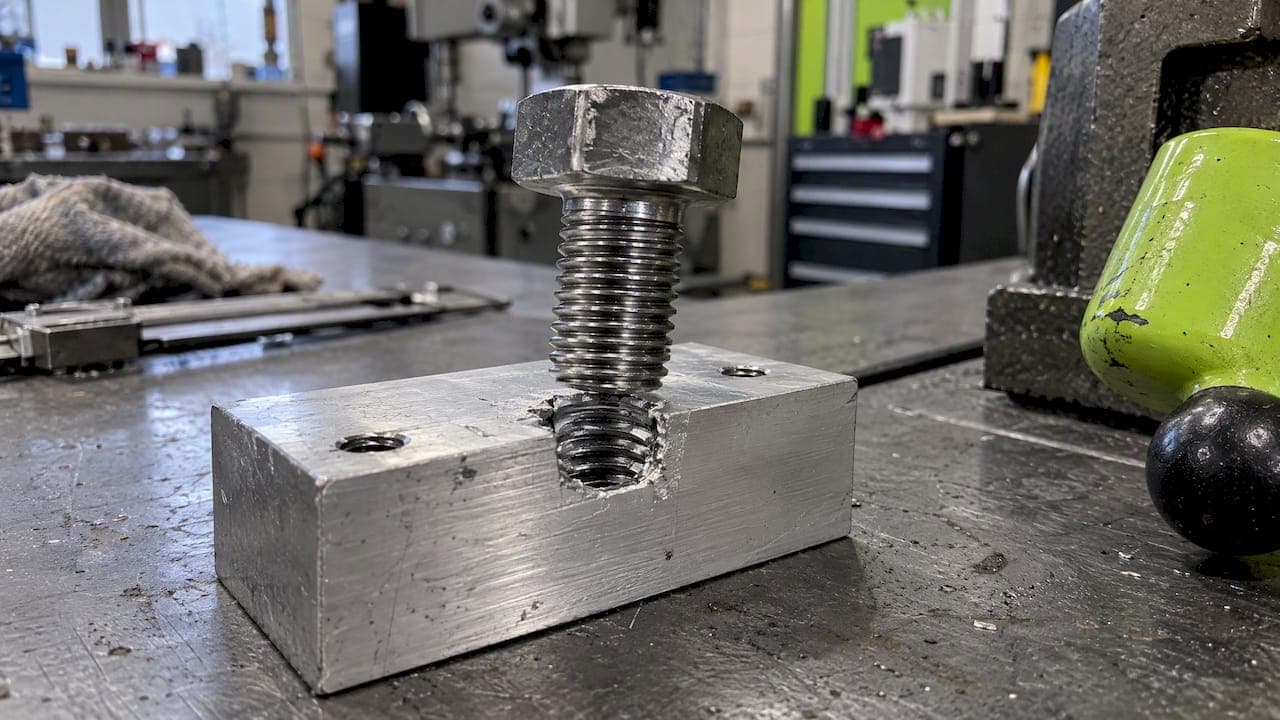
Good aluminum thread design comes down to four decisions: a fully specified thread callout, enough engagement length, a thread made by the right process, and an insert wherever the joint will be assembled and disassembled often or loaded hard. Aluminum is softer than steel, so the internal thread, not the bolt, is almost always the weak link. Design around that and most stripped-thread failures never happen.
This guide is written for engineers, designers and shop buyers who send aluminum parts out for machining. It reflects how we think about threads when we machine parts in Athens, Alabama.
TL;DR
- Specify the thread system, size, pitch, class, standard edition and mating part on the drawing, not just "M6" or "1/4-20".
- In aluminum, plan on roughly 1.5 times the nominal diameter of engagement; going deeper adds little strength.
- Cold-formed threads can be stronger than cut threads, but they need the right material, lubricant and hole size.
- For joints that are assembled often, loaded dynamically or already stripped once, use a wire thread insert.
- Alloy, temper and nearby machining all change how much load a thread can carry.
Why aluminum threads fail first
In a steel bolt threaded into an aluminum part, the two materials are not equals. The bolt is hard and strong; the aluminum female thread is soft and has far less shear strength. Under load, the aluminum threads are the ones that yield, strip or gall.
The design goal is to make the bolt break in tension before either set of threads strips. Fastener engineering guidance states this directly and adds a warning: thread stripping can go unnoticed until the fastener is already in service. A stripped thread does not announce itself on the bench. It shows up later as a loose bracket or a lost clamp load.
The load is also not shared evenly. In a typical 7/8-9 Grade 8 nut, the first engaged thread carries 34% of the load. That is why a ragged first thread, a burr at the hole entry or a chamfer that is too aggressive matters more than most designers expect.
Start with a complete thread callout
Most thread problems that reach a machinist begin as a drawing problem. "Tap 1/4-20" tells the shop very little. A useful callout names the governed thread system (unified inch, ISO metric, NPT and so on), the size, the pitch, the tolerance class, the applicable edition of the standard and the mating counterpart. A practical CNC thread guide makes the same point: choose the system from the mating function, then specify all of those items together.
A short checklist for the drawing:
- Thread system and size, such as ISO metric M6 or UNC 1/4-20.
- Pitch, written out for fine-pitch threads.
- Class or tolerance, for example 6H for an internal metric thread.
- Standard and edition, so the inspection limits are unambiguous. The same guide notes that ISO 965-2:2024 defines the scope of its listed thread-size limits.
- Thread depth and full-thread depth, separately, for blind holes.
- Mating part, especially if it is a different material, plated or anodized.
- Finish called out before or after threading.
If the thread is pipe thread, the system choice alone is a trap. Our guides on NPT versus BSP threads and NPT thread design with ASME specs cover that decision in detail.
Coarse or fine pitch in aluminum
Fine threads look attractive on paper because they give more adjustment and a larger tensile stress area on the bolt. In aluminum they are harder to live with. Practitioners on engineering forums describe fine threads in aluminum as asking for trouble, both while cutting them and when mating parts are turned together. Fine threads have a shallower profile, so there is less aluminum in shear, and they cross-thread and gall more easily.
As a default, use coarse threads in aluminum parts. Choose fine pitch only when you have a real reason, such as a thin wall or a fine adjustment, and then prove it with a test coupon.
Threads in light metals have their own rules
Standards for light-metal joints exist because the usual steel-on-steel rules do not carry over. The German automotive association's VDA 235-107 publication covers assemblies that use ISO metric M5 to M24 bolts and screws, regular or fine pitch, property class 8.8 and higher, in light metal alloys. Its requirements are geometric and production-specific, so treat it as an example of how seriously automotive programs treat the problem, not as a drop-in rule for every part.
How much thread engagement aluminum needs
Engagement length is the cheapest strength you can buy. For aluminum, one fastener distributor's design guide gives approximately 1.5 times the nominal diameter as the engagement length, and says that beyond that there is no appreciable increase in strength.
What that looks like in practice:
| Fastener | Nominal diameter | Engagement at 1.5 × D |
|---|---|---|
| M5 | 5 mm | 7.5 mm |
| M6 | 6 mm | 9 mm |
| M8 | 8 mm | 12 mm |
| 1/4-20 | 0.250 in | 0.375 in |
| 3/8-16 | 0.375 in | 0.563 in |
These are starting points for the full-thread depth, calculated directly from that 1.5 × D guideline. Add clearance below the thread for the tap chamfer and for chips in a blind hole. Our write-up on thread engagement length goes through the reasoning and the rework that comes from guessing, and our guide to blind hole tapping shows how to leave room below the last full thread.
Two cautions. First, the number assumes a bolt that is not stronger than the situation requires. A high-strength bolt in a low-strength alloy at full preload can still strip a joint that looks fine on paper. Second, if the load is critical, test it. Pull a coupon cut from the same stock and see where it fails.
Thinking like a pressure vessel engineer
Engineers who size pressure vessels are used to derating a joint with an efficiency factor rather than assuming it is perfect; ASME joint efficiency is the familiar example for welds. Threads deserve the same humility. Aluminum threads are a joint with a built-in efficiency penalty compared with steel, and engagement length, safety margin and an insert are how you pay it back.
Alloy and temper change the answer
Not every aluminum is the same. Practitioners note that 7075 is one of the stronger aluminum alloys and advise matching alloy, temper and thread to the applied load. The same discussion points out that machining nearby can locally anneal the material and reduce strength. Heavy cuts, dull tools and heat from adjacent operations can all leave a thread boss softer than the datasheet suggests.
For the common structural alloy 6061, a 1997 study at a U.S. research laboratory ran torque tests on 6061-T651 aluminum threads and found both coarse and fine threads adequate after three stress-relieving treatments. That is reassuring for stress-relieved plate, but it does not mean every thread in every aluminum is equal.
Temper also affects machining behavior and stability. If you are choosing between plate and extrusion tempers for a part with many threaded holes, see our comparison of T6 versus T6511 aluminum.
Anodizing and threads
A finish changes thread fit. Anodize builds a layer on the surface and, depending on thickness, can make an internal thread tighter and the first threads more brittle. Decide whether threads are cut before anodizing, masked, or chased afterward, and say so on the drawing. Our hardcoat anodize thickness guide explains how to account for the buildup.
Cut threads or formed threads
Aluminum threads can be cut with a tap, milled with a thread mill, or cold-formed with a forming tap. They behave differently.
Cutting taps remove material and are the default for most prototypes and small runs. They need the correct drill size, sharp tools, and lubricant. Aluminum tends to load flutes and tear, so clear chips often and lubricate for every hole. Practitioners also report reducing tap-drill size to get fuller threads, and advise watching the process and cleaning the tap between holes. Our guide to tapping aluminum lists drill sizes, taps and technique.
Thread milling is often the safer choice in high-value parts, large holes or hard-to-clear blind holes, because a broken thread mill is easy to remove and a broken tap is not. Our thread milling versus tapping comparison gives three rules for choosing.
Cold forming displaces the metal instead of cutting it. According to the maker of forming taps, cold forming can increase static and dynamic strength, and the process depends on material, lubrication and preparatory-hole diameter. The same catalog says materials suitable for cold forming usually have a tensile strength below 1400 N/mm² and a fracture strain of at least 5%.
Formed threads do not make chips, which helps in deep blind holes. The trade-off is that the pre-drilled hole size is critical. Too small and the tap overloads; too large and the thread is shallow.

Thread-forming screws
Thread-forming and thread-cutting screws that make their own thread in a drilled aluminum hole save an operation, but the torque window is narrow. Fastener engineering guidance recommends testing installation torque on the actual mating part or a same-material sample, because the requirement varies with hole preparation and material. Do not copy a torque value from a steel test.
When to use a thread insert
A wire thread insert is a coil of precision wire that screws into an oversized tapped hole and gives a hard, smooth internal thread. They are the standard answer when aluminum threads must stand up to repeated assembly or high load.
Use an insert when:
- The joint will be opened and closed many times (service panels, covers, adjustable brackets).
- Preload is high or the load is dynamic.
- A thread has already stripped and the part is worth saving.
- Wall thickness limits engagement depth and you cannot get to 1.5 × D.
Manufacturer documentation says helically formed wire inserts can repair stripped threads and provide stronger threads in soft materials such as aluminum, zinc die cast and magnesium. One insert maker states that its inserts reinforce threads in low-strength materials like aluminum, distribute load and preload more uniformly, and increase fatigue strength under dynamic loads.
Insert length matters. In the same guide, minimum insert length depends on the parent-material strength and the screw property class, and the guide table runs from 1.5d to 3.5d. So a stronger bolt in a weaker alloy asks for a longer insert. Shorter lengths are possible if tests confirm them.
For cast aluminum, the insert can be part of the casting. One maker notes that in-moulding inserts can be used in cast aluminum, where the casting forms a wear-free, high-strength thread around them. For machined parts, a standard tapped-in insert is the usual route.

Thread locking
Soft threads and vibration are a bad combination, and the reflex is to reach for threadlocker. Grade, cleaning and cure matter on aluminum, which is why we wrote a separate guide on threadlocker on aluminum.
Heat, vibration and long-term durability
Threaded joints between steel and aluminum do not hold the same preload when they get hot, because the metals expand at different rates. The insert maker's guidance says that for screw joints under thermal stress, you should account for changes in temperature-dependent material parameters. In practice that means checking preload at the hot and cold ends of the operating range, not only at room temperature.
Vibration is the other long-term killer. Fine-pitch threads, short engagement and low preload all let joints work loose. Specify torque, use the longer engagement, add an insert and consider a locking method together rather than hoping one of them is enough.
Perspective: what we see at the machine
We design and machine parts from one shop, so the person who reads your drawing is the person who cuts the thread. That changes how we think about thread design. Most of the rework we see is not exotic. It is a callout missing a class, a blind hole with no clearance below the last thread, or a thread specified in a finish that was never accounted for.
Our rule of thumb is simple: if a thread matters, say so on the drawing, and if it matters a lot, talk to the machinist before the part is released. A five-minute conversation about engagement, tap choice and finish saves a scrapped part. When we build parts for riders, such as bolt-on motorcycle parts that live with vibration, dirt and repeated tightening, we design threads for the abuse, not for the CAD model.
— Drake
Machined with the machinist in the loop
If you have a part with critical threads, we can prototype it, run short batches, or machine the fixtures and brackets that go with it. You work directly with the machinist who cuts the part, so thread questions get answered before metal is cut. Send us your drawing through Flying Chip Factory for a quote on prototype machining, short-run production or fixtures, brackets and support parts.

We also sell parts we design ourselves. The E2 Kickstand for the KTM SX-E 2, GASGAS MC-E 2 and Husqvarna EE 2 electric mini dirt bikes is a CNC-machined bolt-on replacement for the factory triangle stand, priced at $100–$105.
FAQ
How much thread engagement do I need in aluminum?
A common design guideline for aluminum is about 1.5 times the nominal diameter, with no appreciable strength gain beyond that, according to a fastener design guide. For an M6 bolt that is roughly 9 mm. If the joint is critical, confirm with a pull test on the actual alloy.
Is aluminum thread strength good enough without an insert?
Often yes, for a joint that is assembled once or a few times and carries modest load. Use coarse threads, adequate engagement and a stronger alloy where needed. Add an insert when the joint sees repeated assembly, dynamic load or high preload.
Should I use coarse or fine threads in aluminum?
Default to coarse. Fine threads have less material in shear and are harder to cut and mate cleanly in aluminum. Choose fine pitch only for a specific reason and test it first.
Can I tap a thread before anodizing?
Yes, but anodize buildup changes the fit, so the drawing must say whether threads are masked, cut before finishing or chased afterward. See our hardcoat anodize thickness guide for how to account for it.
Sources
- Screw Thread Design, fastener engineering guide
- Torque and Thread Cutting or Rolling Screws
- CNC Thread Design, Callouts and Inspection
- VDA 235-107, Threaded Joints in Light Metals
- Threads in 6061 & 2024 Aluminum, engineering forum discussion
- Torque Tests on Aluminum Threads
- InnoForm Cold-forming Taps
- Wire thread insert catalog
- HELICOIL Tangfree
- IMTEC thread inserts for in-moulding processes