
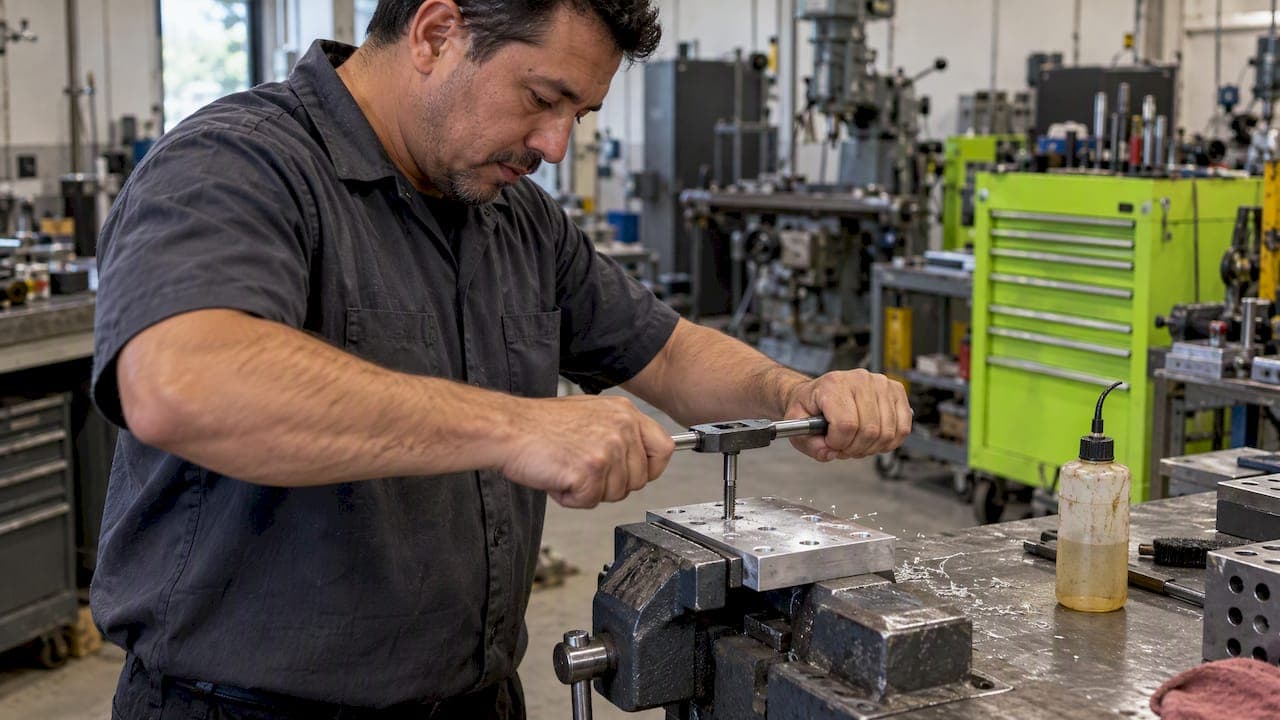
Tapping aluminum is easy to start and easy to ruin. The metal is soft, so the tap goes in without a fight, but that same softness makes chips stringy and lets material weld to the tool. The result is oversized, rough or torn threads, or a tap snapped off in the part. The fixes are few: the right tap geometry, a correctly sized hole, real tapping fluid, and a rhythm that keeps chips from packing.
We machine aluminum parts every week in our Athens, Alabama shop, including the bolt-on kickstands we sell for electric mini bikes. What follows is how we think about threads in aluminum, and what we would tell a friend standing at the drill press.
TL;DR
- Aluminum welds to the tool (built-up edge), so use a sharp tap made for it. Forming taps are the usual expert recommendation because they displace metal instead of cutting it.
- Do not chase 100% thread. 55% to 60% engagement is often enough, and going higher mostly raises torque and the risk of breaking the tap.
- Use a real tapping fluid, not whatever oil is on the shelf, and clamp the work in a vise or fixture rather than holding it by hand.
- By hand, turn forward about one turn, then back about half a turn, every time, to break the chips.
Why aluminum is different from steel
Steel fights back, so you feel trouble coming. Aluminum gives you no warning. According to Machining Doctor, aluminum builds up on the cutting edge at fairly low temperatures, roughly 150 to 200°C (300 to 390°F), because its low melting point and affinity for tool surfaces let it pressure-weld to the edge. Once that happens, the tap stops cutting cleanly and starts smearing.
The same source notes that standard 118-degree twist drills and general-purpose cut taps often struggle here, and that high-helix drills (35 to 40 degrees) and forming taps manage the material better.
Three practical consequences follow:
- Sharpness matters more than strength. A dull or worn tap in aluminum tears threads. Replace it earlier than you would a steel tap.
- Chips are the enemy. Long, stringy chips pack the flutes and snap taps.
- Lubrication is not optional. Dry tapping is how threads get galled.
Forming taps or cutting taps
A cutting tap removes material and makes chips. A forming tap (also called a roll tap) pushes the metal aside into the thread shape and makes no chips at all. In a long-chipping material like aluminum, that removes the most common failure: a jammed, broken tap. OSG describes this chip-free approach in an aluminum production case, and experts quoted by Machining Doctor recommend form taps to avoid chip-evacuation problems and get longer tool life.
Here is how the two compare in practice.
| Cutting tap | Forming tap | |
|---|---|---|
| Makes chips | Yes | No |
| Hole size | Standard tap drill | Larger drill than a cutting tap, per the tap maker's chart |
| Best for | Through holes, general work, hand tapping small jobs | Production, blind holes, parts where a broken tap means scrap |
| Main risk | Chip packing, breakage | Wrong drill size gives poor threads or high torque |
| Thread surface | Cut | Burnished, work-hardened surface |
Forming taps need a different tap drill from cutting taps, so always read the chart that comes with the tap. A cutting-tap drill size in a forming tap makes for very high torque.
Forming taps are also not for every alloy or every situation. Very hard tempers and some high-silicon cast alloys do better with cutting taps. If you only have to tap a few holes in 6061, a sharp, aluminum-rated cutting tap with good fluid will do the job fine.
Chamfer length
One detail catches people out. The chamfer is the tapered lead at the front of the tap. Guhring's guide to tapping chamfer forms warns that a long chamfer in aluminum can make the tap behave like a core drill, enlarging the hole instead of forming a thread, and the research we reviewed points to short leads of two to three threads for aluminum, whether the hole is blind or through.
The same "don't over-taper" thinking applies to the hole itself. If you are working on a blind hole, our guide to blind hole tapping covers drill depth and tap choice in more detail.
Sizing the hole: the step that decides everything
Every tapping failure we see traces back to the drilled hole. Too small, and torque climbs until the tap breaks. Too large, and you get shallow threads that strip. Experts quoted in the OSHA mill training material stress that proper sizing of the tap drill is the most important factor in preventing thread-loading problems and tap breakage, and that tapping with no pre-sized hole is inadvisable.

How much thread do you need?

A full 100% thread is not stronger in any way that matters. Per the Machinery's Handbook, as summarized by PDQ Tool, 55% to 60% thread engagement is often enough for most applications. Pushing past 60% does not meaningfully raise thread strength but does dramatically raise the torque needed and the risk of tap breakage. Many charts list 75% as a standard for an extra margin, and it is not always ideal for high-strength aluminum alloys.
So for most aluminum work:
- Pick the tap drill from the tap manufacturer's chart, not from memory.
- For cutting taps in aluminum, drills that give roughly 60% to 75% thread are the usual range. Lean to the lower end when the alloy is strong or the hole is deep.
- Check the hole with a pin gauge or a test bolt before you tap the whole part.
Thread percentage is about the diameter. Thread length is a separate question: how many turns of thread do you need so the bolt breaks before the aluminum strips? We wrote that up in thread engagement length for engineers and shops. Because aluminum is softer than a steel bolt, you generally want more engaged length in aluminum than you would in steel, and fastener class and load decide the rest.
Drilling the hole well
- Use a sharp drill. High-helix drills clear aluminum chips better than a standard 118-degree twist drill, per Machining Doctor.
- Peck or retract on deeper holes to clear chips before they pack.
- Deburr and lightly chamfer the hole entrance, so the tap starts square and the first thread does not raise a burr.
- Drill a little deeper than your thread depth on blind holes, so the tap does not bottom out.
Lubricant: what to use and what to skip
Aluminum welds to the tap in a dry or poorly lubricated cut. OSG's technical guide recommends chlorine-based extreme-pressure water-soluble oils, or non-water-soluble chlorinated oils, for aluminum and die-cast aluminum alloys, to get better internal thread finishes. Sulfur-based products appear in the same family of options for other metals.
On a shop floor, that translates into:
- Use a purpose-made tapping fluid and apply it generously, and keep applying it. The Jarvis Cutting Tools guide says general-purpose oil is not enough.
- Flood or brush it in the hole, not just on the tap tip. For blind holes, make sure fluid actually reaches the bottom.
- Skip rubbing alcohol and thin sprays as a habit. They evaporate quickly, which is exactly when the tap needs them most.
- Check material compatibility if the part will be anodized or is a food-contact or medical component. Clean the fluid out completely before finishing.
That last point links to finishing. Threads that will see hardcoat or masked anodize need extra thought about size before the part leaves the machine. Our notes on hardcoat anodize thickness and anodize masking dwell time explain why.
Tapping aluminum by hand
Yes, you can tap aluminum by hand. The research we reviewed is clear that it takes precision and technique, a sharp tap (ideally one designed for aluminum), and a stable, guided tap handle. Here is the sequence we would follow.
- Secure the part. Clamp it in a vise or fixture. The OSHA mill training script treats holding the workpiece in a device, rather than by hand, as the safe method, because a tap that grabs can drag the part and injure your hand.
- Drill and deburr the hole to the right size, with a small entry chamfer.
- Start the tap square. Use a spring-loaded guide, a drill press chuck turned by hand, or a square against the part. A crooked start gives eccentric threads and puts side load on the tap.
- Add fluid before the first turn.
- Turn forward one turn, back half a turn. The Jarvis guide calls this rhythm essential in aluminum because the reversal breaks stringy chips before they jam the tap.
- Add fluid again every few turns, and back the tap fully out occasionally to clear the flutes.
- Stop at the first sign of resistance. If the handle suddenly feels gritty or tight, back out and clean the tap. Forcing it is how taps snap.
For a forming tap, you do not reverse to break chips because there are none, but you still go steadily and keep it well lubricated, since the process takes more torque.
Can you self-tap into aluminum?
Thread-forming or self-tapping screws can work in thin aluminum sheet with a correctly sized pilot hole. Driving a screw into an unprepared, undersized or solid spot is another matter. The research we reviewed calls it generally inadvisable and prone to failure for professional results. For anything structural, or anything you will disassemble repeatedly, tap the hole properly or use an insert.
Common problems and what causes them
| Symptom | Likely cause | Fix |
|---|---|---|
| Threads torn or rough | Built-up edge, dull tap, poor lubrication | New sharp tap, proper fluid, faster steady feed |
| Thread too loose or oversize | Long chamfer, wobble, oversized drill | Short-chamfer tap, start square, check drill size |
| Tap breaks | Chips packed, hole too small, forcing it | Larger tap drill within chart, reverse to clear, or switch to a forming tap |
| Bolt strips out of the hole | Too little engaged length, soft alloy | Add thread length, or fit a thread insert |
| Tap binds or runs rough | General-purpose tap not suited to aluminum | Use an aluminum-rated tap |
When to stop tapping and mill the thread
Tapping is fast, but it is not always the right process. When the hole is large, the part is expensive, or the material is hard enough that a broken tap means scrap, thread milling is safer. A milled thread never jams, and a thread mill that breaks is easy to remove. We lay out the trade-offs in thread milling vs tapping. If your design includes pipe threads, our note on NPT thread design covers the specs that bite shops most.
Alloy and temper change how it taps
Not every aluminum taps the same. Softer, gummier alloys tend to load the tap, while stronger alloys like 7075 put more torque on it. The advice in results we reviewed for 7075 is to use a high-quality tap and proper technique to avoid damage. In 6061, the temper matters too, and we compare T6 and T6511 for machined parts, since stress-relieved stretched stock can behave differently after you remove a lot of material near the hole.
If you machine stainless alongside aluminum, do not carry settings between them. Stainless needs different taps, speeds and fluids, and our stainless steel machining guide shows the differences.
Perspective: how we thread parts that riders depend on
On a motorcycle, a thread is a safety feature. A kickstand bolt that pulls out, or a mount that loosens under vibration, is more than a nuisance on a trail. That shapes how we make parts at Flying Chip Factory.
We design, machine and ship from one shop, and the person who programs the part is the person who taps it. That matters for threads, because we do not hand off a drawing and hope. If a thread feels wrong on the first part, we change the drill size, the tap or the process the same day, and then document it for the next run.
Our rules of thumb:
- We would rather size a hole carefully and use a good tap than add a bigger bolt.
- We favor forming or purpose-made aluminum taps where scrap is expensive, because a broken tap in a finished part is the worst possible moment.
- We think about the finished part, including anodize and the fastener that will actually be used, before we choose the thread depth.
- When a thread will be taken apart over and over, we consider an insert early rather than late.
None of that is exotic. It is attention, applied consistently, with a machinist you can talk to directly.
— Drake
Need threaded aluminum parts made for you?
If you would rather not scrap a part to learn this, we can machine it. We take on prototypes, short-run production, and fixtures, brackets and support parts, with direct access to the machinist who runs your job. See what we machine and request a quote.
If you ride an electric mini bike, our CNC-machined E2 Kickstand for the KTM SX-E 2, GASGAS MC-E 2 and Husqvarna EE 2 is a bolt-on replacement for the factory triangle stand, priced at 100-105 $.
For tolerances that matter on threaded features, our guide to tight tolerance machining is a good place to start before you send a drawing.
FAQ
What lubricant should I use for tapping aluminum?
Use a tapping fluid made for aluminum. OSG's technical guide recommends chlorine-based extreme-pressure water-soluble oils or chlorinated non-water-soluble oils. Apply plenty, and reapply during the cut.
Is it possible to tap aluminum by hand?
Yes. Use a sharp tap, a guided handle and a clamped workpiece. Turn forward about one turn, back about half a turn, and keep fluid on the tap. Stop if resistance suddenly rises.
Can you self-tap into aluminum?
Sometimes, in thin sheet with a properly sized pilot hole and a thread-forming screw. Driving into solid aluminum without a correctly sized hole is prone to failure. For structural or repeatedly disassembled joints, tap the hole properly or use a thread insert.
Is it possible to thread aluminum without a tap?
Yes. Thread milling on a CNC machine cuts internal threads with a rotating cutter instead of a tap, which suits larger holes and expensive parts. You can also cut external threads with a die or on a lathe.
What percentage of thread engagement should I aim for?
For most aluminum applications, 55% to 60% thread depth is often enough, per the Machinery's Handbook figures summarized by PDQ Tool. Higher percentages raise tapping torque and breakage risk without a meaningful strength gain.
Sources
- Machining Aluminum: Speeds, Feeds, Tooling & Coolant, Machining Doctor
- Percent of thread engagement, PDQ Tool
- Technical guide for taps, OSG
- Complete Chip Control, OSG
- Tapping chamfer forms: selection and application, Guhring
- How to Drill and Tap Aluminum, Jarvis Cutting Tools
- Mill trainer script, OSHA