
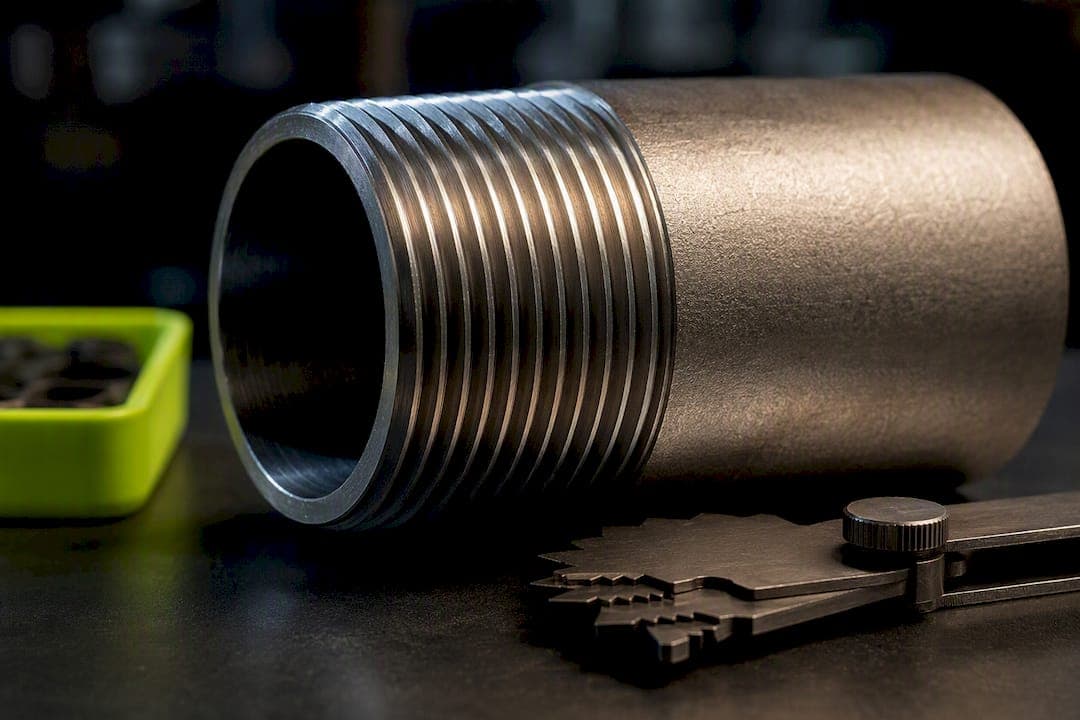
NPT (National Pipe Taper) is the ASME B1.20.1-defined tapered pipe thread with a 60° thread angle and a 1:16 taper on diameter, or 3/4 inch per foot. That taper, roughly 1°47′ measured on the diameter, is what creates the mechanical wedge fit between mating parts. Because metal-to-metal contact alone rarely holds pressure reliably, most NPT joints need a sealant like PTFE tape or pipe dope unless you're running dryseal NPTF threads instead.
TL;DR:
- Larger nominal pipe sizes like 1 inch feature coarser threads, with TPI decreasing from 18 to 11.5 as diameter increases to maintain strength.
- NPT seal relies on thread deformation and requires supplementary sealants like PTFE tape or dope unless using NPTF dryseal threads, which create a metal-to-metal seal.
- Precise dimensioning, including specifying gage class and sealant requirements, is essential on drawings to prevent rework and leaks during assembly.
- Machining NPT threads involves tapping after drilling and reaming, with thread-milling preferred for tight tolerances or interrupted threads to improve accuracy.
- Inspecting NPT threads with plug and ring gages involves checking taper, engagement, and truncation to ensure proper sealing and fit within ASME standards.
What Is NPT Thread Design and Why Does the Taper Matter?
ASME B1.20.1 is the governing document for general-purpose pipe threads in the United States, and it's the standard you cite on any drawing calling out NPT. It defines the thread form down to the flank angle, the crest and root truncation, and a reference point called the gauge plane, which marks where the pitch diameter matches its basic value. That plane is the anchor for two engagement stages engineers reference constantly: E0, the theoretical hand-tight position, and E1, the pitch diameter one turn further in, roughly where a wrench-tight, sealed joint should land.
The taper itself is defined at 1:16 on diameter, which works out to 3/4 inch per foot of length, or an included angle of about 1°47′. Combined with the 60° thread angle and 30° flank angles, this geometry is what lets an external and internal NPT thread wedge together tighter as you turn, rather than just spinning to a stop like a straight thread.
On a drawing, NPT gets called out with nominal pipe size, threads per inch, and the series symbol, formatted like 3/8-18 NPT. Add an "LH" suffix for left-hand threads, such as 1/8-27 NPT-LH. Some shops prefer decimal notation (0.375-18 NPT) when the fraction risks misreading on a CAD export, and ASME B1.20.1 accepts both.
NPT Thread Dimensions and Tap Drill Sizes by Nominal Pipe Size
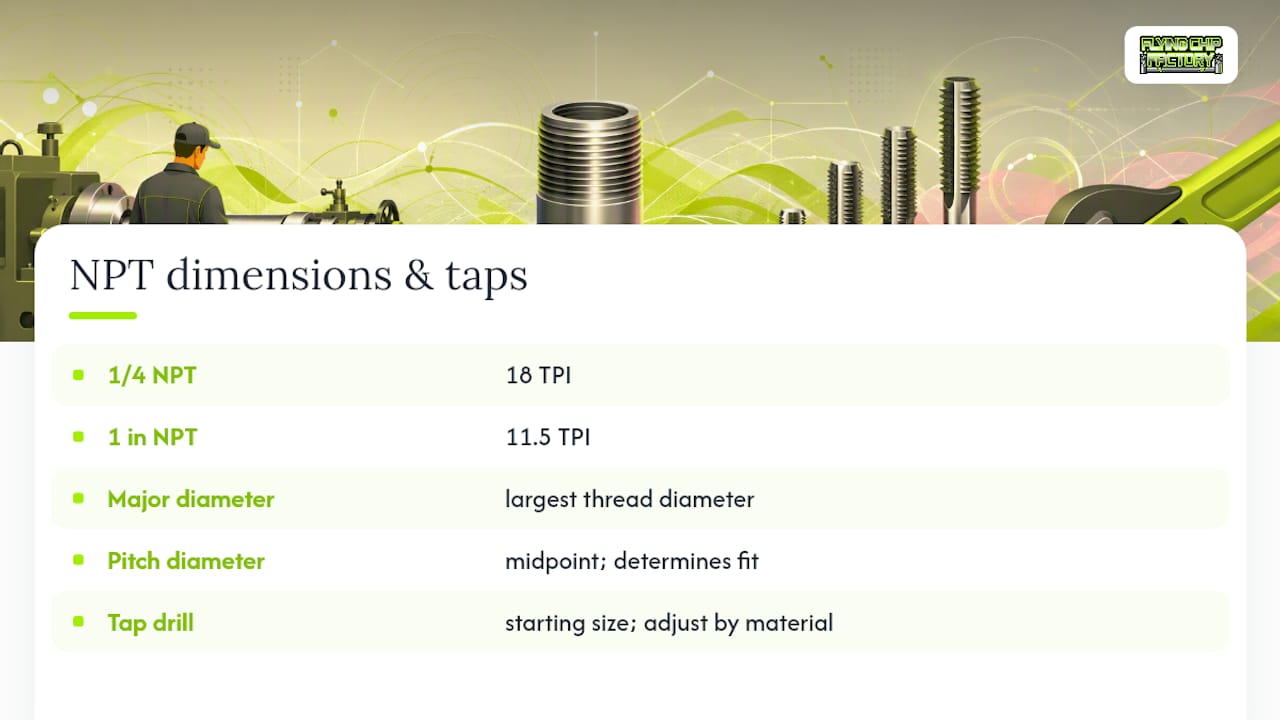
Threads per inch (TPI) drops as nominal pipe size increases, which surprises people who expect a smooth linear relationship. It doesn't work that way. A 1/4-18 NPT thread has 18 threads per inch, while a 1-inch NPT thread drops to 11.5 TPI, because larger diameters need coarser, deeper threads to maintain proportional strength and sealing engagement.
The table below covers the sizes machinists run most often in fixtures, fittings, and fluid-power assemblies. Every dimension traces back to ASME B1.20.1's dimensional charts, and the tap drill column reflects standard recommendations from Engineers Edge.
Major diameter is the largest thread diameter, measured at the gauge plane. Pitch diameter sits at the theoretical midpoint between crest and root, and it's the dimension that actually determines whether two mating NPT parts will seat correctly at the right depth. Minor diameter, the root of the external thread or crest of the internal one, isn't listed here because it's rarely the dimension a machinist checks on the floor. Hand-tight engagement is how far the parts should thread together by hand before you reach for a wrench.
Treat every tap drill figure as a starting point, not gospel. Aluminum, stainless, and cast iron all behave differently under a tap, and thread percentage targets shift accordingly. A drill that produces a clean 75% thread in mild steel might tear or gall in 304 stainless, so shops running production volume typically dial in their own drill size after a few test parts.
How Does an NPT Thread Actually Seal a Joint?
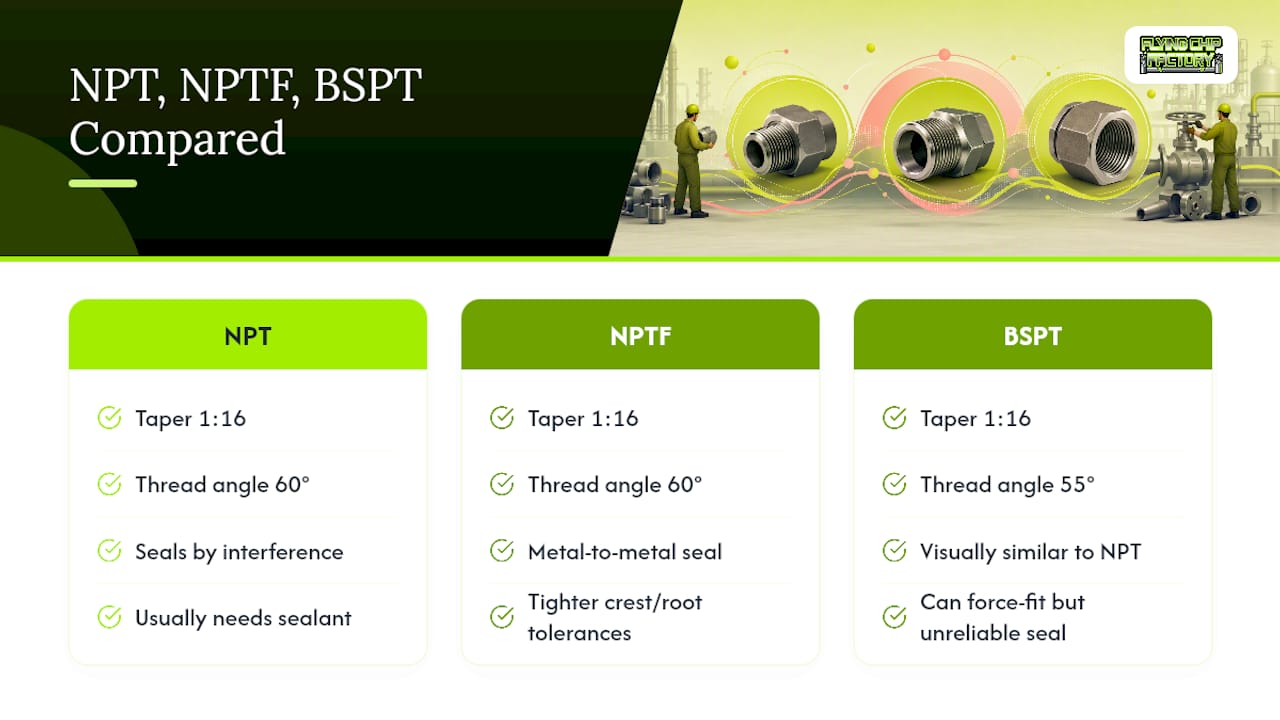
NPT doesn't seal the way a gasketed flange does. It seals through interference. As you thread two tapered parts together past hand-tight, the flanks of the male and female threads deform slightly against each other, and that mechanical wedging is what resists pressure. In practice, that deformation alone rarely produces a perfect metal-to-metal seal, so most NPT joints rely on a sealant such as PTFE tape or an anaerobic pipe dope to fill the microscopic gaps between crest and root.
Where you can't tolerate tape or dope contamination in the line, dryseal NPTF threads solve the problem differently. NPTF uses the same 60° angle and 1:16 taper but tightens the crest and root truncation tolerances so the crests of one part collapse into the roots of the other, creating a metal-to-metal seal without sealant. NPT and NPTF taps are not interchangeable, and mixing an NPT male with an NPTF female (or vice versa) is a common source of leaks that gets blamed on "bad tape" when the real issue is thread-form mismatch.
BSPT (British Standard Pipe Taper) looks similar at a glance and confuses people constantly. It shares the same 1:16 taper, but its thread angle is 55°, not 60°. That five-degree difference in flank geometry means an NPT male fitting can sometimes force itself into a BSPT female thread with enough torque, but the seal will be unreliable and the mismatch stresses both parts. If your assembly touches European or Asian-sourced fittings, verify the standard before you spec a mating part. A closer look at how NPT and BSP threads differ is worth a read before you commit a drawing to production.
Assembly practice matters as much as the parts themselves. Hand-tighten first to confirm proper engagement, then use a wrench for one to three additional turns depending on size, per the manufacturer's torque guidance. Overtightening past that point doesn't improve the seal. It cracks fittings, galls threads, and turns a five-minute fix into a scrapped part.
How to Specify NPT Threads on Drawings and Purchase Orders
Ambiguous thread callouts cause more rework than almost any other drawing error. The fix is a consistent, complete designation every time.
- Use the full format: nominal size, TPI, series symbol, and hand designation, such as 3/8-18 NPT or 1/8-27 NPT-LH for left-hand.
- Switch to decimal equivalence (0.125-27 NPT) when a vendor's CAD system or CNC post-processor has a history of mangling fractional callouts.
- Reference ASME B1.20.1 directly on the print, along with the required gage class, so an inspector knows exactly which tolerance band applies.
- State explicitly whether the joint requires sealant, or whether NPTF dryseal threads are mandatory, since this single line prevents an entire category of field failures.
- Call out material, plating or coating, and any torque limit for final assembly, especially on parts going into pressure or vibration-heavy service.
Leaving any of these off a drawing shifts the decision to whoever is running the machine that day, and that's how you end up with three different vendors interpreting the same print three different ways.
Machining NPT Threads: Drill, Ream, Tap, or Thread-Mill?
Cutting a clean NPT thread comes down to picking the right process for your tolerance, material, and hole geometry. Here's the general sequence a shop follows for internal threads:
- Drill the starting hole using a standard tap drill size, such as 7/16" for 1/4-18 NPT or 23/32" for 1/2-14 NPT, per Engineers Edge tap-drill data. Adjust down slightly in softer materials or up slightly in materials prone to spring-back.
- Ream with a tapered reamer when concentricity and taper accuracy actually matter, rather than relying on the tap to correct an undersized straight hole. Drilling one size under and reaming to the tapered profile reduces stress on the tap and extends tool life significantly.
- Calculate blind-hole depth carefully. The effective thread length (L2) isn't the whole story. You also need clearance for vanish and washout threads at the tap's lead end, or the tap bottoms out before it finishes cutting full-form threads, and chips have nowhere to go. Ignoring this is one of the most common sources of scrapped blind-hole parts in shops running NPT for the first time.
- Tap with proper lubrication and speed control. Rigid tapping works well in most ductile materials, but brittle or high-strength alloys benefit from slower spindle speeds and cutting oil rated for tapping, not general-purpose coolant.
- Consider thread-milling for interrupted threads or tight concentricity callouts. Thread-milling gives you more control over taper accuracy than tapping, especially on parts where the thread axis has to align precisely with another feature.
Pro Tip: When a part's function depends on tight concentricity between the NPT thread and another bore or face, don't trust a tap alone to hold that relationship. Ream the taper first with a dedicated tapered reamer, or thread-mill the feature on the same setup as the reference surface. It costs a little more setup time and saves you a batch of parts that leak on the test bench.
For deeper detail on planning blind-hole depth, see this breakdown of drill, depth, and tap choice, and for a direct comparison of when milling beats tapping, this shop-level guide walks through the tradeoffs.
How Are NPT Threads Gaged and Inspected?
Inspectors check NPT threads with plug gages for internal threads and ring gages for external threads, both built around the L1 engagement standard defined in ASME B1.20.1. The gage threads into the part, and the number of turns it takes to reach the gauge plane, either flush, one turn large, or one turn small, tells you whether the part is within tolerance.
Beyond basic go/no-go engagement, inspectors watch a handful of specific factors: taper accuracy across the full thread length, crest and root truncation (critical for NPTF dryseal parts especially), and lead angle consistency, since a wandering lead throws off the seal even when diameters check out fine. The ASME B1.20.1 appendices detail the full turns-of-engagement gaging method and acceptable variance.
A part that gages one full turn small typically gets reworked if there's material to remove, or rejected if the thread is already at minimum wall thickness. One turn large from wear or an oversized tap usually means scrap, since there's no practical way to add material back to a tapped hole. Getting this right the first time is far cheaper than catching it at final inspection.
Where Did the NPT Thread Standard Come From?
NPT traces back to the mid-1800s and William Sellers, whose uniform thread system for the United States eventually evolved into the pipe thread standards American industry still uses. Pipe threads needed something straight threads couldn't offer: a way to seal against pressure without a separate gasket, using nothing but metal deformation and a wedge fit. The taper design solved that problem directly, and it became the basis for what eventually formalized into ASME B1.20.1.
The standard has been revised multiple times since, refining gaging methods, tolerance bands, and the distinction between NPT and its dryseal cousin NPTF, which emerged later specifically for aerospace and hydraulic applications where sealant contamination in the line wasn't acceptable. What's notable is how little the core geometry has changed. The 60° angle and 1:16 taper that define NPT today are essentially the same numbers that defined it generations ago, because the physics of a tapered wedge seal hasn't changed even as manufacturing tolerances have gotten tighter.
That stability is part of why NPT remains dominant in North American piping and fitting design despite plenty of competing standards developed since. A fitting made to spec decades ago still threads correctly into a part cut on a modern CNC machine today, provided both sides respect the same ASME B1.20.1 geometry.
Where Is NPT Thread Design Used Most?
NPT shows up anywhere a threaded connection needs to hold pressure without a separate gasket. Plumbing and HVAC systems use it constantly for water lines, gas lines, and fitting connections, where a plumber wrapping PTFE tape around a fitting is applying the exact sealant principle this thread form depends on.
Hydraulic and pneumatic systems lean on NPT heavily too, particularly in fluid-power assemblies, cylinders, and valve bodies where pressure ratings can run into the thousands of psi. Compressed air tooling, fuel systems, and lubrication lines in industrial machinery all use NPT fittings for the same reason: the taper seals reliably across a wide range of vibration and thermal cycling conditions.
Automotive and small-engine applications use NPT for sensor ports, oil pressure fittings, and coolant lines, often in smaller sizes like 1/8-27 or 1/4-18. Powersports and off-road equipment, including the electric mini dirt bike platforms Flying Chip Factory builds parts for, occasionally need custom brackets or fixtures with NPT ports for sensors or fluid lines, which is exactly the kind of prototype work a small CNC shop handles well.
Oil and gas, aerospace ground support, and general industrial equipment round out the list, though aerospace fluid systems often specify NPTF dryseal threads specifically to eliminate sealant as a contamination risk in critical lines.
NPT vs. Metric and Other Thread Standards
NPT isn't the only pipe thread standard in circulation, and confusing it with a lookalike is one of the most expensive mistakes a buyer can make. ISO metric pipe threads, most commonly ISO 7-1 (parallel) and ISO 7-2, use a completely different profile than NPT: a 55° thread angle inherited from the British Standard Pipe family, measured in metric pitch rather than TPI, and typically specified as parallel (straight) rather than tapered. A G1/2 ISO fitting and a 1/2-14 NPT fitting are not interchangeable under any circumstance, despite looking similar to an untrained eye.
Straight thread series within the ASME system itself, NPSC, NPSM, and NPSL, add another layer of confusion because they share ASME B1.20.1's parent document but serve mechanical or non-sealing purposes rather than pressure-tight joints. NPSM, for example, is often used for mechanical fastening where an O-ring or gasket handles the actual sealing, not the thread form.
Metric fine and coarse fastener threads, governed by ISO 261 and related standards, are a different category entirely, designed for clamping force rather than fluid sealing, and shouldn't be confused with metric pipe threads even though both use metric dimensions.
The practical takeaway: never assume compatibility based on thread pitch or diameter looking close on a caliper. Confirm the actual standard called out on the print, and if a supplier drawing doesn't specify one, ask before you cut metal.
Why Do NPT Joints Fail, and How Do You Fix Them?
Leaking is the complaint you'll hear most, and it's almost always one of three causes: insufficient engagement, damaged threads, or the wrong sealant for the application. A joint that's only hand-tight, or that stopped short of the proper wrench-tight turns, simply hasn't developed enough interference to seal. The fix is straightforward: disassemble, inspect the threads for damage, reapply sealant, and reassemble to the correct engagement depth.
Galling and seizing show up most often in stainless steel and other work-hardening alloys, where thread flanks cold-weld together under torque. Anti-seize compound rated for the material in question, applied before assembly, prevents most of this. Once a joint has galled, it usually needs to be cut off and remade rather than salvaged.
Cracked fittings, especially in cast iron or brittle plastics, almost always trace back to overtightening. NPT's wedge geometry means torque keeps increasing the tighter you go, and there's no natural stopping point the way there is with a straight thread against a shoulder. Following manufacturer torque specs, rather than tightening until it "feels right," avoids this entirely.
Cross-threading during assembly, particularly with plastic or soft-metal fittings, is a startup problem more than a design flaw. Starting the joint by hand and confirming smooth engagement before applying a wrench catches this before it becomes a scrapped part.
Best Materials and Coatings for NPT Fittings
Material choice for NPT fittings depends heavily on the service environment. Brass remains a common choice for water and low-pressure pneumatic lines because it machines cleanly, resists corrosion reasonably well, and doesn't gall against most mating materials. Stainless steel, typically 303 or 316, handles corrosive fluids, higher pressures, and outdoor exposure, though 316 in particular is prone to galling without anti-seize compound during assembly.
Carbon steel fittings, often galvanized or black-oxide coated, show up in industrial piping where cost matters more than corrosion resistance and the environment is relatively controlled. For fluid-power and hydraulic applications, plated steel, usually zinc or zinc-nickel, balances cost against a reasonable service life in most indoor industrial settings.
Aluminum NPT fittings turn up in weight-sensitive applications like small engine and powersports components, though aluminum's softer thread flanks make it more prone to stripping under repeated assembly and disassembly cycles, so anodizing or a hard coating helps extend service life in high-cycle applications.
Coating choice matters as much as base material. PTFE-based dry-film coatings reduce galling risk on stainless fittings without changing dimensional tolerances the way plating can. Nickel plating adds corrosion resistance for marine or chemical exposure, while simple black oxide offers a low-cost option for indoor, low-corrosion environments where appearance and minor rust prevention are the main concerns.
How Do Temperature and Pressure Affect NPT Thread Performance?
Thermal cycling is where a lot of NPT joints reveal problems that never showed up in a static pressure test. As a fitting heats and cools, differential expansion between dissimilar materials, say, a steel fitting into an aluminum housing, can loosen the mechanical interference that makes the seal work in the first place. This is especially relevant in engine and exhaust-adjacent applications, where a joint that seals perfectly at room temperature can start seeping once it cycles through a few hundred degrees repeatedly.
High-pressure service pushes harder on thread engagement depth and material selection. A joint sized correctly for 100 psi water service isn't automatically adequate for 3,000 psi hydraulic pressure, even if the NPT designation looks identical on paper. Higher pressure applications generally call for fuller thread engagement, verified sealant compatibility, and often a higher-strength base material to prevent the tapered wedge from deforming under sustained load.
Sealant choice needs to match the temperature range too. Standard PTFE tape has a practical upper limit, and pushing past it, in exhaust systems or high-temperature process piping, calls for a sealant or dryseal NPTF approach rated for that range specifically. Mismatching sealant to temperature is a quiet failure mode that often doesn't show up until months into service, long after the assembly team has moved on to other work.
The Shop Perspective on NPT Design
Most NPT problems Flying Chip Factory sees in prototype and short-run work aren't design failures. They're execution gaps between what a print calls out and what actually gets machined. A drawing that says "1/4-18 NPT" without specifying gage class or sealant requirement leaves too much room for interpretation on the shop floor.
When precise concentricity matters, or the alloy is difficult, thread-milling or tapered reaming beats a straight tap-and-drill approach every time, even though it takes longer to set up. Quotes move faster when a customer includes nominal size, TPI, material, and required gage class upfront rather than a bare thread callout. That single detail cuts revision cycles dramatically on custom fixture and bracket work.
— Drake
Get NPT-Threaded Parts Machined Right the First Time
Flying Chip Factory is the direct route to correctly machined NPT parts without the back-and-forth of a broker or sales layer between you and the person actually cutting the metal. Every prototype, fixture, or short-run job is designed and machined in the same shop, with direct access to the machinist for quick revisions when a print needs clarifying or a gage check comes back borderline.

If you're sourcing a custom fixture, bracket, or fitting with an NPT port, a quote request moves fastest when you include the nominal pipe size, TPI, material, and required gage class upfront, along with whether the application needs sealant or a dryseal NPTF thread instead. Riders and small manufacturers alike can also see the shop's machining and design approach in action on the E2 Kickstand for KTM SX-E 2, GASGAS MC-E 2 and Husqvarna EE 2, a bolt-on part designed and CNC-machined in-house. Pricing details are available on the product page. For prototype machining, short-run production, or custom fixtures and support parts, start a quote at the Flying Chip Factory machining page.
Sources
- NPT (National Pipe Taper) threads - EngineeringToolBox
- Pipe Tap and Drill Size Chart — Engineers Edge
- Tap Drill Charts | National Pipe Threads — Allied Machine
FAQ
How Do I Specify NPT Threads on Drawings?
Use the full designation format: nominal size, threads per inch, and series symbol, such as 3/8-18 NPT, with an "LH" suffix for left-hand threads. Reference ASME B1.20.1 directly and note the required gage class and whether sealant or NPTF dryseal is mandatory.
Are NPT Threads Tapered or Straight?
NPT threads are always tapered, at a rate of 1:16 on diameter, or 3/4 inch per foot. Straight pipe thread series like NPSC and NPSM exist under the same ASME document but serve mechanical or non-sealing purposes rather than pressure-tight connections.
How Many Threads Are in 1/4-Inch NPT?
A 1/4-inch NPT thread has 18 threads per inch. TPI varies by nominal size, ranging from 27 TPI on the smallest sizes down to 8 TPI on the largest sizes.
How Do You Identify NPT Threads on an Unmarked Part?
Check the thread angle and taper first. A 60° included angle with a visible taper along the thread length points to NPT, while a 55° angle suggests BSPT, and a straight, non-tapered thread rules NPT out entirely. A thread gage or caliper measurement against a known chart, or a plug/ring gage check per ASME B1.20.1, confirms it definitively when visual inspection isn't conclusive.
What Does Flying Chip Factory Charge for NPT-Threaded Parts?
Pricing depends on the part, material, and quantity, so prototype and short-run machining quotes are available on request through the Flying Chip Factory site. The in-house E2 Kickstand, a fixed example product rather than a custom quote, is priced at $100 to $105 on the product page.