
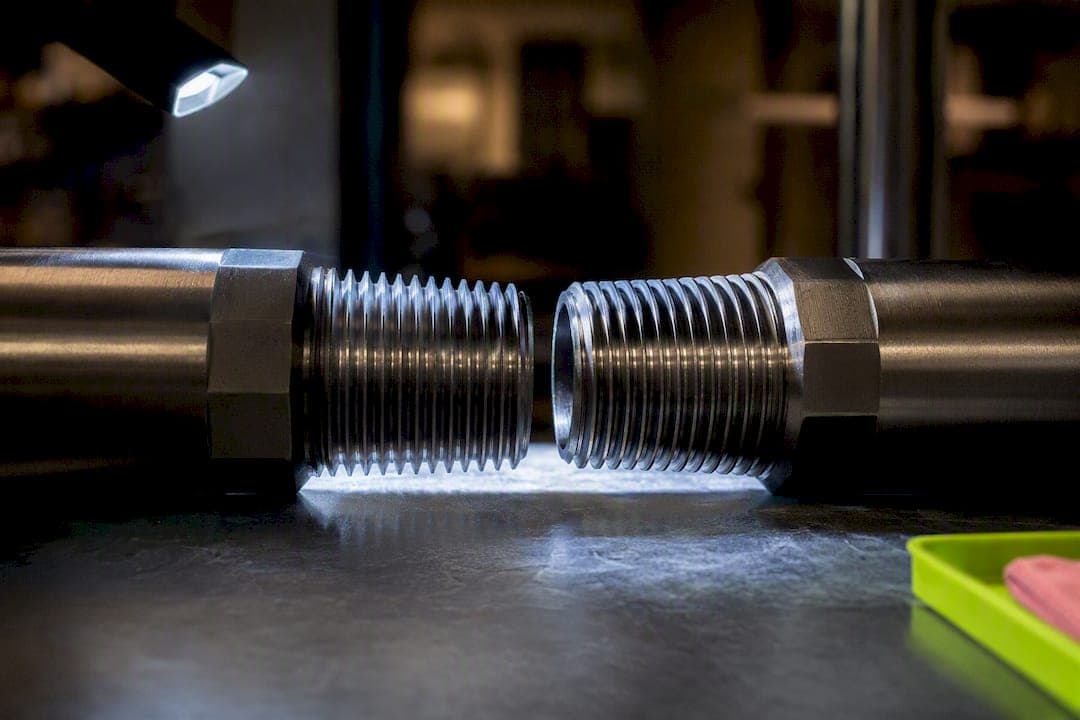
NPTF is the dry-seal version of tapered pipe thread, built to form a metal-to-metal interference fit that closes off the spiral leak path without compound. NPT is the general-purpose thread most people picture when they hear "pipe thread," and it's designed to seal with the help of PTFE tape or pipe dope. If your application can't tolerate sealant residue, or your shop already has the gauging to verify dryseal geometry, specify NPTF. Otherwise, NPT with proper sealant does the job.
TL;DR:
- NPTF creates a precise interference fit by controlling crest and root dimensions, requiring more rigorous inspection and matching parts, unlike the looser NPT fit.
- Sealing with NPTF depends on both mating parts meeting tight tolerance standards; mixing NPTF with NPT often leads to leaks or cracks.
- Assembly of NPTF joints benefits from light lubrication to prevent galling, especially on stainless steel, and a proper torque plus pressure testing ensures a reliable seal.
- Gauging NPTF threads needs L2 and L3 inspection tools to verify the critical dimensions, as visual checks and standard gauges are insufficient.
- For critical dryseal applications, specifying gauged NPTF to strict standards and confirming media compatibility reduces the risk of leaks and failure.
What Are NPT and NPTF, Exactly?
NPT stands for National Pipe Taper, governed by ASME B1.20.1. NPTF stands for National Pipe Taper Fuel, governed by ASME B1.20.3, which is why machinists often just call it "dryseal." Both threads were built on the same skeleton, then diverged where it mattered for sealing performance.
Here's what they have in common, and where they split:
- Both use a 60-degree thread angle and a 1:16 taper.
- Both share identical pitch values for a given nominal size.
- NPTF tightens root and crest tolerances so mating parts create an interference fit instead of a clearance fit.
- NPTF requires more rigorous inspection because sealing performance depends on precise crest and root positioning, not just thread depth.
That last point is the one most engineers miss on a drawing. NPT tolerates more variation because it was never meant to seal on thread contact alone. NPTF was engineered specifically to close that gap.
How Dryseal Geometry Actually Closes the Leak Path
Standard NPT threads have flattened crests and roots, which leaves a small clearance where the male and female crests don't fully contact the opposite root. That clearance is exactly where a fluid finds a spiral path out, which is why NPT depends on sealant to fill it. NPTF eliminates that gap by controlling crest and root truncation so the male crest is slightly larger and the female root slightly smaller, forcing an interference fit as the threads engage.
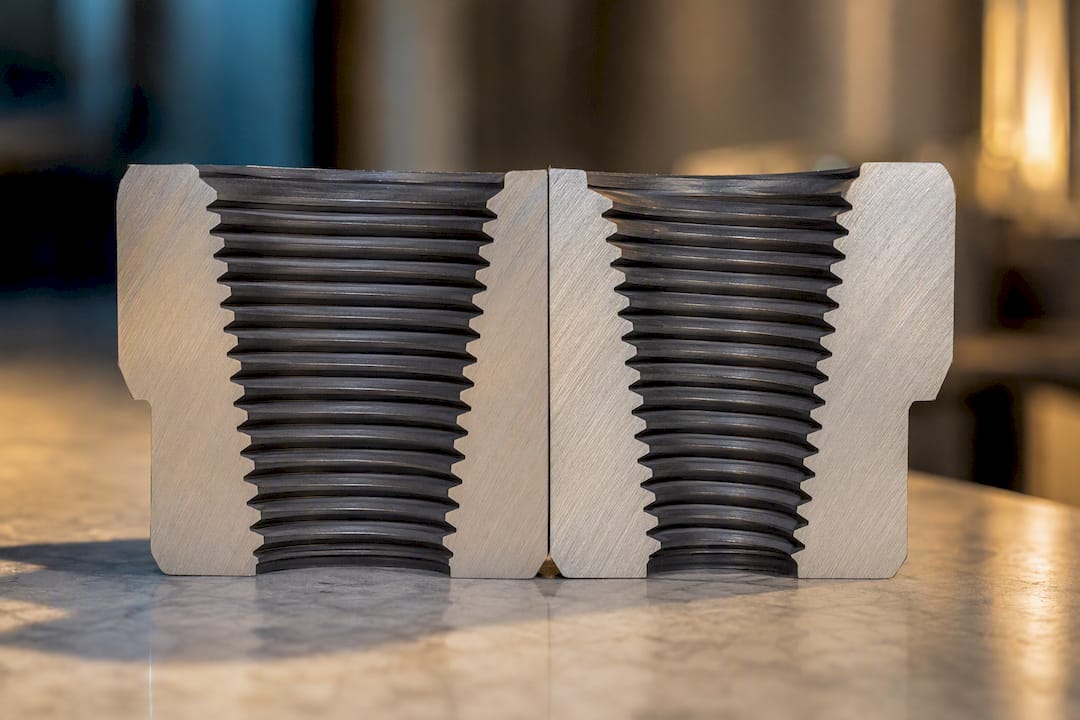
During tightening, that interference isn't just contact, it's controlled deformation. The crest displaces into the root material under torque, which is why surface finish and dimensional tolerance matter more here than on almost any other thread type a shop cuts. A rough or out-of-tolerance crest won't deform predictably, and the seal fails exactly where a standards document says it shouldn't.
A few practical notes worth knowing:
- Interference only develops correctly when both mating parts meet NPTF tolerance, not just one.
- Coarse surface finish increases the odds of micro-leak paths even on a properly gauged NPTF part.
- Material hardness affects how cleanly the crest deforms during assembly.
Pro Tip: Even a textbook-perfect NPTF joint benefits from a light lubricant on assembly. Dry metal-to-metal contact under torque is exactly the condition that causes galling, especially on stainless steel, and a seized fitting is a worse problem than a trace of sealant.
Can You Mix NPT and NPTF Threads in the Field?
The intended pairing is NPTF-to-NPTF, since that's the only combination engineered to produce the full interference fit both halves depend on. A common field substitution pairs an NPTF male with an NPSF female, which is a straight (non-tapered) dryseal thread, and it works but without the same interference characteristics as a matched taper pair.
Mixing NPT and NPTF is where most leak complaints originate, because the geometry assumptions on each side don't match. NPT expects clearance and sealant; NPTF expects interference and none. Torque a mismatched pair to NPT specs and the NPTF side may never seat correctly. Torque it to NPTF expectations and you risk cracking a fitting rated for standard NPT tolerances.
If mixing is unavoidable, here's a practical order of operations:
- Identify which side is NPT and which is NPTF before assembly, not after a leak shows up.
- Always add PTFE tape or compound when NPT is one half of the pairing, even if the other side is NPTF.
- Inspect for thread damage before assembly. A dinged crest on either side defeats the seal regardless of thread type.
- Avoid mixing on high-pressure or fuel lines where a marginal seal isn't an acceptable risk.
- When in doubt, re-cut or replace one side rather than force a questionable fit.
Sealing Methods: Tape, Compound, and When to Skip Both
NPT almost always needs PTFE tape or pipe dope, since the standard was never designed to seal on thread contact alone. NPTF is designed to dry-seal, but tape or joint compound is still recommended in a lot of real-world assembly as a lubricant and a backup margin, not a crutch for bad geometry.
A few things that separate a clean install from a leaker:
- Wrap PTFE tape in the direction of the threads (clockwise when viewed from the pipe end) so it doesn't unravel during tightening.
- A small number of wraps is typically enough; more than that just adds bulk that can throw off torque feel.
- On stainless fittings, treat tape as galling prevention as much as sealant. Dry metal-to-metal assembly on stainless is a real risk, and a light lubricant reduces that risk on dryseal threads too.
- Torque to hand-tight plus one to two turns past finger-tight, then check for leaks under actual working pressure, not just a quick air test.
Pro Tip: On fuel and gas systems, contamination risk from certain pipe dopes is a real concern. Confirm your sealant is rated for the specific media before it goes anywhere near a fuel line, and never assume a general-purpose compound is safe just because it seals well on water lines.
Temperature swings and vibration both work against a marginal seal over time, which is another reason shops lean on a backup sealant even on threads that are technically designed to work without one.
Inspection and Gauging: Why NPTF Demands More Scrutiny
L1, L2, and L3 gages exist because NPT and NPTF need different levels of verification. A basic L1 ring or plug gage checks thread engagement depth on standard NPT, which is usually enough since the thread isn't relying on tight crest and root tolerances to seal. NPTF needs L2 and L3 gaging on top of that because sealing performance depends on precise major and minor diameter control, not just "does it thread in far enough."
A few notes for anyone specifying or producing these parts:
- Taps rated for NPTF can generally cut an acceptable NPT thread, but the reverse isn't reliable for seal-critical parts.
- Surface finish directly affects sealing performance on NPTF; a tap that's dull or chattering will produce a thread that looks fine but doesn't seal.
- Any visible thread damage, even a single nicked crest, is enough to compromise a dryseal joint that passed gauging before the ding happened.
Shops that cut both thread types regularly keep separate go/no-go gage sets for exactly this reason. Guessing based on visual inspection alone is how marginal parts slip through. For a deeper look at how shops verify thread geometry before parts ship, see this breakdown of go/no-go gauge specs.
A Quick Checklist for Specifying NPT vs NPTF
Before a drawing goes out for quote, run through this list:
- What's the media, and can it tolerate sealant residue or contamination risk?
- What's the working temperature and pressure range, and does it exceed typical field-seal margins?
- Does the application demand a dry, compound-free seal, or is standard sealant acceptable?
- Does your supplier have L2/L3 gaging capability if you're specifying NPTF?
- What's the mating material, and does it carry galling risk during dry assembly?
- Are installation conditions (access, torque control, inspection after assembly) realistic for the thread type you're specifying?
A sample line you can adapt for a drawing or purchase order: "Thread per ASME B1.20.3 (NPTF), dryseal, gauged to L2 minimum, certification required." Swap in B1.20.1 for standard NPT work where sealant is expected.
For critical dryseal joints, don't take a supplier's word on gauging. Ask for the inspection data with the parts, not after a failure shows up downstream. If you're also weighing NPT against other thread standards on an international job, this comparison of NPT and BSP threads covers the cross-standard traps worth knowing before you finalize a spec.
What Flying Chip Factory Sees on the Shop Floor
Drake's coverage of thread specification, including a spec-ready comparison of NPT and BSP threads, comes out of the same shop floor that machines these parts daily. Dryseal theory holds up in a controlled environment. What it doesn't account for is a dinged crest, a rushed install, or a gage that hasn't been checked in a year. That's why Flying Chip Factory tends to recommend the conservative option, sealant included, unless the application genuinely demands otherwise.
— Drake
Get Threaded Parts Machined and Verified to Spec
Getting NPT or NPTF geometry right on paper is one thing. Getting it right in metal, on a deadline, with gauging to prove it, is the actual job. Prototype and short-run CNC machining services offer direct access to the machinist cutting your parts, so a tolerance question doesn't sit in a queue for a week.

Services include thread production to ASME B1.20.1 or B1.20.3, fixture and replacement part fabrication, and inspection support to verify dryseal tolerances. Send over your print, call out the standard and gaging requirement, and get a quote back fast. Start at Flyingchipfactory to request a quote or talk through your spec directly with the shop.
FAQ
Are NPT and NPTF Interchangeable?
Not reliably. They share the same angle, taper, and pitch, but NPTF's tighter crest and root tolerances create an interference fit that a standard NPT part isn't built to match, so mixing them risks a marginal or failed seal.
What Does the F Stand for in NPTF?
The F stands for Fuel. NPTF is short for National Pipe Taper Fuel, reflecting its original design purpose as a dry-sealing thread for fuel and fluid systems.
How Can You Tell the Difference Between NPT and NPTF?
Visually they look nearly identical, so the reliable method is gauging: NPTF requires L2 and L3 ring or plug gages to verify crest and root position, while standard NPT typically only needs an L1 check.
What Does NPTF Stand For?
NPTF stands for National Pipe Taper Fuel, the dryseal thread standard defined by ASME B1.20.3 for metal-to-metal sealing without compound.