
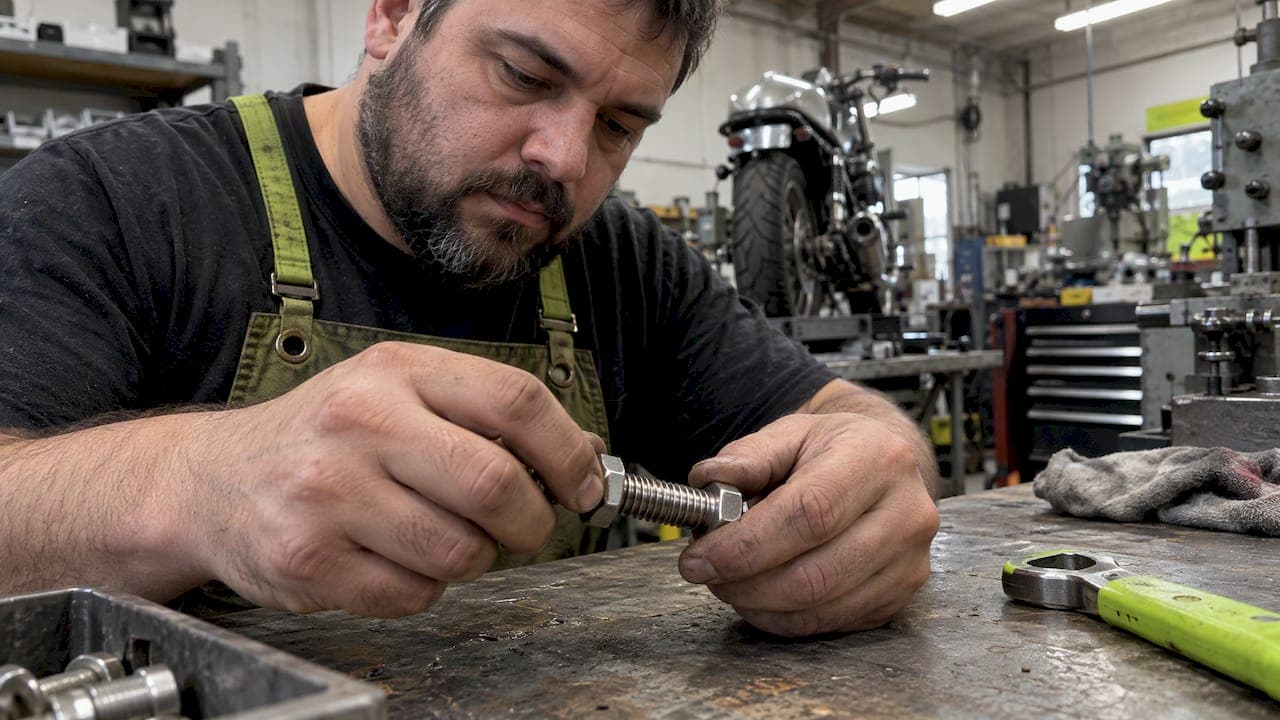
Thread galling is prevented by cutting the heat and pressure at the thread interface: install slowly with hand tools, keep threads clean and burr-free, put a lubricant or anti-seize on them, and avoid mating identical alloys. If you do only one thing, stop running stainless fasteners in with an impact driver. If you do two, add a compatible anti-seize and correct your torque for it.
This guide is written from a machine shop's point of view. We cut threads, make brackets and fixtures, and build motorcycle parts, so we see galled fasteners from both sides: as the person who made the part and as the person who has to get it apart again.
TL;DR
- Galling is cold welding between mating threads. It comes from pressure, friction heat and surfaces that rely on a thin oxide film, which is why stainless, titanium and aluminum are the usual victims.
- Slow down. Fast installation with a power driver generates heat at the thread contact points, and heat is what starts the weld.
- Use a hardness gap of at least 50 Brinell between nut and bolt, or a different grade or alloy on each side, and add a lubricant or anti-seize.
- Lubricated threads reach higher clamp load at the same torque. Never use dry torque values on an anti-seized joint.
- Inspect and deburr threads before assembly. Dirty, rough or damaged threads gall far more often.
What galling is, and why it feels like a thread "seized"
Galling, often called cold welding, happens when high points on mating thread surfaces under pressure break through protective oxide layers and fuse together from frictional heat. Materials that depend on a self-healing oxide film, such as stainless steel, titanium and aluminum, are the most common cases.
The sequence is easy to recognize once you have felt it:
- The bolt runs in smoothly for several turns.
- Torque climbs sharply well before the joint is clamped, or the bolt suddenly gets stiff.
- You push harder or switch to a power tool. The microscopic welds tear, which makes more rough surface and more heat.
- The fastener stops. Backing it out either strips material off the threads or snaps the bolt.
The key point is that galling is not rust and it is not thread damage from corrosion. It is an adhesive wear problem. That is why a brand-new, clean stainless bolt in a brand-new stainless nut can seize on the first assembly.
The four conditions that cause it
Every galling failure we see traces back to some mix of these.
Pressure
The surface pressure at the thread flanks is what pushes metal through the oxide layer. Reducing that pressure, by increasing contact area or reducing load, lowers galling risk. In practice this means full thread engagement, good thread fit and not over-tightening.
Heat
Speed matters more than most people expect. Fast assembly with power tools can build heat faster than the fastener sheds it, and heat accelerates the cold weld. Engineering guidance from fastener specialists lists high installation speed among the known factors that raise the share of threads that gall.
Matched materials
Identical alloys on both sides of the joint are the classic trap. A stainless nut on a stainless bolt of the same grade has the same hardness and the same surface chemistry, so the surfaces have no tendency to resist one another. The process is made worse by using the same alloy for both nut and bolt.
Rough, dirty or damaged surfaces
Debris in the thread, burrs from cutting, and reused fasteners all raise friction. Soft connection elements and rough surfaces sit on the same list of risk factors.
Step-by-step: how to prevent galling during assembly
1. Inspect and clean the threads
Wipe both parts. Look at the threads with a magnifier. A practical check from the engineering FAQs is the cloth-snag test: if a clean cloth snags on the threads, they are rough or damaged enough that you should treat or replace them before using them somewhere you can't easily get back to. Our experience matches that. A burr at the thread crest is a small thing that turns into a seized bolt.
One counterintuitive detail: very smooth, polished surfaces are not automatically safe. If a polishing process leaves tiny rough edges, the surface can gall more easily, so deburr before assembly.

2. Choose the material pairing on purpose
You have several options, in roughly the order we would consider them:
- Different hardness. The guideline in the ASSDA galling FAQ is a hardness difference of at least 50 Brinell between nut and bolt.
- Different grades. Using different stainless grades for bolt and nut reduces galling caused by matched hardness, though you need to check that the strength still meets the job.
- Galling-resistant alloys. Specialty stainless such as Nitronic 60 is designed for this, and the Nitronic route appears in most expert advice. It costs more and is not always available in the size you need.
- Surface hardening. Low-temperature carburizing treatments can raise austenitic stainless surface hardness dramatically, and are used where the base alloy cannot change.
As Laurence Claus argues in his fastener-industry paper, it is unreasonable to simply avoid stainless, because its corrosion resistance is so valuable. The job is to manage the risk, not to ban the material.
3. Lubricate or use anti-seize
This is the step most readers searching "anti seize for stainless" want. Yes, it works, and it is the single most common fix. Anti-seize compounds containing molybdenum disulfide, graphite, nickel or copper reduce friction between the threads.
Two examples of what is published for stainless service:
- A copper anti-seize data sheet describes a product made for stainless and similar alloys, rated from -30°F to 1800°F.
- A nickel-based anti-seize paste from Henkel is described as resisting galling and corrosion in heavy-pressure applications.
Apply a thin, even film on the male thread only, not a glob. Keep it off brake parts, friction surfaces and anywhere the manufacturer says no lubricant. Read the product's own limits: some pastes are not for oxygen service, some contain metals you may not want near certain alloys, and wet pastes can migrate or attract dirt.
Where a paste is the wrong tool, a dry film lubricant is the alternative. Coatings that meet MIL-PRF-46010 are used on threaded fasteners to prevent galling and control installation torque, and they do not drip or pick up contamination the way a paste does. That makes them a fit for clean environments and production parts you can send out for coating.
4. Correct your torque for the lubricant
This is where a good fix becomes a dangerous one. Published torque values assume a particular friction condition, usually dry or lightly oiled. When you add anti-seize, the same torque produces a higher clamp load, because less of your effort is lost to friction. Aviation service bulletin guidance states that if the threads are not in the specified condition, the correct preload will not be reached even though the torque value is reached.
The practical rules:
- If the manufacturer specifies a torque for dry threads and you add anti-seize, use the manufacturer's lubricated value if one exists. If none exists, ask the manufacturer or an engineer. Do not guess.
- If the manufacturer says to install without lubricant, don't add any.
- There is no universal torque number. It always depends on the friction of the specific thread interface.
Over-tightening a lubricated bolt can yield it, stretch it or strip the threads in a soft mating part, and none of that is visible until it fails. On safety-critical joints such as brakes, steering, suspension or anything that carries a rider, follow the factory service manual and, if you are unsure, ask a qualified mechanic.
5. Slow down and use hand tools
Run the fastener in by hand first to confirm it is not cross-threaded. Finish with a hand wrench or a torque wrench instead of an impact driver. Fastener-industry sources say that switching to hand tools lowers the temperature at the thread interface, and power drivers come up repeatedly as the main cause in galling incidents. If you must use a power tool, use a low speed setting and stop short of final tightening.
6. Avoid reusing fasteners where it matters
A thread that galled slightly last time is already damaged. If a stainless fastener felt rough on removal, replace it rather than gamble on it a second time.
Quick reference: which fix for which situation
| Situation | Best first move | Watch out for |
|---|---|---|
| Stainless bolt into stainless nut, general use | Different grades or hardness plus anti-seize on the bolt | Check strength of the lower-grade part |
| Stainless bolt into aluminum | Anti-seize and hand-tighten | Dissimilar-metal corrosion in wet conditions |
| High-temperature service | High-temperature nickel or copper anti-seize rated for the range | Stated temperature limit of the product |
| Clean environment or production runs | Dry film lubricant coating | Coating thickness and fit on fine threads |
| Frequently disassembled joint | Galling-resistant alloy or surface treatment | Cost and availability |
| Safety-critical joint | Follow the manufacturer's spec exactly | Lubricated versus dry torque values |
When not to use stainless fasteners at all
Stainless is not always the right answer. Stainless bolts are a poor choice in high-duty-cycle use, in high-temperature service, or where both mating parts must be the same stainless without lubrication or any hardness difference. In those cases, a zinc-plated or alloy-steel fastener, or a coated one, may do better. Choose stainless when corrosion resistance is the real requirement, not because it looks better.
How machinists prevent galling when making threaded parts
If you are specifying a part and not just assembling one, prevention starts on the drawing and in the shop.
- Specify thread class and finish. A well-formed thread with a clean finish gives lower friction than a torn one. Our guide on stainless steel machining covers why stainless work-hardens and tears if the tool rubs instead of cutting.
- Avoid a built-up edge. A built-up edge leaves a rough, smeared surface that raises friction. See our notes on built-up edge and rough finish.
- Get engagement right. Enough thread engagement spreads the load and lowers contact pressure. We explain our approach in thread engagement length.
- Passivate to a standard. Passivation restores the protective surface after machining. If you need it, call out the spec; see ASTM A967 for stainless passivation. Passivation helps corrosion resistance, but it is not a galling cure by itself, so don't count on it alone.
- Deburr every thread. Tool deflection and finish targets matter here too. Our tool deflection checks show how we hold finish on small features.
Our perspective
We machine parts for electric mini dirt bikes, and a kickstand is a good test of this subject. It is bolted on, it gets knocked, rained on, washed and removed by parents and kids who don't own a shop full of tools. A fastener that seizes is a ruined afternoon.
Our view, built on making parts and talking directly to the people who use them:
- Galling is a process problem more than a material problem. The same bolt is fine when installed by hand with a little lubricant and a disaster under an impact driver.
- Design it out where you can. Good threads, clean finishes and sensible material choices cost far less than extraction later.
- Lubrication is a trade, not a free fix. It protects the threads but changes the torque, so we tell customers to treat it as part of the fastening spec.
- On small bikes, the fastener should be easy to service with ordinary hand tools. That is how we think about installation of our parts: straightforward, no special equipment.
Our shop works this way because the person who designs and machines a part is the person you talk to. If a thread or fit question comes up, you get the machinist, not a ticket queue.
— Drake
Where our shop fits in
If you are building a prototype, a short production run or a fixture that has to survive repeated assembly, bring us the drawing and tell us the fastener and material pairing. We can machine the threads and surfaces with galling in mind, and you can iterate directly with the machinist. See our prototype, short-run and fixture machining services.
If you ride an electric mini bike, our E2 Kickstand is a CNC-machined bolt-on for the KTM SX-E 2, GASGAS MC-E 2 and Husqvarna EE 2, priced at $100–$105.
FAQ
What is galling in metal and how does it occur?
Galling is adhesive wear in which two sliding or tightening surfaces weld together at microscopic points. It happens when pressure and friction heat break through the oxide layer that normally protects metals like stainless steel, titanium and aluminum. Fast assembly, matched alloys and rough surfaces make it more likely.
Can you put anti-seize on threads?
Yes, and on stainless threads it is one of the most common ways to prevent galling. Apply a thin film to the male thread, and check that the product suits the metals and temperature involved. Remember that lubricated threads reach higher clamp load at a given torque, so don't use the dry torque value and follow the manufacturer's guidance.
Will aluminum gall on stainless?
It can. Aluminum also relies on an oxide film and is listed among the metals prone to galling. Anti-seize, slower hand installation and clean threads all help. In wet conditions, also consider the corrosion that can occur between dissimilar metals.
When should you not use stainless steel bolts?
Avoid them in high-duty-cycle or high-temperature service, and wherever identical stainless parts must mate with no lubricant or hardness difference. If corrosion resistance is not the main need, a plated or alloy steel fastener is often simpler. Where stainless is required, use different grades or hardness and lubricate.
Sources
- Thread Galling, The Blue Print (Fastenal)
- Laurence Claus, fastener galling paper (LINK, Spring 2021)
- Galling and Its Control (ASSDA FAQ 5)
- What is Galling? (TWI)
- Thread galling tech sheet (PEM)
- Permatex Copper Anti-Seize data sheet
- LOCTITE LB 771 (Henkel)
- Dry Film Lubricant MIL-PRF-46010 (Gleco)
- Torque limits service bulletin (NTSB docket)