
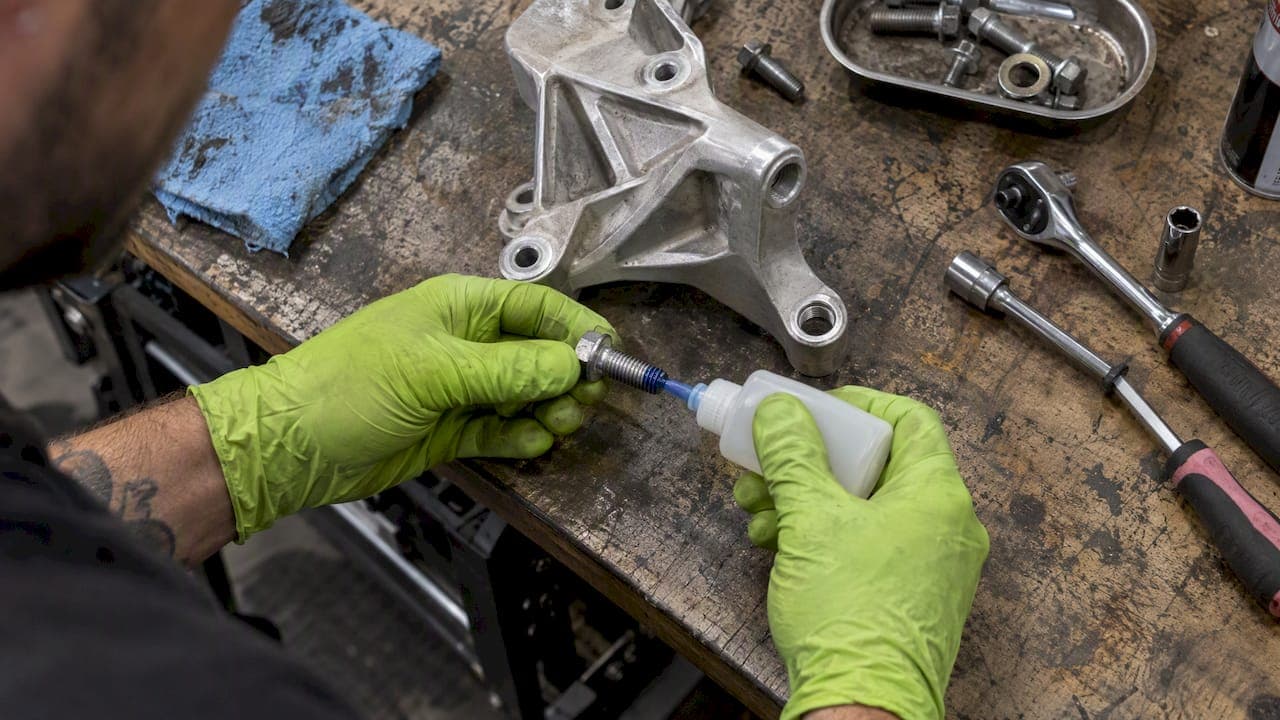
Yes, you can use threadlocker on aluminum, and in most cases you should. Modern general-purpose grades such as blue LOCTITE 243 and purple LOCTITE 222 are made to work on passive metals like aluminum and stainless steel without a primer, as long as the surfaces are reasonably clean. The real question is not whether it sticks. It is how strong a grade you pick, because aluminum threads are soft and a bolt that is locked too hard will take the threads with it when you remove it.
This guide covers grade choice (blue versus red, and why purple matters), surface prep, blind holes, cure time, and the mistakes we see most often.
TL;DR
- Blue (medium strength) is the right default for aluminum fasteners you may remove again. Purple (low strength) suits small screws under 1/4 inch.
- Red (high strength) is for permanent, safety-critical joints, and removal usually needs heat. On small aluminum threads it risks ripping the threads out.
- Clean the threads, and never put fresh threadlocker over old cured residue.
- Below about 41°F (5°C) or on dirty parts, use an activator. Give the joint 24 hours to reach full cure before hard service.
- In blind holes, put the product in the hole, not on the bolt.
Why aluminum needs a second thought
Threadlockers are anaerobic adhesives. They cure when air is shut out and metal ions are present. Aluminum carries a natural oxide layer that slows that reaction, which is why older or cheaper formulas could cure slowly or inconsistently on it. Current primerless products are formulated to get past this, but the oxide layer is the reason prep and temperature matter more on aluminum than on bare steel.
The second issue is mechanical. Aluminum is much softer than a steel bolt. The bond between locker and thread is only one half of the story. The other half is whether the aluminum threads can survive the torque it takes to break that bond later.
Blue vs red threadlocker on aluminum
This is the choice most readers are really making. The short version: choose the lowest strength that holds the fastener.
| Grade | Color | Strength | Removal | Typical use on aluminum |
|---|---|---|---|---|
| LOCTITE 222 | Purple | Low | Hand tools | Small screws under 1/4 inch (6.35 mm) in soft metals |
| LOCTITE 243 | Blue | Medium | Hand tools | Most serviceable fasteners: covers, brackets, mounts |
| LOCTITE 271 | Red | High | Heat, around 482°F (250°C) | Permanent, safety-critical joints |
Blue: the default
Blue is the industry standard for fasteners that need periodic removal in the sense that it locks against shock and vibration yet comes apart with hand tools. It also tolerates light oil films left on parts, which helps with freshly machined or lightly oiled hardware. For brackets, covers, mounts and accessories on aluminum, blue is almost always the answer.
Purple: for small screws
Below 1/4 inch in diameter, even blue can be more than a small screw in soft metal needs. Purple LOCTITE 222 is a low-strength grade for fasteners under 6.35 mm (1/4 inch), where the risk is stripping the head or snapping the screw during removal. Think instrument screws, small sensor brackets and similar light hardware.
Red: use sparingly
Red is built for parts that should stay put, and removal normally means heating the joint to roughly 250°C. A common mistake is over-specifying. Red on small aluminum bolts can break threads or housings on removal, because the torque needed to break the bond can exceed what the aluminum threads can take. If a joint is truly permanent and the aluminum is thick, with a steel insert or generous thread depth, red can make sense. If you might ever take it apart, drop to blue.
A quick decision path
- Is the fastener under 1/4 inch and in soft aluminum? Start with purple.
- Will you service it, or might you? Use blue.
- Is it permanent, safety-critical, and in thick, well-engaged threads? Consider red, and plan on heat for removal.
- Not sure? Choose the weaker grade and check torque again after the first use.
Prepping aluminum threads
Prep is where most failed jobs are decided.
- Clean both parts. Remove chips, oil and dirt. Primerless blue and purple can cure through light oils, but heavy contamination is a different story.
- Remove old locker. Fresh threadlocker over old cured residue gives a soft, weak bond, because the adhesive needs to touch raw metal to start curing. Pick out the residue with a brush or pick and wipe the threads.
- Check the bottle. The cap color is not a guarantee. Read the product name and label before you apply.
- Apply a small amount. You want coverage of the engaged threads, not a flood that squeezes out.
When to use an activator
An activator is a surface-prep product that wakes up an inactive surface. Activators such as LOCTITE SF 7649 or SF 7240 are recommended when you assemble below about 41°F (5°C) or when the fastener surfaces are heavily contaminated. Loctite's own guide lists faster return to service, curing through larger gaps and deep threads, and much faster cure on cold parts among the reasons to use a primer. If you work in an unheated garage in winter, this is the step that saves you.
Blind holes and through holes
In a through hole, apply a few drops to the bolt threads where they will engage the nut or the female threads, then assemble.
A blind hole is different. Trapped air can push liquid out of the threads as the bolt goes in, which leaves an inconsistent fill. Instead, put the product in the lower third of the threaded hole and then thread the bolt in. The bolt pushes the adhesive up along the threads as it advances.

Cure time: fixture is not full cure
After assembly the part may feel set within minutes to an hour. That is fixture time, not full strength. Full cure usually takes about 24 hours, and hard service before then can leave you with a failed joint. Cold shop, slow cure: expect to wait longer, or use an activator. If you built a bike, a fixture or a machine on Saturday, let it sit overnight before the first hard run.
Threadlocker versus anti-seize
Forum posts often argue the point. Some people swear by anti-seize on aluminum, and for parts that must come apart often, or where stainless screws thread into aluminum and tend to gall, that is a reasonable debate. Threadlocker and anti-seize do opposite jobs, though. One prevents loosening and the other prevents seizing. If a fastener is vibrating, anti-seize is lubricating the very joint you want to hold. Torque specs also change with lubricants, so check the spec before you add either.

Threadlocker also seals threads. That matters on aluminum housings, where a steel bolt in contact with aluminum can set up galvanic corrosion in humid conditions. Loctite's guide notes that the sealing barrier helps prevent seizing and the stripped threads that can follow on removal. That is a good reason to use blue on steel-in-aluminum joints you plan to service.
Mistakes that strip or loosen aluminum joints
- Using red by default. Higher strength feels safer. In soft aluminum it is the quickest way to ruin a thread.
- Skipping the cleanup of old locker. You think you have locked it. You have not.
- Too little thread engagement. No threadlocker rescues a joint with short threads. Our guide to thread engagement length explains how deep a fastener needs to go in aluminum.
- Rushing cure time. Fixture time is a handling milestone, nothing more.
- Forgetting the temperature. A cold part is a slow part.
- Torquing without a spec. Over-torque stretches aluminum threads before locker ever comes into play.
Our perspective
We machine aluminum all day, so we see this from both sides: how threads get cut, and how they get abused afterward. A few things we would tell any rider or engineer.
First, the thread itself matters as much as the chemistry. A clean, correctly sized thread with proper engagement beats a sloppy one with a lot of red locker. If you are specifying parts, the method used to make the thread matters too, and we walk through that in thread milling vs tapping.
Second, think about the next person to open the joint, which is often you. Dirt bikes, fixtures and prototypes all get taken apart. We would reach for blue on nearly every aluminum fastener, purple on small screws, and save red for things that never come off.
Third, vibration is the reason people reach for threadlocker in the first place. That is also why we care about it on the bike itself: our work on isolated handlebar mounts comes from the same problem, managing vibration at the joints that hold a bike together.
— Drake
If you need an aluminum part made
If the real problem is a bracket, fixture or replacement part with threads that need to hold in aluminum, we can machine it. We handle prototype machining, short-run production, and fixtures, brackets and support parts, and you talk directly to the machinist who builds the job. Send your drawing through Flying Chip Factory and we will come back with a quote.
Riding an electric mini bike? Our E2 Kickstand for the KTM SX-E 2, GASGAS MC-E 2 and Husqvarna EE 2 is a CNC-machined, bolt-on replacement for the factory triangle stand, priced at $100-$105.
FAQ
Will Loctite adhere to aluminum?
Yes. LOCTITE 243 and 222 are designed for all metals, including passive ones like aluminum and stainless steel, without a primer. Keep the threads clean, and use an activator if the parts are cold or very dirty.
Is blue Loctite okay for aluminum?
Blue is the best general choice. It locks against vibration, and you can still remove the fastener with hand tools. For screws smaller than 1/4 inch, purple is gentler on soft aluminum threads.
Which threadlocker is not recommended for aluminum?
Red is the one to avoid on small aluminum fasteners or threads you may need to reopen. Removal normally takes heat, and the torque needed can damage the aluminum before the bond lets go. Reserve it for permanent joints in thick material.
How long should I wait before using the part?
Wait about 24 hours for full cure. The joint may feel solid sooner, but fixture time is not full strength. In cold conditions, use an activator or wait longer.
Can I put new threadlocker over old?
Not reliably. Clean the old cured residue off down to bare metal first, since the adhesive needs metal contact to cure properly.
Sources
- LOCTITE 243, Henkel Adhesives
- Henkel Adhesives
- Threadlocker: Red or blue, which one's right for you?, Loctite
- Know-How Notes: Threadlocker Guide, NAPA
- Do You Have a Screw Loose? Gears Magazine
- Loctite Automotive Chemicals Guide