
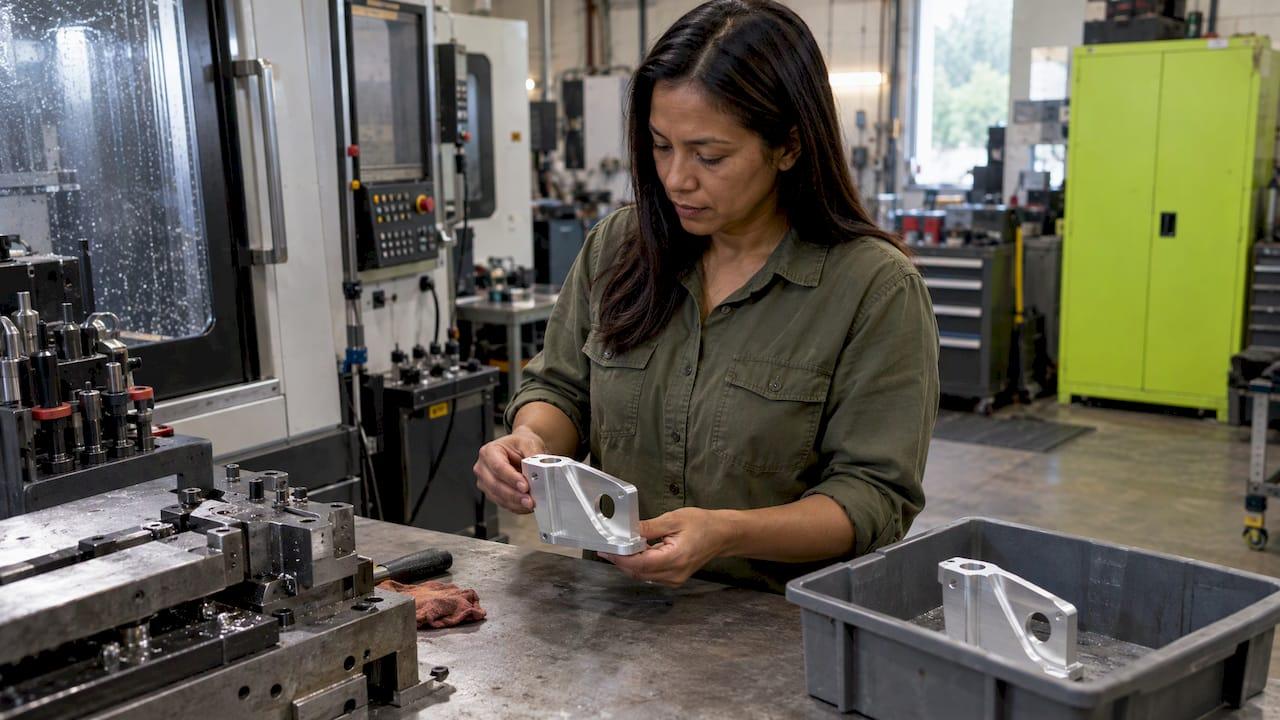
For most small manufacturers, engineers and product builders, buying machined parts from a shop with direct machinist access beats owning a machine. That holds whenever volume is low, uneven or still changing. A machine, a programmer, tooling and inspection gear only pay back when the same parts keep the spindle busy all year. Until then, you pay for idle capacity. A quoted part turns that fixed cost into a per-part cost.
This guide shows how to run the decision for one part at a time, which costs belong in the comparison, and where the answer flips.
TL;DR
- A make-or-buy decision is made per part and per job. Making means using your own machines and people. Buying means ordering the finished part from an outside shop.
- Compare only costs that change between the two options. Sunk costs and overhead that stays either way do not belong in the math.
- Low, variable or unproven volume favors buying. Stable, recurring families of parts are what justify owning capacity.
- Many teams end up hybrid: critical repeat work stays close, while prototypes, overflow and specialty parts go out.
- A shop where you talk straight to the machinist who builds the part keeps the revision loop short, which is most of what in-house machining promises.
What a make-or-buy decision means in machining
In machining, "make" means you cut the part yourself, on your own machines, with your own staff, programs and inspection. "Buy" means you send a drawing or model to an outside shop and receive finished parts. The same choice shows up for prototypes, brackets, fixtures, replacement parts and short production runs.
It is not only a price question. It is a question of where you want your money, attention and skilled hours to go. A shop owner with a machine that is booked solid has a different answer than a product designer who needs forty brackets twice a year.
Two habits keep the decision honest:
- Decide per part number. A bracket that ships 3,000 a year and a one-off fixture have nothing in common financially.
- Decide at the volume you actually expect. Not the volume you hope for after launch.
Count the right costs
The core rule from managerial accounting is simple: only relevant costs count. OpenStax's managerial accounting text frames make-or-buy as a comparison of purchase cost against production cost. Production cost there covers direct materials, direct labor, variable overhead and fixed overhead. It also explains that avoidable costs disappear if you buy, while unavoidable costs stay and must be considered in the buy analysis.
A professional cost-accounting reference puts the same rule in a sentence: a cost matters only if it is a future cost that differs between the options. Equipment you already own, and the depreciation on it, is sunk. It should not tip the scale either way.
The make side
For one part at its expected annual volume, list what you would spend or give up:
- Material at today's replacement price, not what is already on the shelf
- Programmer and operator time at the rate you actually pay
- Cutting tools, inserts and workholding
- Setup time for every run, not only cycle time
- Inspection time and gauges
- Scrap and rework
- Variable overhead, and fixed costs that truly go away if you stop
- The opportunity cost of the machine: what else it could have produced in those hours
That last line is the one people skip. If a machine is your bottleneck, every hour it spends on a bracket is an hour it is not making the work that earns your margin.
The buy side
The quote is not the whole price either:
- Unit price and any tooling or setup charge, spread over the run
- Freight and packaging
- Drawing cleanup and a first-article check before the first real order
- Receiving inspection when parts arrive
- Your own time on communication, revisions and change control
- Safety stock, if you cannot afford to wait on a reorder
One way to keep the buy side small is to start with a single first-article inspection and a clean drawing. Our guide to outsourcing CNC machining with one FAI walks through what to ask for.
A worked example
The numbers below are illustrative, not market data. Say you can make a bracket for $10 in variable cost (material, labor, tooling), and doing so adds $6,000 in fixed cost you would not otherwise carry, such as fixturing, programming and a share of capacity. An outside shop quotes $12.50 per part, with nothing fixed on your side.
The break-even quantity is the fixed-cost difference divided by the per-part difference: $6,000 ÷ ($12.50 − $10) = 2,400 parts. Below 2,400 parts, buying is cheaper. Above that, making saves $2.50 per part.

Now stress the example. If you need 800 parts a year and the design may change, you never reach break-even, and every revision restarts the fixed cost. If you need 8,000 identical parts a year for five years, making deserves a serious look. The formula is a linear simplification. It ignores overtime, learning curves and the chance that your machine is already full, so treat it as a screen, not a verdict.
Where volume tips the answer
Volume is the first thing to test, but steadiness matters as much as size. A one-time order of thousands of parts may not justify a machine if the design disappears afterward. A smaller family of parts that returns every quarter, reuses the same programs and fixtures, and keeps the spindle loaded can.
| Situation | Usually leans toward |
|---|---|
| Prototypes and early designs that change often | Buy |
| Low or irregular annual volume | Buy |
| Short runs of 10 to a few hundred parts | Buy |
| Specialty processes you lack (multi-axis, plating, heat treat) | Buy |
| Stable, recurring part family with steady demand | Make, or hybrid |
| Iteration needed within hours, every day | Make, or a shop you can call directly |
| Your machine is already the bottleneck | Buy the overflow |
Our short-run production guide covers the small-batch end of this table, where a quoted job usually beats tying up a machine.
Quality, lead time and control
Owning the machine feels like owning quality. In practice, quality comes from process control: a clear drawing, a stated tolerance, a measured first article and a record of what was checked. You can have that internally or from a supplier. What differs is who carries the work.
When you buy, put the requirements on paper: material, revision, tolerances, finish and what inspection records you want. When you make, you carry programming, maintenance, inspection and corrective action yourself. Internal shops under production pressure can also let inspection slip when the machine is busy.
Lead time works the same way. In-house is immediate only when the machine is free. Outsourced parts depend on the shop's queue plus shipping. The practical fix is to buy from a shop that is close enough to talk to. Our guide on rapid CNC prototyping covers getting production-intent parts back in two to three days.
Direct contact matters here. Most delays in outsourced work are not cutting time. They are questions that wait for an account manager to relay them. Our work and questions go straight to the machinist who designs and builds the parts, with no sales intermediary in between.
Risks and strategic factors
Cost rarely settles a close call. When the numbers are within a few percent, these factors decide it.
Know-how and IP. Parts that carry proprietary design or process knowledge deserve more control. Keep drawings tight, and decide which parts are core to your product.
Supplier dependence. Relying on one source for a critical part is a risk. Check whether the shop can deliver the quantity you need and whether the quoted price holds on reorder rather than being an introductory rate. OpenStax lists both in its qualitative factors.
Capital and flexibility. Owning machines ties up cash in equipment, tooling and inventory. Buying converts that fixed cost into a variable one that rises and falls with your orders.
Strategic position. A BCG study on make-or-buy recommends scoring each part on two axes: strategic value and relative cost position. Parts that are both strategic and cheaper to make belong in-house. It also warns that companies misallocate equipment and overhead to parts using crude proxies like raw-material share, which distorts the inputs.
Why hybrid is common
The decision is not permanent. Teams that start by buying sometimes bring a stable part in-house as volume grows. Teams that own machines often send out overflow, specialty work and prototypes. A workable split:
- Keep close the parts that are stable, repeated and tolerance-sensitive.
- Send out prototypes, low-volume specials, fixtures and anything needing a process you lack.
- Revisit each part when its annual volume or design stability changes.
If you are weighing outsourced capacity against fabrication and milling shops, such as custom milling and fabrication capacity offered on the Gulf coast of Florida, compare lead times and requirements part by part, not shop by shop.
How to buy machined parts well
If the numbers say buy, a few steps decide whether it goes smoothly.
- Write a complete drawing. Include revision, material, critical dimensions, tolerances and finish. A shop can only quote what you define. Our list of machine shop questions shows what a quoting engineer should ask you, and what you should ask back.
- Understand the quote. Material, setup, cycle time and finishing drive the price. Our CNC quote formula guide shows how to reproduce a shop's math as a sanity check.
- Prototype before committing to a run. Our prototyping cost checklist helps small businesses compare quotes fairly.
- Inspect the first article. Confirm the critical dimensions before releasing the full order.
- Plan reorders. Ask whether programs and fixtures are kept so a repeat order is quick and consistent.
Two more things help. Choose a shop that will talk about the design, not only the price. And think about process: if you are deciding between machining and another route, our comparison of forging vs machining shows how to choose.
A real example: the E2 Kickstand
We face this decision ourselves. Our E2 Kickstand fits the KTM SX-E 2, GASGAS MC-E 2 and Husqvarna EE 2 electric mini dirt bikes, and we design it, machine it and ship it from one shop in Athens, Alabama. Because the people designing the part are the people machining it, a fit issue becomes a design change quickly rather than a ticket in a queue.
That is the same advantage we offer a customer who needs a bracket or a short run. The part gets built where it was designed, and you talk to the person cutting it.
Prototype, short-run and fixture work from our shop
We take on prototype machining, short-run production, and fixtures, brackets and support parts. You deal directly with the machinist, which keeps questions and revisions fast. If you are weighing make vs buy on a part, send us the drawing and the volume you expect and we will quote the job.
If you ride a KTM SX-E 2, GASGAS MC-E 2 or Husqvarna EE 2, the E2 Kickstand is a bolt-on CNC-machined stand priced at $100-$105. For quotes on custom work, start at the Flying Chip Factory home page.
Our view
Most make-or-buy arguments we hear start with the machine. They should start with the part: how many, how often, how stable the design is, and how fast you need answers.
We build our own products and machine other people's parts in the same shop, so we see both sides of the decision. A machine pays back when it stays busy on work that does not change. Most parts in their first year are not that work. The design moves, the quantity is a guess, and the real need is someone who will pick up the phone when a hole is 0.01 inch off.
That is why we run the shop the way we do. The machinist who designs and builds the part is the one you talk to. Prototype, revise, run a short batch, then reorder when you need more. You skip the capital, the programming time and the sales relay, and you keep your own people on the work only you can do.
If a part grows into a steady family, bring us the drawings and we will quote the run.
Drake
FAQ
What is a make vs buy decision?
It is the choice between producing a part yourself and purchasing it from an outside supplier. In machining, you compare the full cost of cutting it on your own equipment with the full price of a finished part delivered and checked. Quality, lead time, risk and control are weighed alongside cost.
At what volume does in-house machining make sense?
There is no universal number. It depends on how steady the demand is, how many spindle hours you can fill, and whether the design is stable. A recurring family of parts that reuses programs and fixtures can justify a machine at modest volumes. A one-off large order often cannot. Calculate break-even for your own part.
Which costs should I leave out of the comparison?
Leave out sunk costs, such as a machine you already own, and fixed overhead that stays the same whichever option you pick. Include only future costs that differ, plus the opportunity cost of the machine time you would use.
Is a hybrid approach better than choosing one?
For many teams, yes. Keep stable, repeated, critical parts where you control them, and send prototypes, overflow, fixtures and specialty processes to a shop you can talk to directly. Revisit the split whenever a part's volume or design changes.
Sources
- OpenStax, Principles of Managerial Accounting: Evaluate and Determine Whether to Make or Buy a Component
- Cost & Profitability: Make-or-Buy Decisions, Which Costs Are Actually Relevant
- BCG: Maximizing the Make-or-Buy Advantage