
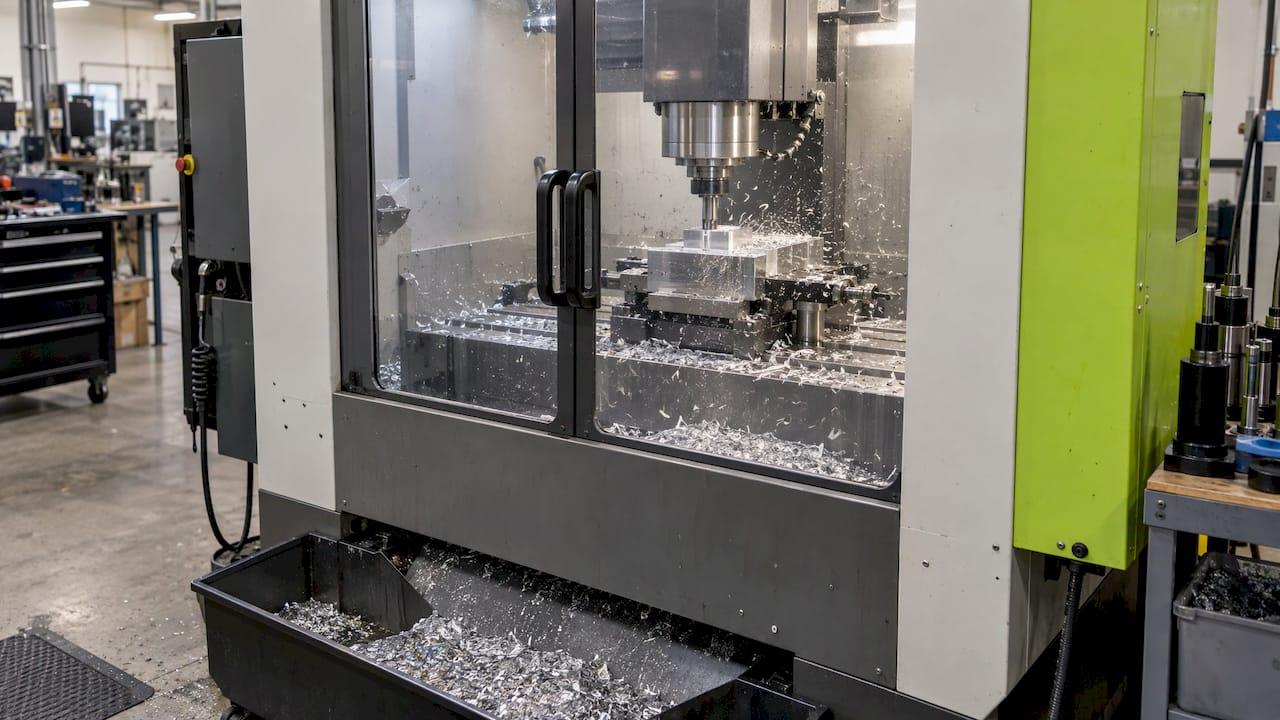
You can machine aluminum without flood coolant, and for many operations it is the better choice. Milling, boring and turning with sharp, polished tooling and good chip removal often run fine dry. Drilling and tapping are the exceptions: chips stay trapped near the cut, so those operations usually need air blast, a mist of oil or a lubricant. This guide covers what separates a clean dry cut from a gummed-up one, with the evidence behind it.
TL;DR
- Open-faced operations such as milling and boring run dry well because chips can leave the cut. Drilling and tapping generally cannot.
- Use sharp tools with high positive rake and polished flutes, and keep chips moving. Built-up edge is the main enemy.
- Gummy grades like 1100 and 3003 are harder dry than 6061 and 7075.
- Compressed air, or air with a tiny amount of oil, is the usual middle ground when fully dry is not enough.
- Surface finish dry is good but can be beaten by MQL or cryogenic cooling in some tests.
What dry machining of aluminum actually means
Dry machining removes material with no liquid cutting fluid at all. Heat has to leave with the chip, and chips have to leave the cut on their own or with a blast of air.
Three approaches get confused:
| Method | What reaches the cut | Typical use |
|---|---|---|
| Flood coolant | Large volume of fluid | Deep drilling, tapping, heavy production |
| MQL (minimum quantity lubrication) | Metered oil mist carried by air | Drilling, finishing, sticky alloys |
| Dry | Nothing, or plain compressed air | Milling, boring, turning with free chip flow |
The European Aluminium Association's machining guide notes that milling and turning without liquid lubrication is often a better alternative. Lubricant makes fumes when the tool heats it, new inserts are often designed to run dry, and there is no thermal shock from fluid hitting a hot insert.
If you are choosing a fluid for the jobs that do need one, our coolant selection guide matches fluid to material.
Why aluminum suits dry cutting
Aluminum is easy on tools compared with steel. A 2023 Springer review reports tool wear on aluminum alloys that is 30 to 40% lower than on steel alloys, thanks to higher ductility and lower strength. It also puts cutting temperatures at roughly 200 to 400 °C.
So the problem is rarely tool heat in the way it is with titanium or stainless. If you cut those materials, see our guides to titanium machining and stainless steel machining, where heat control is the whole game.
With aluminum, the trouble is adhesion. The same Springer review states that without coolant, pressure and temperature at the tool-chip contact can drive diffusion between aluminum and cobalt in carbide tools. Aluminum welds to the edge, and that is where dry cuts go wrong.
Heat is also mostly a chip story. A 2009 STLE article cites research finding that about 70% of machining heat comes from plastic deformation of the workpiece, and the other 30% from friction at the chip and tool interfaces. When the chip carries most of that away, getting it out of the cut is the cooling strategy.

Which operations run dry and which do not
The STLE piece, quoting John Sutherland, draws the line clearly. Open-faced operations such as milling and boring can run dry because chips can be moved away from the tool and workpiece interface. Closed-face operations such as drilling and tapping cannot run efficiently dry, because the chips stay near the interface with no way out.

Milling, boring and turning
These are the natural dry operations. The cutter spends part of each revolution out of the cut, chips fall away, and the tool sees less thermal cycling. Dennis Quinto of Balzers, quoted in the same STLE article, explains that coolant in milling makes the cutting edge temperature swing as the tool enters and leaves the cut. That can cause thermal cracking and early edge failure. Dry, the temperature stays steadier and tool life can extend.
Drilling
The European Aluminium Association guide explains the failure mode: without lubrication, chips collect around the hole and can be squeezed between drill and workpiece, scratching the surface. Its fix is to clear chips with compressed air. For deep holes, peck cycles and through-tool air are the practical answers. Our article on chip evacuation walks through three checks to make before you blame the tool.
Tapping and thread forming
Continuous flank contact in a tap invites galling. Plan on lubricant or at least a mist here. Our tapping aluminum guide covers drill sizes, tap choice and technique, and our thread design article covers engagement and inserts when a thread needs to survive repeated use.
Tooling for dry aluminum
Dry cutting rewards the right tool and punishes the wrong one. The common thread across sources is sharpness and smoothness.
Geometry
Use a high positive rake and a truly sharp edge. Published recommendations commonly fall in the 10 to 25 degree rake range, with ground rather than honed edges and generous clearance. Polished flutes and wide chip space help the chip release instead of packing. Tools built for steel, with low rake and tight flutes, are the usual reason carbide "fails" in aluminum.
Coatings
This is where advice differs, so be precise.
- Uncoated, polished carbide is the safe default for dry work. Many shops prefer it because aluminum-bearing coatings can pick up aluminum from the workpiece.
- DLC and ZrN coatings are commonly recommended when a coating is wanted, because they are slick and do not grab aluminum.
- TiAlN has a mixed record. STLE reports it is thermally stable to about 900 °C and that coatings raise tooling cost by only about 10% on average. A Production Machining report describes a tooling specialist choosing a TiAlN-coated carbide grade for boring 7075 thin-wall parts, citing its low friction and resistance to built-up edge. In that case it worked, and it shows that grade and polish matter as much as the coating name.
- PCD gives the longest life in high-volume aluminum, though it costs more and suits dedicated setups.
For a one-off prototype, a sharp, polished, uncoated carbide end mill designed for aluminum is hard to beat.
Speeds, feeds and chip control
Speed is your friend. The 2016 study on built-up edge of aluminum alloys is summarized in the research as finding that at low spindle speed, a larger, unstable BUE forms and chips fracture readily, leaving a rough surface. Raising spindle speed removes the tendency. Running too slowly with a sharp tool is a classic way to get a smeared finish.
A few working principles:
- Run fast enough. Aluminum likes high surface speed. Rigid machines can run roughing passes at thousands of SFM, limited mostly by spindle RPM and workholding safety.
- Feed enough to make a chip. Starving the cut produces rubbing, heat and adhesion. Heavier chips carry heat away.
- Break the chips. In turning, a roughing feed near 0.010 to 0.015 inch per revolution tends to curl and snap aluminum chips, while finishing passes drop to a few thousandths.
- Do not recut chips. A 2016 MDPI Applied Sciences study found that under dry conditions chip evacuation becomes especially important, and high cutting-zone temperatures cause material adhesion on the tool, which in turn hampers chip evacuation. It is a loop, and it feeds on itself.
- Use air. A directed air blast is the cheapest upgrade to a dry setup. It clears chips, and in high-speed machining the chip takes most of the heat with it.
A 2023 study of dry turning of 7075 with plain tungsten carbide inserts found feed rate was the most influential factor on surface roughness, and the relationship was direct: more feed, rougher surface. Its best finish came at 207 RPM, 1.2 mm depth of cut and 0.12 mm per revolution, for that specific lathe and insert. Treat those numbers as that experiment's result, not a universal recipe.
Alloy matters
Not every aluminum behaves the same dry.
- 6061 and 7075 rank among the easiest to machine. They cut cleanly and break chips well, so they are the best candidates for dry work.
- 1100 and 3003 are soft and gummy. Without lubrication they build up edge badly. Use mist or a lubricant if you must cut them.
- Cast alloys vary with silicon content, and high-silicon grades wear tools faster, so tool choice shifts.
If a part will be anodized or coated afterward, plan the sequence before cutting. See our notes on machining after coating and anodize masking dwell times so you do not rework a finished surface.
Surface finish: dry versus MQL versus cryogenic
Dry is good, not always best. The numbers from published tests:
| Study | Conditions | Result |
|---|---|---|
| End milling 6061 | Dry vs MQL | MQL up to 20% lower roughness; best Ra 0.58 µm dry, 0.50 µm MQL |
| Turning 7075-T6 | Dry, flood, cryogenic CO₂ | Cryogenic gave best finish and less BUE; best mean Ra 0.736 µm at 220 m/min, 0.05 mm/rev, 0.5 mm depth |
Two takeaways. First, the gap between dry and MQL in the milling test is a few tenths of a micron, which is invisible on most functional parts. Second, cryogenic cooling is a specialty setup, not a shop-floor default.
If your drawing calls for a tight finish, such as a sealing surface or a bearing bore, test a finish pass with air or mist. If it calls for a clean, functional machined surface, dry is usually enough.
When to add air blast or MQL
Add a little help when:
- You are drilling deeper than a few diameters.
- You are tapping or thread forming.
- You are cutting gummy grades such as 1100 or 3003.
- Chips are welding to the flutes despite good speeds.
- The finish pass shows smearing.
The European Aluminium Association guide notes that compressed air is sometimes used with a small amount of oil, giving an oil mist that lubricates without causing fumes. That is MQL in practice. It is also a good fit for shops that want a clean floor and clean parts without flood systems.
One caution on MQL for production: it offers almost no workpiece cooling. A cutting fluid comparison reports parts running well above ambient during heavy runs, which can cause thermal growth errors until they stabilize before finish passes. The same applies to dry cutting. If you hold tight tolerances, let the part settle, or take the finish pass after a pause.
A practical dry-machining checklist
- Pick the operation. Milling, boring, turning: start dry. Drilling, tapping: plan air or mist.
- Confirm the alloy. Favor 6061 or 7075 for dry work.
- Choose a sharp, polished tool made for aluminum, with high rake and open flutes.
- Set speed high and feed firm enough to form a real chip.
- Point an air blast at the cut and check that chips leave rather than recut.
- Watch for the signs of built-up edge: shiny smears on the edge, rising spindle load, a hazy finish.
- Stop and clean the edge when you see them, then adjust speed or add mist.
- Let heavy-cut parts cool before the finish pass if tolerance is tight.
Slotting deserves its own mention, since a slot traps chips more than a profile does. Our slot machining guide covers that case.
Perspective: what we have seen at the machine
We design and machine parts in one shop, and the person who programs the job is the person who runs it. That shortens the loop between a chip that looks wrong and a change to the tool or the program.
Our view is that coolant is a tool selection question, not a belief. If the operation lets chips escape, sharp aluminum-specific tooling and good chip clearance do most of the work. If the operation traps chips, a little lubricant is cheaper than a scrapped part.
What we value in motorcycle parts is repeatability: the fifth part matching the first, and a finish that holds up to anodizing and to real riding. That comes from a stable process, steady tool condition and a machinist who is watching the cut, not from any one fluid strategy.
If you are developing a part and want that kind of direct feedback during prototyping, talk to the person who will cut it.
Drake
Need aluminum parts machined?
If you would rather have a machinist handle the cutting, we take prototype machining, short-run production, and fixtures, brackets and support parts. You deal directly with the machinist who runs your job, so questions about tolerances, finish or material get a quick answer. Start at our shop page and tell us what you are building.

Riding an electric mini bike? Our CNC-machined E2 Kickstand fits the KTM SX-E 2, GASGAS MC-E 2 and Husqvarna EE 2, and is priced at $100-$105.
FAQ
Can you machine aluminum without coolant?
Yes. Milling, boring and turning commonly run dry with sharp, polished tooling and good chip removal. Drilling and tapping are harder because chips stay trapped, so they usually need compressed air or a light mist of oil.
Why does aluminum stick to the tool when cut dry?
Heat and pressure at the cutting edge make aluminum weld to the tool, forming built-up edge. Low spindle speed, dull edges and unpolished flutes make it worse. Higher speed, sharper tools and clear chip flow reduce it.
Is dry machining or MQL better for aluminum?
Dry is simpler and works well for open operations. In one 6061 milling test, MQL gave up to 20% lower roughness, so it can help when finish or chip sticking is a problem. Choose by operation and the finish your drawing needs.
Which cutting tool is best for dry aluminum?
A sharp carbide tool made for aluminum, with high positive rake, wide polished flutes and a ground edge. Uncoated or DLC and ZrN coated tools are common picks, and PCD suits high-volume work.
Sources
- European Aluminium Association, AAM machining guide
- STLE, Metalworking article (March 2009)
- Springer review on machinability of aluminum alloys (2023)
- Production Machining, Turning Thin-Walled Aerospace Parts
- Okonkwo et al., aluminum surface roughness under dry and MQL conditions
- MDPI Applied Sciences, chip geometry in dry machining
- Gupta et al., machinability of aluminum 7075 under dry conditions
- MDPI, turning Al7075-T6 with cryogenic cooling
- Cutting fluid types comparison