
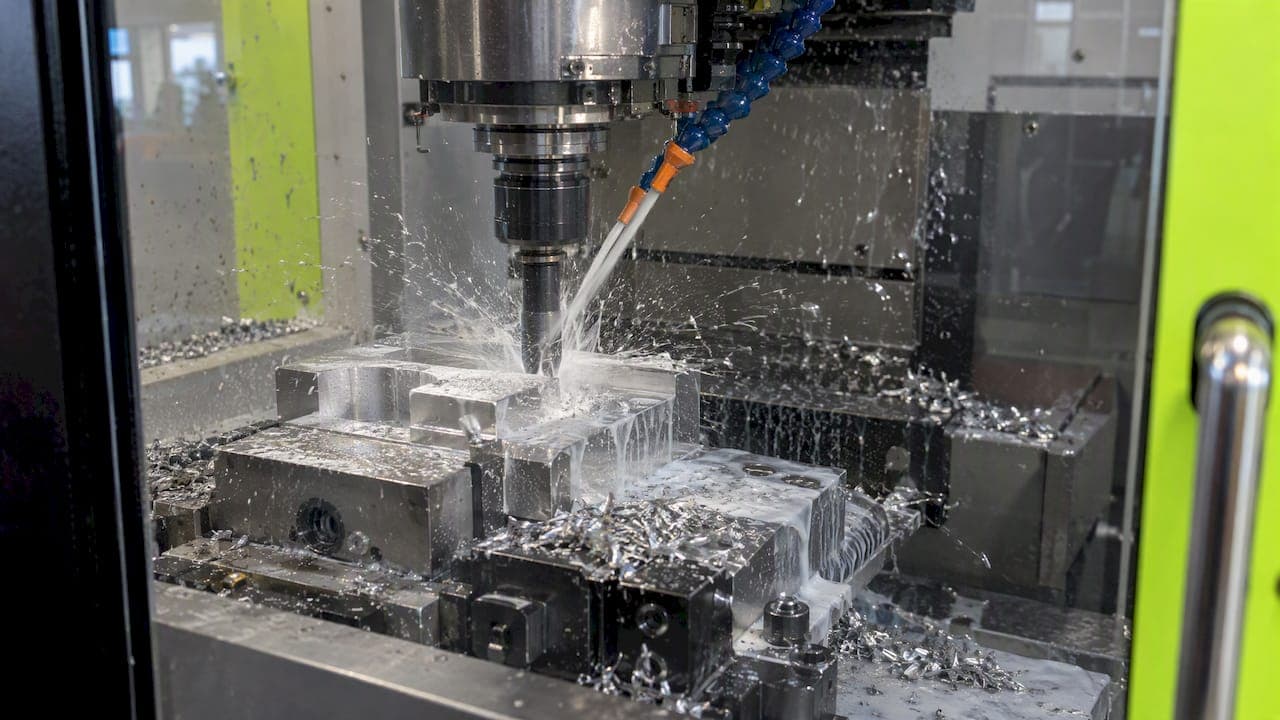
Pick coolant by asking three questions in order: what are you cutting, how fast are you cutting it, and where does the fluid have to go? For most shops, a water-based emulsion or semi-synthetic fluid is the starting point. Aluminum needs a fluid with the right inhibitors and a sensible pH. Hard, high-speed work leans on cooling, while slow cuts in soft metal lean on lubrication. And sometimes the right answer is less coolant, or none.
This guide walks through those decisions the way we make them at the bench, with the research behind them.
TL;DR
- Coolant does four jobs: it removes heat, lowers friction, flushes chips and protects against corrosion. Choose the fluid that does the job your cut needs most.
- Higher speeds and harder materials make cooling more important than lubrication. Slower speeds and softer materials make lubrication the priority.
- For aluminum, use a fluid formulated for it, because aluminum can stain or corrode at high pH. Check your water hardness before you mix.
- Delivery matters as much as chemistry. Chip evacuation, mist control and fluid upkeep decide whether a good coolant stays good.
- Dry cutting and minimum-quantity lubrication are legitimate choices for some operations. Follow your tool maker's guidance.
What coolant actually does in a cut
People say "coolant" and picture one job. Metalworking fluids do several. The Society of Manufacturing Engineers lists cooling, flushing chips from the cutting zone, lubrication to reduce friction and corrosion protection as the core functions. The European Agency for Safety and Health at Work describes the same set, and adds that the right fluid depends on the machining operation and the functions it must perform.
That last point is the whole game. A fluid that is perfect for a slow tapping job may be a poor choice for a high-speed finishing pass. Before you look at a single product, decide which function is hurting you right now:
- Heat: discolored chips, tool edges that soften, parts that grow as they warm up.
- Friction and built-up edge: material smearing onto the flute, torn surfaces, rising spindle load.
- Chips: recutting, packed pockets, scratches from chips dragged across a finished wall.
- Corrosion: flash rust on steel, staining on aluminum, a machine bed that pits.
If chips are your actual problem, the fix is often fluid delivery rather than fluid type. We wrote up three coolant checks to run before you change tools, and it is worth reading before you spend money on a new chemistry.
The main coolant families
The SME study guide identifies four principal families: straight oils, soluble oils (chemical emulsions), semi-synthetic fluids and synthetic fluids. Here is how they compare in practice.
| Fluid type | Best at | Trade-offs | Typical fit |
|---|---|---|---|
| Straight (neat) oil | Lubrication, tough cuts, slow speeds | Poor cooling, smoke and mist, fire concerns | Tapping, broaching, difficult alloys at low speed |
| Soluble oil (emulsion) | Balanced lubrication and cooling | Needs water quality control and upkeep | General milling and turning |
| Semi-synthetic | Good cooling with decent lubricity, cleaner than emulsions | Foaming and water sensitivity can show up | Mixed-material job shops |
| Synthetic | Cooling, cleanliness, visibility | Less lubricity, can be harsher on some materials and machine finishes | High-speed work where heat is the enemy |
Sandvik Coromant notes that the most common CNC coolant is a water-based emulsion, typically 5 to 10 percent oil in water. Straight cutting oil, compressed air, minimum-quantity lubrication (MQL) and cryogenic coolant round out the list.
A 2023 peer-reviewed review in the journal Sustainability compared flood cooling, solid lubrication, MQL, compressed air and cryogenic cooling. Its conclusion is that no single method is best for every application. We agree. The best coolant is the one that fits your material, your machine and your people.
Start with speed and material
There is a simple rule of thumb from the SME guide: in high-speed machining or with harder materials, cooling becomes more critical than lubrication, while slower speeds and softer materials put lubrication first. Use it to narrow the field before anything else.
- Fast cutting, small chips, hard material: favor a fluid with strong cooling. That points to a well-mixed emulsion, semi-synthetic or synthetic, delivered at the cut.
- Slow cutting, soft or gummy material: favor lubricity. A richer emulsion or a neat oil helps keep material from welding to the edge.
- Difficult alloys that weld to the tool: the SME guide says extreme pressure (EP) additives such as chlorine, sulfur or phosphorus are used to prevent chip welding and edge build-up. Those additives bring their own handling and compatibility concerns, so check them against the metals you cut and the rest of your process.
Stainless is a good example of a material where the fluid and the strategy have to work together. Our shop-ready guide to machining stainless steel covers how it behaves under the tool.
Coolant for aluminum
Aluminum is where we get asked the most, and where the details matter. It cuts easily, but it is sensitive to chemistry.
A technical guide from the fluid supplier Rotek Oil explains that aluminum-friendly fluids use special inhibitors, because aluminum can discolor or corrode at high pH. The same guide flags water hardness: very soft water can cause foaming, while very hard water can break down the emulsion and lead to saponification.
Translate that into shop habits:
- Read the product data sheet and look for explicit aluminum compatibility. Do not assume a general-purpose fluid is safe on every alloy.
- Check your water. Mixing is a chemistry step. Test the hardness of the water you actually use before blaming the concentrate.
- Watch the parts. Staining or dull spots on freshly cut aluminum is a signal. Stop and investigate the fluid before it reaches a whole batch.
- Do not mix brands casually. The same Rotek guide cautions against assuming coolants are interchangeable between brands, and says final compatibility should be verified with the manufacturer for your water quality and process.
- Plan your finish. Stains and residues can interfere with later surface treatments. If your parts go on to anodizing or conversion coating, see our guides on Alodine versus anodize and hardcoat anodize thickness.
For operations like tapping, lubricant choice is its own topic. We covered it in tapping aluminum: drill sizes, taps, lubricant and technique.
Do you need coolant at all?
Sometimes not. Sandvik Coromant's position is that coolant is not automatically required: some operations can run dry, but coolant may be needed to hold tolerance, surface finish or machinability. The SME guide lists dry machining among delivery options, for example with cast iron.
More is not always better either. A coolant supply guide from hose maker Hirt-Line points out that more coolant does not automatically mean less tool wear. It advises following the tool manufacturer's recommendations on wet or dry cutting to avoid thermal cracking, which can happen when a hot carbide edge keeps getting flooded and dried in cycles.
The practical rule: read the tooling data for your inserts and end mills. If the maker recommends dry for a given grade and operation, test dry first.
Delivery: how the fluid reaches the cut
The SME guide describes a range of methods: simple flood cooling with a low-pressure pump, high-pressure high-volume (HPHV) for chip evacuation, spray mist, MQL and dry machining.
Sandvik Coromant adds some useful contrasts: compressed air evacuates chips but removes heat poorly, MQL combines compressed air with a minimum quantity of oil, and cryogenic coolant needs special equipment. The 2023 review adds that cryogenic systems typically use high-velocity jets of liquid nitrogen or liquid carbon dioxide.
Here is how we think about each:
- Flood: the default for a reason. It handles heat and chips together and is forgiving. Aim nozzles at the cutting edge, not at the part in general.
- High pressure: earns its cost in deep pockets, drilling and slots where chips pack. Sandvik Coromant reports that integrating high-pressure coolant can raise productivity by 20 percent and tool life by 50 percent by creating a hydraulic wedge that improves chip control. That is a manufacturer's figure from 2010, so treat it as a ceiling, not a promise for your machine.
- MQL or mist: a clean option for light cuts, especially in aluminum. Mist control becomes your responsibility (see safety below).
- Air blast: fine for chip clearing in a shallow cut, weak for heat.
- Cryogenic: specialized, for operations where conventional methods fall short.
Slots are a place where delivery and chip control collide. If you cut a lot of them, our shop-ready slot machining guide is worth a read next.
A decision path you can use
Work through these in order and stop when the answer is clear.
- Check the tooling data. Does the tool maker recommend dry, MQL or wet for your material and operation?
- Name the dominant problem. Heat, friction, chips or corrosion. Pick a fluid family that leads with that function.
- Confirm material compatibility. For aluminum, confirm inhibitors and pH. For steels, confirm corrosion protection. For anything with downstream finishing, confirm the residue is compatible.
- Match delivery to geometry. Shallow, open cuts tolerate flood or air. Deep, closed cuts need pressure and well-aimed nozzles.
- Check your water and your sump. The best concentrate fails in bad water or a neglected tank.
- Run a test part. Measure tool wear, surface finish and dimensions. Change one variable at a time.
For mixed-material shops, a single semi-synthetic that is rated for the metals you cut is often the pragmatic answer. For a one-material shop, you can tune much further.
Keeping coolant healthy
A coolant decision is really a maintenance decision. Monroe Fluid Technology's end-user guide recommends running oil skimmers during downtime to remove tramp oil, keeping fluid levels up with properly mixed makeup, and aerating the sump during idle periods to prevent anaerobic bacteria. Those bacteria are what make a tank smell bad over a weekend.
A simple routine:
- Check concentration regularly and write it down.
- Skim tramp oil and keep chips and fines out of the sump.
- Top up with mixed fluid, not plain water, unless the supplier says otherwise.
- Keep a log of when you changed the tank and why.
Safety: mist, skin and ventilation
Metalworking fluids are chemistry you breathe and touch. OSHA's guidance states that local exhaust ventilation is the most effective means of removing airborne contaminants at the source, before they reach the operator. It also stresses that the best way to control exposure is designing systems to minimize mist at the source, such as lower-pressure delivery and enclosing the machine, rather than relying only on personal protective equipment.

That has a direct consequence for fluid selection. High pressure and MQL both create fine mist, so if you choose them, plan enclosure and exhaust at the same time. If you have operators with skin irritation or breathing complaints, talk to your occupational health provider and your fluid supplier, and review the safety data sheet for the product in your tank.
Our perspective
We run a small CNC shop in Athens, Alabama, and the same machinist who designs a part programs it, cuts it and ships it. That shapes how we think about coolant. We do not chase exotic fluids. We chase predictability.

Most of what we machine is aluminum, including the parts we make for electric mini dirt bikes. On that kind of work, the failure modes we worry about are packed chips in a pocket, stained surfaces and inconsistent finishes between batches. In our experience, the fix is almost always one of three things: aim the nozzle better, keep the fluid in good condition, or slow down and let the tool do its job. Changing the brand of coolant is rarely the first move.
Our advice is to pick one well-suited fluid, learn it deeply and keep it clean. Change one thing at a time when something goes wrong. Write down what you changed. Parts made on a stable process fit better, and that is what riders and customers notice.
— Drake
When the part matters more than the process
If you are an engineer or small manufacturer and would rather hand off the machining than tune a coolant system, that is what we do. We take on prototypes, short production runs, and fixtures, brackets and support parts, with direct access to the machinist who will cut your job. Send us your drawing at Flying Chip Factory and ask for a quote.
If you ride an electric mini, our CNC-machined E2 Kickstand for the KTM SX-E 2, GASGAS MC-E 2 and Husqvarna EE 2 is a bolt-on replacement for the factory triangle stand, listed at $100 to $105.
FAQ
What coolant is best for aluminum?
Use a fluid that states aluminum compatibility on its data sheet. Aluminum can discolor or corrode at high pH, so fluids with suitable inhibitors are the safer choice. Check your water hardness too, since very soft water foams and very hard water can break down the emulsion.
What is the purpose of coolant in milling?
Coolant removes heat, reduces friction between tool and workpiece, flushes chips out of the cut and protects against corrosion. Which of those matters most depends on your speed and material. Faster cutting and harder metals put cooling first, and slower cutting in softer metals puts lubrication first.
What coolant do CNC machines use?
Most commonly a water-based emulsion, typically 5 to 10 percent oil in water. Shops also use straight cutting oil, semi-synthetic and synthetic fluids, compressed air, MQL and, in specialized cases, cryogenic coolant. A 2023 review found no single method is best for every application.
Can I machine without coolant?
Often, yes. Some operations run dry, and some materials such as cast iron are commonly cut dry. But you may need coolant to hold tolerance, surface finish or machinability, so follow your tool manufacturer's guidance and test on a scrap part first.
Can I mix different coolant brands?
Do not assume brands are interchangeable. Compatibility depends on your water quality and process, so verify with the manufacturer before topping up a tank with a different product.
Sources
- Metalcutting Fluids, Society of Manufacturing Engineers study guide
- Metalworking fluids, OSHwiki, European Agency for Safety and Health at Work
- How to apply coolant and cutting fluid in turning, Sandvik Coromant
- Review of Lubrication and Cooling in Computer Numerical Control Machining, Sustainability, 2023
- Metalworking Fluid Selection by Machined Metal, Rotek Oil
- End User Coolant Management and Trouble Shooting, Monroe Fluid Technology
- Metalworking Fluids: Safety and Health Best Practices Manual, OSHA
- Machine Integration, Sandvik Coromant
- Optimize coolant supply during milling, Hirt-Line