
Choose Alodine when you need electrical conductivity, negligible dimensional change, and fast turnaround. Choose anodize when the part faces wear, long-term corrosion exposure, or needs to hold a dye. Those two sentences cover the majority of finish decisions on aluminum parts.
The core difference is the process itself. Alodine, formally a chromate conversion coating, reacts chemically with the aluminum surface to form a thin, conductive film. Anodizing is electrochemical: it grows an aluminum oxide layer directly from the substrate, consuming the base metal in the process. That distinction drives every performance tradeoff below.
The most common exceptions: hardcoat (Type III) anodize when abrasion resistance is the primary requirement, electroless nickel when you need hardness on a non-aluminum substrate, and a chem film primer layer when a part needs both conductivity and paint adhesion before a topcoat goes on.
- Pick Alodine (chem film) for grounding, EMI shielding, tight tolerances, paint pretreatment, and quick prototype turnaround.
- Pick anodize for wear surfaces, architectural exposure, colored or dyed parts, and long service life.
- Pick Type III hardcoat when abrasion metrics drive the spec.
- Combine them (Alodine under paint) when you need adhesion without sacrificing conductivity.
How do Alodine and anodize compare side by side?
| Dimension | Alodine / Chem Film | Anodize (Type II) | Hardcoat (Type III) |
|---|---|---|---|
| Process | Chemical conversion; no current required | Electrolytic oxidation in acid bath | Electrolytic; colder bath, higher current |
| Corrosion resistance | Moderate; good with topcoat | Excellent when sealed | Excellent when sealed |
| Wear / hardness | Low | Moderate | High (comparable to hard chrome) |
| Electrical conductivity | Conductive | Non-conductive after sealing | Non-conductive after sealing |
| Paint adhesion | Excellent primer base | Good with etch primer | Good with etch primer |
| Thickness range | — | 0.0002 in (5 µm) | 0.001 in (25 µm) |
| Appearance / dyeing | Clear or yellow-gold; no dye options | Dye to nearly any color before sealing | Typically dark gray/black; limited dye |
| Cost & turnaround | Lower cost; faster | Moderate cost; slightly longer | Higher cost; longest lead time |
| Alloy compatibility | Broad; works on most aluminum alloys | Best on 1xxx, 5xxx, 6xxx; 2xxx vary | 6061 ideal; 2024 and 7075 need care |
| Environmental / waste | Hexavalent chromium (Cr6+) regulated; RoHS concern | Acid bath waste; no heavy metals | Same as Type II; higher energy use |
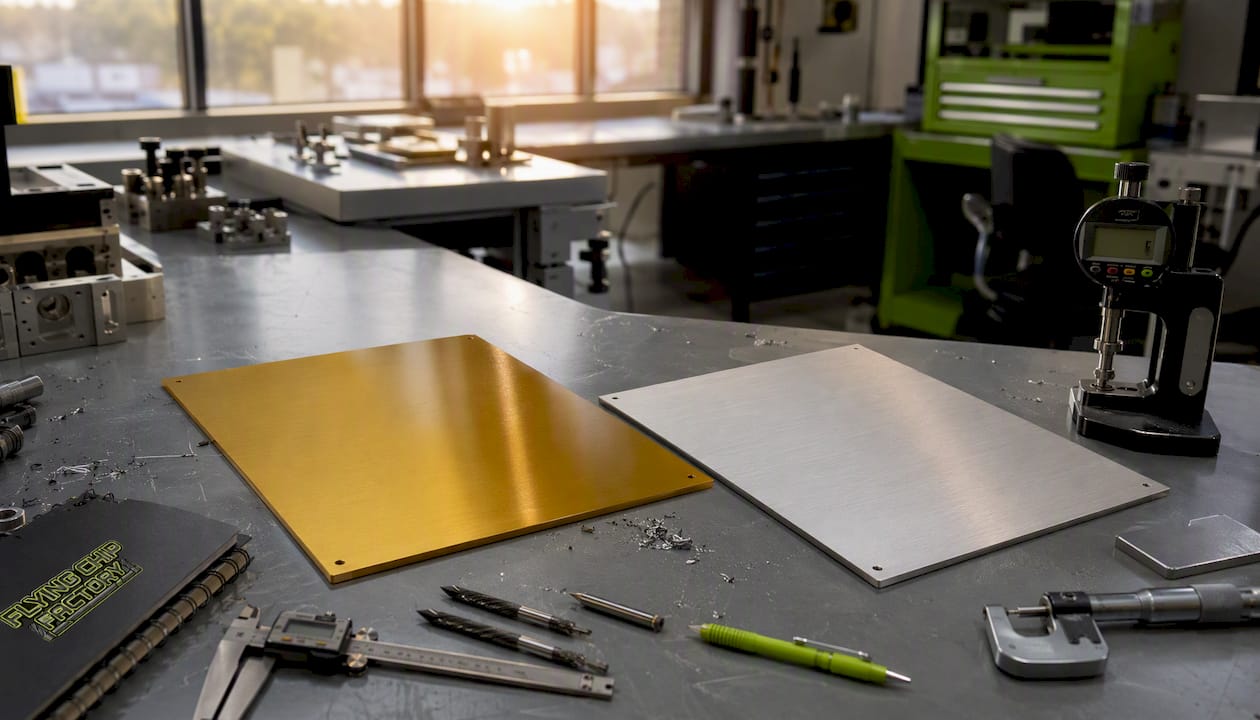
Quick rule of thumb: If the drawing calls for electrical grounding or very tight part tolerances on critical fits, specify chem film. If the part will see abrasion, UV exposure, or a customer-facing color requirement, specify anodize. The alloy and sealing columns are the most spec-sensitive cells in that table.
How does each process actually work?
Understanding the mechanism matters when you are writing a spec or coordinating with a finishing shop. The two processes are fundamentally different at the chemistry level, which is why their performance profiles diverge so sharply.
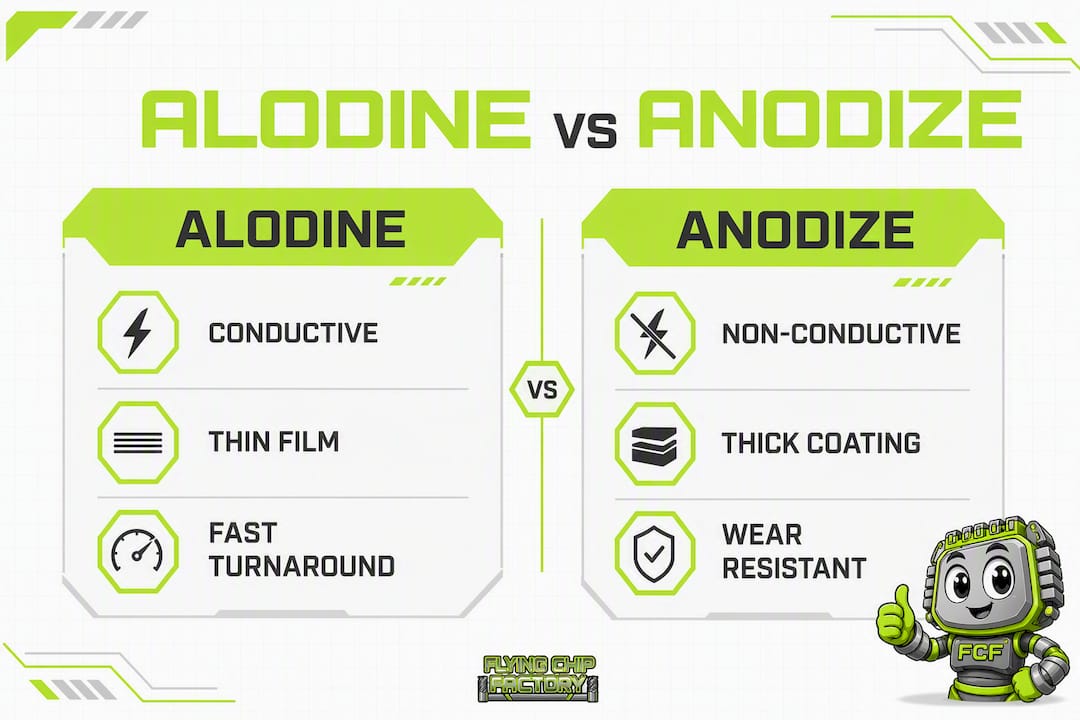
Alodine / chem film (chromate conversion coating)
Chromate conversion works by chemically reacting with the aluminum surface to produce a thin, amorphous chromate layer that is integral to the metal. No electrical current is involved. The coating is typically very thin, adding virtually no measurable dimension to the part.
- Clean and degrease the part to remove oils, chips, and oxides.
- Etch lightly in an alkaline or acid solution to expose fresh aluminum.
- Desmut to remove smut left by the etch, especially on high-copper alloys.
- Apply the chromate bath (Alodine or equivalent) for 1–5 minutes at room temperature.
- Rinse thoroughly in deionized water.
- Air dry or low-temperature oven dry; no sealing step required.
The resulting film stays electrically conductive because it is thin enough that electrons pass through it freely.
Anodize (Type II and Type III)
Anodizing grows an aluminum oxide layer electrochemically. The part is submerged in a sulfuric acid bath and connected as the anode; current drives oxygen ions into the surface, converting aluminum to Al₂O₃. The oxide grows both inward and outward from the original surface, which is why it changes part dimensions. Type II (conventional sulfuric acid anodize) produces a porous layer suitable for dyeing and sealing. Typical thickness varies depending on time and current density, generally greater than chem film thickness.
- Clean, degrease, and etch more aggressively than for chem film.
- Desmut to remove intermetallic compounds exposed by the etch.
- Anodize in sulfuric acid bath at controlled temperature and current.
- Dye (optional, Type II only) while pores are still open.
- Seal in hot deionized water or nickel acetate to close pores and lock in dye.
- Rinse and dry.
Type III hardcoat uses a colder electrolyte and higher current density to grow a denser, harder oxide with thickness notably greater than Type II anodize. That extra thickness is why hardcoat changes part dimensions enough to require pre-machining allowances on tight fits.
Pro Tip: When coordinating with a finishing shop, send a dimensioned print with finish callouts before quoting. Shops need to know whether to leave stock for anodize build-up on bores and shafts, or whether a chem film spec allows them to finish to final dimension.
How do the finishes perform on the dimensions that matter?
| Performance Attribute | Alodine / Chem Film | Type II Anodize | Type III Hardcoat |
|---|---|---|---|
| Salt spray (ASTM B117) | 168–336 hrs typical with topcoat | 336 hrs when sealed | 336 hrs when sealed |
| Hardness | Soft (base aluminum hardness) | — | — |
| Electrical resistivity | Low (conductive) | High (insulating after seal) | High (insulating after seal) |
| Paint adhesion | Excellent (ASTM D3359 cross-cut) | Good with etch primer | Good with etch primer |
| Thickness | 0.25–1 µm | 5–20 µm | 25–50 µm |
| Sealing required? | No | Yes for full corrosion resistance | Yes for full corrosion resistance |
Corrosion resistance is where sealing makes or breaks the anodize spec. Unsealed Type II anodize has open pores that absorb contaminants; sealed anodize is significantly more resistant. Chem film without a topcoat provides moderate corrosion protection on its own, adequate for interior structural parts but not for prolonged outdoor or marine exposure.
Wear and hardness favor anodize, especially Type III. Hardcoat anodize reaches hardness values comparable to hard chrome in some alloy-process combinations. Chem film adds no meaningful hardness; the part wears at the base aluminum rate.
Electrical behavior is the sharpest dividing line. Anodize is non-conductive after sealing; conversion coatings remain conductive unless overcoated with an insulating layer. For RF enclosures, chassis grounding, and bonding jumpers, chem film is the only sensible choice between the two.
Paint adhesion is where chem film earns its place even on parts that will eventually be painted. Chromate conversion coatings increase paint adhesion and are a standard pretreatment in aerospace primer systems. Anodize also accepts paint well, but the chem film surface is the preferred base when conductivity must be preserved under the paint.
Pro Tip: On first articles, request the vendor's salt spray test report (ASTM B117) and a thickness measurement (ASTM B244 for anodize, ASTM B530 for chem film). Do not accept verbal confirmation of compliance on a new finish vendor.
When should you specify each finish?
The performance data above translates into a short set of decision rules you can quote directly in a design review.
Alodine / chem film is the right call when:
- The part is an RF enclosure, chassis, or bonding point where electrical continuity is required.
- Tolerances are tight enough that even 5–20 µm of anodize build-up would affect fit (bores, shafts, precision slots).
- The part is a prototype or short run where cost and lead time matter more than long-term surface durability.
- The part will be painted and the primer system requires a conductive or chromate-compatible base.
- The alloy is a high-copper series (2024, 2219) that anodizes unevenly.
Anodize is the right call when:
- The part faces wear, sliding contact, or abrasion (Type III for severe cases).
- The part will be exposed to outdoor weathering, UV, or salt spray without a topcoat.
- Color or appearance is a customer requirement. Anodize can be dyed nearly any color before sealing; Alodine produces only clear or yellow-gold tones.
- Long service life with minimal maintenance is the goal.
- The part is architectural trim, consumer-facing hardware, or a branded component.
Decision rules for drawings:
- Electrical grounding required → Specify MIL-DTL-5541, Class 1A or 3, chem film.
- Wear or abrasion resistance required → Specify MIL-A-8625, Type III, Class 1 hardcoat anodize.
- Color or dye required → Specify MIL-A-8625, Type II, Class 2 (dyed), with sealing.
- Paint pretreatment on aluminum → Specify MIL-DTL-5541 chem film as primer base.
- Tight bore or shaft tolerance (±0.001 in or tighter) → Specify chem film; flag to shop if anodize is required so stock allowance can be added.
What shop-level constraints affect your finish choice?
Finish selection does not end at the drawing. How the part is made, what alloy it is, and how the shop handles masking all affect whether the specified finish comes out right.
Surface preparation differences
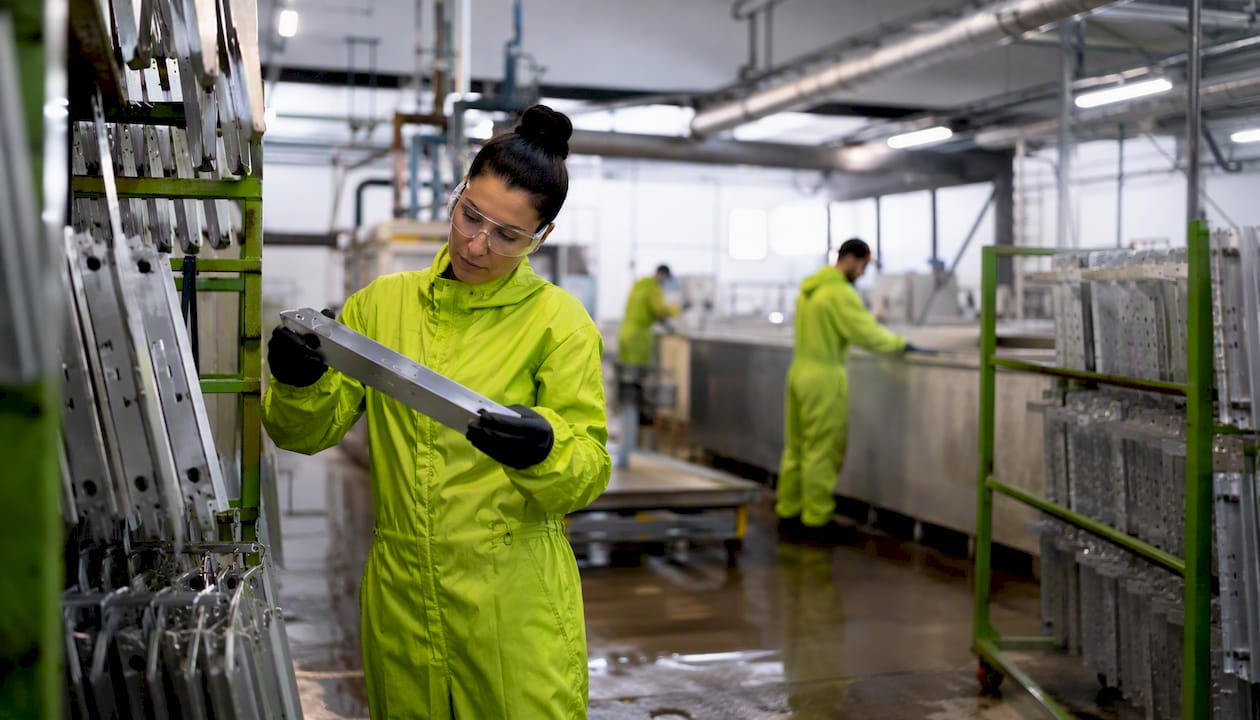
Anodize demands more aggressive surface prep than chem film. The etch step for anodize removes more base material and can alter surface finish Ra values, which matters on sealing surfaces or optical flats. Chem film prep is gentler: degrease, light etch, desmut, done. If a part has a ground surface or a lapped face, confirm with the finishing shop that their etch process will not degrade it.
Masking and feature geometry
Threaded holes, blind bores, and deep slots trap acid and rinse water. For anodize, these features typically need plugs or tape masks to prevent over-etching and to keep the bath clean. Chem film is more forgiving because the bath chemistry is milder, but blind holes still need attention to avoid pooling. Parts with complex internal geometry cost more to mask and rack, which shows up in the quote.
Alloy compatibility
6061-T6 is the benchmark alloy for both processes. 5052 and 5083 anodize well. 2024 and 7075 are trickier: their high copper and zinc content, respectively, can produce uneven anodize color and reduced corrosion performance. Electroless nickel plating is sometimes the better call on 2024 when both wear and corrosion resistance are needed, because it deposits a uniform layer regardless of alloy composition. Chem film works on a broader range of aluminum alloys without the color variation risk.
Repairability
Chem film can be touched up in the field with a brush-on Alodine solution (Alodine 1132 pen applicators are common in aerospace MRO). Anodize cannot be locally repaired; a damaged anodized part either gets stripped and re-anodized or lives with the defect. For parts that will see handling damage or field repair, chem film's repairability is a real operational advantage.
Pro Tip: If a part will be re-machined or reworked after finishing, specify chem film. Stripping and re-anodizing a part removes base material each cycle; after two or three strip-and-re-anodize cycles, tight tolerances are gone.
How do cost and lead time factor into the decision?
Chem film is typically faster and cheaper than anodizing. The process runs at room temperature, requires no rectifier setup, and the bath chemistry is simpler to maintain. For a small prototype batch, chem film can often turn around in one to two days. Anodize requires bath temperature control, current density management, and a sealing step, which adds time and process complexity.
The cost drivers for anodize are bath setup, rack fixturing, dyeing (if specified), sealing, and waste disposal. Hexavalent chromium in chem film baths carries its own regulatory cost: shops must manage Cr6+ waste streams under EPA and state environmental rules, which is factored into their pricing. Trivalent chromate alternatives (RoHS-compliant) are available but may not meet all MIL-DTL-5541 requirements, so confirm compliance with your finishing vendor if RoHS matters for your end market.
For short runs of five to twenty-five parts, the per-part cost difference between chem film and Type II anodize is usually modest. The gap widens with Type III hardcoat, which requires colder bath temperatures, higher energy, and longer cycle times. Hardcoat makes sense when the wear data justifies it; specifying it on a part that only needs moderate corrosion protection is money left on the table.
The lifecycle argument favors anodize on production parts that face real environmental exposure. A chem film part without a topcoat will need maintenance or replacement sooner than a sealed anodized part in the same environment. For a prototype or a first-article run where you are still validating geometry, chem film's lower cost and faster turnaround usually win.
Which U.S. standards should you call out on drawings?
Ambiguous finish callouts are one of the most common sources of rework and vendor disputes. These are the specs to reference:
- MIL-DTL-5541 — covers chemical conversion coatings on aluminum and aluminum alloys. Class 1A is for maximum corrosion protection; Class 3 is for lower electrical resistance (thinner coating). A complete callout: "Chem film per MIL-DTL-5541, Class 3."
Acceptance criteria starting points: Type II anodize at 10–20 µm for general use; Type III hardcoat at 25–50 µm; chem film at 0.25–1 µm. Salt spray minimums are typically 336 hours for Type II sealed and 168 hours for chem film per MIL-DTL-5541 Class 1A.
How Flying Chip Factory coordinates finishing on prototypes and short runs
At Flying Chip Factory, finish selection comes up during quoting, not after the parts are machined. When a customer sends an RFQ for an aluminum prototype, the first question is whether the drawing calls out a finish spec or just says "anodize" or "Alodine" with no class or type. Vague callouts cost time and money because the finishing shop has to guess, and they usually guess conservatively (which means more expensive).
A typical workflow: the customer sends a drawing, we flag any finish callout that lacks a MIL spec or thickness requirement, and we either clarify with the customer or note the assumption in the quote. For electrical enclosures and chassis parts, we default to recommending MIL-DTL-5541 Class 3 chem film unless the drawing explicitly requires anodize. For wear parts and anything customer-facing, we push toward Type II or Type III anodize and note the dimensional allowance needed on bores and shafts.
For prototype runs, we often machine parts to final dimension for chem film, or leave 0.0005–0.001 in of stock on critical fits when anodize is specified, then verify after finishing. That extra step catches dimensional issues before a full production run.
Pro Tip: Put the finish spec on the drawing before you send the RFQ, not after. A drawing that says "MIL-A-8625, Type II, Class 1, 10–15 µm" gets a more accurate quote than one that says "anodize TBD." Shops price uncertainty into their quotes.
Key Takeaways
Alodine preserves conductivity and holds tight tolerances; anodize delivers wear resistance, color, and long-term corrosion protection. Specifying the correct MIL standard on the drawing is what separates a clean first article from a rework cycle.
| Point | Details |
|---|---|
| Conductivity drives the Alodine choice | Chem film stays conductive; sealed anodize is non-conductive. Specify MIL-DTL-5541 Class 3 for grounding applications. |
| Anodize thickness changes dimensions | Type II adds 5–20 µm; Type III adds 25–50 µm. Leave stock on bores and shafts when anodize is required. |
| Hardcoat only when wear data justifies it | Type III anodize costs more and takes longer. Specify it only when abrasion resistance metrics require it. |
| Chem film is faster and cheaper for prototypes | Alodine typically turns around in one to two days and costs less than anodize for small batches. |
| Flying Chip Factory | The shop flags finish spec gaps at quoting and coordinates chem film or anodize finishing for aluminum prototypes and short runs. |
The finish decision most engineers get wrong
The most common mistake is treating "anodize" as a default quality upgrade. Engineers specify Type II anodize on a prototype electrical enclosure because it looks better and sounds more durable, then discover the chassis ground path no longer works because the anodize is non-conductive. The part has to be stripped, re-finished with chem film, and re-tested. That is a two-week delay on a prototype that should have shipped in five days.
The second mistake runs the other direction: specifying chem film on a part that will see real wear or outdoor exposure because it is cheaper and faster. Chem film without a topcoat is not a long-term corrosion solution. It is a primer base and a conductivity preserving treatment. Treating it as a substitute for sealed anodize on an exposed structural part is a maintenance problem waiting to happen.
What actually matters is matching the finish to the functional requirement, not to a default or a cost target. The conductivity question and the dimensional tolerance question answer themselves if you ask them before the part is machined. The wear and exposure questions answer themselves if you look at the service environment honestly. The spec language question answers itself if you use MIL-A-8625 and MIL-DTL-5541 instead of generic callouts.
The shops that get this right are the ones that ask about the finish during quoting, not after the parts are on the bench.
Flying Chip Factory handles finishing coordination from the first quote
When you are machining aluminum prototypes or short-run production parts, the finish decision affects tolerances, lead time, and cost from day one. Flying Chip Factory coordinates chem film and anodize finishing as part of the quoting process, so the spec is locked before the first chip flies. You get direct access to a machinist who knows the difference between a Class 3 chem film callout and a Type III hardcoat spec, and who will flag dimensional allowances before they become a rework problem.
Whether you need a quick-turn aluminum prototype with MIL-DTL-5541 chem film or a short production run of anodized wear parts, Flying Chip Factory gives you a clear quote with the finish spec included. Request a quote at Flying Chip Factory and get a machinist on the phone, not a sales rep.
Useful sources and specs
These are the primary references used in this article. Send the MIL spec pages to your finishing vendor when placing a purchase order.
- MIL-DTL-5541 (Wikipedia overview): Background on the chromate conversion coating spec, class definitions, and regulatory context including RoHS and Cr6+ restrictions.
- Anodizing Institute: What Is Anodizing?: Authoritative process background from the Aluminum Anodizers Council; useful for understanding Type I, II, and III distinctions.
- NAMF: Chem Film vs Anodize: Concise industry explanation of conductivity and process differences; good reference for design review discussions.
- Best Technology Inc.: What Is Alodine / Chem Film?: Process overview and paint adhesion context for chromate conversion coatings.
- Pioneer Metal: Anodizing FAQ: Practical answers on Type II vs Type III, thickness ranges, and electroless nickel comparisons.
- PFI Inc.: Electroless Nickel vs Anodizing: Useful when the application requires comparing additive coatings (electroless nickel) against conversion-based anodize.
- ChemResearchCo: Chem Film vs Anodize: Cost and lead time context for prototype and short-run decisions.