
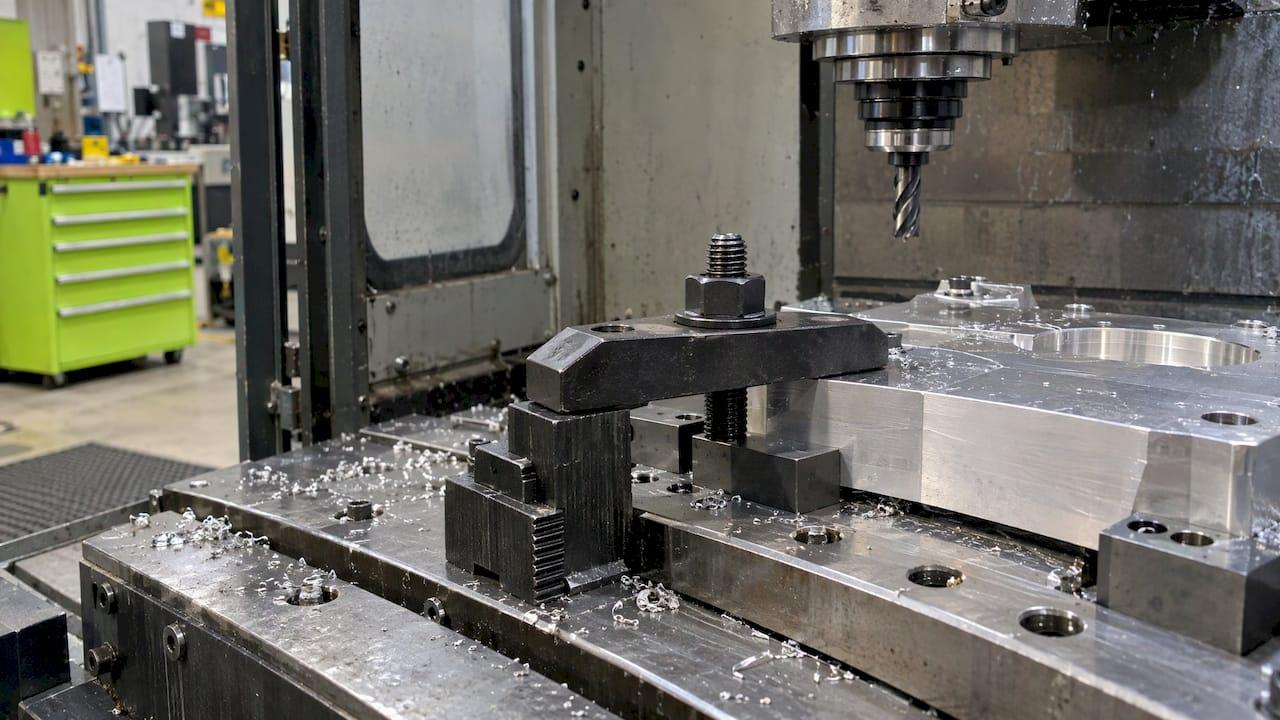
Fixture clamps fall into two broad classes: manually operated clamps (strap, toe, screw, swing, edge, C, cam and toggle) and power-operated clamps (hydraulic and pneumatic). Which one is right depends on how often you load the part, how much the part varies, how much room you have around it and how hard the cutter pushes. This guide walks through each type, shows where it earns its place, and gives you a way to choose. If you would rather hand the fixture design to a machinist, we make fixtures, brackets and support parts in our own shop.
TL;DR
- Manual clamps (strap, toe, screw, cam, toggle) suit prototypes, short runs and repeat jobs where an operator loads each part by hand.
- Toggle clamps come in vertical, horizontal, push-pull and latch styles. Lever position when clamped, and the space around the part, decide which one fits.
- Hydraulic and pneumatic clamps add power and automation, and retracting versions clear the way for loading.
- A clamp's catalog rating is its holding capacity when locked. The force it actually applies depends on the operator and the setup.
- Choose by part size and variation, holding force, clearance, cycle frequency and environment, not by clamp name alone.
What a fixture clamp does
A fixture clamp presses a located workpiece against the fixture's locating surfaces so the part stays put while the cutting tool pushes on it. One workholding guide puts it this way: locators position the part, and clamps keep it there against cutting and process forces.
That is different from a general-purpose vise. Fixture clamps are described as part of a purpose-built workholding system, shaped around a particular part geometry and machining operation. The same overview notes that actuation can be hydraulic, pneumatic or mechanical, and that the job is to stabilize the part against cutting forces and vibration.
Two jobs, then: locate, then clamp. Clamps that try to do both usually do neither well. Our guide on fixture design basics for engineers covers locating strategy in more depth.

Manual clamps: the everyday family
Manual clamps are the workhorses of prototype and short-run work. The common manual families are strap, screw, swing, edge, C, cam and toggle clamps. Here is how the main ones behave.
Strap clamps
A strap clamp applies downward pressure with one end on the part and the other end supported by a step block. According to the CNC fixture components handbook, step blocks can be stacked to different heights, so one strap setup adapts to parts of different thickness.
Where it goes wrong: a strap that is not level pushes the part sideways as well as down, and a step block that is shorter than the part surface tilts the strap. Keep the bolt close to the part, not close to the block, so most of the force lands on the workpiece.
Toe clamps
Toe clamps mount to the table or fixture plate. The same handbook explains that the nose grips the part and is driven against it and downward as you turn a screw. They suit work where a strap would be in the toolpath, because the clamp sits low and to the side.
Screw, swing and edge clamps
Screw clamps squeeze a part between a fixed surface and a threaded pad. Swing clamps pivot out of the way so you can load and unload quickly, then swing back over the part. Edge clamps grip along the part's edge, leaving the top face open for machining. Each trades a little speed or rigidity for access, so match the choice to which faces you need to cut.
C clamps and cam clamps
C clamps are the familiar, flexible choice for setups and temporary holding. Cam clamps lock with a rotating eccentric, which makes them fast. A guide on toggle and cam clamping notes that cam clamps may suit parts with larger thickness variation than toggle clamps do.
Toggle clamp types
Toggle clamps are the answer to a very common question: how do I clamp the same part quickly, hundreds of times, with no tool in my hand? A lever and toggle linkage turn a large handle movement into a smaller clamping-arm movement, and the linkage locks after passing dead center. A 2025 technical appendix adds that once the mechanism is locked over center, it cannot unlock unless the linkage is moved. That is why a toggle clamp holds without constant operator effort.
The main toggle clamp styles are vertical, horizontal, push-pull and latch.
| Type | How it works | Best for |
|---|---|---|
| Vertical hold-down | Handle stands upright when clamped; the arm pushes down on the part | Parts with open space above the clamp |
| Horizontal hold-down | Handle lies flat when clamped; same holding action in a lower profile | Fixtures with limited overhead clearance |
| Push-pull | Operates in both directions and typically locks in both | Pulling or pushing a part against a stop, sliding workpieces |
| Latch | A horizontally acting U-bolt hooks and tensions | Pulling two surfaces together, such as covers or fixture halves |
Vertical versus horizontal
Vertical clamps apply downward force, and one manufacturer's catalog says they offer at least a 90-degree opening angle for loading and unloading. Horizontal clamps use the same basic action but a lower-height design, with the handle and clamping bar moving in opposite directions.
So a horizontal toggle clamp is simply a hold-down clamp whose handle lies flat when closed. Use it when you have a spindle, a guard or a second fixture plate close overhead. Another source confirms the same split: vertical handles stand up when clamped, horizontal handles lie down.
Four actions
A different way to sort toggle clamps is by action. One engineering guide lists vertical, pushing, pulling and squeezing actions, with horizontal-handle and reverse-handle variants within vertical action. Think about the direction of force you need first. The handle style follows from that and from the space you have.
Power clamps: hydraulic and pneumatic
When the cycle time gets short or the part count gets large, an operator with a handle becomes the bottleneck. Power-operated clamps take over. The same guide that lists manual families says pneumatic and hydraulic clamps can deliver hold-down, swing or linear motions. Retracting clamps move forward, pivot down to clamp, and retract again so the operator or robot has clear access to load the part.
Some designs overlap the manual and powered classes, so treat the categories as a guide, not a wall.
Power clamping makes the most sense when you have:
- many identical parts per setup, or multiple parts clamped at once;
- a need for repeatable force from one cycle to the next;
- tight loading windows, such as pallet changes or multi-part tombstones.
It does not make sense for a one-off prototype. The plumbing, the manifold and the design time cost more than the setup saves. For thin or delicate parts that a mechanical clamp would distort, our guide to vacuum fixture design and clamping force shows another route to holding without pressure on the edges.
How to choose: a practical checklist
Start with the part, then the process, then the operator. DESTACO recommends weighing part size and shape, how uniform the parts are, holding capacity, operator strength, dexterity and position, operating frequency, cycle time and sequence, and the environment.
Sandfield's guide adds a sizing checklist: required holding force, available space, reach from pivot to clamping point, and clearance beneath the clamp bar.
Here is how that turns into a decision.
| Your situation | Clamp family to look at first |
|---|---|
| Prototype, one or a few parts, varied shapes | Strap and toe clamps with step blocks |
| Repeated loading, consistent part thickness | Toggle clamps |
| Repeated loading, noticeable thickness variation | Cam clamps, or toggle clamps with springs or spring washers |
| Tight overhead clearance | Horizontal toggle clamps |
| Pulling parts together or against a stop | Push-pull or latch toggle clamps |
| High volume, short cycles, automation | Hydraulic or pneumatic clamps, retracting where access matters |
The guide on toggle clamps says they suit repeat applications and parts with little thickness variation, and that springs or spring washers can absorb some variation.
Worked example
Say you have a 6061 aluminum bracket, 0.25 inch thick, and you plan to run 50 of them. You need the top face open for a pocket and the edges open for a profile pass. A strap clamp would block the toolpath. A toe clamp can hold the part from the side, and a pair of horizontal toggle clamps can hold it at the end of the fixture where there is a spindle overhead. Locators set the part position first, and the clamps only have to keep it there. That pairing is a typical fixture for a short run, and it loads in seconds.
Holding capacity is not clamping force
One trap catches many engineers. DESTACO's appendix distinguishes holding capacity from applied clamping force: the catalog rating is the force sustained in the closed, locked state, while the actual force depends on things like operator effort and spindle position. So a rating is a ceiling for the clamp, not a promise about your setup. Size the clamp with margin, and work out the cutting forces separately. Our article on clamp force calculation with torque, K-factor and bolt size shows the screw-based math.
Making the fixture around the clamp
A clamp is only as good as the plate, jaws, pads and stops around it. The most common problems are not in the clamp at all:
- Force without support. Clamping a part where nothing is underneath bends it. Put the clamp over a support or locator.
- Clamps in the toolpath. Plan the clamp positions with the toolpaths, not after.
- Wrong-way loading. If a part can go in backward, eventually it will. Poka-yoke fixtures are designed so it cannot.
- Slow changeovers. Repeated setups eat the margin on small runs. Quick-change fixturing and modular fixturing cut that time.
For round or turned work the clamping conversation changes entirely, and lathe workholding options cover chucks, collets and mandrels. If a part needs a self-centering grip on a milled feature, dovetail workholding is worth a look.
Where we come in
We design and CNC-machine parts in our own shop in Athens, Alabama. For engineers, designers and small manufacturers, that includes prototype machining, short-run production, and fixtures, brackets and support parts. Every job is handled directly by the machinist who builds it, so questions about clamp placement, pad material or locator layout go to the person cutting the part, with no sales intermediary in between.
If you have a part that needs a fixture, or a fixture that needs a better bracket, send us the part and describe the run. You can see what we make on our main page.

Our perspective
Most clamping problems we see on paper begin before a clamp is picked. The part has no clear datum, the fixture has no clear job, and the clamp gets asked to fix both.
We build products and run customer jobs from the same shop, so we think about clamps the way a rider thinks about a bolt-on part: it has to fit, it has to hold up, and it has to be straightforward to use. Our E2 Kickstand and our customer fixtures follow the same rule. Design it for the real forces, machine it cleanly, and keep the person who designed it close to the person who cuts it.
That is why direct access to the machinist matters. A clamp location moved by half an inch, a locator added, a pad changed: those are five-minute conversations when the machinist is on the line, and week-long email chains when they are not.
Drake
FAQ
What are the four main types of clamps?
There is no single official list, but the most common families in workholding are strap, screw, toggle and cam clamps. Many guides add C clamps, swing clamps and edge clamps. Power-operated hydraulic and pneumatic clamps form a separate class for automated or high-volume work.
What is a horizontal toggle clamp?
It is a hold-down toggle clamp whose handle lies flat when the clamp is closed. It applies the same holding action as a vertical toggle clamp, in a lower profile. Use it where overhead clearance is tight.
What is the difference between a fixture clamp and a vise?
A vise is a general-purpose holding device that fits many parts. A fixture clamp is part of a purpose-built workholding setup, arranged around the geometry of one part and the operations it needs.
Which toggle clamp type should I pick?
Choose by the direction of force and the space around the part. Vertical hold-down fits when there is room above, horizontal when there is not, push-pull when you need to push or pull in both directions, and latch when you are drawing two surfaces together. Then check holding capacity, reach and clearance under the clamp bar.
Sources
- Fixture clamping solutions: manual and power-operated clamp families
- Fixture clamps and workholding overview
- CNC handbook: fixture components
- Toggle clamp types and how the linkage works
- 2025 technical appendix on clamp selection and holding capacity
- Toggle clamp catalog: vertical and horizontal hold-down clamps
- Engineering guide to toggle clamp actions and sizing