
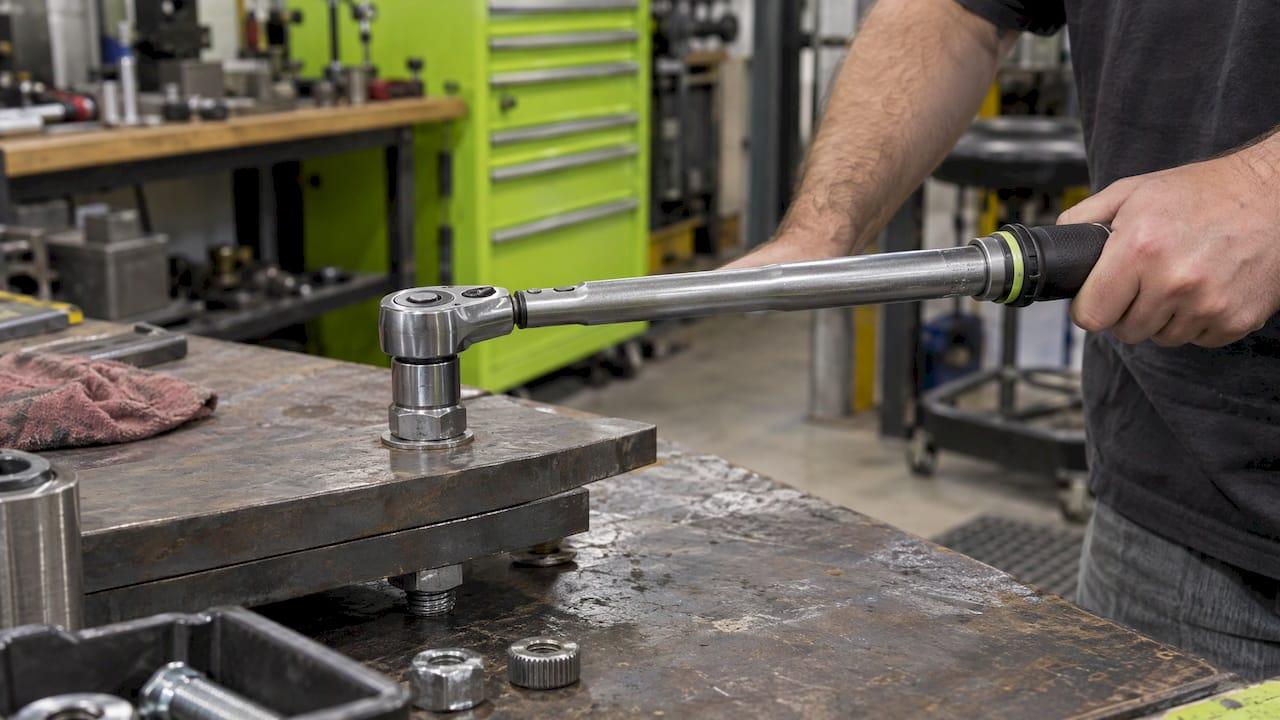
To estimate clamp force from tightening torque, use F = T ÷ (K × D). T is the applied torque, K is the dimensionless nut factor (torque coefficient), and D is the nominal bolt diameter. RoyMech gives the same relationship as T = K·Fp·d, so you can solve it for preload. The result is an estimate, not a measurement, and almost all of the uncertainty sits in K. This guide covers the formula, the units, a worked example, K values for common conditions and the point where you should stop trusting torque.
TL;DR
- Clamp force F = T ÷ (K × D). Keep torque and diameter in consistent units, and convert lb-ft to lb-in before dividing.
- K depends on friction. Dry steel is typically near 0.20, and oiled or lubricated threads are lower, so the same torque gives more clamp.
- Only about 10–15% of input torque becomes clamp force. The rest is lost to thread and underhead friction.
- Check the answer against the bolt's proof load and the joint's required clamp load, and allow for scatter.
- For critical joints, measure bolt stretch or tension instead of relying on torque alone.
The clamp force formula
The most widely used approximate relationship between tightening torque and preload is T = K·Fp·d: torque equals the empirical nut factor times the desired preload times the nominal diameter. Rearranged, the clamp-force form is F = T/(K×D).
The variables:
- F: clamp force (preload) in N or lbf
- T: applied torque in N·m or lb-in
- K: nut factor, dimensionless
- D: nominal bolt diameter in m or inches
The formula works because torque and clamp force are linear in the elastic range. A PCB white paper describes T = K·D·F as a practical starting point once prevailing torque and alignment effects are accounted for.
Clamp force, clamp load and preload
The three terms get used loosely. Nord-Lock defines preload as the tension created in the fastener when it is tightened, and clamp force as the compressive force acting on the clamped parts in response. In an ideal, perfectly parallel joint they are equal. In real joints they can diverge because of settling, distortion and dynamic loads.
For day-to-day torque calculations, treat clamp force, clamp load and preload as the same number: the tension you are trying to put in the bolt.
Units: the usual source of mistakes
The calculation works in any consistent system. Engineers Edge notes you can use N·mm with mm and N, or in-lb with inches and lbf.
Three safe combinations:
| Torque | Diameter | Clamp force |
|---|---|---|
| N·m | meters | N |
| N·mm | mm | N |
| lb-in | inches | lbf |
If your wrench reads in lb-ft, multiply by 12 to get lb-in before dividing by diameter in inches. A common slip in metric work is entering an M10 as 10 instead of 0.010 m, which makes the answer 1,000 times too small.
Worked examples
Metric: M10 Class 8.8
Baetro's example tightens an M10 Class 8.8 bolt to 48 N·m with a lightly oiled K of 0.15:
F = 48 ÷ (0.15 × 0.010) = 32,000 N, or 32.0 kN.
That is 94% of the roughly 34.0 kN proof load for Class 8.8, which is already aggressive. It shows how quickly a low K pushes a bolt toward yield.
Imperial: 3/8-in bolt
Suppose you tighten a 3/8-in bolt (0.375 in) to 30 lb-ft with K = 0.20. First convert: 30 × 12 = 360 lb-in.
F = 360 ÷ (0.20 × 0.375) = 4,800 lbf.
This is our own arithmetic using the formula above. Change K to 0.15 and the same torque gives 6,400 lbf, a third more clamp. That is why lubrication changes the answer so much.
Choosing K: friction decides the result
K bundles geometry, thread friction and underhead friction. PCB splits it into three factors: K1 geometric, K2 thread friction, K3 underhead friction.
ToolGrit lists nominal values:
| Condition | Nominal K |
|---|---|
| Dry, unplated (black oxide) | 0.20 |
| Zinc plated, dry | 0.17 |
| Oiled | 0.15 |
| Anti-seize | 0.12 |
| Moly paste | 0.10 |
The same source puts the typical scatter at ±25% for any K. DuPont says K typically falls between 0.1 and 0.25, and recommends testing the lubricant together with the fastener. PEM suggests 0.20 as a starting point for dry zinc-plated hardware, within a 0.10 to 0.30 range.
For a derived value, Applied Mechanics shows that the full torque expression reduces to K ≈ 0.2 for unlubricated steel bolts.
Why only 10–15% of torque clamps
Atlas Copco's guide says about 10% of applied torque becomes clamping force, with roughly 40% lost to thread friction and 50% to friction under the head. Lubrication shifts that balance. At the same torque more load converts to clamp force, which can over-tension the screw, while a completely dry screw can give too little clamp and risk loosening.

Checking the result against the bolt and the joint
A number from the formula means little until you compare it with two limits.
Upper limit: the bolt
A common target is about 70% of yield. Applied Mechanics gives F0 = 0.7·Rp0.2·As for a steel bolt tightened dry, with a tightening moment of roughly 0.2·F0·d. Here Rp0.2 is yield strength and As is tensile stress area. Sabre Industrial's chart assumes usable strength is 75% of proof load times tensile stress area. ASEE researchers note that optimal torque techniques approach 75–85% of tensile yield.
Lower limit: what the joint needs
The required clamp force depends on the job. FVA-Service describes a check in which the minimum residual clamp load must exceed the load needed for friction grip, sealing and preventing the joint from opening, giving a slip safety factor above 1.0. RoyMech's design checklist adds preload scatter, losses from settlement, embedding and gasket relaxation, and fatigue from fluctuating load.
A practical sequence:
- Establish the clamp force the joint needs to avoid slip, separation or leakage.
- Pick a bolt class that supplies it with margin below about 70–75% of proof or yield.
- Choose K for your actual finish and lubricant.
- Calculate torque as T = K·D·F.
- Allow for scatter and for embedding loss after assembly.
When the torque method breaks down
Torque is a stand-in for clamp force, not a measurement of it. Atlas Copco notes that clamping force can rarely be measured in normal production, so torque is used as the control variable.
The cost of that shortcut can be large. A Bolt Science case study needed at least 41 kN, but torque tightening scattered between 25 kN and 40 kN. For critical joints, ToolGrit recommends measuring bolt stretch with ultrasonic methods or direct tension indicating washers. Torque-angle tightening is another route. Bolt Science also warns that torque readings can drift by as much as 20% if bolts stand for two days, because of embedding and friction changes.
If you can, determine K experimentally for the exact fastener, finish and lubricant, using a load cell or force washer.

Other clamps: pneumatic and two-bolt
Searches for clamp force also reach different mechanisms.
- Pneumatic link clamp: Vektek gives F = F_cyl × (B ÷ C) × E. F_cyl is pressure times piston area, B and C are lever lengths, and E is efficiency.
- Two-bolt clamp under axial load: CalcDevice states the tightening force is F = 1.2 × P ÷ (2μ), where P is axial load and μ is the friction coefficient at the clamped surface.
Neither uses a nut factor, so do not mix them with the bolt formula above.
Thread design affects the clamp you actually get
A clamp calculation assumes the threads can carry the load. In tapped holes, thread length matters as much as torque. Our guide on thread engagement length covers the 1.3×D rule, and aluminum thread design explains when inserts are the better call. If you use stainless fasteners, read about preventing thread galling, since galling wrecks the K you assumed.
Perspective
We machine brackets, fixtures and motorcycle parts in one shop, and the torque question comes up constantly. Our view: a clamp-force number is only as good as the part holding the bolt. Clean, correctly sized threads with proper engagement make K predictable, and that is what makes a torque spec meaningful.
That is why we design and machine our own parts, such as the E2 Kickstand, with fastener loads in mind, and why customers talk straight to the machinist who builds the part. If your joint needs a specific preload, tell us early and we can build the threads, bosses and bearing faces around it.
Drake
Need parts built around your clamp load?
If you are designing a joint and want threaded parts machined to suit, we do prototype machining, short-run production, and fixtures, brackets and support parts, with direct access to the machinist. Send your drawing through our CNC machining services.

Riders with a KTM SX-E 2, GASGAS MC-E 2 or Husqvarna EE 2 can also see our bolt-on E2 Kickstand, listed at 100-105 $.
FAQ
What is the formula for clamp force?
F = T ÷ (K × D), where T is tightening torque, K is the nut factor and D is nominal bolt diameter. Use consistent units. The result is an estimate because K varies with friction.
What K value should I use?
A value of 0.20 is a common starting point for dry steel. Oiled threads are about 0.15, and anti-seize or moly paste is lower. Expect roughly ±25% scatter, so test the actual fastener and lubricant if the joint is critical.
Why does lubricant change clamp force?
Lubricant cuts friction in the threads and under the head, so more of the same torque turns into bolt tension. That can over-tension a bolt tightened to a dry-thread torque spec.
How do I check that a bolt is not over-tightened?
Compare the calculated force with the bolt's proof load or yield strength. A common target is about 70–75% of that limit. For critical joints, measure bolt elongation or tension directly.
Sources
- RoyMech: Bolt Preload, Joint Stiffness, Tightening Torque and Clamp Force
- RivCut: Bolt Clamping Force and Torque Calculator
- PCB: Threaded Fastener Design and Analysis
- Nord-Lock: Preload and clamp force under external loads
- Sensorise: Clamping Force and Bolt Elongation
- Engineers Edge: Bolt Torque Calculator
- Bolt Clamp Force Calculator (unit conversion)
- Baetro: Bolt Clamp Force Calculator
- ToolGrit: Bolt Torque to Clamping Force Guide
- DuPont: Know Your Fastener K-Factor
- PEM: Tightening Torque
- Applied Mechanics: Bolted joints
- Atlas Copco: Pocket Guide to Tightening Technique
- Sabre Industrial: Bolt Clamping Force chart
- ASEE: Tightening Torque and Clamp Force
- FVA-Service: Bolted joints
- Bolt Science: Torque-angle tightening case study
- Bolt Science: Quality Control in the Tightening of Bolts
- Vektek: Pneumatic Link Clamps
- CalcDevice: Two-bolt Clamp Calculator