
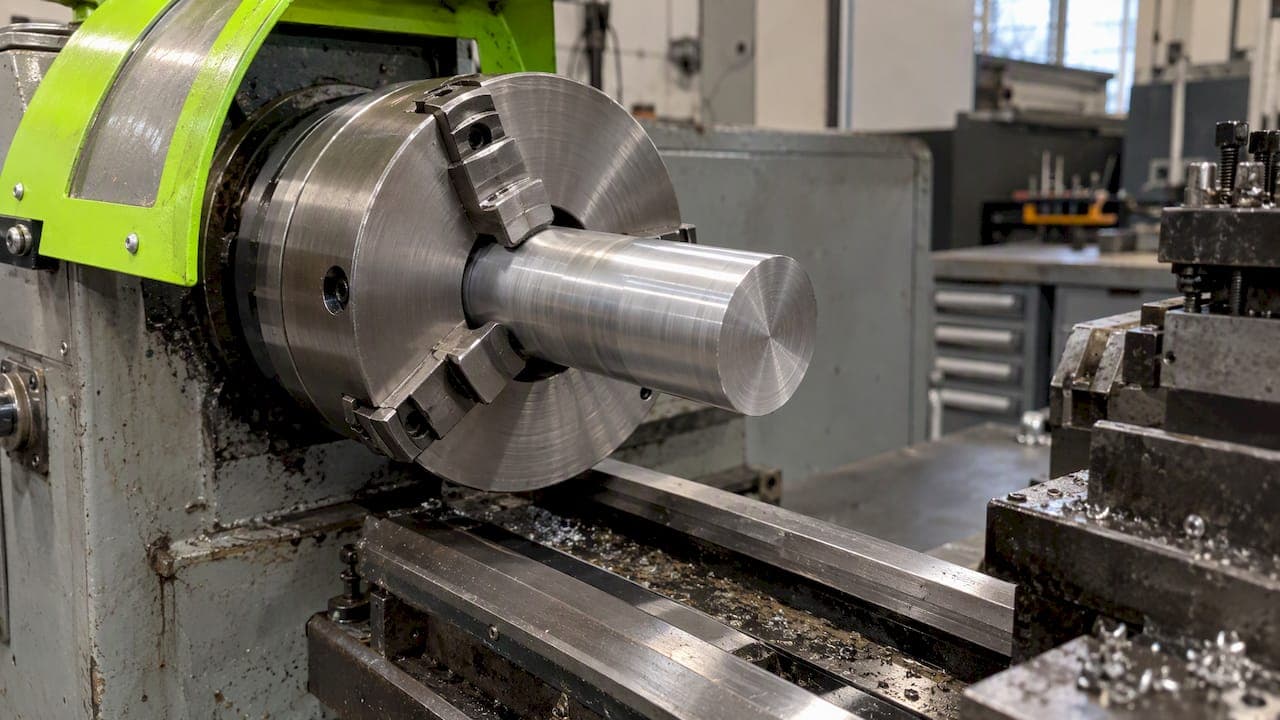
The right way to hold a part on a lathe depends on its shape, its mass and how much precision the cut demands. Round bar stock usually goes in a three-jaw chuck. Irregular parts go in a four-jaw. Repeat work that needs very low runout belongs in a collet. Parts that already have a finished bore are best turned on a mandrel. Long, slender work needs a steady rest or a center for support. The rest of this guide explains how to choose between them.
TL;DR
- A lathe workholder has two jobs: it must clamp the part firmly and spin it with the spindle. Milling workholding does not have to do the second one. (Practical Machinist)
- Collets give the best concentricity and suit consistent bar stock. Jaw chucks give up some precision but accept a much wider range of sizes and shapes.
- Mandrels let you machine the outside of a part relative to a finished bore, which is hard to do in a chuck.
- Guarding, chuck-key habits and clothing matter as much as the workholding you choose.
- If you only need a handful of parts, a shop with a machinist you can talk to is often cheaper than buying tooling for one job.
What a lathe has to do with your part
On a mill, the part sits still and the cutter moves. On a lathe, the part itself is the moving mass. That changes what you ask of the workholding. It has to resist cutting forces and also survive spindle speed, and it has to keep the part on the spindle axis. Any error in centering shows up as runout, so the cut surface wobbles relative to the features you machined in another setup.
According to Practical Machinist, the choice of device generally comes down to the workpiece's shape, length and diameter, its mass, and the precision the cut requires. Keep those four questions in mind through every section below.
Three-jaw chucks: the default for round stock
The three-jaw universal chuck is the workhorse. Its jaws move together, so round and hex stock self-center in seconds. Most hobby and job-shop lathes ship with one for good reason.
What it does well:
- Quick loading and unloading of round or hex bar
- Wide range of diameters without changing hardware
- Good enough accuracy for most general turning
Where it falls short is repeatability. A scroll chuck's accuracy depends on wear and on how clean the jaws and scroll are. If you flip a part to finish the other end, expect a little eccentricity. For tight-tolerance work, a three-jaw is a compromise.
A six-jaw version spreads clamping force over more contact points, which helps thin-walled parts resist distortion. That is the reason Practical Machinist lists six-jaw chucks for thin-walled work. Our own notes on thin wall machining go deeper on why clamping pressure and feed rate matter so much once walls get thin.
Four-jaw independent chucks: for odd shapes and dialing in
Each jaw on a four-jaw chuck moves on its own. That makes it slower to set up but much more capable. You can hold square stock, castings and eccentric shapes. You can also dial a round part in with an indicator until it runs true to a few tenths of a thousandth.
That last point matters. A well-set four-jaw can beat a worn three-jaw for concentricity, but it costs you time on every part. It makes sense for one-offs and repairs. It makes little sense for batches of fifty.
Two-jaw chucks, usually with custom jaws, are a different animal. They are listed for rectangular parts, and in production they are normally paired with jaws cut to fit the part.
Collets and collet chucks: precision and repeatability
A collet is a sleeve that closes around the stock and grips it all the way around. Practical Machinist notes that this 360-degree contact reduces runout and avoids the deformation that jaw pressure can cause. Collets also tend to be lighter than a full chuck body, which helps at high spindle speeds.
The trade-off is range. A collet grips a narrow band of diameters, so you need a set of them, and the same source puts typical collet capacity at diameters up to about 3 inches. Changing sizes means changing collets.
There is also a stock-quality rule. Production Machining reports a rule of thumb for standard draw-in collets: every 0.001 inch of variation in the gripping surface can produce about 0.003 inch of axial movement. In practice that means you should buy consistent, ground or good-quality drawn stock if you plan to use collets. A jaw chuck forgives variation but gives up that precision.
Collet vs chuck: how to decide
The question comes up constantly, so here is the short version.
| Factor | Jaw chuck | Collet |
|---|---|---|
| Concentricity | Good, depends on wear and setup | Best, with consistent stock |
| Size range per setup | Wide | Narrow, needs a set |
| Irregular shapes | Yes (four-jaw) | No |
| Spindle speed | Moderate, mass limits it | High, lower mass helps |
| Best for | Mixed jobs, big or odd parts | Repeat runs of small round parts |
If your day is mixed, with many diameters and one-off parts, a jaw chuck wins on flexibility. If you are cutting a few hundred identical small parts from consistent bar, a collet wins on accuracy and speed. The research from Practical Machinist says the same: collets for precise cylindrical work, jaw chucks when part sizes vary.
Soft jaws: when the chuck has to match the part
Soft jaws are a middle path. They are blanks you bore or machine to the exact shape of the part, so the jaws wrap the part instead of pinching it at three points. They help on finished surfaces, thin walls and awkward profiles.
Design is where they succeed or fail. We cover contact-pad layout in soft jaw design from a shop machinist's view. The short version: bore them at the same clamping pressure you will use on the part, so the jaws are the right size when loaded.
Mandrels: holding a part by its bore
When a part already has a finished hole, you can hold it by that hole. A mandrel is a shaft that fits the bore, so the outside diameter can be turned concentric to it in one setup. Wikipedia's mandrel entry describes the two main families:
- Tapered (solid) mandrels grip by friction. They commonly carry a taper of about 0.005 inch per foot, which pairs with a reamed bore.
- Expanding mandrels grip with a mechanism that expands inside the bore. They avoid the wear that comes from repeatedly driving solid mandrels into parts.
That answers a question many readers type: mandrel turning is how you make the outside of a gear blank, bushing or pulley run true to its bore. It is not a replacement for a chuck on general stock. It is a specialist way to keep two surfaces concentric.
Orientation matters with tapered mandrels. One machining reference explains that the larger end should face the headstock, so cutting forces push the part further onto the taper, not off it. Reverse it and the part can slip or be thrown.
Bore quality drives mandrel quality. If the hole is out of round or poorly sized, even a perfect mandrel will not fix it. Our guide to reaming versus boring covers how to get a bore that is ready for a mandrel, and the piece on expanding mandrels covers tuning one to the tolerance you need.
Faceplates, centers and steady rests
Faceplates are flat plates that mount on the spindle. You clamp odd parts to them with bolts and straps. They are slow but they hold shapes nothing else will.
Centers support work between the spindle and the tailstock. A live center turns with the part. A dead center stays fixed and needs lubrication. Shafts turned between centers can be flipped end for end and stay concentric, because the centers define the axis.
Steady rests support the middle of long, slender stock. Practical Machinist calls them essential for preventing deflection. A long thin bar held at one end only will bend away from the tool and cut tapered. A steady rest or a tailstock support stops that.

Matching the workholding to the job
Use these as starting points, not laws.
- Short round or hex bar, mixed sizes: three-jaw chuck.
- Square, cast or eccentric parts: four-jaw chuck or faceplate.
- High-volume small round parts, consistent stock: collet.
- Thin-walled rings and tubes: six-jaw chuck or soft jaws, with light clamping.
- Parts with a finished bore: mandrel.
- Long shafts: between centers, or chuck plus tailstock, with a steady rest if needed.
Material changes the picture too. Soft aluminum marks easily under hard jaws. Tough alloys push harder against the work. When you pick a material for a prototype, CNC machining materials are worth reviewing alongside the workholding, since the two decisions affect each other.
Safety at the chuck
The chuck is the hazard on a lathe, not just the tool. Federal safety guidance says there is no single safeguard that fits every chuck. Hazards have to be judged case by case, and the danger is greatest at the rotating workholder, especially with irregular shapes or projections. The same guidance warns that swapping a guard for a weaker material can fail catastrophically.
Some habits cost nothing:
- Keep your hand on the chuck key until it is out of the chuck. Harvard's machine shop guidance says to never let go of the key while it is in the chuck and to set it on a tray after removal. A key left in can be thrown when the spindle starts. Spring-loaded keys are a common safeguard.
- Do not polish rotating shafts by hand with emery cloth. Oregon OSHA names this as a way operators get pulled into a lathe, along with wearing gloves near it.
- Remove loose clothing and jewelry. The Naval Postgraduate School safety bulletin stresses that guarding does not replace safe behavior.
If you are unsure whether your setup is guarded correctly, ask your employer's safety officer or the state OSHA office before running it.
Perspective: what we have learned running a single shop
We design and CNC-machine our parts in Athens, Alabama, and the same person who draws a part also cuts it. That shapes how we think about workholding. The part is never just the part. It is the part plus the way you will hold it, and the best fixture is often decided before the first line of the drawing.
Three things we hold to:
- Plan the second operation first. If a feature must be concentric to a bore or a datum, decide on the first operation how you will hold the part for the second. Mandrels, soft jaws and dedicated fixtures are cheap compared with scrap.
- Do not chase runout with tooling you do not need. For many parts a well-bored soft jaw does the same job as a collet set.
- Talk to the machinist early. A conversation before the quote saves a revision after it. That is why we handle questions directly, with no intermediary.
For tolerance language, our write-up on concentricity versus runout explains which control to call out on a drawing so the shop knows how to hold the part. For repeat work, quick-change fixturing and dovetail workholding can cut setup time.
— Drake
When to buy tooling and when to outsource
Good workholding is an investment. A set of collets, a mandrel kit, or custom soft-jaw blanks can add up, and they only pay back if you run enough parts. For a one-off prototype, a short run or a replacement part, it often makes more sense to have a shop that already owns the right fixtures cut it.
That is what we do. Flying Chip Factory offers prototype machining, short-run production, and fixtures, brackets and support parts, with direct access to the machinist who will run your job. If you have a drawing or a sample part, send it to our shop for a quote and we will talk through how it should be held and cut.
If you ride, we also make the E2 Kickstand for the KTM SX-E 2, GASGAS MC-E 2 and Husqvarna EE 2, listed at 100-105 $. It is a CNC-machined, bolt-on replacement for the factory triangle stand, made on the same machines and held by the same fixturing principles described above.
FAQ
What is the difference between a collet and a chuck?
A collet is a sleeve that grips stock around its full circumference, which gives low runout but only over a narrow size range. A chuck uses jaws, usually three or four, and handles a far wider range of sizes and shapes. Pick a collet for repeatable precision on consistent round stock, and a chuck for flexibility.
What is mandrel turning used for?
It is used to machine the outside of a part that already has a finished bore, so the outer surface ends up concentric to the hole. Tapered mandrels grip by friction, and expanding mandrels grip by expanding inside the bore. Gears, bushings and sleeves are common examples.
What is the most common lathe workholding device?
The three-jaw self-centering chuck. It centers round and hex stock quickly and covers many diameters. For higher accuracy or irregular parts, machinists move to collets, four-jaw chucks, soft jaws or mandrels.
How do I hold a long, thin shaft on a lathe?
Support it at both ends, either between centers or with a chuck and a tailstock. Add a steady rest if the middle starts to deflect. Without support, the bar bends away from the tool and the cut comes out tapered.
Sources
- Lathe Workholding, Practical Machinist
- Collets vs. Chucks, Production Machining
- Mandrel, Wikipedia
- Turning with the Aid of a Mandrel
- OSHA standard interpretation on lathe chuck safeguarding
- Harvard EHS machine shop safety guidance for lathes
- Oregon OSHA machine safeguarding guide
- Naval Postgraduate School lathe safety bulletin