
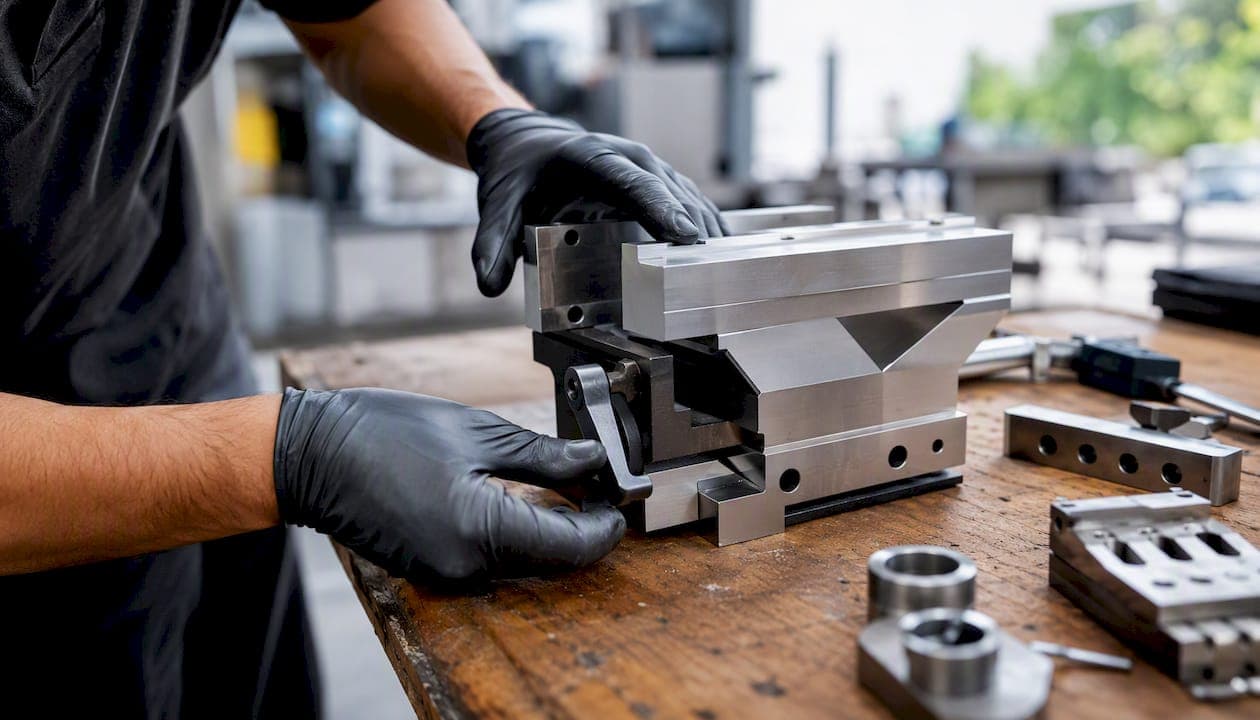
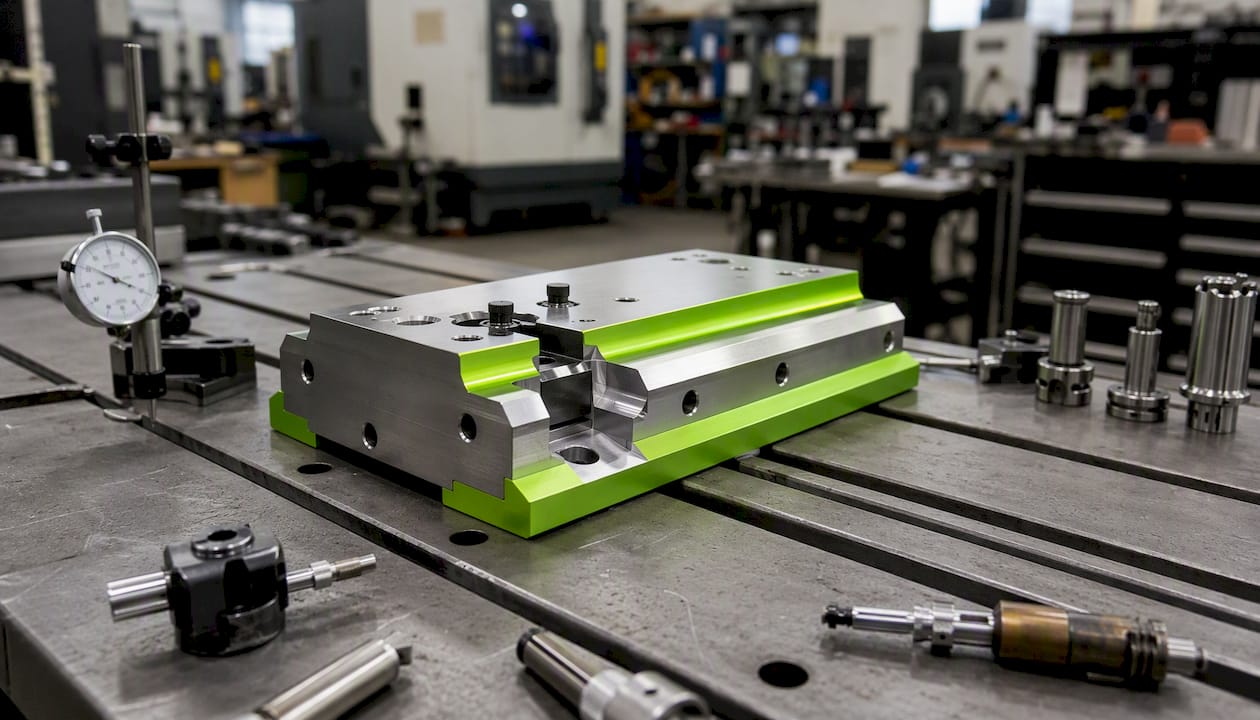
Dovetail workholding is the right call when you need high rigidity, repeatable locating, and multi-face access on parts that can accept a machined dovetail feature. The geometry does something a standard vise can't: it converts clamping force into simultaneous inward and downward pressure, seating the part firmly against the fixture without lateral slip. If your job involves 4th or 5th-axis operations, tight tolerances across multiple setups, or short-run production where re-fixturing kills your cycle time, a dovetail fixture belongs in your process.
Before you go further, here's what you need to decide or prepare:
- What profile fits your application. Industrial CNC fixtures commonly use a 45° dovetail angle with locating pins. Woodworking and modular shop systems like the Microjig MATCHFIT Dovetail Clamps use a 1/2" x 14° profile.
- Whether your part can accept the feature. You need enough wall thickness behind the dovetail, and the geometry can't interfere with your toolpaths.
- Your spec checklist. Profile angle, nominal dimensions, tolerance, locating pin requirements, material, and surface finish all need to be defined before quoting.
- Your next step. Either spec the fixture yourself using the design rules below, or send your CAD and part details to Flying Chip Factory for a custom fixture quote.
Key Takeaways
Dovetail workholding delivers repeatable, high-rigidity fixturing for CNC jobs when the part geometry allows a machined dovetail feature and multi-face access is required.
| Point | Details |
|---|---|
| Profile angle drives compatibility | Use 45° for industrial CNC fixtures; 14° (1/2" wide) for MATCHFIT-style modular and woodworking systems. |
| Minimum wall thickness is critical | Under-specifying material behind the dovetail causes groove deformation; specify minimum wall and a support radius. |
| Datum from the groove bottom | Reference from the groove bottom, not the top face, to avoid compounding error across setups. |
| Verify fit before first production run | Indicate the part face after tightening to spec torque; more than 0.001" of movement signals a groove or feature issue. |
| Flying Chip Factory for custom fixtures | Send CAD, spec checklist, and part photos to Flying Chip Factory for a fast quote on custom dovetail fixture fabrication. |
How does dovetail workholding actually hold a part?
The mechanical principle is straightforward but easy to underestimate. A dovetail profile, cut at an angle into either the workpiece or the fixture, creates a wedge-shaped engagement. When the clamp or fixture body tightens against that profile, the angled faces redirect force along two vectors simultaneously: one pushing the part inward (toward the fixture body) and one pushing it down (against the datum surface).
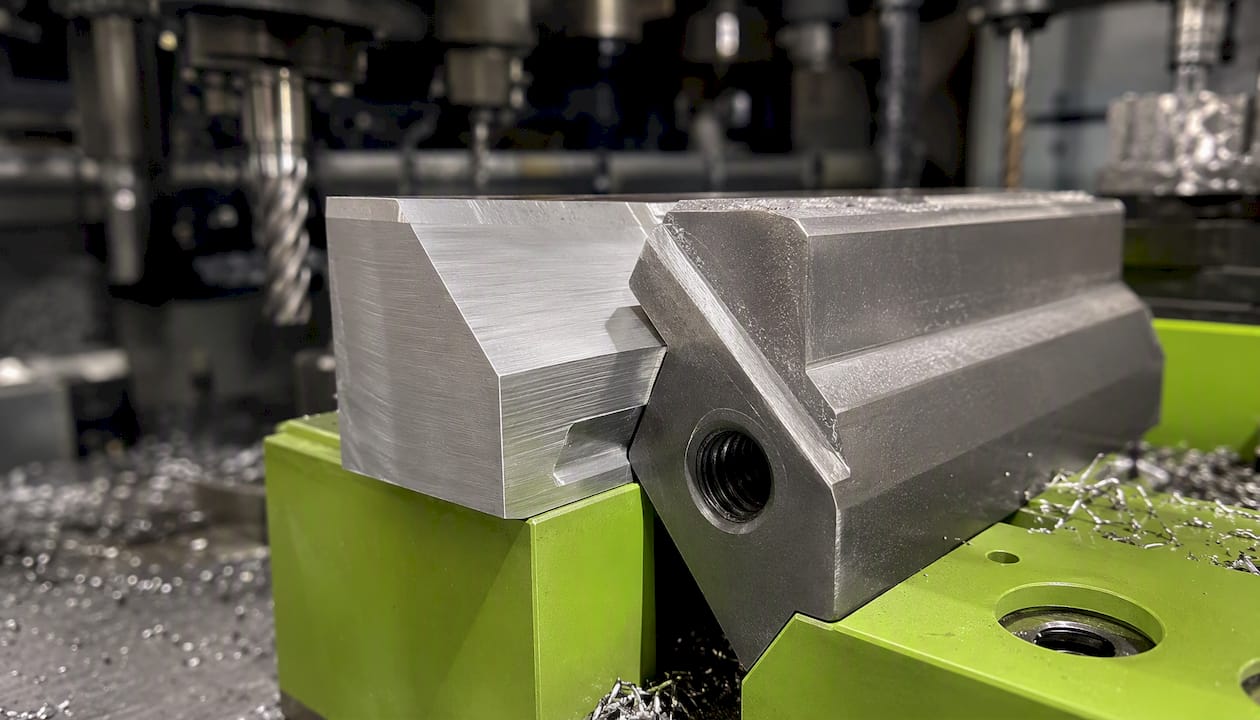
According to 5th Axis, this equal in-and-down force distribution is what gives dovetail fixtures their superior stability compared with conventional lateral clamping. A standard vise applies force from the side; the part can still lift or rock under aggressive cuts. A dovetail fixture eliminates that degree of freedom.
There are real constraints, though. The part must be prepped with the dovetail feature before fixturing, which adds a machining step. The feature requires minimum wall thickness behind it to avoid deformation or collapse under load. And depending on your fixture geometry, the dovetail body can shadow certain toolpaths, so you need to plan clearance early. Material matters too: soft alloys like 6061 aluminum hold a dovetail feature well, but very thin-walled parts or brittle materials can crack at the feature if the geometry isn't supported correctly. The JLCCNC design guide covers these constraints in detail and is worth reviewing before you commit to a profile.
What dimensions and tolerances should you specify?
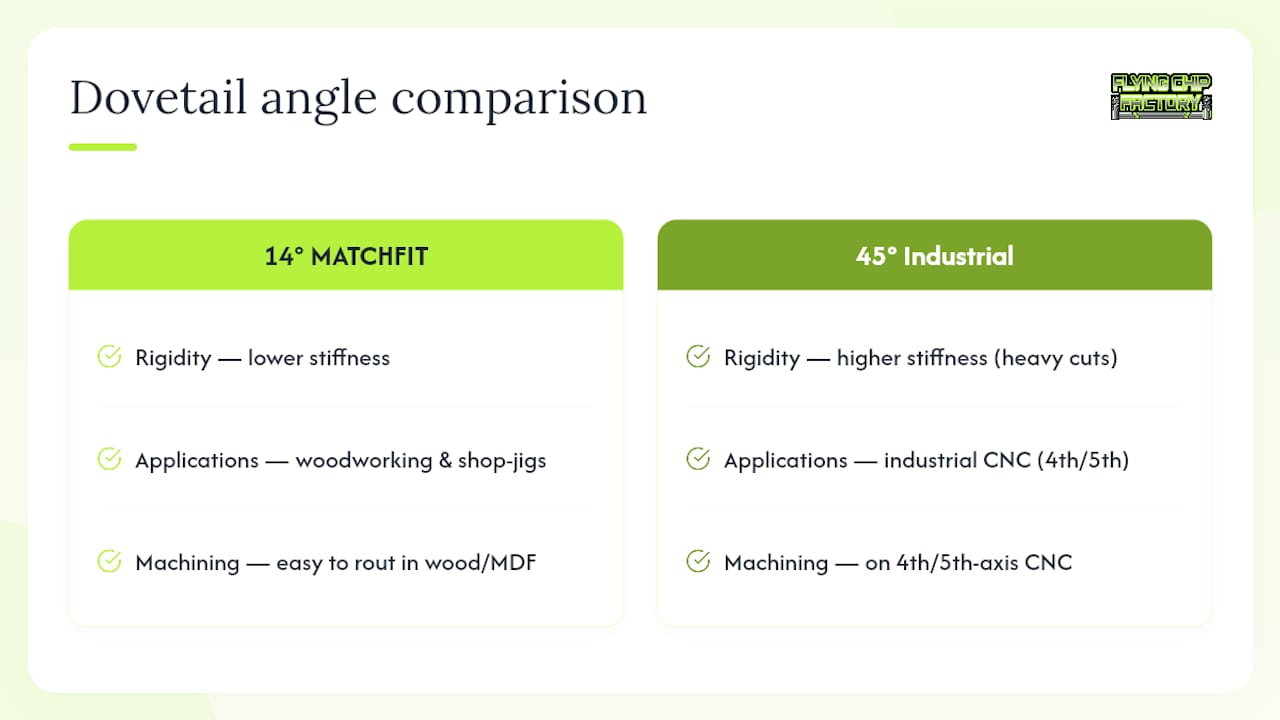
Getting the profile right is where most shops either nail it or waste a setup. Two angles dominate the field: 14° for modular woodworking and shop-jig systems (the MATCHFIT standard), and 45° for industrial CNC fixtures used in 4th and 5th-axis work. The 45° angle is stiffer under heavy cuts; the 14° angle is easier to rout in wood or MDF for low-force applications.
For locating pins, a standard approach is one or two ground pins in the fixture body that engage corresponding holes in the part or a pallet. The 5th Axis dovetail system uses this strategy specifically to prevent part ejection during machining and to give you sub-0.001" repeatability across setups. Pin diameter tolerances of H7/g6 (clearance fit) are typical for production fixtures; tighter fits add repeatability but complicate loading.
Datum strategy: always reference from the bottom of the dovetail groove, not the top face. The groove bottom is the controlled surface. The top face of a machined dovetail can vary with tool wear, so using it as a datum introduces error that compounds across setups.
Edge breaks matter more than most shops acknowledge. A sharp corner at the dovetail entry will chip under repeated loading. Specify a 0.005"–0.010" chamfer or radius on all dovetail edges, and deburr thoroughly before the first part run.
Pro Tip: Before your first production part, check the fit with a ground gauge or a known-good reference slug. Slide it through the full length of the groove under hand pressure. Any binding or rocking tells you the profile needs a cleanup pass before you load a real part.
What tools do you use to machine a dovetail feature?
The tooling choice depends on the material, the angle, and whether you're cutting the fixture or the part.
For aluminum and soft-metal fixtures:
- Dovetail endmills (also called dovetail form cutters): the standard choice for CNC mills. Available in 14°, 45°, and other angles; carbide is preferred for aluminum. Run at conservative feeds on the first pass, then open up. A 1/2" diameter 45° dovetail endmill in 6061 aluminum typically runs at 600–800 SFM with a 0.003"–0.005" chip load per tooth.
- Single-point form operations: useful when you need a custom profile that no off-the-shelf cutter matches. Slower, but gives you full control over the geometry.
- Router dovetail bits (1/2" x 14°): the correct bit for cutting MATCHFIT-compatible grooves in wood or MDF. A 3/8" deep groove is the recommended depth for the MATCHFIT system. Run the router at full speed with a single climb-cut pass for clean walls.
For hardened steel fixtures:
- Profile grind the dovetail after hardening using a formed wheel. This is the most accurate method for wear-resistant fixtures.
- EDM (wire or sinker) for complex profiles or when grinding clearance is limited.
- Pre-machine the dovetail soft, harden, then finish-grind to final tolerance.
For part-side dovetail features (the workpiece itself):
- Face the part to establish a clean datum.
- Rough the dovetail pocket with a standard endmill to remove bulk material.
- Finish with the dovetail form cutter in a single climb pass to hit the profile tolerance.
- Deburr and verify with a gauge before fixturing.
Tooling compatibility note: if you're building fixtures for the MATCHFIT clamp system, the router bit geometry must match exactly. The Microjig MATCHFIT product page specifies the 1/2" x 14° profile. Industrial fixture systems using 45° profiles need a matched dovetail endmill or form cutter, and the two are not interchangeable. Check your clamp system's spec sheet before you cut.
For slot machining operations that feed into dovetail prep, the same fixturing and feed-rate discipline applies.
What fixture types and materials work best?
The dovetail workholding ecosystem covers a wide range, from simple router-cut wooden jigs to hardened steel production fixtures.
Common fixture types:
- Compact dovetail vises (like the SPE MDV-003): designed for 4/5-axis work, these hold small-to-medium parts with a 45° dovetail and a locating pin. The MDV-003 is available in 7075 aluminum and specifies a max tightening torque of 21 Nm. Good for prototype runs and short production.
- Modular dovetail fixture rails: bolt to a tombstone or fixture plate and accept multiple parts in a single setup. Efficient for batch work.
- Dovetail clamp track systems (MATCHFIT): route a 1/2" x 14° groove into wood, MDF, or a fixture board, and the clamps slide anywhere along the track. Clamp capacity runs 0–5-1/4" with approximately 595 lb. of clamping pressure at 4" open. Low cost, fast to set up, and ideal for shop jigs and non-production fixtures.
Material trade-offs:
- 6061-T6 aluminum: easy to machine, light, and adequate for most prototype and short-run fixtures. Wears faster than steel under repeated loading.
- 7075-T6 aluminum: significantly stronger than 6061, still light, and a solid choice for fixtures that see higher clamping forces or more cycles. The T6 vs T6511 temper differences matter here if you're specifying bar stock.
- Hardened steel: maximum wear resistance and rigidity. Required for high-volume production fixtures. Heavier and more expensive to machine and finish.
- Stainless steel: corrosion resistance where coolant exposure is heavy, but harder to machine and typically unnecessary for most fixture applications.
Accessories and compatibility:
- Locating pins (ground, hardened): essential for repeatability across setups and machines.
- Risers and adapter plates: raise the part off the fixture body for clearance, or adapt a dovetail fixture to a zero-point pallet system.
- Zero-point pallets: some shops mount dovetail fixtures on zero-point bases (like UNILOCK-style systems from Big Daishowa) to combine the rigidity of a dovetail grip with the fast changeover of a zero-point system.
When your dovetail fixture needs a protective finish, hardcoat anodize on aluminum fixtures adds wear resistance without significant dimensional change, typically 0.001"–0.002" per surface.
When should you use dovetail workholding, and when shouldn't you?
Dovetail workholding is the right choice when:
- The part can accept a machined dovetail feature without compromising structural integrity.
- You need repeatable locating across multiple setups or machines.
- Multi-face access is required and a vise jaw would block your toolpaths.
- Clamping distortion is a concern (the in-and-down force minimizes lateral squeeze).
- Techni-Grip's documentation notes that dovetail clamping reduces material scrap compared with some traditional approaches, partly because the feature prep removes less stock than soft-jaw boring.
It's the wrong call when:
- The part geometry doesn't allow a dovetail feature (thin walls, complex contours, or fragile materials).
- You're running one-off parts where the prep time outweighs the fixturing benefit.
- The required feature depth would compromise the finished part.
Alternatives and when they win:
- Conventional vises with soft jaws: faster setup for simple parts, no part modification required, but lower rigidity and limited multi-face access.
- Kinematic mounts: excellent repeatability (sub-micron in precision versions), but expensive and better suited to inspection fixtures than aggressive machining.
- Zero-point systems: fast changeover and good repeatability, but higher upfront cost and typically require a pallet ecosystem. Big Daishowa's UNILOCK system is a reference point for this category.
- Vacuum fixtures: great for thin flat parts, poor for anything with interrupted surfaces or heavy side loads.
Decision checklist:
- Can the part accept a dovetail feature without weakening the finished geometry?
- Is the production volume high enough to justify prep time (generally, more than a handful of parts)?
- Does the job require multi-face access or repeatable re-fixturing?
- Is clamping distortion a concern for your tolerance requirements?
- Does your shop have the tooling to cut the dovetail profile accurately?
If you answer yes to three or more of these, a dovetail fixture is worth specifying. The PracticalMachinist forum thread on dovetail workholding captures real shop experience on both sides of this decision.
What do you need to specify when ordering a custom fixture?
A complete RFQ for a dovetail fixture should include:
- Dovetail profile: angle (14° or 45°), width, and depth (nominal dimensions).
- Tolerance: fit tolerance on the dovetail width and depth; locating pin diameter and fit class.
- Material: fixture body material and temper (6061-T6, 7075-T6, hardened steel, etc.).
- Surface finish: as-machined, anodized, or hardened and ground.
- Locating features: pin count, diameter, location, and tolerance.
- Part volume: how many parts per fixture, expected production cycles.
- Inspection requirements: go/no-go gauge, CMM, or first-article inspection. Go/no-go gauge templates are a practical starting point for dovetail fit verification.
- CAD files: 3D model of the fixture and the part it holds, with GD&T callouts.
| Spec Item | What to Include |
|---|---|
| Dovetail profile | Angle, width (nominal), depth (nominal) |
| Tolerance | Width ±0.001"–0.002", locating pin H7/g6 |
| Material | Alloy, temper, and hardness if applicable |
| Surface finish | As-machined, anodized, or ground |
| Locating features | Pin count, diameter, location |
| Production volume | Parts per fixture, expected cycle count |
| Inspection | FAI, go/no-go, or CMM requirement |
Cost and lead time vary with material, complexity, and finishing. A simple aluminum dovetail fixture for prototype work can turn around in days. A hardened steel production fixture with ground dovetails and multiple locating pins takes longer and costs more, reflecting the grinding and heat-treat steps. Sending a complete CAD package with your RFQ cuts quoting time significantly.
Shop-tested tips and common pitfalls
The most common mistake shops make with dovetail workholding is under-specifying the material behind the feature. Leaving too little wall thickness causes the groove to deform under clamping load, especially in aluminum. The JLCCNC design guide flags this specifically: specify minimum material and a support radius to prevent localized collapse.
Other pitfalls worth knowing:
- Wrong profile angle: cutting a 45° groove for a 14° clamp (or vice versa) means the clamp never seats correctly. Verify the angle before you cut.
- Ignoring burrs: a burr at the dovetail entry prevents full seating and introduces a locating error. Deburr every feature before the first load.
- Skipping the datum check: if the groove bottom isn't flat and square to your datum, every part you load will carry that error. Indicate the groove bottom before committing to production.
- Over-torquing: dovetail fixtures grip efficiently at moderate torque. The SPE MDV-003 specifies a max of 21 Nm for a reason. Exceeding it deforms the fixture or the part feature.
- Coolant contamination: chips packed into the dovetail groove prevent full seating. Blow out the groove before every load in production.
Pro Tip: On first-article runs, load the part, tighten to spec torque, then indicate the part face before cutting. If you see more than 0.001" of movement when you re-indicate after tightening, the groove or the part feature needs attention before you run.
For cleaning and maintenance: wipe the dovetail surfaces with a clean rag and light oil after every production run. Inspect the groove walls for galling or wear marks every 50–100 cycles depending on material. A worn groove loses its locating accuracy faster than it loses its clamping force, so don't wait for slip to tell you there's a problem.
Flying Chip Factory builds custom dovetail fixtures for short-run CNC work
Flying Chip Factory is a CNC job shop in Athens, Alabama, built around direct machinist access and fast iteration. For dovetail fixture work, that means you talk to the person cutting your fixture, not a project manager relaying messages. Send your CAD, your spec checklist from the section above, and any photos of the part you're holding, and you'll get a quote that reflects the actual job, not a templated estimate.
The shop handles custom fixture fabrication, prototype machining, and short-run production, with the same process discipline the team applies to its own in-house motorcycle parts. If your fixture needs hardcoat anodize, a specific aluminum temper, or a tight locating-pin tolerance, those details get addressed in the first conversation, not discovered at delivery.
Get a quote for your custom dovetail fixture at Flying Chip Factory and include your dovetail profile, material preference, and part volume. The faster you send the spec, the faster the fixture ships.
Why dovetail fixtures earn their place in the right jobs
Most shops reach for a vise by default, and for a lot of jobs, that's the right call. But when a part needs to come off the machine, go to inspection, and come back to exactly the same location, a vise with soft jaws is asking for trouble. The dovetail fixture solves that problem mechanically, not through careful re-indicating.
The shops that get the most out of dovetail workholding are the ones that commit to the prep work: correct profile, correct tolerance, correct datum strategy. The geometry rewards that discipline with repeatability that's hard to match with any lateral-clamping approach. For precision prototypes and multi-face operations, the fixture prep time pays back quickly.
The spec checklist in this guide and Flying Chip Factory's quoting process are the two fastest ways to move from "considering dovetail workholding" to "running parts."
Sources
These are the primary references used to build this guide. Check each for spec sheets, CAD downloads, and deeper technical detail.
- Why Dovetail? - CNC Workholding Solutions - 5th-Axis
- MATCHFIT Dovetail Track Clamp® (2-pack) | Microjig
- Dovetail Workholding | Techni-Grip | Tacoma, WA
- Opinions on dovetails for work holding? (PracticalMachinist forum)