
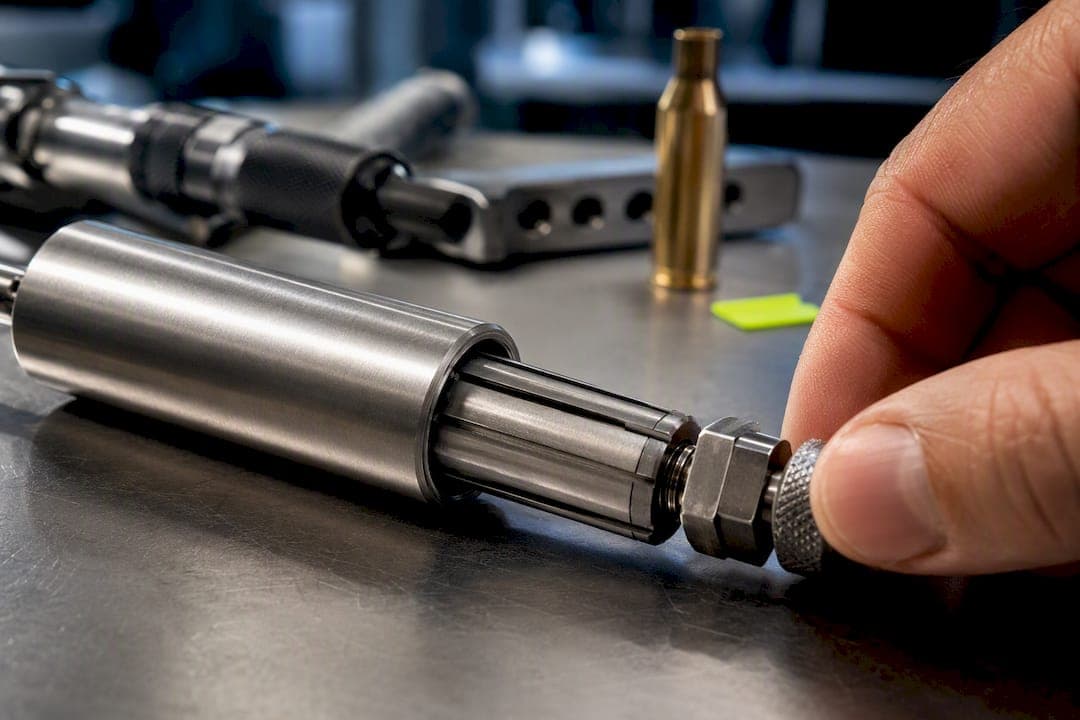
An expanding mandrel is an internal-expansion tool that clamps a bore or case neck from the inside out, giving you a precise, repeatable datum without squeezing the outside of the part. Machinists use them to hold thin-walled or feature-covered workpieces during turning, milling, or grinding. Reloaders use a smaller version to set consistent case-neck inside diameter after resizing. The choice between a mandrel and a simple expander ball usually comes down to whether you need that separate, controllable sizing step.
TL;DR:
- Proper setup involves accurate die height, correct contact length, and initial testing with a few parts to avoid sizing issues later in production.
- Lubrication with dry neck lube and proper storage in individual cases prevent buildup and preserve the mandrel’s accuracy over time.
- Mandrels work best for parts with features or thin walls where external clamps could distort geometry, but they are not suited for heavy cutting forces.
- Consistent, careful setup and verification are more critical than brand choice, as proper discipline ensures mandrel accuracy and longevity.
What Are the Main Types of Expanding Mandrel?
Not every mandrel does the same job, and picking the wrong family wastes time and money. Lathe and inspection mandrels use sleeves or arbors that expand against a bore, often with multiple sleeve diameters kept on hand so one arbor body covers a range of hole sizes. Reloading die mounted mandrels work on the same principle at a much smaller scale, threading into a sizing die body to correct case-neck inside diameter right after full-length resizing.
Diameter precision separates the good from the merely adequate. Precision reloading mandrels are commonly ground in .0005 inch increments, which lets you tune neck tension in small, predictable steps rather than guessing between two coarse options.
Actuation is where the real variety shows up:
- Manual screw or nut-actuated mandrels, common on lathe work and low-volume reloading setups.
- Drawbar or power-actuated units, built for CNC sub-spindles and repeat production runs.
- Single-side actuators for short, stubby parts versus multi-independent actuators for long, thin parts with a high length-to-diameter ratio.
Machining mandrels range from small precision sizes to large custom diameters, so if your bore falls outside a catalog size, most manufacturers will grind a custom mandrel to match rather than force you into an off-size compromise.
How Does an Expanding Mandrel Actually Work?
The mechanism is simple: a tapered arbor or screw forces a sleeve outward against the inside of a bore, creating even, radial contact that centers the part without pinching it out of round. Because the clamping force comes from inside the workpiece, you get full external access. That is the whole appeal for parts covered in bosses, slots, or contoured surfaces that a three-jaw chuck or soft jaws would otherwise block.
Thin-walled parts benefit the most. External clamping tends to flex a thin wall into a slightly oval shape that springs back once you release the part, which quietly ruins concentricity. An expanding mandrel avoids that distortion because the support comes from underneath the wall, not from squeezing it, so the part holds its true shape through the whole operation.
That advantage comes with a ceiling. Mandrels generally can't take the cutting force that a solid four-jaw or hydraulic external chuck can, so heavy roughing passes or a part that wants to spin on you are real risks. Contact length matters more than most people expect. A short sleeve engaged in a shallow bore might be fine for a quick inspection setup, but the same short sleeve under a real cutting load can slip. When you're running production quantities or working off a CNC sub-spindle, power actuation earns its cost by giving you consistent, repeatable grip pressure that a hand-tightened screw can't match run after run.
What Size Mandrel or Neck Tension Should You Use?
The right number depends on whether you're chasing a bore tolerance or a bullet grip, but the underlying logic is the same: start close, then step toward the result you actually want.
- Reloaders should start with a mandrel roughly 0.001 to 0.002 inch below bullet diameter since standard mandrels are commonly supplied slightly under nominal bullet diameter to allow for spring-back. as a baseline.
- Fine-tune neck tension in .0005 inch steps rather than jumping a full thousandth at a time; that smaller increment is exactly why precision mandrel sets exist.
- Machinists should choose sleeve length and arbor range to minimize total indicated runout, and match contact length to bore depth so the grip zone isn't fighting a bore that's deeper or shallower than the sleeve.
- Decide early whether you're running a bushing-plus-mandrel workflow. If so, pull the expander ball out of the full-length sizing die entirely and let the mandrel do the final internal sizing on its own pass.
- Verify before you commit to a batch: test-seat a few bullets or measure neck inside diameter with a pin gauge after expansion, and adjust from there.
That last step is the one people skip and regret. A five-minute check on one case or one part saves you from finding a sizing problem forty pieces into a production run.
How Do You Set Up an Expanding Mandrel Correctly?
Most mandrel problems trace back to setup, not the tool itself. Get the fundamentals right once and the tool basically runs itself after that.
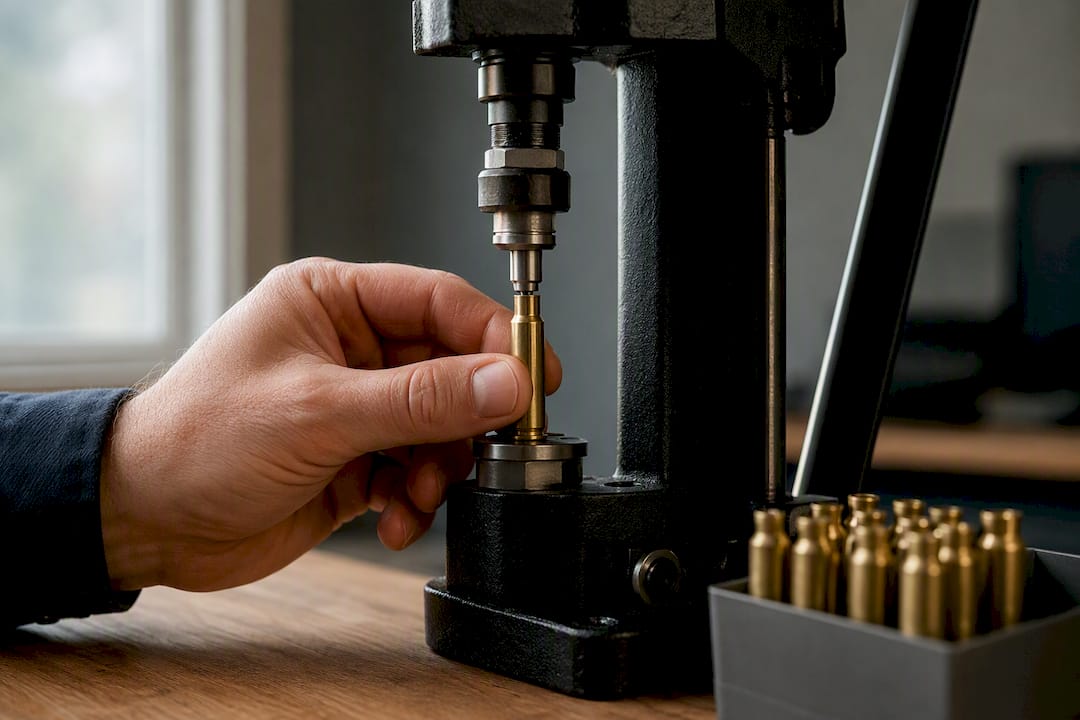
For reloading, die height is the first thing to get right. Don't bottom the shellholder hard against the die; instead, set the die so the case neck only engages the working portion of the mandrel, using the window or stop features most dies include to prevent over-extension. Lock the ring down once you've found that position so it doesn't drift between sessions.
Lubrication matters more than most reloaders assume:
- Apply a dry neck lube before expanding to cut friction and prevent brass from dragging on the mandrel.
- Wipe lubricant off the neck before seating a bullet, since leftover lube changes seating feel and can affect tension.
- Keep a copper solvent on hand for buildup rather than scraping at it dry.
For machining setups, confirm the mandrel has full, correct bore engagement before you touch the spindle switch, and add back-up support for heavy cuts whenever the part geometry allows it. Never push grip torque past what the mandrel's rated for just because a part feels like it's holding fine at low RPM.
Pro Tip: Run one test case or one test part all the way through your process before starting a full batch. It costs you a few minutes and it's the cheapest insurance against discovering a sizing or grip problem after you've already committed a hundred pieces.
How Do You Maintain a Mandrel and Fix Common Problems?
Brass and chip buildup are the two enemies of long-term accuracy, and both are preventable with a little discipline.
- Lubricate case necks before expanding to reduce the copper transfer that causes buildup in the first place.
- Remove existing buildup with copper solvent or light polishing while rotating the mandrel, never with aggressive scraping.
- Watch your polishing habit: excessive polishing changes the ground diameter and can compromise concentricity, so treat it as light maintenance, not a fix for a worn-out tool.
- If a part is spinning, dragging excessively, or seating off-center, check contact length and grip pressure first. Undersized engagement is the usual culprit.
- Store tool-steel mandrels dry, lightly oiled, and separated from other hardened tools to avoid rust and surface dings that ruin a precision ground finish.
When Does Flying Chip Factory Reach for an Expanding Mandrel?
Some parts basically demand a mandrel. Thin-walled motorcycle components and parts with features covering most of the outside diameter are the clearest case. Soft jaws and standard three-jaw chucks work fine until the part has nothing flat or round left to grab without blocking a feature you still need to cut.
That's when a mandrel-based fixture design earns its place on the shop floor: the part gets held from the inside, and every external surface stays open for the tool. If you want a deeper look at how workholding choices affect tolerance and access, our posts on dovetail workholding and tight tolerance machining walk through the tradeoffs in more detail. If you're working on a part that needs a custom mandrel setup or a short-run CNC job, Some shops take on prototyping and production work with direct machinist access to your job.
What Safety Steps Matter With Expanding Mandrels?
Reloading and machining carry different risks with mandrels, but both punish carelessness the same way: with a damaged part, a damaged tool, or a damaged hand.
On the reloading bench, the biggest hazard is over-torquing the mandrel into the press. Forcing a case neck past its normal resistance can crack a case, bind the mandrel in the neck, or send brass fragments flying when something finally gives. Keep your press stroke smooth and consistent, and stop immediately if resistance spikes on a case that normally sizes easily. That spike usually means debris, a dented neck, or a mandrel that's picked up buildup and needs cleaning before you keep going.
On the machining side, grip failure is the real danger. A part that spins on an under-torqued mandrel doesn't just ruin the workpiece. It can throw material, damage the spindle, or catch a hand near the working envelope if you're checking clearance too close to a running machine. Never exceed the mandrel manufacturer's rated grip torque to compensate for a light cut you think will be forgiving. Confirm bore engagement and back-up support before the first pass, not after you hear something go wrong. Eye protection and standard machine guarding apply here just as much as on any other workholding setup, and a mandrel under load deserves the same respect as a chuck under load.
Both worlds share one rule worth repeating: test at low force first, whether that's a slow press stroke or a light first pass, and only commit to full pressure once you've confirmed everything is seated and aligned the way it should be.
How Does a Mandrel Compare to Other Neck Expanding Methods?
An expander ball and an expanding mandrel solve the same basic problem in different ways, and the distinction actually matters for consistency. An expander ball is pulled through the case neck during the resizing stroke itself, combining resizing and expansion into one motion. A mandrel is a separate precision-ground tool run as its own step after full-length resizing, which gives you a dedicated, controllable pass focused purely on internal neck diameter.
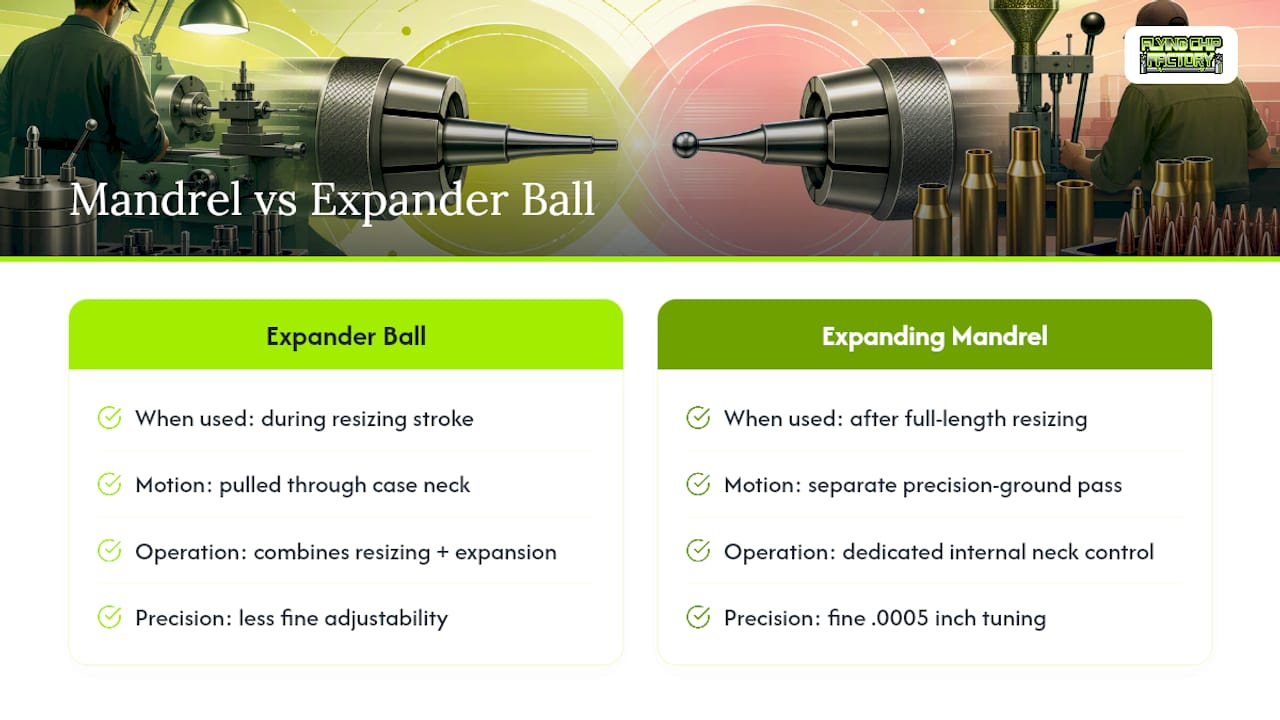
That separation is why much precision reloaders prefer the mandrel approach, especially on new brass. Running an expander mandrel over new brass irons out factory dents and produces more uniform neck tension, which tends to show up as tighter extreme spread and standard deviation numbers downstream. An expander ball gets brass close to where it needs to be in a single stroke, which is faster and fine for casual shooting, but it doesn't offer the same fine adjustability that a .0005 inch mandrel set does.
On the machining side, the comparison runs against collet chucks, soft jaws, and solid arbors rather than expander balls. Collets and soft jaws grip from the outside and work well when the part has enough flat, uninterrupted surface to clamp. An expanding mandrel wins when that outside surface is already covered in features you need to cut, or when the wall is thin enough that outside clamping would distort it. Neither approach is universally better. The right pick depends on what part of the workpiece you can afford to give up for holding it.
Which Manufacturers and Quality Signs Should You Look For?
Reloading die manufacturers that publish detailed spec sheets and heat-treatment information are usually the safer bet, since that documentation signals they expect their mandrels to be measured and held to a tolerance, not just eyeballed. Look for stated diameter increments, clear instructions on die height setup, and published guidance on lubrication and cleaning. A manufacturer that tells you exactly how to maintain the tool is one that expects the tool to last.
On the machining side, quality shows up in a few concrete ways. Precision-ground sleeves and arbors should carry a stated tolerance, not a vague "precision fit" claim with no number attached. Heat-treated tool steel construction matters for wear resistance, especially on mandrels that see repeated expansion cycles in production. Custom sizing availability is another good sign, since a shop that only sells fixed catalog sizes may not be set up to support a part that falls between standard diameters.
Material choice also plays into long-term performance, particularly for shops running mixed production. Reviewing material machinability references helps when you're deciding what mandrel material and hardness pairs well with the parts you're actually cutting, since a mismatch there shows up as premature wear or galling long before the mandrel itself fails.
Whether you're buying a reloading die or a machining mandrel, ask for the actual tolerance number and the actual heat-treatment spec. A vendor who hesitates to give you either number is telling you something.
How Should You Store an Expanding Mandrel Between Uses?
A mandrel is a precision-ground piece of tool steel, and it gets treated worth exactly what it costs to regrind or replace, which is usually more than people expect. Storing it loose in a drawer next to other hardened tools is the fastest way to pick up a nick that ruins its finish.
Keep mandrels in individual cases, foam-lined trays, or dedicated slots where nothing else can bang against the working surface. A light coat of oil before storage prevents surface rust, especially in a shop or reloading bench that isn't climate controlled year round. Humidity swings are the quiet killer of tool steel that sits unused for months at a time.
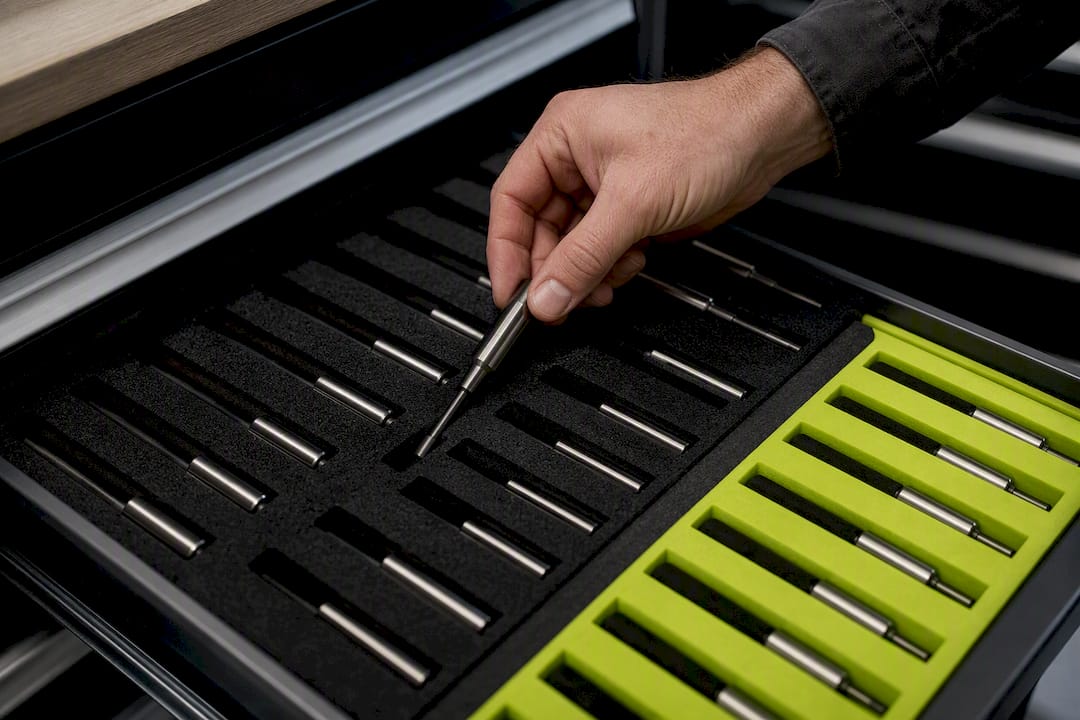
Label mandrels by diameter and increment if you're running a full set, since mixing up two mandrels that differ by half a thousandth defeats the entire point of buying a precision set. A simple sizing chart taped inside the storage case saves you from squinting at faint stamped markings under bad shop lighting. Handle mandrels by the shank or body, not the working sleeve or expansion surface, even when they're clean and you're just moving them from bench to storage. Skin oils and incidental contact add up over time on a surface that's supposed to hold a tight tolerance.
A Shop Perspective on Getting Expanding Mandrels Right
The conventional advice on this topic treats reloading mandrels and machining mandrels as if they belong in separate conversations. They don't. Both are solving the identical problem: get a precise, repeatable internal datum without deforming the part you're holding. Once you see it that way, the sizing logic transfers directly. A reloader stepping through .0005 inch increments to find the right neck tension is running the same trial-and-verify process a machinist runs when picking a sleeve diameter to minimize runout.
Where most guides fall short is treating tool selection as the finish line. The real leverage sits in setup discipline: die height, contact length, test-seating before a batch, checking bore engagement before a cutting pass. A mediocre mandrel run correctly outperforms a premium mandrel run carelessly, every time.
If you're new to this, prioritize the verification step before you obsess over which brand to buy. Measure the neck after expansion. Test-seat a bullet. Check runout on a test part before committing a fixture to production. The mandrel is only as good as the fifteen minutes you spend confirming it's actually doing what you think it is.
— Drake
Sources
The numeric guidance in this article comes from manufacturer documentation, not guesswork. Redding's precision expanding die specifications cover sizing increments and maintenance. K&M's case neck expander instructions detail die height setup. Xpandrel's standard model catalog shows the range of machining actuator designs available.
- Expander balls vs mandrels: what's the real difference? — Forster Products
- Precision Expanding Die — Redding Reloading
- The expanding mandrel and its uses — LeBlond Ltd.