
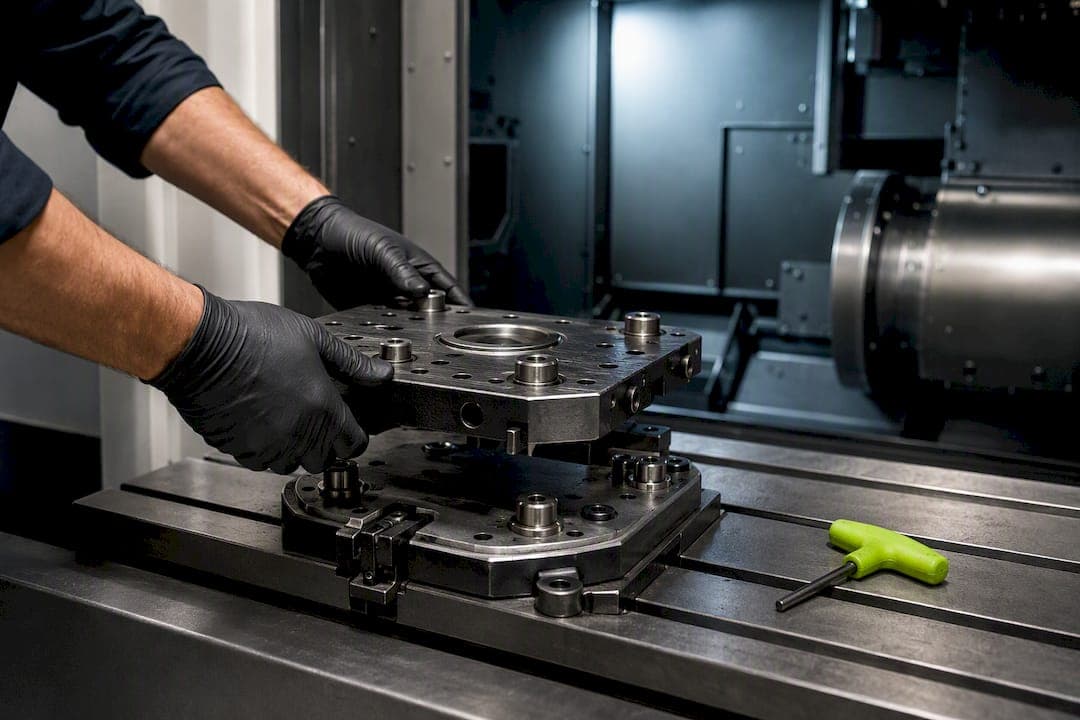
Shops running multiple job changes per shift should move to zero-point or modular quick-change fixturing; shops swapping setups weekly can usually stick with simpler mechanical subplates. The payoff is direct: less time spent indicating parts, a repeatable datum that holds across machines, and more spindle hours per day. If your floor runs several changeovers daily, the investment often pays for itself within a year.
TL;DR:
- Shops with multiple daily changeovers should prioritize zero-point or modular fixturing to maximize spindle hours and reduce setup time, often recouping costs within a year.
- Mechanical systems are cost-effective for low-frequency changeovers but require precise operator technique, while powered and zero-point systems offer higher repeatability suitable for automation and high-mix production.
- Selecting the right system depends on changeover frequency, part geometry, machine compatibility, and planned automation, with verified repeatability being more important than marketing claims.
- Conducting a pilot with a real-world repeatability and retention force test on the worst-offending job ensures a reliable ROI before full deployment.
- Proper fixture labeling, cleanliness, and a clear understanding of retrofit needs are crucial for maintaining precision and maximizing the benefits of quick-change fixturing.
What Is Quick Change Fixturing, and Why Do Shops Use It?
Quick change fixturing is a workholding approach that lets a shop swap fixtures, pallets, or vises in seconds instead of minutes, without re-indicating the part. Zero point fixturing is the most refined version of this idea: every fixture plate locates against the same reference points on the machine table, so the machine "knows" exactly where the part sits the moment the pallet locks down.
The mechanics come down to two jobs, locating and retention. Locating uses spigots, nipples, or tapered pins that drop into matching sockets to set X, Y, and Z position. Retention is the clamp or lock, usually a mechanical cam, a pneumatic piston, or a hydraulic collet, that pulls the fixture flush and holds it there under cutting forces. Carr Lane's technical rundown frames these as two separate design decisions, and getting either one wrong undermines the whole system.
Shops adopt this approach for a few concrete operational reasons:
- Eliminate manual indicating on every job change
- Standardize fixture bases across multiple machines
- Build and qualify fixtures offline while the spindle keeps cutting
- Reduce operator-to-operator variation in setup quality
Mechanical, Powered, or Zero-Point: Which Fits Your Shop?
Not every shop needs the same architecture, and picking the wrong one wastes money either way.
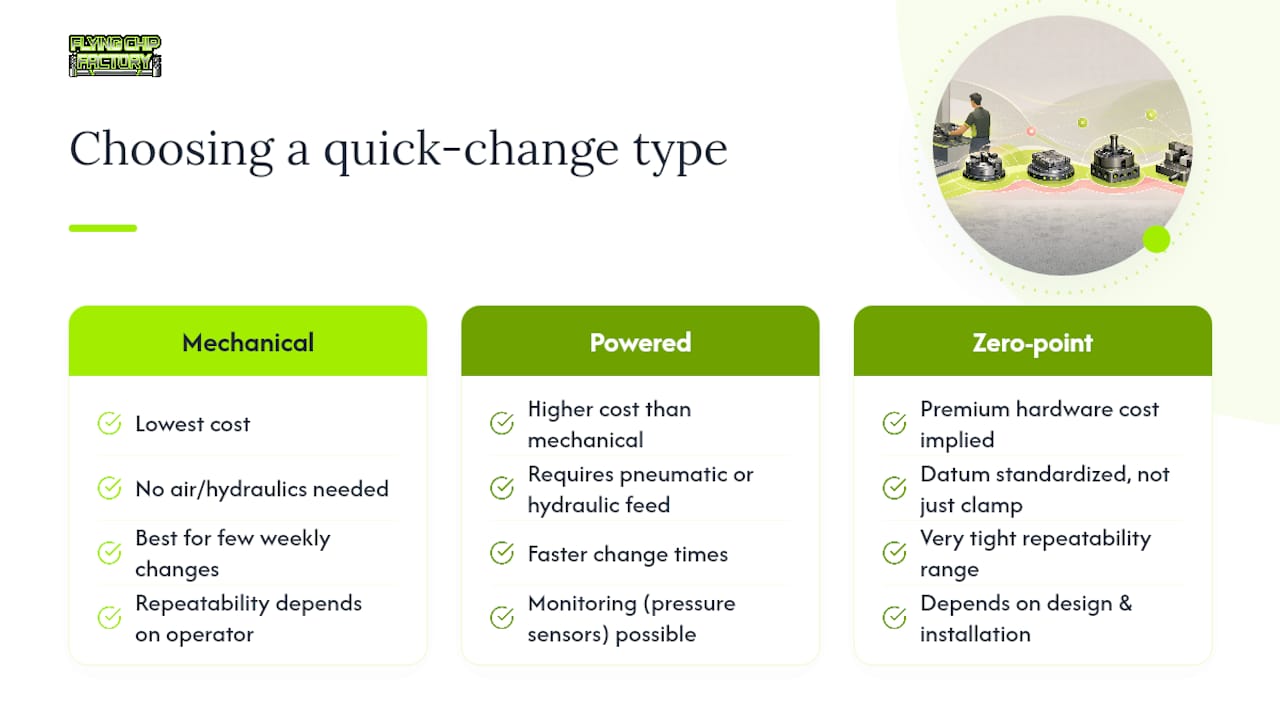
Mechanical quick-change systems use manual levers, cam locks, or bolted subplates. They cost the least, need no compressed air or hydraulics, and work fine for shops doing a handful of changeovers a week. The tradeoff is accuracy: repeatability depends heavily on operator technique and how well the locking mechanism is maintained.
Powered systems (pneumatic or hydraulic) actuate the clamp with the push of a button, cutting change time further and adding monitoring options like pressure sensors that confirm full lockup. Retrofitting powered actuation onto an older machine table takes real planning, since you need air or hydraulic lines routed to the table without interfering with chip flow or coolant.
Zero-point systems** standardize the datum itself,, not just the clamp. Repeatability thresholds on modern zero-point hardware fall within a very tight range, though the exact figure depends on mechanical versus pneumatic design and installation quality, according to Gleason's technical documentation. Some variants support fully unattended pallet changes, which matters if automation is on your roadmap.
Pro Tip: Don't buy for the accuracy spec alone. Buy for the repeatability you can actually verify on your own machine, under your own clamping loads, after your own installation crew bolts it down.
Where Quick Change Fixturing Pays Off First
High-mix, low-volume shops feel the benefit almost immediately, since every part number is a new setup and those setups stack up fast. Multi-shift operations see it compound: a five-minute change done twelve times a day adds up to an hour of pure non-cutting time, every single day. Five-axis work and automated cells benefit even more, because reindicating a complex part on a trunnion table eats far more time than a simple vise swap ever would.
Vendor literature backs the scale of the win. Modern Machine Shop reports zero-point clamping can cut setup time by as much as 90% in some installations, and one documented case saw a shop reduce manual tightening steps on large fixture plates while holding repeatability steady.
Beyond raw time savings, shops report:
- Fewer scrapped parts from setup error
- More predictable scheduling since job changes stop being a wildcard
- Safer, less physical operator workflows with fewer manual clamp adjustments
- Cleaner handoff to inspection, since the datum used on the mill matches the datum used on the CMM
How to Choose the Right Quick Change System
Start with your changeover count, not your budget. A shop doing eight setups a day has a fundamentally different math problem than one doing two a week, and the system that makes sense follows from that number.
- Count your changeovers per day and multiply against average minutes lost per change to size the real opportunity.
- Match the system to your part geometry. Thin-walled or delicate parts need gentler clamping and possibly sacrificial mounting points rather than aggressive mechanical clamps.
- Confirm machine compatibility, including table size, T-slot pattern, and whether the machine already has air or hydraulic supply routed to the work zone.
- Ask about automation plans. If robotic pallet changing is even a possibility in two years, buy hardware that supports it now.
- Demand a written repeatability tolerance, not a marketing range, and ask how it was measured (under load, after how many cycles, at what temperature).
- Check anti-twist features on the locating pins, since rotational play under cutting torque is a common failure point vendors gloss over.
- Ask what a retrofit actually requires, down to whether your existing table needs to be redrilled or resurfaced.
Watch for vendors who cite a repeatability number without explaining installation requirements. A number that assumes perfect cleanliness and a fresh install is not the number you'll get on a shop floor six months in.
Pro Tip: Before signing anything, ask the vendor how many spare pallets you'll need to keep pre-qualified. A single spare pallet per critical job removes the temptation to modify a fixture mid-production and protects your payback math.
Rolling Out Quick Change Fixturing Without Losing Your ROI
Start with an audit, not a purchase order. Time your current changeovers on your worst-offending job, the one that eats the most setup minutes relative to run time, and use that as your pilot.
Pick one machine, standardize the pallet interface on it, and run a real commissioning check before calling it done:
- Repeatability test: load and unload the same part 10 to 20 times and measure position drift
- Retention force check: confirm the clamp holds full force under simulated cutting loads
- Cleanliness verification: chips or coolant residue on locating faces will throw off every number above
The ROI math itself is simple: minutes saved per changeover, multiplied by changeovers per day, multiplied by your blended labor and spindle cost per minute, minus the fixture retrofit cost amortized over expected job volume. Lyndex-Nikken's data shows shops with several daily changeovers often hit full payback inside the first year, while shops changing over weekly stretch that recovery period out considerably.
Don't stop at the mill. Standardizing the same pallet interface at inspection and assembly stations preserves the time savings; otherwise reindicating downstream erases the gain you just paid for. Set a requalification cadence, quarterly for high-cycle stations, to catch wear before it shows up as scrap.
What Flying Chip Factory Has Learned Building Fixtures
Flying Chip Factory leans toward zero-point hardware when a client's job mix changes multiple times a week and toward simple bolted subplates when the part count is small and stable. Both approaches earn their place, and the deciding factor is almost always changeover frequency, not part complexity.
A few things worth stealing from the shop floor:
- For thin-walled parts, mounting the zero-point stud to sacrificial material or an existing threaded hole avoids the clamping distortion that ruins fine tolerances, an approach Römheld's clamping documentation also recommends.
- Label every fixture and pallet clearly. A mislabeled pallet during a shift change costs more time than the quick-change system just saved.
- Keep locating faces spotless. A single chip under a nipple can throw off position by more than the entire repeatability spec allows.
Related reading on modular build strategy lives in Flying Chip Factory's modular fixturing setup guide and its dovetail workholding spec guide.
A Straight Answer on Where to Start
Frequency drives the decision more than anything else. If you're changing jobs multiple times a day, pilot zero-point on your worst offender and expand once the numbers hold up. If you're changing over once a week, save the capital and refine your subplates instead. Short-run validation is exactly where a second set of eyes on the fixture design earns its cost back.
— Drake
Get Your Fixtures Built and Retrofitted Without the Guesswork
CNC fixture and subplate fabrication, retrofit machining on existing tables, and short-run production testing are available, often with one machinist handling a job start to finish instead of routing through a sales layer.

That single point of contact matters more than it sounds. When a zero-point pallet needs a redesign after the first commissioning test, you're talking directly to the person cutting the metal, not waiting on a project manager to relay notes. Hands-on experience with modular fixturing builds reveals why anti-twist locating and clean mounting faces matter more than a spec sheet number. For planning interoperability across a full cell, Mestric's guide to flexible manufacturing systems is a solid companion resource on the automation side.
If your next job needs a fixture built, an existing table retrofitted for quick-change, or a short production run validated before you commit to volume, request a quote from Flying Chip Factory and describe your changeover count. That number is what shapes the recommendation.
Sources
- Reduce CNC setup time by 90% with zero-point clamping (Lyndex-Nikken content)
- General considerations for quick-change workholding (Carr Lane)
- Zero-point workholding: Faster changeovers, repeatable results (Modern Machine Shop, 2026)
FAQ
What Is the Difference Between Quick Change and Zero-Point Fixturing?
Quick change fixturing is the broad category covering any fast-swap workholding, while zero point fixturing is a specific type that standardizes a fixed datum reference across every pallet and machine.
How Much Setup Time Does Zero-Point Clamping Actually Save?
Some vendor case studies report reductions of up to 90% in setup time, though actual savings depend heavily on your current process and installation quality.
How Many Changeovers Per Day Justify the Investment?
Shops running several changeovers per shift typically see payback within the first year, while shops changing over only weekly face a longer recovery period.
Does Flying Chip Factory Build Custom Fixture Plates?
Yes, custom fixture plates, subplates, and quick-change hardware fabrication and retrofitting are available as part of CNC machining services, sometimes with direct collaboration through design and short-run validation.
What Maintenance Does a Quick-Change System Require?
Locating faces need regular cleaning to prevent chip contamination, and repeatability should be reverified on a set cadence, often quarterly for high-cycle stations, to catch wear before it affects part quality.