
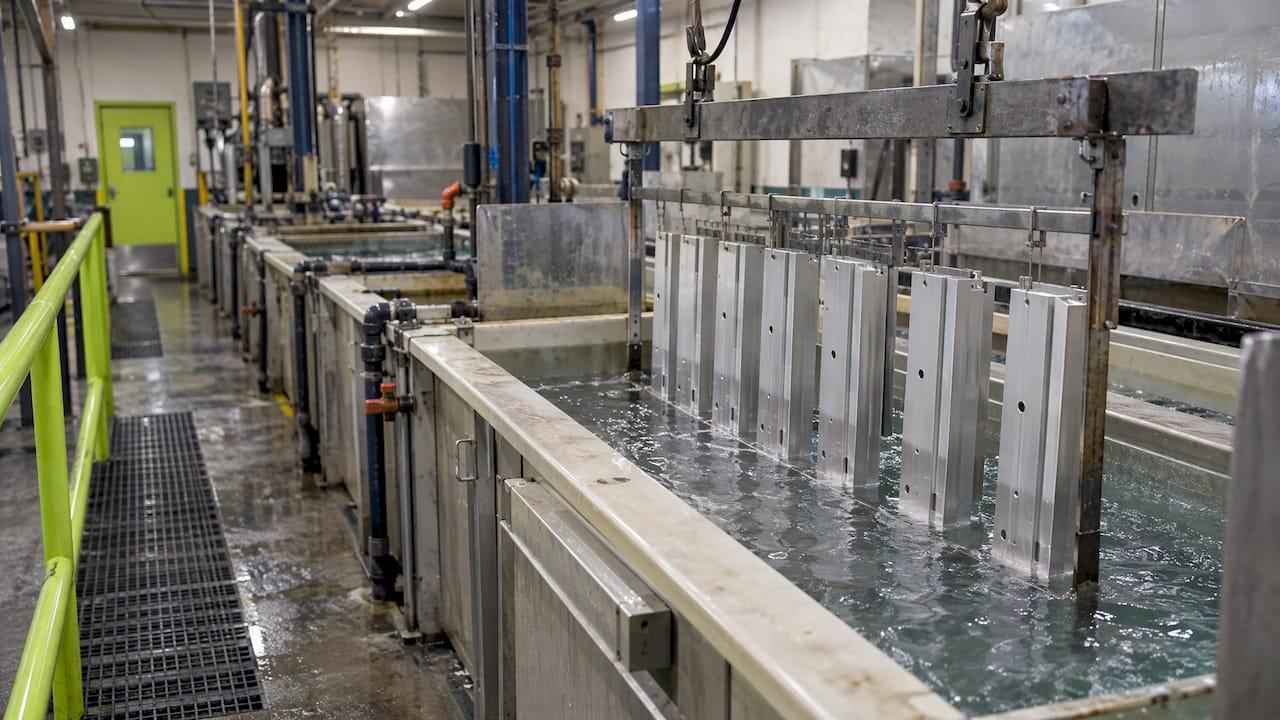
Anodizing comes in three types that matter for most CNC parts. Type I uses chromic acid and gives a thin, corrosion-resistant film. Type II uses sulfuric acid and is the standard clear or colored finish. Type III is hardcoat, built for wear and abrasion. Pick Type II when you want corrosion protection and color. Pick Type III when the part slides, rubs or takes abuse. Reserve Type I for fatigue-sensitive or paint-base work. Because the coating changes your part's dimensions, make this choice before the part is machined, not after. We machine aluminum parts in Athens, Alabama, so that is the angle we take here.
TL;DR
- Type II (sulfuric acid) is the common finish: good corrosion resistance, takes dye well, and is the usual choice for brackets, housings and cosmetic parts.
- Type III (hardcoat) is thicker and tougher for wear and abrasion. It also builds up more on every surface, so it affects fits and threads more.
- Type I (chromic acid) is the thinnest, kept for fatigue-sensitive and paint-base uses. Its low-voltage and non-chromic variants (IB and IC) exist because of environmental pressure.
- Class 1 and Class 2 mean undyed and dyed in the military spec. Do not confuse them with the architectural Class I and II, which are a different system.
- Call out thickness on the drawing whenever a fit, wear surface or appearance depends on it.
What anodizing does to aluminum
Anodizing is an electrolytic process. The aluminum part becomes the anode in a dilute acid bath, and oxidation at its surface forms an oxide film that is very adherent to the underlying metal. That is the key difference from paint or plating. The coating is not laid on top of the part. It is grown from the part itself.
TWI notes that the oxide layer is typically 5 to 30 µm thick and is used for wear and corrosion resistance or as a decorative layer. The film is porous when it forms. That porosity is what lets dye soak in, and it is why parts are sealed afterward. ASTM B580 says anodized parts should be sealed in water or aqueous chemical solutions unless the specification says otherwise.
The type you choose decides the acid, the bath temperature, the electrical settings and, in the end, how thick, hard and colorful the finish is.
The types of anodizing, side by side
In the United States, most anodizing is called out to MIL-A-8625, now often written MIL-PRF-8625. The Aluminum Anodizers Council describes six types and two classes in that specification. NASA's process specification PRC-5006 lists the same six types: I, IB, IC, II, IIB and III.
| Type | Chemistry | Typical use |
|---|---|---|
| I | Chromic acid, conventional | Corrosion resistance, paint adhesion, fatigue-sensitive parts |
| IB | Chromic acid, low voltage | Same family as Type I, run at lower voltage |
| IC | Non-chromic acid (for example, boric-sulfuric) | Chromate-free alternative to Type I |
| II | Sulfuric acid, conventional | The most common industrial finish, takes dye |
| IIB | Thin-film sulfuric acid | Non-chromate alternative where a thin film is enough |
| III | Sulfuric acid or mixed chemistry, hardcoat | Extreme wear and abrasion resistance |
Those descriptions come from the AAC's summary of the specification. NASA gives the low-voltage figure for Type IB as 22 ± 2 volts.
Most shop conversations only involve II and III. The rest of the list matters when a drawing from aerospace or defense work arrives with an unfamiliar callout.
Type I: chromic acid anodizing
Type I is the thinnest of the three main types. It is valued for corrosion resistance, paint adhesion and preserving fatigue life, which is why aerospace has long used it on parts that flex and cycle. The AAC describes Type I as giving outstanding corrosion resistance, paint adhesion and fatigue resistance.
In practice you will rarely choose it for a motorcycle, robotics or general machine part. The chromic acid chemistry is the reason variants IB and IC exist. IB runs at lower voltage. IC removes chromic acid altogether, as in boric-sulfuric processes. If a print calls for Type I and you have no aerospace reason for it, ask the designer whether IC or II would meet the real requirement. That conversation is easiest when you can reach the person making the part.
Type II: sulfuric acid anodizing
Type II is the workhorse. The AAC says sulfuric acid anodizing is the predominant process today, with coatings of 0.1 to 1.0 mil formed in a sulfuric acid solution at room-range temperatures. That is roughly 2.5 to 25 µm.
Why it dominates:
- It gives solid corrosion protection for most environments.
- It takes dye readily, so it covers black, red, blue and other colors.
- It is moderate in cost compared with thicker finishes.
- It leaves less dimensional change than hardcoat.
Type II also has a sub-split. In the military spec, Class 1 is undyed and Class 2 is dyed. NASA's specification defines the same two classes, non-dyed and dyed.
Type IIB: thin sulfuric
Type IIB is a thin-film sulfuric process, described by the AAC as a non-chromate alternative to Type I. You will meet it mostly on aerospace drawings. For commercial CNC work, Type II at a specified thickness usually covers the same ground.
Type III: hardcoat anodizing
Type III is the answer when a surface slides, rubs, gets struck or sees grit. The AAC places it as the choice for extreme wear and abrasion-resistant applications. It is also made in a sulfuric acid bath, but the process runs colder and with more current, which makes the oxide denser and thicker. NASA's specification goes as far as prohibiting Type III coatings formed at room temperature, a reminder that temperature control is part of what makes a coating hardcoat.
Typical uses include gears, pistons, valve components, guides and tooling. For the thickness ranges, tolerances and how to write them on a print, see our guide to hardcoat anodize thickness for CNC parts.
Hardcoat has trade-offs you should plan for in the design, not discover at inspection:
- Thicker buildup. More oxide grows on every face, so tight bores and threads need allowance.
- Fatigue. Hard oxide layers can crack when a part flexes repeatedly. For parts under cyclic loading, a thinner type is usually the safer choice.
- Limited color. Hardcoat is typically dark gray to black in natural tone, so bright colors are not its strength.
Class 1 vs Class 2, and Class I vs Class II
This is where many searchers get confused, because two different systems use similar names.
- Military spec classes (Class 1 and Class 2) describe whether the coating is undyed or dyed. They sit under the type.
- Aluminum Association classes (Class I and Class II) are architectural designations. The AAC FAQ explains that Class I is a high-performance finish for exterior use with a minimum thickness of 0.7 mil (18 microns). Class II is a commercial coating with a minimum of 0.4 mil (10 microns), for interior use or exteriors that get regular cleaning.
The AAC states plainly that the Class I and II designations should not be confused with Type I, II and III of MIL-A-8625. If a customer says "Class 2 anodize" on a machined part, confirm which system they mean. In a machine shop context it usually means Type II, Class 2: sulfuric acid, dyed.
How the types affect color
Color is controlled mostly by Type II. The AAC's description of coloring methods separates two approaches:
- Organic dyeing gives spectral colors such as deep yellow, red, blue, turquoise and black. It keeps the metallic brilliance of the aluminum and needs a minimum anodic film thickness of 20 µm.
- Inorganic coloring gives pale to dark bronze and gold tones, with a somewhat duller film.
The alloy matters as much as the dye. Columbia Chemical's expert article says 6XXX series alloys anodize consistently well, while 2XXX and 7XXX tend toward darker, less uniform finishes, and 4XXX with higher silicon trends to darker gray. If you need a color match across several parts, make them from the same alloy and, ideally, the same lot. Surface prep also changes the look. Our note on bead blasting before anodizing covers how to avoid a patchy result.
The 50/50 rule: anodizing changes your dimensions

The oxide does not just sit on the surface. NASA's specification says the coating grows at roughly twice the thickness of the converted metal: about half penetrates the metal and half builds up outward.
The practical math, using NASA's default thickness of 0.0020 inch ± 0.0004 inch when none is specified:
- A 0.0020 in coating adds about 0.0010 in to each coated face.
- A shaft with two coated sides grows by about 0.0020 in in diameter.
- A bore shrinks by the same amount.
That is why press fits, bearing seats, and threads need attention. Our guide to aluminum thread design covers geometry and engagement. If a feature has to be at final size after coating, read machining after coating before you cut. When a surface must stay bare, such as a grounding point or a thread, masking is the usual answer, and anodize masking dwell time is a common source of rework.
How to choose an anodizing type
Work through these questions in order.
- Does the part slide, rub or take impact? Choose Type III, and allow for the buildup.
- Does it flex or cycle under load? Favor a thinner coating, Type II or Type I, over hardcoat.
- Do you need color? Choose Type II, Class 2, in an alloy that anodizes evenly such as 6061.
- Is it a paint base or an aerospace print? Type I, IB or IC may be called out. Follow the drawing or ask the designer which requirement drives it.
- Does a dimension depend on the finish? Write the thickness on the drawing, along with which surfaces are masked.
The AAC's mention of a standard also helps here. ISO 7599 covers decorative and protective anodic coatings and excludes hard anodic coatings used mainly for engineering, which fall under a separate standard. If your customer works to ISO rather than MIL specs, check which one applies before you order.
If your real question is whether anodizing is the right finish at all, compare it with chemical conversion coating in Alodine vs anodize, or with plating in electroless nickel on aluminum. If the part needs conductivity, see Alodine for conductivity, because anodize is an electrical insulator.
Common problems and how to prevent them
Columbia Chemical lists the usual causes of trouble: inadequate surface preparation, thickness drift, burning or pitting at sharp edges, premature pore closure that hurts color consistency, and poor sealing that leaves a chalky surface. Most are prevented on the machining side:
- Break sharp edges slightly. Sharp corners concentrate current and can burn.
- Avoid trapped cavities where acid can hide.
- Keep surface finish consistent, because the anodize shows every tool mark and blast pattern.
- Use one alloy and one lot per color-matched set.
- State thickness and class on the drawing, not just "anodize black."
Caring for an anodized finish
Anodizing is durable, but the finish can still be dulled by the wrong cleaner. Use mild, non-acid products on coated parts, and rinse well. This guide to non acid cleaners for coated surfaces explains why acid-based cleaners are a risk on coated wheels, and the same thinking applies to anodized motorcycle and machine parts.
Where we come in
The finishing choice starts at the machine. Edge breaks, surface texture, thread allowances and masked areas are all decided during machining, and they decide how the anodize turns out. At Flying Chip Factory, prototypes, short production runs and fixtures, brackets and support parts are designed, machined and shipped from one shop, with direct access to the machinist for quick communication and revision. That means the question "Type II or Type III, and how much allowance on this bore?" goes to the person who will cut it.
If you are planning a part that will be anodized, send us the drawing and talk it through on our prototype machining and short-run production page.
Riders can also see what we build ourselves: the E2 Kickstand for the KTM SX-E 2, GASGAS MC-E 2 and Husqvarna EE 2 is CNC-machined in our shop and priced at $100-$105.
Our perspective on anodizing
Most finishing problems we see on a drawing are really machining decisions made too late. Type II or Type III is the easy part. The hard part is knowing that the coating will grow on every face, that a sharp edge will burn, and that a tight thread will not close the same way after the part comes back.
We design and machine parts ourselves, so we work from the same rule on customer jobs: decide the finish before the first cut. Pick the type for the job the surface has to do, put the thickness on the print, and leave room for the coating on every critical fit.
That is also why we like having the machinist in the conversation. A two-minute exchange about alloy, edge breaks and masking saves a rerun. Quick iteration on a prototype beats a long email chain about a finish callout.
Drake
FAQ
What are the three main types of anodizing?
Type I is chromic acid anodizing, Type II is sulfuric acid anodizing, and Type III is hardcoat. Type II is the most common industrial finish, and Type III is chosen for extreme wear and abrasion resistance. Type I is the thinnest and is used where corrosion resistance, paint adhesion or fatigue life matter most.
Is Type II or Type III anodizing better?
Neither is better in general. Type II suits parts that need corrosion protection and color, with less dimensional change. Type III suits parts that see wear, sliding or abrasion, with more buildup to plan for. Match the type to the job the surface has to do.
What is the difference between Class 1 and Class 2 anodizing?
In the military specification, Class 1 means the coating is not dyed and Class 2 means it is dyed. The architectural Class I and Class II from the Aluminum Association are a separate system based on minimum thickness and exposure, so check which one a drawing refers to.
Does anodizing change the size of a part?
Yes. Roughly half the coating grows into the metal and half builds outward, so outside dimensions increase and holes get smaller. Allow for that on press fits, bearing seats and threads, and call out the thickness on the drawing.
Can any aluminum alloy be anodized the same way?
No. Results vary by alloy series. The 6XXX series anodizes consistently well, while 2XXX, 4XXX and 7XXX series tend to give darker or less uniform finishes. For color-matched parts, use the same alloy throughout.
Sources
- What is anodising? TWI
- Process Specification for the Anodizing of Aluminum Alloys, NASA PRC-5006
- What is the Military Specification MIL-A-8625? AAC
- Current Anodizing Processes and Coloring Methods, AAC
- A Conclusive FAQ Guide for Anodized Aluminum, AAC
- ASTM B580 Standard Specification for Anodic Oxide Coatings on Aluminum
- ISO 7599:2018 Anodizing of aluminium and its alloys
- Ask The Expert: Aluminum Anodizing, Columbia Chemical