
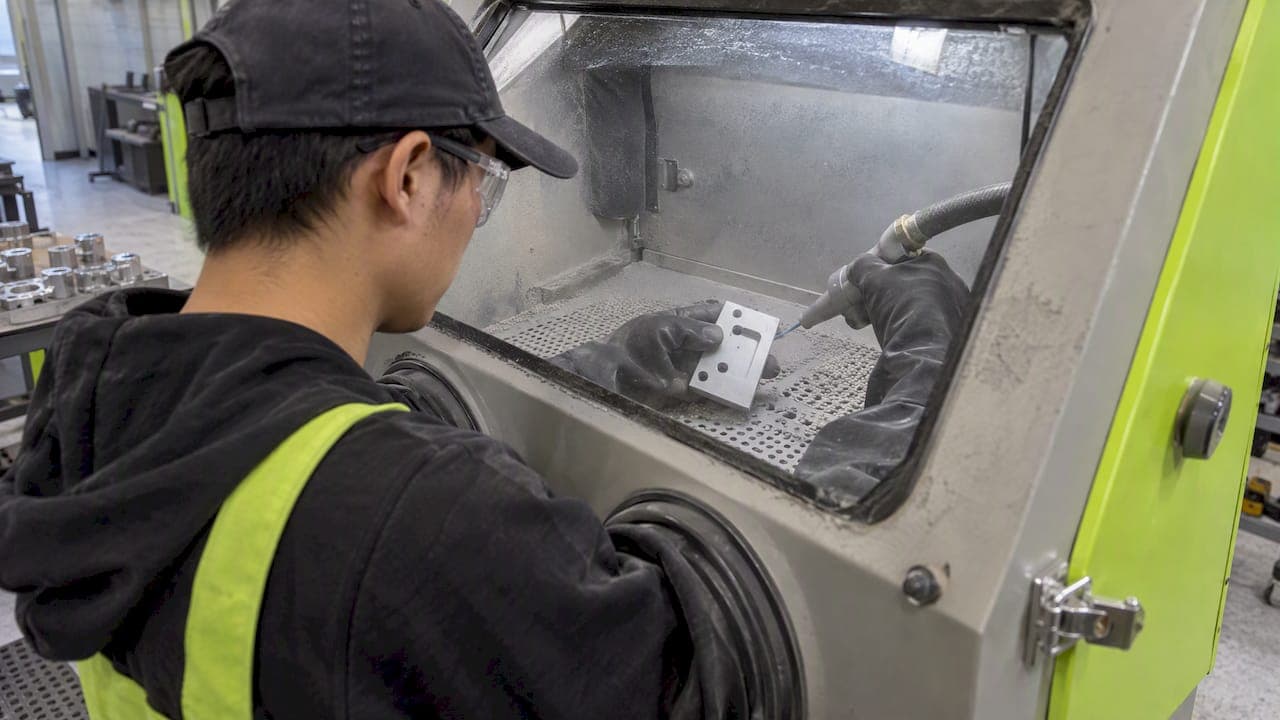
Yes, bead blasting before anodize is the right call when you want a matte or satin finish, because the anodic layer follows the blasted texture. Two rules decide the result: use clean, nonmetallic media dedicated to aluminum, and hold your blasting parameters steady while cleaning thoroughly afterward. Skip either one and the defects show up only after anodize, when fixing them is costly.
TL;DR:
- Approve a sample before production, then record media grade, pressure, nozzle distance, blasting time, and visual or Ra acceptance criteria on the drawing.
- Use clean, nonmetallic beads in equipment reserved for aluminum; steel grit and mixed media can embed particles that cause rust, pitting, or color defects.
- Standardize pressure, media size, nozzle path, and part orientation, then test No. 9 to 13 glass beads on matching alloy coupons for sheen.
- After blasting, remove dust and residue with air, vacuuming, ultrasonic cleaning, or washing; inspect under controlled light and test dye on a sample.
- Choose chemical micro etching when media embedding or peening threatens thin walls, or repeatability matters more than the texture bead blasting produces.
How does bead blasting change what anodize looks like?
Bead blasting uses media to turn machining marks into a fine matte texture. Abrasive blasting produces a matte texture The blasted texture contributes to the final appearance. Anodize does not hide a bad substrate. It reproduces it.
Blasted parts can look different from machined ones because blasting changes the surface texture. Uneven roughness or abrasive particles lodged in the surface can contribute to a patchy appearance after anodizing.
The practical answer is to treat appearance as a specification. Define the acceptable look, get a sample approved, and compare production parts against it. A guide to aluminum bead blasting makes the same point: blasting should be sample-approved before production starts.
Which blasting media are safe to use before anodize?
Glass beads can give CNC-machined aluminum a satin finish. Keep the media clean and check its condition, since media cleanliness affects the consistency of the finish. Ceramic beads are an alternative, but approve them on samples rather than assuming their finish will match glass beads.
Metallic abrasives are where trouble starts. Steel grit can embed and later rust unless it is removed chemically, which is why we keep it away from parts headed for anodize.
Cross-contamination is the other big risk. Shared blasting cabinets or mixed-media systems can embed foreign particles that later cause non-uniform appearance or pitting during anodizing. A cabinet dedicated to aluminum, with media that is regularly screened and replaced, removes most of that risk before it starts. If you are weighing bead against sand for your part, our bead blast vs sandblast comparison covers the differences in detail.
What process parameters control finish consistency?
Blasting consistency depends on factors such as air pressure, media size, and nozzle movement. Nozzle movement, media size and pressure all strongly affect how uniform the anodize color turns out. Changes to these conditions can affect the finish.
Operator variability is the quiet enemy. Variations in nozzle movement can produce different textures on otherwise similar parts. Fixturing that holds each part in the same orientation, plus a standard nozzle path or a conveyor or robotic motion, takes much of that variation out.
For sheen control, bead size matters. One practitioner workflow in Products Finishing pairs vibratory refinement with glass bead blasting and suggests testing bead sizes from No. 9 to 13 depending on the sheen you want.
Our sample routine is simple. Blast coupons from the same alloy, with the same machine marks and the same part orientation as production. Then write down the recipe: media grade, pressure, nozzle distance, time. If you need to specify surface texture before blasting, this guide to CNC surface finish and Ra ranges is a useful reference.
What causes patchy anodize, and how do you fix it?
The usual culprits are uneven blast coverage, pressure swings, contaminated or broken-down media, and weak cleaning before the anodize tank. In one practitioner thread on sandblasting before anodizing, glass bead blasting ahead of Type II anodize left white streaks when blasting was uneven, and the same discussion names media contamination and uneven blasting as frequent root causes.
Start with the process. Lower the pressure, confirm the media is correct and clean, and keep the nozzle moving at a steady pace. If the surface is already compromised, assess the cause and test any rework on a sample before treating production parts.
When embedded particles are the problem, chemistry comes next. The finishing discussion describes a sequence of short caustic etch, deoxidize, ABF, flash anodize, strip, re-etch and re-anodize. A deep etch in 5% sodium hydroxide at 40–65 °C or a nitric-fluoride treatment can also remove embedded abrasive, but both etches must be tuned or they can leave a mottled surface. Run test panels first, control the timing, and never rework a full lot on a guess.
How should you clean parts between blasting and anodize?
Remove dust and spent media using suitable cleaning methods, such as compressed air, vacuuming, ultrasonic cleaning, or a water wash. The PartsMastery guide lists these steps as essential for reliable anodize appearance, and a firearms-industry finishing whitepaper stresses that post-blast cleaning is critical to remove blast dust and residues.

Chemistry follows. Typical options include a short alkaline etch, a deoxidize step and ABF, chosen to suit the alloy and the finish you approved. Flash anodize and strip cycles are sometimes used as rework to clear cosmetic streaks before the final anodize, as in the practitioner sequence above.
Build inspection into the flow:
- Check parts visually under controlled lighting.
- Run a test dye patch on a sample.
- Record batch controls so any defect can be traced to a step.
Mind the coating type as well. Type II is thinner and more cosmetic, while Type III hardcoat is thicker and changes dimensions more; our hardcoat anodize thickness guide covers how that affects CNC parts.
When does a chemical matte beat bead blasting?
Sometimes you can skip the blast cabinet entirely. Luke Matte is a chemical micro-etch applied during anodizing to give a consistent matte finish, and it can shorten lead times and avoid separate glass bead blasting in some applications. AnoBlack 606 is a chemical pretreatment that micro-etches to a non-reflective matte black while minimizing base metal removal, and for some wrought alloys it can eliminate glass bead blasting and cut process steps.
Choose a chemical matte when media embedding risk is unacceptable, when parts are thin-walled and sensitive to peening, or when high-volume repeatability matters more than the specific texture bead blasting gives. Choose bead blasting when you want to mask machining lines mechanically or need a particular satin look. If your real question is whether anodize is the right finish at all, our Alodine vs anodize decision guide lays out the trade-offs.

What should a blast and anodize purchase order require?
Put these items on the drawing or PO:
- A signed sample approval with photos and an annotated blast recipe: media grade, psi, nozzle distance, time.
- Dedicated aluminum media, plus named cleaning steps: air blow, ultrasonic, deoxidize.
- Visual acceptance criteria or an Ra range.
- A documented corrective action plan and rework allowance if defects appear after anodize.
- Masking instructions, where relevant; our anodize masking guide covers dwell time and procurement language.
Why we coordinate blasting and anodize on short runs
On prototypes and short runs, the cheapest fix is a conversation before the first cut. When the machinist who made the part also sees the blast sample, problems get caught at coupon stage, not after a full lot is anodized. Splitting blasting and anodize across separate vendors usually multiplies handoffs and finger-pointing.
— Drake
Get bead-blasted, anodize-ready parts from one shop
Flying Chip Factory offers prototype machining and short-run production, plus fixtures, brackets and support parts. You talk directly to the machinist who is making your parts, so changes get made fast.
When you request a quote, ask for these four things: a sample approval, the blast recipe, the cleaning steps, and inspection photos. For a finished example, our E2 Kickstand shows the kind of part where controlled finishing matters. Send us your drawing and finish requirements, and we will quote the job with the sample workflow built in.
FAQ
Can you bead blast aluminum before anodizing?
Yes. Bead blasting gives aluminum a uniform matte texture that the anodic coating follows, so it is a standard way to get a satin anodized look. Use clean, nonmetallic media and clean the parts thoroughly afterward.
What is the difference between sandblasting and bead blasting?
Bead blasting uses spherical media such as glass beads that peen the surface to a smooth satin finish. Sandblasting uses abrasive media, while bead blasting uses beads; the resulting texture depends on the media and process. Bead blasting is one option for preparing aluminum for an anodized cosmetic finish.
What is anodizing in metal finishing?
Anodizing creates an oxide layer on aluminum. Type II is thinner and more cosmetic, while Type III hardcoat is thicker and more durable, as summarized in the MIL-A-8625 overview.
Why does my blasted part look patchy after anodize?
Patchiness usually traces to uneven blasting, pressure variation, contaminated media or incomplete cleaning. Fix the process first, then use a validated chemical rework cycle if embedded particles remain.
Sources
- Sandblasting before Anodizing - Q&A, Problems & Solutions - FinishingDotCom
- Aluminum Bead Blasting: A Complete Guide to Process, Media, and Quality Control -PartsMastery
- TACTICAL
- Hillockanodizing