
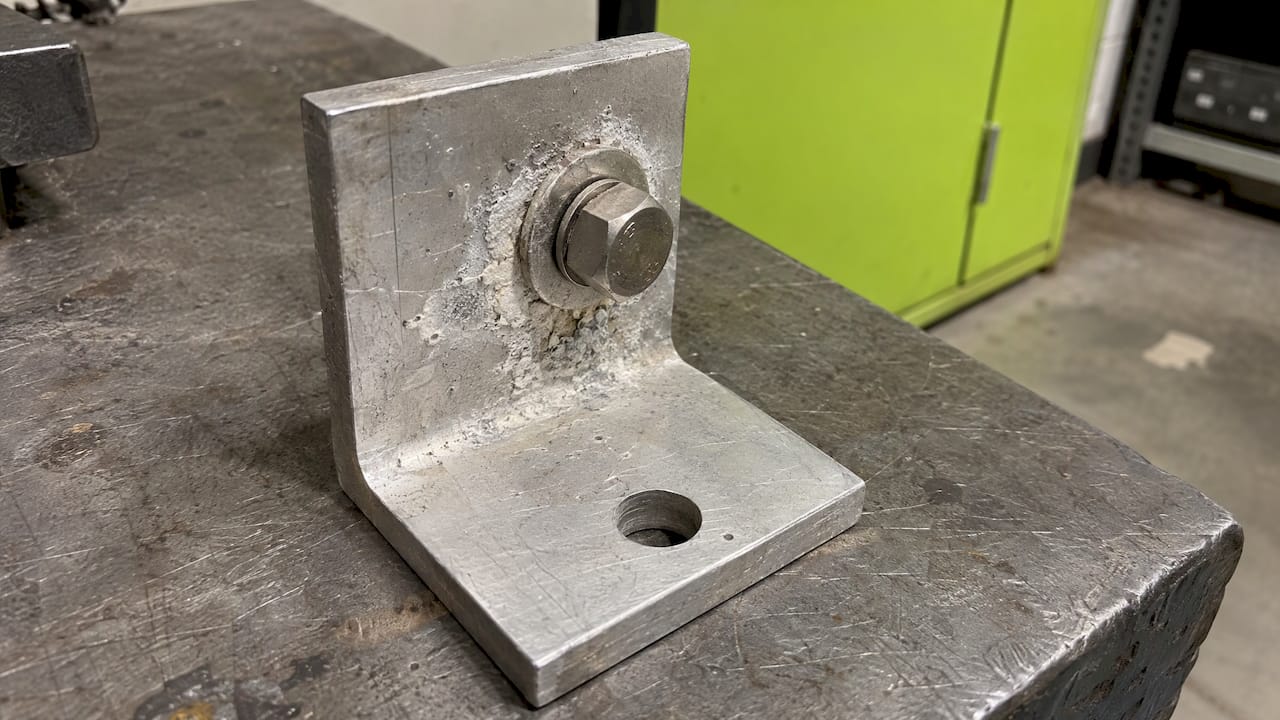
Aluminum and stainless steel can live together on a bike, a trailer or a machine, but only if you control three things: moisture, metal-to-metal contact and the size of each surface. When they touch and get wet, the aluminum is the metal that gives. The stainless steel stays shiny, and the aluminum around the bolt turns to white powder and pits. We machine aluminum and stainless parts in Athens, Alabama, so this is the practical version: why it happens, how to tell if your joint is at risk, and how to design it so it never becomes a problem.
TL;DR
- Galvanic corrosion needs three things at once: two different metals, direct electrical contact, and a conductive liquid such as rain, road spray, condensation or salt. Remove any one and it stops.
- In an aluminum and stainless pair, aluminum is the sacrificial metal. It corrodes faster than it would alone, and the stainless corrodes slower.
- Area matters most. A small aluminum fastener in a big stainless part is the worst case. A small stainless bolt in a big aluminum part is usually fine.
- Break the path with non-conductive washers, sleeves, sealant and coatings, and let the joint drain and dry.
- Dry, indoor and lightly exposed joints are low risk. Salt, mud, standing water and crevices are where trouble starts.
What actually happens when aluminum meets stainless steel
Every metal has an electrochemical potential, a measure of how readily it gives up electrons. Put two metals with different potentials in contact, bridge them with water that carries ions, and you have a small battery. Current flows, and the more active metal (the anode) is eaten away.
The numbers show why aluminum loses. The University of Delaware's corrosion notes put an aluminum alloy at roughly −0.7 to −0.9 V and 300-series stainless steel at about −0.07 V, a difference of around 0.73 V. That voltage difference drives current, and the aluminum anode corrodes faster than it would on its own while the stainless cathode corrodes slower or not at all.
Stainless steel has an advantage here because of its thin, self-healing oxide film. The UK's National Physical Laboratory notes that stainless steels such as 316 sit in a passive state with very low corrosion rates while that film is intact, and that coupling to another metal can push the partner metal into pitting it would never have suffered alone. In other words, the stainless is not attacking the aluminum. It is simply the more noble partner in a circuit the aluminum can't win.

What it looks like
The early sign is a buildup of corrosion product right at the joint. NASA's corrosion pages describe galvanic corrosion as recognizable by a buildup at the junction of dissimilar metals. On aluminum, the FAA describes the product as a white or gray powdery deposit, like dust, that blotches the surface. Clean it off and you will see tiny pits or holes underneath.
A real-world example from the British Stainless Steel Association: on a marine ladder, aluminum treads secured with uninsulated stainless bolts showed severe localized pitting, while bolts fitted with sound insulating washers left the surrounding aluminum unpitted. Same metals, same environment, and the only difference was the barrier.
The three conditions, and why most joints are safe
The Specialty Steel Industry of North America lists three conditions that must all be present: metals with different corrosion potentials, direct electrical contact, and a conductive electrolyte that regularly connects them, such as immersion, condensation, rain or fog.

That third condition is why this problem is often overstated. The BSSA is explicit that if the metals are dry, galvanic corrosion cannot occur, and that seawater or salt-laden moist air is a bigger risk than rain or tap water. The same page says stainless steel fasteners in aluminum plate or sheet are normally considered safe. What it calls unwise is the reverse: aluminum rivets or bolts holding stainless parts together.
So the honest answer to "can I put aluminum and stainless together?" is yes, with conditions. The conditions are about how wet the joint gets, how long it stays wet, and which metal has the larger surface.
Surface area: the rule that decides most cases
This is the single most useful idea in the topic. Galvanic current is concentrated on the anode. If the anode is small and the cathode is large, all that current attacks a tiny patch of aluminum and corrosion is rapid and severe. If the anode is large and the cathode small, the same current spreads over a big area and the damage is slow and superficial. The FAA states this directly: when the corroding metal's surface is smaller than the less active metal's, corrosion will be rapid and severe.
The University of Delaware notes give the clean comparison: a small aluminum rivet in a large stainless plate corrodes severely, while a small stainless rivet in a large aluminum plate corrodes much less, even though the voltage difference is identical.
A simple way to apply it:
| Joint | Area ratio | Risk when wet |
|---|---|---|
| Stainless bolt in a large aluminum bracket | Aluminum much larger | Low to moderate |
| Aluminum plate against a similar-size stainless plate | About equal | Moderate, manage with a barrier |
| Aluminum screw or spacer on a large stainless frame member | Aluminum much smaller | High |
BRANZ, New Zealand's building research body, makes the same point about distance: atmospheric galvanic corrosion localizes around the contact point and decreases with distance. The damage shows up at the contact edge, not across the whole panel.
Environments that raise the risk
BRANZ flags places where moisture or rainwater is retained or trapped for long periods as high-risk, along with coastal and heavily polluted industrial settings. It also notes that a small crack in anodized aluminum that exposes bare metal next to a stainless fastener can cause localized, increased corrosion in aggressive environments. Anodizing helps, but a chip in it next to a stainless bolt becomes the small anode we just talked about.
For riders, this translates to the places bikes actually live: washed with a hose and put away damp, hauled in an open trailer on salted winter roads, parked near the coast, or ridden through wet mud that packs into every crevice and stays there. If you want a broader look at how coastal air and salt attack equipment, this saltwater protection guide for boats covers the environmental side well, and the same salt that eats a hull eats a bolt boss.
Crevices deserve special mention. World Stainless notes that permanently wet crevices between stainless steel and less noble materials such as aluminum can be problem areas. Good drainage, good aeration and smooth surfaces help humidity films dry fast, and that alone reduces attack.
How to stop it: a practical sequence
BRANZ's guidance boils down to four moves: avoid dissimilar metals where you can, minimize moisture and salt or dust buildup at the contact, use durable non-conductive spacers or washers to break the conducting path, and apply durable polymeric coatings to isolate the whole joint area. Here is how that plays out on an actual assembly.
1. Decide which metal should be the large one
If you have a choice, make the aluminum part the large member and the stainless part the small fastener. This is the cheapest protection there is, because it costs nothing and works every time the joint gets wet. It is also a design decision, which is why it should be made before anything is cut. When we machine brackets, fixtures and support parts, this is the first conversation: what touches what, and how big is each piece.
2. Break the electrical path
The Norwegian Havtil review of dissimilar-metal connections recommends 3 to 4 mm neoprene or PTFE pads, or 1 to 2 mm PTFE pads where space is tight, with 316 stainless washers and sealing compound in bolt holes and at external corners to keep water out. PTFE has a bonus: it makes surfaces hydrophobic, so water films are disrupted and the electrolyte condition fails.
Note what a washer does and does not do. It insulates the head side. A bolt that threads directly into aluminum still touches it along the thread, so for a severe environment you want sleeves or coated threads as well as washers, or you accept that the thread contact exists and control the moisture and area ratio instead.
3. Seal the joint, with the right sealant
Sealant keeps electrolyte out of the crevice, but type matters. World Stainless says elastic joint seals that fill the crevice are a proven remedy, while sealants that go brittle and crack can make things worse. A flexible sealant that stays bonded through heat cycles and vibration is the goal. On a vibrating dirt bike, a rigid sealant is going to crack.
4. Coat the cathode, not just the anode
This surprises people. If the stainless is the large cathode, coating only the aluminum leaves any pinhole as a tiny, ferociously corroding anode. World Stainless advises that in atmospheric conditions, coating the stainless steel in a narrow zone along the contact line is usually sufficient, a few centimeters wide in a normal room atmosphere, but wider than 10 cm where salty liquid films several millimeters thick enlarge the effective cathode.
For aluminum parts that must stay conductive, a chromate conversion coating is one option, and we explain the spec in our guide to Alodine to MIL-DTL-5541 Class 3. For wear and corrosion resistance on aluminum, see electroless nickel on aluminum. On the stainless side, correct passivation to ASTM A967 restores the oxide film that keeps the stainless in its passive, low-corrosion state.
5. Let it drain and dry
Look at your joint as water would. An upward-facing recess that collects water keeps a joint wet far longer than the same joint on a vertical face. Free drainage and air flow turn a continuously wet joint into an intermittently wet one, and intermittent is survivable.
6. Do not trade one problem for another
Stainless threads in aluminum can seize, which is galling, not corrosion, but it often gets blamed on corrosion because the result is the same: a bolt you cannot remove. Our guide to preventing thread galling on stainless fasteners covers that, and our notes on threadlocker on aluminum explain what to use to keep fasteners from backing out. If you are designing the threaded hole itself, aluminum thread design covers engagement and inserts.
Why it is not a numbers game
You will find charts that give a voltage difference limit: 0.15 V in harsh environments, 0.25 V in normal ones and 0.50 V in controlled ones. They are handy for a first screen. On such a chart aluminum against stainless usually lands in the "some concern" band for outdoor use. But a chart cannot see your joint. Corrosion rate depends on wetted area, how long the surface stays wet, how much oxygen reaches it, temperature and the electrolyte itself.
That is why the practical test is the one at the top of this article: is there contact, is there a conductive film, and which metal is bigger? Answer those and you know more than the chart does.
One caution from the Sintef report on aluminum in marine service: after offshore experience showed severe corrosion on aluminum touching stainless, Norway's NORSOK M-001 standard was corrected in 2021 to require that direct contact between aluminum and steel be prevented in marine environments, with surfaces segregated by non-metallic pads. If your equipment sits in salt air or spray all year, treat isolation as mandatory, not optional.
What this means for dirt bikes and bolt-on parts
A bike is a worst-case test bench: vibration loosens things, mud holds water against metal, washing forces water into crevices, and the machine is often stored damp. Most of the time a stainless bolt in a large aluminum mount is fine, and the habits that keep it that way are cheap: rinse, dry, and don't leave wet gear packed against the bike.
A practical routine for any aluminum and stainless joint on your bike:
- After riding in mud, wet grass or salted roads, rinse and dry the joints, then check them.
- When removing a bolt, look for white or gray powder at the edge of the hole. That is the early sign.
- Reassemble with a barrier, a washer or coating at the contact, and fresh sealant where water could collect.
- Keep an eye on small aluminum fasteners and spacers against big stainless members, because that is the unfavorable pairing.
Our point of view
We design and machine parts for a living, and the lesson we keep coming back to is that corrosion is decided at the drawing, not in the garage.
Every joint in a part we make is a question: what touches what, where does water go, and which piece is the bigger one? Those answers cost nothing when the part is on the screen and a lot when it is on a bike in someone's trailer in January.
That is why we run the shop as one place. The parts are designed, machined and shipped from a single shop, and the person who answers your question is the machinist who builds the part. There is no sales layer between your question about a coating, a thread or a washer and the person who can change the drawing.
Our bolt-on E2 Kickstand and our BDE Bar Mount work come from riders who want durable construction and straightforward installation. Materials and joints are chosen with real use in mind, and the same thinking goes into every customer job.
Drake
Put it into a part
If you ride a KTM SX-E 2, GASGAS MC-E 2 or Husqvarna EE 2, our E2 Kickstand is a CNC-machined, bolt-on replacement for the factory triangle stand, priced at $100 to $105. It is built for riders who want a durable alternative and an easy install. Our BDE Bar Mounts are in development as an isolated 1 1/8-inch handlebar mount system.

If you are an engineer, designer or small manufacturer with a mixed-metal assembly, we offer prototype machining, short-run production, and fixtures, brackets and support parts, with direct access to the machinist who will make them. Send us the assembly and where it lives, and we can talk through the materials and joint details before any metal is cut. Start at Flying Chip Factory.
FAQ
Is it okay to put aluminum and stainless steel together?
Yes, in most dry or lightly exposed settings. Stainless fasteners in aluminum plate are normally considered safe by the British Stainless Steel Association. The risk rises with salt, standing water and small aluminum parts against large stainless ones, so isolate the joint in those cases.
Which metal corrodes, the aluminum or the stainless steel?
The aluminum. It is the more active metal, so it becomes the anode and corrodes faster, while the stainless is protected. The effect is worst when the aluminum is the smaller of the two surfaces.
Does switching from 304 to 316 stainless stop the problem?
Not by itself. Both grades are far more noble than aluminum, so the pairing is still galvanic. 316 does resist chlorides and pitting better, which helps the stainless itself, and the Norwegian offshore specification asks for it. You still need a barrier and a drained joint.
Do I need to worry about galvanic corrosion on a bike I ride in dry weather?
Usually not much. With no electrolyte there is no galvanic cell. The habits that matter are rinsing and drying after wet or salty use, and checking bolt holes for white powder when you service the bike.
Sources
- University of Delaware, corrosion notes
- NPL Corrosion Guide No. 5, Bimetallic Corrosion
- NASA, Forms of Corrosion
- FAA Advisory Circular AC 43-4B
- British Stainless Steel Association, Bimetallic (galvanic) corrosion
- SSINA, Galvanic Corrosion
- BRANZ, Compatibility of aluminium and steel
- World Stainless, Stainless Steel in Contact with Other Metallic Materials
- Havtil, Review of structural connections of dissimilar metals
- Sintef, Corrosion of Al in marine environments
- Saltwater protection guide for boats