
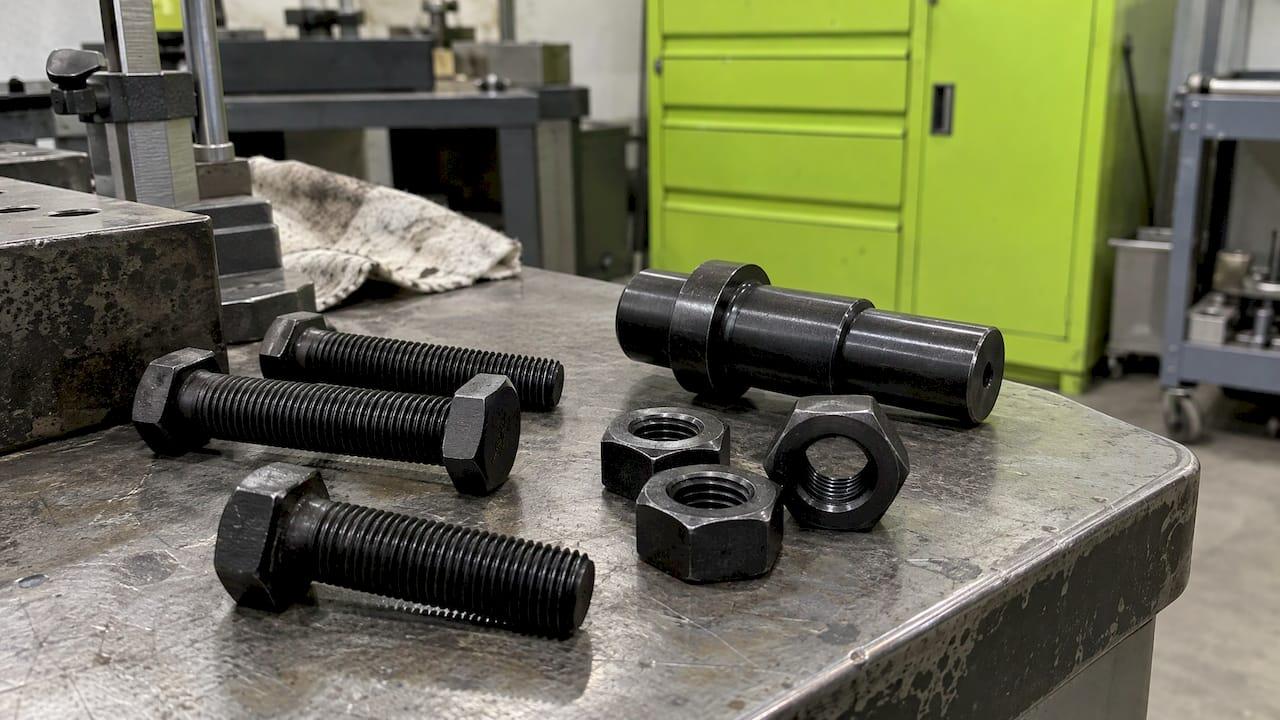
A black oxide finish is a chemical conversion coating. It turns the surface of steel into a thin layer of black magnetite (Fe3O4) instead of adding paint or plating on top. It barely changes part dimensions, cuts glare and costs little. On its own it gives very little rust protection, so the oil, wax or lacquer applied after the bath does most of the protective work.
This guide covers what the process does, how the steps run, how to read its corrosion claims, which metals take it, how it differs from bluing, and how to design and machine parts so the finish comes out right.
TL;DR
- Black oxide converts the steel surface to magnetite. It does not build a thick layer, so tolerances stay essentially intact.
- Corrosion resistance depends on the sealer. The military specification itself says protection is only very limited under mildly corrosive conditions.
- It suits carbon, alloy and tool steels well. Stainless needs a different, lower-temperature chemistry, and plated parts must be stripped first.
- Bluing and black oxide are the same chemistry. The names mostly separate thin coatings from heavier ones.
- Decide on finish before you cut: machine first, blacken second, and plan for any later cutting.
What a black oxide finish is
Black oxide is also called blackening, and in the firearms world it is called gun bluing. Coating suppliers describe it as a reaction between the iron in a ferrous part and oxidizing salts in a hot aqueous bath. The reaction forms an extremely thin layer of magnetite on the surface.
The key word is conversion. The coating is the part's own surface, chemically changed. It does not sit on the steel the way paint or plating does. Because of that, the finish will not chip, peel or flake. It can only be removed by mechanically or chemically removing the finish itself.
That is why black oxide shows up on parts that have to fit precisely: fasteners such as bolts, nuts and screws, gears and shafts, tools, automotive parts and machinery components, according to one finisher's list of applications.

How the process runs, step by step
Shops vary the details, but the sequence is consistent. A typical hot black oxide line looks like this:
- Alkaline clean. Oils, cutting fluid and shop dirt come off. Any film left behind shows up later as a patchy finish.
- Rinse. Thorough rinsing keeps one tank's chemistry out of the next.
- Acid activation or pickling. Guidance for mild and stainless steel includes an acid step and another rinse before the blackening bath. Scale and oxide on the surface get removed here.
- Black oxide bath. The parts are immersed in an alkaline oxidizing solution. One supplier describes the hot bath as operating at approximately 285 °F. Another puts the typical range at 285°F to 295°F. The bath typically contains sodium hydroxide and oxidizing salts such as sodium nitrate or nitrite.
- Rinse.
- Sealer or post-treatment. Oil, wax or lacquer goes on. This step sets the final look (from dry matte to a satin sheen) and most of the real-world protection.
The bath temperature is not a detail to skip over. It sits well above the boiling point of water, which is why replacement water can flash explosively into steam. This is a process for a finishing house with proper tanks, not a garage.
Hot, mid-temperature and room-temperature blackening
The three versions are not interchangeable:
| Type | Typical bath temperature | What it produces |
|---|---|---|
| Hot black oxide | About 285 °F | True magnetite (Fe3O4) finish |
| Mid-temperature black oxide | 225 to 245 °F | Magnetite finish at lower temperature |
| Room-temperature blackening | 65 to 85 °F | A different chemistry, not true black oxide |
The figures come from a finisher's knowledge base. The room-temperature version applies a copper selenium compound rather than forming magnetite, and it can be smutty and rub off on hands and clothes. If a drawing says black oxide to a specification, make sure the process you are quoted is the hot or mid-temperature one.
How rust-resistant is a black oxide finish?
Not very, by itself. The specification that governs most black oxide work, MIL-DTL-13924E from September 2018, states that black oxide on ferrous metals gives only very limited corrosion protection under mildly corrosive conditions.
What changes the picture is the sealer. Magnetite from the bath is slightly porous. As one industry source puts it, black oxide is a very good sponge for oil or wax, and that is where most of the resistance comes from.
The numbers back that up:
- With no after-finish, black oxide has very poor corrosion protection.
- With oil, wax or lacquer, the same source reports 100+ hours of indoor corrosion protection in a humidity cabinet.
- It is not suited to severe outdoor use or corrosive environments.
So, is black oxide rust-proof? No. It is rust-resistant when sealed, in dry or lightly humid conditions, and it needs its oil film maintained. A bolt on a bench or inside a machine will do fine. A part that gets wet, muddy and washed repeatedly needs a different finish, or a regular wipe-down with oil or a protectant.
Stainless steel is a special case
Black oxide on stainless is mainly cosmetic. A finisher's technical review notes that in a salt spray test, bare stainless would perform the same as stainless with a black coating. Choose it for the look and the glare reduction, not for corrosion performance. If stainless is your material, our stainless steel machining guide covers how it behaves at the machine.
Which metals take black oxide
Black oxide is built for ferrous metals. The military specification covers wrought iron, carbon steels, low alloy steels and corrosion-resistant steels. In practice:
- Low and medium carbon steels, alloy steels, tool steels: the standard candidates. Some finishers' chemistries are not compatible with cast iron or stainless, so always ask what your finisher runs.
- Stainless steel: it can be blackened, but with a different class of process. One finisher lists Class 1 for steel at 290 °F and Class 4 for stainless at 250 °F, with 300 and 400 series as typical examples.
- Plated parts: black oxide cannot be formed over zinc, nickel, chromium, cadmium or phosphate. The plating has to come off first.
- Aluminum: not a candidate. Aluminum is typically anodized, which is a different finish with its own thickness rules. See our guides on hardcoat anodize thickness and Alodine versus anodize.
Black oxide versus bluing
There is less difference than the two names suggest. Reference sources note that in colloquial use thin coatings of black oxide are often called gun bluing, while heavier coatings are called black oxide, and both refer to the same chemical process. Hot bluing uses an alkali salt solution at 135 to 155 °C (275 to 311 °F), which lines up with the hot black oxide range above.
In practice, the split looks like this:
- Black oxide is the term used in machining, fastener and tooling work, usually to a spec such as MIL-DTL-13924.
- Bluing is the term used for firearms, where the goal is a particular appearance and a hand-applied oil finish.
- Cold bluing products sold in small bottles are closer to the room-temperature chemistry described above, not the hot process.
If you want the finish to hold up on a working part, ask for the hot or mid-temperature process and a sealer chosen for the environment, whatever it is called.
Thickness, tolerances and fit
This is where black oxide earns its place on precision parts. The layer is tiny. One finisher says it typically adds about 5 to 10 millionths of an inch. Another machining reference puts the range at 0.5 to 2.5 microns, or 0.00002 to 0.0001 inches.
In practical terms:
- Press fits, thread fits and bearing seats usually need no compensation on the drawing.
- Compare that with plating or hardcoat anodize, which grow the part and force you to adjust dimensions before machining. Our guide to machining after coating covers when to cut before and after a finish.
- Surface texture still matters. The blackening follows the surface it is given, so a rough machined surface stays rough. If you specify roughness, our surface finish chart helps with Ra and RMS conversions.
Benefits and limits at a glance
| Factor | Black oxide |
|---|---|
| Dimensional change | Negligible |
| Appearance | Matte to satin black, reduced glare |
| Chipping or flaking | None, since it is a conversion layer |
| Cost | One of the least expensive finishes in its class |
| Lubricity | Improved, with anti-galling characteristics |
| Corrosion resistance | Limited alone, better with oil, wax or lacquer |
| Wear resistance | Thin surface finish, does not harden the metal |
| Best environment | Indoor, dry or lightly humid |
The lubricity and anti-galling benefits come from the same finisher summary cited earlier. They make black oxide a common choice on threaded fasteners and sliding steel parts.
Designing and machining parts for black oxide
Most finish problems start at the machine, not in the tank. A few habits help:
- Pick a steel that blackens evenly. Carbon and alloy steels are the easy path. Free-machining grades and some high-alloy steels can come out uneven, so tell your finisher the exact alloy.
- Remove all cutting fluid residue. Oil in blind holes and threads can carry through cleaning and leave spots.
- Avoid trapped liquid. Blind holes, tight overlapping joints and welded seams can hold bath chemistry, which then weeps rust later. Add a vent or drain hole where the design allows.
- Finish all cutting first. Any cut after blackening exposes bare steel. Touch-up with oil is the usual stopgap, and a fresh bath is the cure.
- Plan for masking, if needed. Surfaces that must stay bare, such as a bearing journal, need a plan before the parts leave the shop.
- Specify the sealer. Oil, wax and lacquer behave differently under handling and weather, so choose for the environment the part will really see.
Caring for finished parts matters too. On motorcycles and other powered equipment, black oxide fasteners and brackets live near water, mud and road salt. Wipe them with a light oil after washing, and protect nearby painted or coated surfaces with a product made for them, for instance ceramic coatings for alloy wheels on the wheels next to your hardware.
Perspective
We machine every part we sell, and we have learned that finish decisions belong at the drawing stage, not after the last cut. A thin, dimension-friendly finish like black oxide is attractive because it leaves a precision-machined part the size you made it.
What we care about is matching the finish to how the part is used. A fastener in a dry assembly and a bracket on a dirt bike that gets hosed off after every ride are not the same job. Be honest about the environment, choose the sealer for it, and keep a rag and a little oil handy.
That is also why we like working directly with the person who will use the part. Because the machinist who designs it also builds it, questions about tolerances, material and finish get answered in one conversation instead of passing through intermediaries.
Drake
Need parts machined before finishing?
If you have a steel bracket, fixture or short run that will go out for a black oxide finish, we can machine it to print and talk through material, tolerances and finish sequence directly with you. Prototype machining, short-run production, and fixtures, brackets and support parts are all handled in one shop, with the machinist as your point of contact. Start from our CNC machining services page.

Riding an electric mini bike? Our E2 Kickstand is a CNC-machined, bolt-on stand for the KTM SX-E 2, GASGAS MC-E 2 and Husqvarna EE 2, priced at $100-105.
How to remove black oxide from steel
Because the finish is part of the steel's surface, it comes off only by removing the finish itself, mechanically or chemically. Mechanical removal means abrasive blasting or sanding, which also takes a little base material and can change fine dimensions. Chemical stripping is done in a finishing shop, since the chemistry and rinsing are not casual work. If you need a bare part for re-machining or a new finish, ask your finisher to strip it and return it to print dimensions.

FAQ
Is black oxide rust proof?
No. The governing military specification says it gives only very limited protection in mildly corrosive conditions. With oil, wax or lacquer it performs much better indoors, but it still needs its protective film kept up.
Does black oxide work on stainless steel?
Yes, with a lower-temperature stainless process, but it is cosmetic. It does not improve the corrosion performance of stainless, and some steel-only chemistries will not blacken it at all. Tell your finisher the exact grade.
Is black oxide the same as bluing?
The chemistry is the same: both form magnetite on iron. Thin coatings tend to be called bluing and heavier coatings black oxide. Cold bluing products from a bottle use a different chemistry from the hot bath.
Will black oxide change my part's dimensions?
Barely. The layer is typically a few millionths of an inch up to about 0.0001 inch, so most fits need no adjustment. Still, tell your finisher about any critical tolerance before the job starts.
Sources
- The Basics of Black Oxide, SWD, Inc.
- Blackening FAQ, Electrochemical Products
- Black Oxide 101 and Troubleshooting Guide, Hubbard-Hall
- Black Oxide Process Data, Coating Technologies
- Black Oxide Coating, Xometry
- FAQ: Black Oxide and Cold Blackening, Finishing.com
- MIL-DTL-13924E, September 2018
- FTM 186: Can black oxide treated stainless rust?
- Functional and Decorative Black Oxide Coatings, Hubbard-Hall
- Black Oxidation FAQ, Nitrera
- Black Oxide Coating, Seminole Metal Finishing
- Bluing (steel), Wikipedia
- Black Oxide Coating for CNC Parts, My Best Machining
- Guide to Types of Gun Finishes, Silvex