
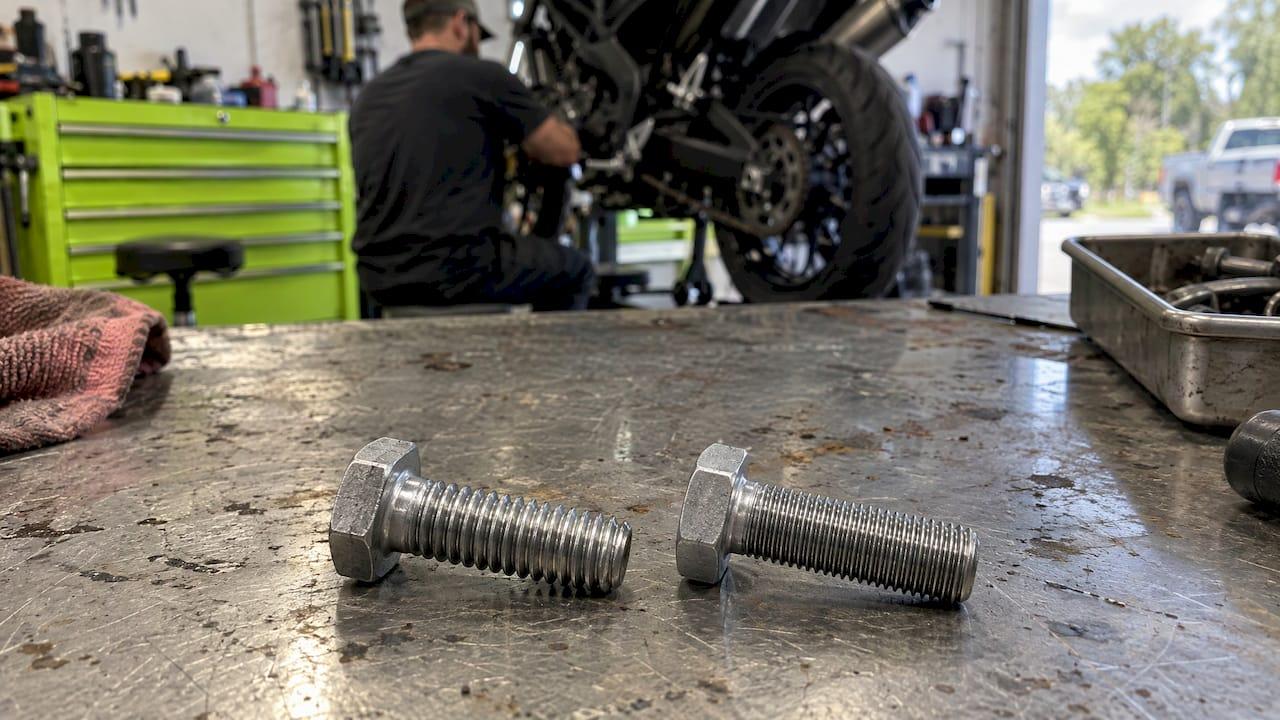
UNC (Unified National Coarse) and UNF (Unified National Fine) are two thread series for the same inch-size screws and bolts. At any given diameter, UNC has fewer, deeper threads per inch and UNF has more, shallower ones. Use UNC by default, especially in aluminum and other soft material. Choose UNF when you need finer adjustment, a thin wall or extra resistance to loosening. The two never mix: a UNC bolt will not properly thread into a UNF hole of the same diameter.
We machine parts for a living at Flying Chip Factory in Athens, Alabama, including our E2 Kickstand for electric mini dirt bikes. Thread choice is something we settle on the drawing before a single chip flies. This guide explains it in plain terms, whether you are replacing a bolt on a bike or specifying a part for a shop.
TL;DR
- UNC means coarse, UNF means fine. For the same diameter, UNC has fewer threads per inch (TPI) and UNF has more.
- The TPI number in the callout tells you which one you have: 1/4-20 is coarse, 1/4-28 is fine.
- UNC is the general-purpose default: faster to assemble, harder to cross-thread, and better in aluminum and other soft materials.
- UNF gives finer adjustment and a larger tensile stress area, and its smaller helix angle helps resist loosening under vibration.
- Never force a UNC fastener into a UNF thread or the reverse. Match the full callout, not just the diameter.
What UNC and UNF actually mean
Both names belong to the Unified Thread Standard, the inch-based system used across North America. It defines a 60° thread form in inch dimensions under ASME B1.1 and is the North American counterpart of the metric thread system. The system dates to 1949, when the US, Great Britain and Canada agreed to standardize thread form, series, allowances and tolerances. Their separate systems had complicated manufacturing and military supply chains.
The series differ in one thing: pitch, the distance from one thread crest to the next. At a 1/4 inch nominal diameter, the coarse thread has 20 threads per inch (1.270 mm pitch) and the fine thread has 28 (0.907 mm). A third series, UNEF (extra fine), goes to 32 TPI at that size.

For inch threads, pitch is simply 1 divided by TPI, per a fastener designation cheat sheet. So 20 TPI is 0.050 in between threads, and 28 TPI is about 0.0357 in.
One point of vocabulary saves arguments. The international standard for unified threads, ISO 263, says "coarse", "fine" and "extra-fine" describe only the relative size of the pitch for a given diameter. They are not quality grades. A fine thread is not a better thread, just a different one.
UNC vs UNF side by side
| UNC (coarse) | UNF (fine) | |
|---|---|---|
| Threads per inch | Fewer | More |
| Thread depth | Deeper | Shallower |
| Assembly speed | Faster, fewer turns | Slower, more turns |
| Cross-threading risk | Lower | Higher |
| Adjustment resolution | Coarser | Finer |
| Tensile stress area | Smaller | Larger |
| Vibration loosening | More prone | Smaller helix angle resists it better |
| Typical material | Aluminum, cast iron, mild steel, plastics | Steel, thin-wall parts, engine and aerospace hardware |
| Common default? | Yes | Specialized uses |
Here is where each row comes from.
Deeper versus shallower threads. The coarse series gives a deeper thread form. At the 1-1/2 inch size, the pair is 1-1/2-6 UNC and 1-1/2-12 UNF, with thread depths of 0.0902 in and 0.0451 in. The fine thread is half as deep.
Speed and forgiveness. Coarse threads advance farther per turn, so they install faster with less chance of cross-threading. The same source notes that fine threads give more precision and control, which is why electronics, aerospace and medical equipment often use them. A coarse thread also tolerates dings, paint and dirt better, which matters on anything that lives outdoors.
Strength. Per ISO 263, fine-series external threads have a greater tensile stress area than comparable coarse sizes. The fine series suits cases where short engagement length or wall thickness demands a fine pitch. That does not make every fine-thread joint stronger. Material, engagement length, preload and how the joint fails still decide the outcome.
Loosening. Fine threads have a smaller helix angle, so friction is more effective at preventing back-rotation under vibration. That is why they turn up in engine hardware and aerospace fasteners.
Does the same diameter mean they fit? No
This is the mistake that ruins parts. Both series share the same nominal diameter, so a 1/4 inch UNC bolt and a 1/4 inch UNF bolt look almost identical at a glance. They are not interchangeable. A 1/4-28 screw will not go into a 1/4-20 hole beyond the first thread or so. Forcing it strips the threads in the part or the fastener, and in aluminum that usually means a ruined hole.
Every size from #1 up to 1-1/2 inches has both a coarse and a fine version, and each needs its own tap and tap drill. If you are repairing a stripped hole or having a part made, you must specify the full callout, not just the diameter.
How to tell which one you have
Read the callout
A callout like 1/4-20 UNC has three parts: the diameter (1/4 inch), the threads per inch (20) and the series (UNC). The second number is the TPI, and it decides whether the thread is coarse or fine. Unlike metric threads, which are described only by outside diameter such as M12, a unified thread's marking reveals diameter, TPI and series.
Here are some pairs worth memorizing:
| Size | UNC | UNF |
|---|---|---|
| 1/4 in | 1/4-20 | 1/4-28 |
| #10 (0.190 in major diameter) | 10-24 | 10-32 |
| 1-1/2 in | 1-1/2-6 | 1-1/2-12 |
So, is 10-32 UNC or UNF? It is UNF. No. 10-32 has a 0.190 in major diameter and 32 TPI, while the coarse #10 is 10-24. Other common fine sizes in the same chart include 1/4-28, 3/8-24 and 1/2-20.
Full designations can carry more detail. They can include a class and handedness, as in 1/4-28 UNF-2A-LH, a left-hand fine thread. The 2A and 2B classes describe how loose or tight the external and internal threads fit together.
Measure it
If the bolt has no markings, measure the major diameter with calipers, then check the pitch with a thread pitch gauge. Hold the gauge leaf against the threads until it meshes with no light showing. Identification guides such as Swagelok's five-step procedure start by checking whether the thread is straight or tapered, then measuring diameter and pitch. Even experienced workers sometimes find identification difficult, so confirm before you cut or order anything.

A quick sanity test: thread a nut onto the bolt by hand. If it spins on smoothly for its full length, the pitch matches. If it binds after a turn, stop and re-measure.
When to choose coarse UNC
UNC is the right call more often than not. The coarse series is the most commonly used thread system in the majority of screws, bolts and nuts, and it suits low-strength materials such as cast iron, mild steel, soft copper alloys and aluminum. It also suits jobs where you want rapid assembly or disassembly.
Soft material is the big one. The deeper thread gives more bite, so a coarse thread cut into aluminum is less likely to strip than a fine one. ISO 263 describes the coarse and fine series together as the first choice for general engineering applications, and within that pair coarse is the one buyers find on the shelf.
Practical reasons to pick UNC:
- You are threading into aluminum, cast iron, plastic or other soft material.
- The fastener will be installed and removed often, in the field or in dirty conditions.
- You want the simplest, most widely stocked hardware.
- The part is a bracket, cover, mount or similar low-demand joint.
If you are working in aluminum, thread engagement matters as much as the series. Our guides on aluminum thread design and the 1.3×D thread engagement length rule go deeper.
When to choose fine UNF
Choose UNF when the joint has a specific reason to be fine:
- Vibration. The smaller helix angle makes the thread less likely to back off under repeated shaking.
- Thin walls or short engagement. A shallower thread leaves more material in the part, and per ISO 263 the fine series suits short engagement or walls that demand a fine pitch.
- Fine adjustment. One turn moves the fastener less, so you can set a position or preload more precisely.
- Harder materials. Steel can carry the fine thread without stripping, so UNF is a common choice for steel parts that need higher tensile strength.
A useful rule of thumb from one shop guide: use UNC for general applications because it is easier to assemble, less likely to cross-thread and cheaper, and move to UNF only when vibration resistance or higher clamping force is needed.
Two cautions. First, fine does not mean strong on its own: a UNF screw threaded into a soft aluminum hole can strip more easily than a coarse one. Second, fine threads are less forgiving of dirt, burrs and cross-threading. Clean the hole and start the bolt by hand.
Stainless fasteners add their own risk. Tight, fine threads can seize, so see our guide on preventing thread galling.
Choosing for a real project: a quick decision path
- What is the hole made of? Aluminum, plastic or cast iron points to UNC. Steel opens the door to UNF.
- Will it see vibration or need a thin wall? If yes, consider UNF, and confirm the engagement length.
- Is it a standard bolt you will replace in the field? Stay with whatever the original design used. Mixing series in a repair is how holes get stripped.
- Are you having the part machined? Put the full callout on the drawing, including series, class and whether it is a threaded hole or a stud. Decide whether the hole will be tapped or thread-milled, as covered in our piece on thread milling versus tapping.
Worked example: you need a 1/4 inch fastener to hold a bracket onto an aluminum plate that will be unbolted regularly. UNC (1/4-20) is the natural fit: deep thread in soft metal, quick to start, quick to remove. Now take a steel adjuster screw where you want to set a position in small increments. A 1/4-28 UNF gives you finer movement per turn.
Inch or metric?
UNC and UNF are inch threads. A metric thread of similar size will sometimes start, but it will not seat correctly. If a bike or machine mixes both systems, check each fastener rather than assuming. Our explainer on why metric and imperial threads never truly match covers the traps, and pipe threads such as NPT are a separate family again.
Need a part with the right thread?
If you want a ready-made part, our E2 Kickstand is a bolt-on, CNC-machined kickstand for the KTM SX-E 2, GASGAS MC-E 2 and Husqvarna EE 2 electric mini dirt bikes, and it sells for $100-105. It is designed, machined and shipped from our single shop in Athens, Alabama.

If you are an engineer, designer or small manufacturer, we also take prototype machining, short-run production, and fixtures, brackets and support parts. You deal directly with the machinist who designs and builds the work, with no sales intermediary, so questions like "coarse or fine here?" get answered by the person cutting the thread. Start from our shop page.
Our perspective
Most thread problems we see on a drawing come from one skipped decision: someone wrote the diameter and left the series to chance. A 1/4 inch hole is not a specification. A 1/4-20 UNC hole is.
We build parts for riders and for shops, and the logic is the same for both. Pick the thread for the material and the job, write it down completely, and cut it once. That is easier when the person who designs the part is also the person running the machine, which is how we work. A question about the thread series gets answered at the machine, not passed through a sales desk.
Our own goal with every part is durable construction and straightforward installation. A correct thread callout is a quiet part of that.
Drake
FAQ
What does UNF stand for?
UNF stands for Unified National Fine. It is the fine-pitch series of the Unified Thread Standard, with more threads per inch than the coarse UNC series at the same diameter. The system was agreed on by the US, Great Britain and Canada in 1949.
Is 10-32 UNC or UNF?
It is UNF. The 10-32 callout means a #10 screw, 0.190 in major diameter, with 32 threads per inch. The coarse thread at the same size is 10-24 UNC, so the two are not interchangeable.
Is UNC or UNF stronger?
Neither is better by definition. Fine threads have a larger tensile stress area, but material, engagement length, preload and failure mode still govern the joint. Coarse threads hold better in soft material like aluminum, and fine threads suit steel and thin walls.
Can I use a UNC bolt in a UNF hole?
No. The pitches differ, so the bolt will not engage properly beyond the first thread or so. Forcing it damages the threads. Match the full callout, including the TPI, before you tighten anything.
What is the difference between coarse and fine threads in general?
Coarse threads have fewer, deeper threads per inch and assemble faster. Fine threads have more, shallower threads per inch, adjust more precisely and resist vibration loosening better. For most general work and any soft material, coarse is the default.
Sources
- ASME B1.1-2024: Unified Inch Screw Threads, ANSI Blog
- ISO 263 (1973), Unified inch screw threads
- The meaning of UNC and UNF thread specifications, Yamawa
- Unified Threads (UNC/UNF/UNEF): Dimensions and Formulas, Machining Doctor
- UNC vs UNF: Coarse vs Fine Thread, Thread Sizes
- Fastener Thread Designations and Pitch Cheat Sheet, LivePhysics
- Understanding Metric and Inch Thread Sizes in Fasteners, MISUMI
- UNF Thread Size Chart, Hydraulic Insight
- Thread and End Connection Identification Guide, Swagelok
- Unified Screw Threads, eFunda
- What Does TPI Mean on Screws, Component Solutions Group
- Thread Specifications Guide, RivCut
- UNC vs UNF Threads: Coarse and Fine Thread Guide, 177Tools