
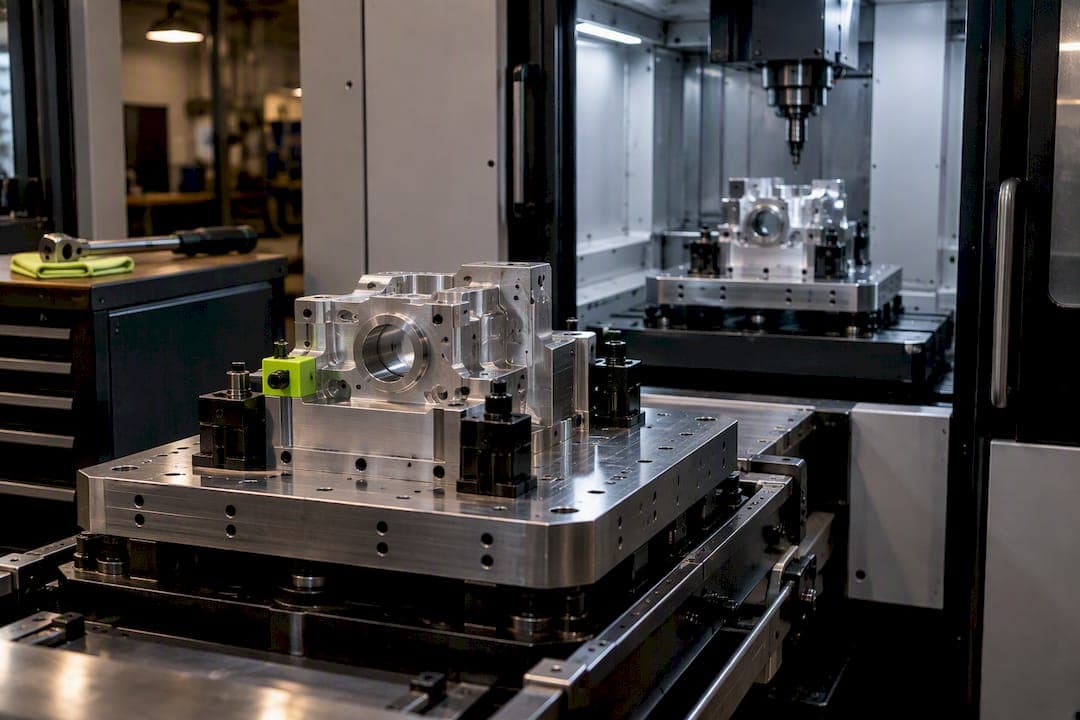
Palletized machining uses multiple preloaded pallets and automated handlers so a CNC machine can move from one job straight into the next with almost no operator intervention. The main payoff is time: the spindle keeps cutting while a new pallet is loaded, clamped, and staged offline. Job shops, medical suppliers, aerospace machine houses, and mold and die shops gain the most, since they all juggle small lots and frequent changeovers that would otherwise idle the machine.
TL;DR:
- Palletized machining boosts machine utilization to over 90% by enabling near-continuous cutting, especially beneficial for shops with wide part mixes and frequent changeovers.
- Choosing between a pallet changer, pool, magazine, or in-machine system depends on your part variety, floor space, and automation needs, with simpler setups suited for narrow part ranges.
- Reliable workholding with repeatable fixtures and standardized datums is critical, with quick-change fixturing paying off by preventing setup errors and reducing cycle times.
- Proper system layout and pre-setting pallets before unattended runs are essential, and a pilot program can verify potential productivity gains before a full investment.
- Small shops can start with a single pallet changer or internal system, and consider outsourcing short-run or prototype work for quick turnaround without upfront capital.
What Are the Main Types of Pallet Systems?
Four setups dominate the market, and picking the wrong one wastes capital fast.
- Pallet changer: a simple two-pallet swap built into or bolted onto a single machine, ideal for shops running one machine unattended overnight.
- Pallet pool/tower: a rack of 10 to 20+ pallets served by a shuttle or robot, suited for shops running high-mix, low-volume work across several part families.
- Pallet magazine: an OEM-integrated storage carousel, like the systems Makino builds for running families of parts with minimal special engineering.
- In-machine/internal pallet systems: shelving built inside the machine envelope, avoiding extra floor space. IntraLoad is one example, offering 9 to 24 pallets depending on the machine with pricing starting around $49,000, providing a more affordable entry point than a full external tower.
If your part mix is narrow and floor space is tight, start with a changer or internal system. If you're running dozens of part numbers across multiple machines, a pool or tower pays for itself faster.
Core Components: How a Palletized Setup Actually Works
A working cell is really five systems talking to each other, not just a rack of pallets.
- Pallets and interfaces: zero-point clamping, ball-lock studs, or index plates that let a pallet seat in the same location every time.
- Load and unload mechanisms: a pallet changer, robot arm, double-loader, or shuttle car that physically moves pallets between staging and the machine table.
- Storage: rotary towers, linear pools, or magazine carousels that hold preloaded pallets in queue.
- Master controller and MES/ERP integration: software that sequences jobs, tracks pallet status, and flags rush orders. DMG MORI's PH Cell and LPP platforms show how parallel order preparation increases machine availability across linked machines.
- Tool magazine interaction: automatic tool changers feed off a shared tool library, so the controller has to track both pallet and tool inventory to avoid a stalled cycle.
RoboJob's servo-gripper systems push this further, handling workpieces, clamping devices, and tools autonomously so a cell can run for days without a hand ever touching a fixture.
What Benefits Does Palletized Machining Deliver?
The core benefit is machine utilization. Spindle time is the expensive resource in any shop, and every minute spent loading, clamping, and zeroing a part is a minute the spindle sits idle. Palletized setups move that dead time offline.
By the numbers: Matsuura reports multi-pallet automation platforms sustaining spindle utilization above 90% on some systems, and Liebherr's PHS Allround line advertises up to 90% machine runtime with unit cost reductions as high as 40%, depending on configuration. Treat these as OEM-stated ceilings, not guaranteed outcomes for every shop.
Track your own numbers against three metrics:
- Uptime percentage across a full shift, not just spindle-on time.
- Parts completed per unattended shift.
- Hours of setup time removed per week.
High-mix, low-volume shops see the biggest swing, along with small-batch medical parts, mold and die inserts, and long-cycle finishing operations where a part can run for hours without anyone watching it.
Planning the Layout: Footprint, Safety, and Timeline
Before you sign a purchase order, map three things: part family, pallet count needed, and the ratio of cycle time to setup time.
Layout decisions matter as much as the equipment itself.
- Put staging stations where an operator can pre-set pallets without walking through the machine's safety zone.
- Plan pallet flow so incoming and outgoing pallets don't cross paths during a shift change.
- Choose systems with front access, which Liebherr designs into its modular PHS shelf levels so technicians can service one machine without stopping the rest of the cell.
- Budget extra weeks for controls, sensors, and interlocks. These integration details, not the mechanical hardware, cause most schedule slips.
Pro Tip: Run a one-shift pilot before committing to a full tower. Pre-set six to eight pallets of your target part family, run them unattended overnight, and compare parts-per-shift against your current manual process. It's a cheap way to validate the numbers before spending real capital, following the same pilot logic behind Makino's palletized horizontal machining case study.
Workholding and Quick-Change Fixturing That Actually Works
Pallets only deliver on their promise if the fixturing underneath them is repeatable. A ball-lock or zero-point pallet interface is worthless if the fixture on top of it shifts by a few thousandths every time it's reseated.
- Use a mechanical positive lock with pneumatic open and mechanical close. If the shop loses air pressure, the chuck stays clamped instead of releasing, which keeps an unattended run safe.
- Design fixtures for off-line pre-setting, so an operator builds tomorrow's pallet while today's job is still running.
- Standardize datum strategy across pallets to kill re-establishment time, letting rush jobs interrupt a queue and return to the original part without losing reference or introducing setup error.
- Consider indexing pallets to reach multiple faces on a 3-axis machine. A published trial found this approach saved 183 production hours on one aerospace component and paid back its setup cost in under a year, essentially emulating 5-axis work without the 5-axis machine.
Shops evaluating this trade-off can look at proven quick-change fixturing practices before deciding whether to buy new spindle capacity or invest in smarter workholding instead.
Choosing the Right Pallet Size, Weight Capacity, and Count
Vendors will throw specs at you fast. Narrow the conversation to five numbers before you take a meeting.
- Maximum transport weight the loader or shuttle can carry, including fixture and part combined.
- Pallet footprint relative to your machine's table size and rotary axis clearance.
- Allowable workpiece height, since tall parts can collide with tool changers or storage shelving.
- Number of pallets needed to cover an unattended shift without running out of queued work.
- Cycle time versus load time, which determines how many pallets actually pay for themselves.
Confirm compatibility with your existing table and any zero-point system already on the floor. Also ask whether the platform scales, since Liebherr's PHS line, for example, comes in stepped shelf variants (PHS 800/1500/3000) so you can add storage later instead of replacing the whole system. Cost drivers here directly affect payback, so running your own cost math before you commit is worth the hour it takes.
Keeping a Pallet System Reliable Day to Day
Unattended running only stays unattended if maintenance keeps up with it.
- Inspect pallet locating surfaces and clamping studs for chips or wear at the start of every shift.
- Put grippers, loaders, and clamping mechanisms on a preventive maintenance schedule, not a reactive one.
- Watch for the two most common failure modes: a dirty locating pin causing a false clamp signal, and air pressure drift tripping a safety interlock.
- Keep spare grippers and sensors on hand, and use telemetry where available to catch drift before it stops a shift.
A tool like an MES platform can flag these issues automatically, cutting the manual inspection burden that otherwise falls on a night-shift operator.
Practical Shop Examples and Flying Chip Factory's Perspective
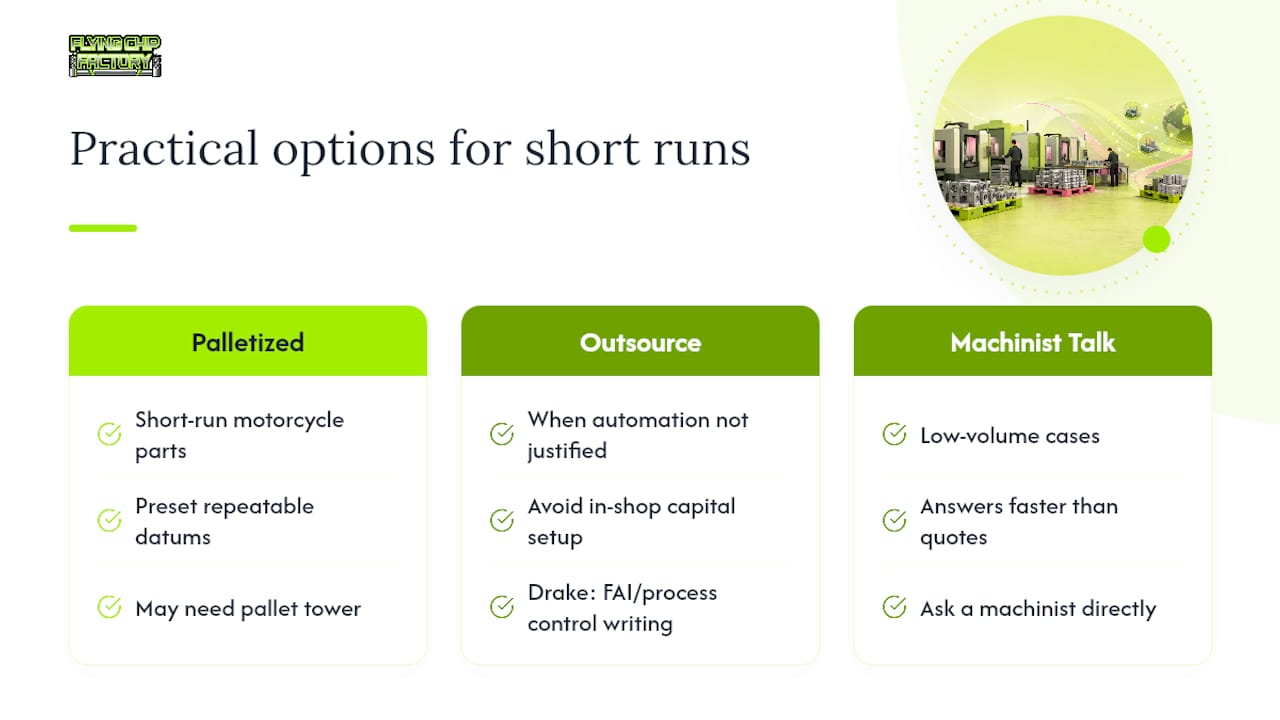
Some CNC shops apply the same fixturing discipline behind palletized machining to short-run motorcycle parts, pre-setting repeatable datums so a part's second run matches the first exactly. Drake, who covers quick-change fixturing and short-run production practices for the shop, has written on FAI and process control for engineers weighing automation against outsourcing. If your volume doesn't justify a pallet tower yet, a direct conversation with a machinist often answers the question faster than a vendor quote.
Should Your Shop Invest in a Pallet System Now?
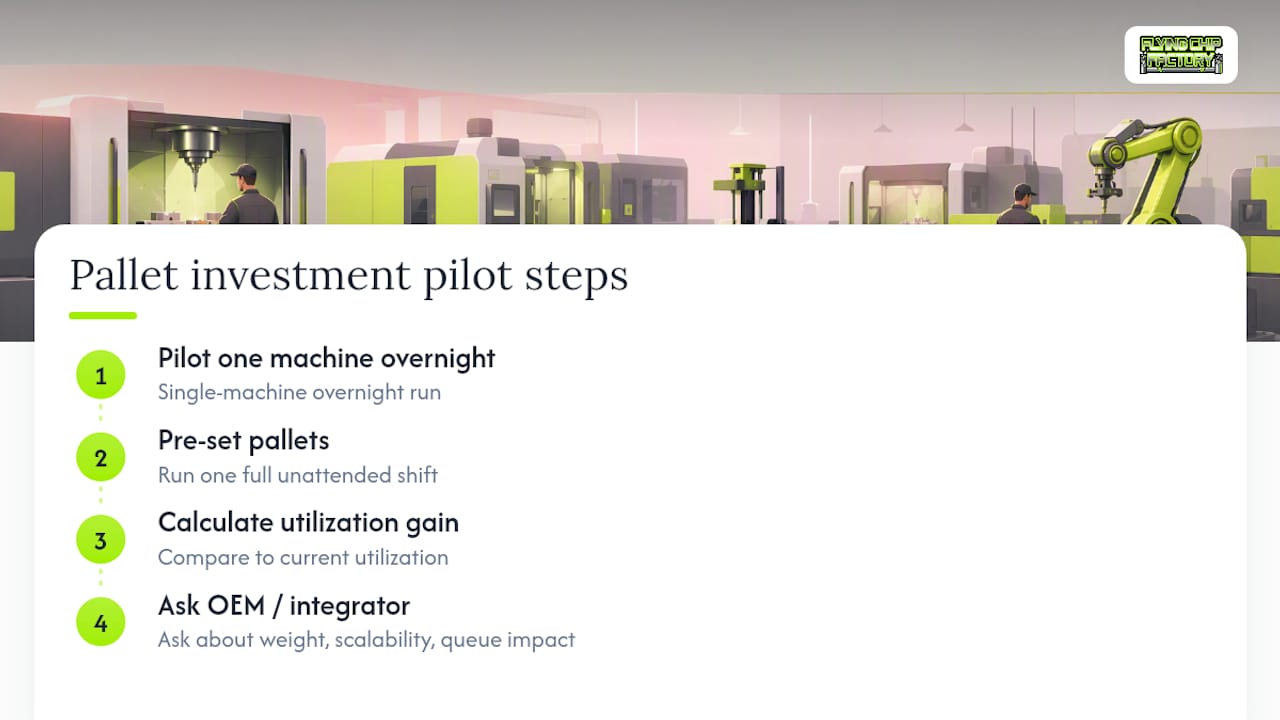
Palletized machining earns its cost when setup time eats a meaningful chunk of your cycle and part mix is wide enough to keep pallets in rotation. Three moves before you buy: pilot a single-machine cell overnight, pre-set a batch of pallets and run one full shift unattended, then calculate the utilization gain against your current numbers. When you talk to an OEM or integrator, ask about transport weight limits, pallet count scalability, and what happens to the queue when a rush job interrupts it.
A Machinist's Take on Choosing Pallet Strategies
Buy standard interfaces before custom ones, and start with one pallet changer before you commit to a tower. The rookie mistake is over-automating a part mix that doesn't exist yet. If you're not sure where your volume lands, talk to a shop running prototype and short-run work first.
— Drake
Get a Quote Instead of Buying a Pallet Tower
Not every shop needs a $50,000 pallet system to solve a changeover problem. Some shops offer direct access to a machinist for prototyping, short-run production, and custom fixtures or brackets, built and shipped from one shop with no sales layer in between.
That direct line matters most when you're running the exact pilot described above: a small batch, a tight deadline, a part that needs a second and third revision before it's right. Some shops handle prototype machining, short-run production, and fixture fabrication with fast turnaround on iterations, since every job and every in-house product goes through the same machinist from design to shipping. The shop's own E2 Kickstand for the KTM SX-E 2, GASGAS MC-E 2, and Husqvarna EE 2 is a working example of that process, a CNC-machined part designed, cut, and sold at $100 to $105 one-off with no middleman. If your next step is a prototype run rather than a capital equipment purchase, request a quote and get a machinist's eyes on your part this week.
Sources
- Matsuura’s Unmanned & Automated Pallet Pool CNC Machining
- Using palletised work-holding to emulate 5-axis machining of aerospace components (research paper)
- Pallet Automation - Makino
FAQ
What Machine Is Best for High-Volume Pallet Production?
For manufacturing pallets themselves as products, dedicated pallet-nailing or pallet-assembly machines dominate that industry, which is a different category from CNC pallet systems used to hold workpieces. In CNC machining, the "best" pallet system depends on your part mix and pallet count needs, with towers suited to high-mix shops and simple changers suited to single-machine unmanned runs.
Is CNC Machining Hard to Learn?
Basic CNC operation is learnable in weeks, but mastering programming, workholding strategy, and process control takes years of shop-floor practice. Palletized setups add another layer, since operators need to understand pallet indexing, zero-point repeatability, and how the master controller sequences jobs across the queue.
What Do You Call the Machine That Loads and Unloads Pallets?
It's typically called a pallet changer, pallet loader, or automated guided shuttle, depending on whether it swaps two pallets on a single machine or moves pallets between a storage pool and multiple machines. Robotic arms performing this function are usually described as pallet-handling robots.
What Is a Pallet in a Vertical Machining Center?
In a VMC, a pallet is a standardized fixture base that carries the workpiece and locates precisely on the machine table, usually through a zero-point or ball-lock interface. Swapping a pre-loaded pallet lets the machine start the next job in seconds instead of the minutes or hours a manual setup would take.
How Much Does It Cost to Outsource Short-Run CNC Work Instead of Automating?
Pricing varies by part complexity, material, and lot size, so there's no single flat rate across the industry. Flying Chip Factory's own in-house products, like the E2 Kickstand priced at $100 to $105, show what a finished CNC part can cost at retail, while custom prototype and short-run jobs are quoted directly based on the part.