
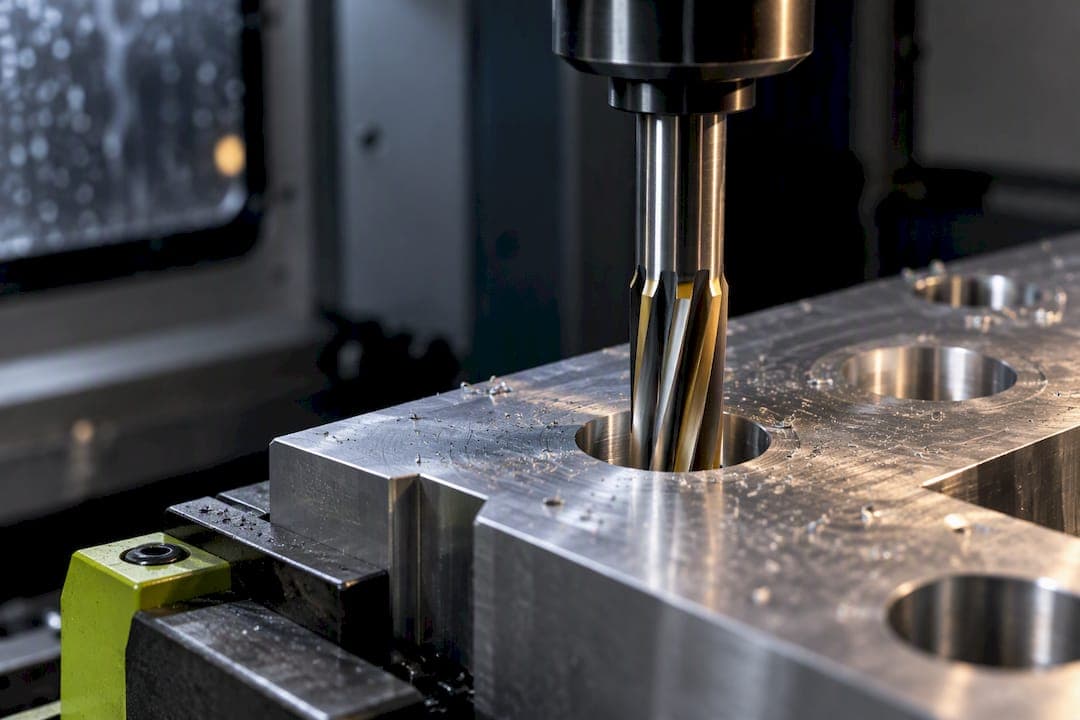
Drilling creates the hole quickly; reaming is a finishing pass to bring that hole to precision and a superior surface finish. If you only need a clearance hole or a rough opening, drilling alone is usually enough. If the hole is going to seat a dowel pin, a bearing, or a press fit, plan on reaming, because no reamer can fix a hole that started out crooked or off-location.
TL;DR:
- Reaming is essential for achieving tight tolerances and smooth finishes in holes that require precise fit, especially for dowel pins and press fits.
- Using a reamer correctly depends on a well-prepared pre-drilled hole, appropriate tooling, reduced spindle speed, and minimal runout under five micrometers.
- Reaming cannot fix misaligned or angled holes, so it requires a properly drilled pilot hole and should follow initial drilling for best results.
- Standard reamers can typically achieve ±0.0003 inch tolerance, but for higher precision, single-point boring can reach ±0.0002 inch and correct misalignments.
- For non-critical, large, or high-volume holes, drilling alone or boring is usually more cost-effective than reaming.
What is drilling: mechanics, tools, and practical limits
A drill bit removes bulk material by rotating a fluted, pointed tool into the workpiece, pushing chips out along helical grooves as the cutting edges shear through the material. Shops typically reach for twist drills for general-purpose holes, spot drills to start a clean location, and step drills when multiple diameters are needed in one pass.
Drilling alone is a rough operation. Bit deflection, spindle runout, tool wear, and loose fixturing all push the finished diameter and location off target, and the resulting bore often shows visible feed marks rather than a smooth wall.
- Twist drills handle most general holemaking, but tend to walk without a starter spot drill.
- Deflection and runout grow with hole depth, so deep holes drift more than shallow ones.
- Drilling-only is fine for clearance holes, mounting holes, and exploratory prototype features that will never see an interference fit.
For a bolt clearance hole or a hole that gets tapped afterward, drilling-only is the right call. For anything that needs a controlled, repeatable diameter, it is only step one.
What is reaming: how reamers work and what they deliver
A reamer is a finishing tool, not a holemaking tool. It follows an existing pilot hole and removes a small, controlled amount of stock to bring the bore to final size, roundness, and finish. According to Cutting Tool Engineering, reaming typically removes only about 2 to 5% of the hole diameter, which is why the quality of the pre-drilled hole matters so much.
Reamers come in several configurations, and picking the right one matters as much as the process itself:
- Straight-flute reamers work well in through-holes and softer materials; spiral-flute versions clear chips better in blind holes.
- Hand reamers are for manual finishing on the bench; chucking reamers run in a machine spindle for production work.
- HSS reamers cover most general shop work, while carbide reamers hold tolerance longer in abrasive or hardened materials.
Manufacturing tolerance bands on the reamer itself set a ceiling on what the finished hole can achieve, and a reamer cannot correct a hole that is off-center or drilled at an angle. It will simply cut a precisely sized bore that follows the existing, misaligned path.
Side-by-side comparison and quick takeaways
Drilling and reaming solve different problems in the same holemaking sequence, and the numbers make the split obvious.
| Factor | Drilling | Reaming |
|---|---|---|
| Purpose / role | Creates the hole, removes bulk stock | Sizes and finishes an existing hole |
| Material removal | Full hole diameter | About 2 to 5% of diameter |
| Achievable tolerance | Loose, general-purpose | Tight, sizing-grade |
| Surface finish | Rougher, visible feed marks | Smooth, sizing-grade finish |
| Tooling | Twist drills, spot drills, step drills | Straight or spiral reamers, guide bushings |
| Cycle time / cost | Fast, low cost per hole | Adds a pass and setup time |
| Choose this | When |
|---|---|
| Drilling only | Clearance holes, non-critical prototypes |
| Drilling then reaming | Dowel pins, bearing seats, press fits |
| Boring | Large diameters or a misaligned pre-hole |
Small diameters with tight fits favor reaming after a drilled pilot. Larger bores, high-volume runs, or a hole that needs its position corrected favor boring instead.
Tolerances and surface finish: numbers, standards, and realistic expectations
Tolerance expectations depend on how the hole is finished, and the gap between drilling and reaming is significant. Reaming, done correctly with a controlled pre-hole and stable setup, can hit tolerances as tight as ±0.0002" with surface finishes in the 15 to 30 microinch range, according to Cutting Tool Engineering.
Reaming standard repeatability is typically ±0.0003" with good setup, according to Industrial Monitor Direct, and that number matters when a print calls for a tighter band than a standard reamer and setup can reliably deliver.
Custom-ground reamers and guide bushings close that gap, but for the tightest positional and dimensional requirements, single-point boring is the more predictable route. Single-point boring routinely achieves ±0.0002", the same source notes, and it can also correct a misaligned or off-location hole, something no reamer can do. Our own breakdown of reaming vs boring walks through when that trade-off favors boring instead. For planning a tolerance budget across a whole part, see our guide to tight tolerance machining.

Tooling, speeds and feeds, and setup: shop-tested rules
Getting a clean, in-tolerance reamed hole comes down to the pre-drilled pilot, the speed you run, and how rigidly the tool is held.
- Leave an industry-recommended small stock allowance for steel or cast iron, and a slightly larger allowance for aluminum, brass, or copper, per the reamer sizing guidance from Drillbitsworld.
- Run the reamer at a reduced speed compared to drilling and use flood coolant on most materials except cast iron, per the same guidance.
- Avoid running a reamer in reverse as it damages the cutting edges and degrades hole finish.
- Use a guide bushing or floating holder placed close to the workpiece, and keep tool overhang short to control runout.
Runout under 5 micrometers is considered best practice, and anything above 15 micrometers is not acceptable for precision work, based on tooling guidance from Tungaloy's ReamMeister brief. Straight-flute reamers suit through-holes in easy-to-machine materials, while spiral flutes and coated carbide hold up better in stainless and other gummy alloys.
Pro Tip: Clamp the workpiece as close to the cutting zone as the fixture allows: extra distance between the clamp and the hole is where chatter creeps in.
Applications: matching common shop jobs to the right process
Most parts fall into one of a few predictable categories, and the right process follows from the fit, not the diameter alone.
- Use drilling only for clearance holes, mounting features, and rough prototype iterations with no interference fit.
- Use drill-then-ream for dowel pin holes, bearing seats, bushings, and shafts that need a controlled, repeatable slip or press fit.
- Choose boring, or a single-point finishing pass, for large-diameter bores, ultra-tight positional tolerances, or any hole that started out misaligned.
- Reserve a custom-ground reamer or a dedicated drill jig for production volumes where the tooling cost pays for itself across many parts, a trade-off covered in our drill jig design guide.
Dowel pin work is the clearest case for drill-then-ream, and our dowel pin hole tolerance reference lays out spec-ready numbers for that exact scenario.
Common mistakes and disadvantages of reaming
The most common reaming mistake is trying to use the tool to correct a hole that is off-center or drilled at an angle. A reamer follows the existing path rather than cutting a new one, so it will faithfully reproduce that misalignment at a precise diameter, as Cutting Tool Engineering points out.
- Too little pre-ream stock causes chatter and rapid edge wear; too much causes excess tool wear and an oversize bore.
- Chatter usually traces back to feed rate, spindle speed, or a holder that is not rigid enough.
- Gauging the hole immediately after reaming, rather than waiting until final inspection, catches drift before it turns into scrap across a batch.
Shop-proven tips from Flying Chip Factory
On steel parts, drilling usually leaves around 0.007 inch of stock before reaming, landing inside a range that keeps the cut clean without inviting chatter. Aluminum jobs typically leave closer to 0.012 inch of stock before reaming. Fixturing is placed close to the cut, with short tool overhangs, to reduce chatter during reaming.

Standard stock reamers cover most dowel pin and bearing seat work. Custom-ground reamers are typically used when tighter tolerance bands than standard tools and guide bushings can hold are required, usually on jobs with minimal tolerance for rework. Switching to a guide bushing instead of seeking a tighter reamer grind can reduce scrap in bearing seat jobs.
Author's perspective: balancing speed, cost, and precision
Process selection is rarely about chasing the tightest number on the print. It is about meeting the spec with the least cost and the least risk of scrap, whether that means a straight drilled hole, a drilled and reamed fit, or a boring pass when a hole needs correcting rather than just sizing. The right call is almost always the cheaper one that still holds the tolerance.
— Drake
Sources
- Reaming Basics – Cutting Tool Engineering
- Drillbitsworld
- Reamed Hole Tolerance: ANSI B94.2 Limits & Achieving ±0.0007" – Industrial Monitor Direct
- ReamMeister – tooling application brief (Tungaloy)
FAQ
What are the disadvantages of reaming?
Reaming cannot correct a hole that is misaligned or drilled at an angle, since the tool follows the existing path rather than cutting a new one. It is also sensitive to pre-drill stock: too little causes chatter and tool wear, and too much causes an oversize, out-of-tolerance bore.
Can you use a drill bit instead of a reamer?
A drill bit alone works for clearance holes and non-critical prototype features where a loose fit is acceptable. It will not deliver the tight diameter control or smooth finish that a reaming pass provides for dowel pins, bearing seats, or press fits.
Can you ream a hole with a drill?
No. A twist drill removes bulk material and leaves a rougher, less precise bore than a reamer, which is built specifically to remove a small, controlled amount of stock for final sizing. The two tools have different geometry and different jobs in the same holemaking sequence.
Why would you ream a hole?
Reaming brings a drilled hole to a tighter, more repeatable diameter with a smoother wall than drilling alone can achieve, with finishes in the 15 to 30 microinch range under good setup, according to Cutting Tool Engineering. It is the standard step for holes that need to seat a dowel pin, bearing, or press-fit component.