

For most extreme-environment applications, PEEK is the right call. When your operating conditions stay below 200°C, dimensional stability matters more than chemical aggression, and budget is a real constraint, ULTEM® (polyetherimide, or PEI) earns its place on the spec sheet.
Here is the short version before the data:
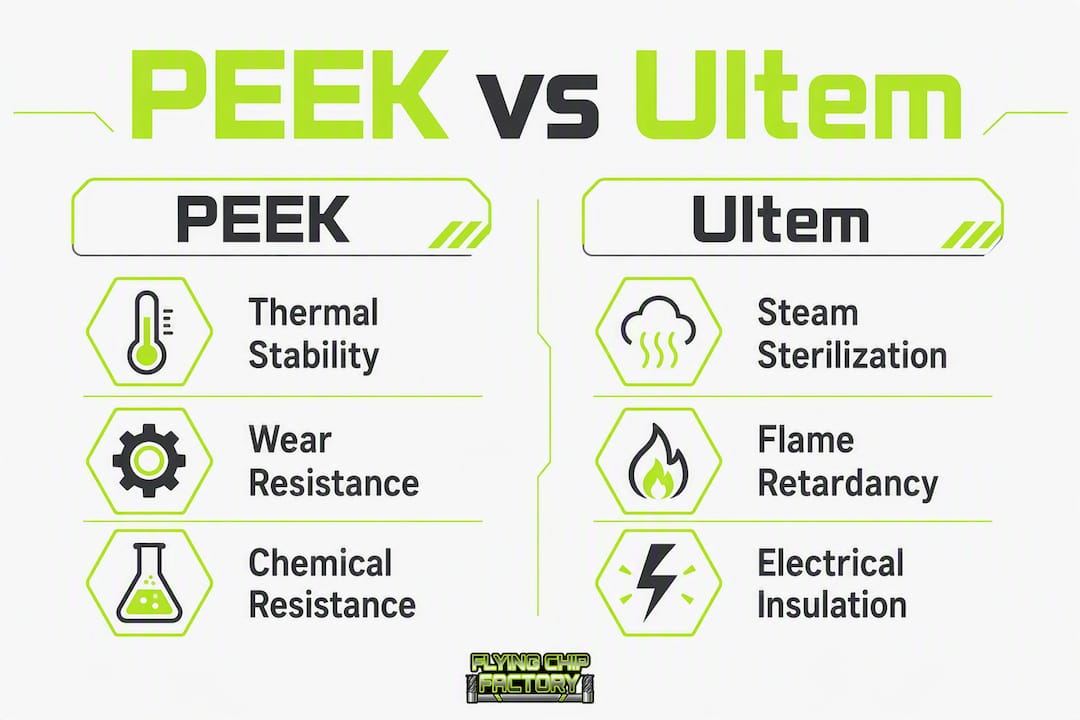
- Continuous service temperature: PEEK handles up to 250°C (480°F); ULTEM® tops out around 170–200°C
- Chemical exposure: PEEK's semi-crystalline structure resists a broader range of solvents, fuels, and acids; ULTEM® is vulnerable to halogenated solvents and strong bases
- Fatigue and wear: PEEK, especially in filled grades, outperforms for cyclic and sliding loads
- Dimensional stability and tight tolerances: ULTEM®'s amorphous structure is more predictable for thin-wall, tight-tolerance machined parts
- Cost: ULTEM® typically costs about 40–60% of equivalent PEEK pricing on a per-pound basis
Quick scenario map:
| Scenario | Recommended material |
|---|---|
| High-temp chemical contact (fuels, solvents, >200°C) | PEEK |
| Tight-tolerance electrical insulator, moderate temp | ULTEM® |
| Repeated steam autoclave sterilization | ULTEM® |
| High-cycle bearing or sliding component | PEEK (filled grade) |
| Aerospace interior with flame/smoke requirements | ULTEM® |
| Downhole or engine-adjacent structural part | PEEK |
How do PEEK and ULTEM® compare on key specs?
The table below pulls from manufacturer datasheets and distributor data. Use it as a starting point; always request grade-specific sheets from Victrex, Solvay KetaSpire, or SABIC before finalizing a spec.
| Property | PEEK (unfilled) | ULTEM® 1010 (unfilled) |
|---|---|---|
| Continuous service temp | 250°C | about 170–200°C |
| Glass transition temp (Tg) | ~143°C | ~217°C |
| Melt temp (Tm) | ~343°C | N/A (amorphous) |
| Flexural modulus | ~600,000 psi | ~480,000–510,000 psi |
| UL94 flame rating | V-0 | V-0 |
| Chemical resistance | Broad (semi-crystalline) | Moderate (amorphous) |
| Moisture absorption | Low | Low–moderate |
| Machinability | Good (anneal first) | Very good |
| Typical cost ratio | Baseline | about 40–60% of PEEK |
| Common filled grades | GF30, CF30, PTFE/graphite | GF30, GF10 |
| Primary industries | Oil & gas, aerospace, medical, semiconductor | Aerospace interiors, medical fixtures, electrical |

One number worth flagging: PEEK's flexural modulus of ~600,000 psi versus ULTEM®'s ~480,000–510,000 psi is a meaningful gap when you are designing a part that sees sustained bending loads. That 15–20% stiffness advantage compounds at elevated temperatures, where ULTEM® softens faster.
How does material structure drive thermal behavior?

ULTEM® is amorphous. PEEK is semi-crystalline. That single structural difference explains most of the performance gap between them.
An amorphous polymer like ULTEM® has no ordered crystalline domains. Its molecules are randomly arranged, which gives it excellent optical clarity in thin sections and very predictable dimensional behavior up to its glass transition temperature (Tg ~217°C). Below Tg, it is stiff and stable. Above Tg, it softens rapidly. There is no melt plateau, just a progressive loss of modulus. That is why ULTEM®'s practical continuous-use ceiling sits at 170–200°C despite a Tg that looks impressive on paper: you need a safety margin below Tg for structural applications.
PEEK behaves differently. Its semi-crystalline domains act as physical crosslinks that persist above Tg (~143°C). The crystalline fraction keeps the polymer dimensionally stable and mechanically capable well above its own Tg, all the way to a true melt point at ~343°C. That is how PEEK achieves a continuous service temperature of 250°C (480°F) while ULTEM® tops out at 170–200°C.
Practical thermal guidance:
- PEEK parts used in high-temperature service benefit from a post-machine anneal cycle (typically 150°C for 4 hours, then slow cool) to relieve internal stresses and stabilize crystallinity before final inspection
- ULTEM® does not require annealing for stress relief the way PEEK does, but thin-wall or notch-sensitive geometries need careful design support near the upper service limit
- For autoclave environments (134°C / 270°F steam cycles), ULTEM® sits comfortably within its service range; PEEK is also compatible but is often over-specified for this use alone
- Creep resistance at elevated temperature strongly favors PEEK; ULTEM® under sustained load near 180°C will show measurable creep that PEEK would not
Pro Tip: If your part operates above 180°C under any sustained mechanical load, do not rely on ULTEM®'s Tg alone as your safety margin. Run a creep simulation or request creep data from the supplier at your actual operating temperature before committing to a grade.
Which material is stronger and more wear-resistant?
Room-temperature tensile strength is nearly a wash. ULTEM® (some grades) measures around the same tensile strength as unfilled PEEK (https://www.readyplastics.com/resources/comparisons/peek-vs-ultem-pei). If your part only ever sees ambient conditions and moderate stress, that gap is not a deciding factor.
The divergence shows up in two places: elevated temperature and cyclic loading.
Stiffness under bending loads
PEEK's flexural modulus is notably higher than ULTEM®'s, which means a PEEK beam or bracket deflects less under the same bending force. For structural brackets, retaining rings, or any part where deflection tolerance is tight, that extra stiffness matters.
| Property | PEEK (unfilled) | ULTEM® 1010 |
|---|---|---|
| Flexural modulus | ~600,000 psi | ~480,000–510,000 psi |
| Wear resistance | Excellent (esp. filled) | Good |
| Fatigue performance | High (semi-crystalline) | Moderate |
Wear, friction, and filled grades
For bearing cages, valve seats, pump gears, and any sliding interface, PEEK is the standard choice. Its semi-crystalline structure gives it inherently better wear resistance than amorphous PEI. Add PTFE, graphite, or carbon fiber fill and you get a bearing-grade material that runs dry, resists galling, and maintains dimensional stability under cyclic thermal and mechanical loads.
ULTEM® filled grades (typically GF10 or GF30) improve stiffness and reduce creep but do not approach PEEK's wear performance for high-cycle sliding applications. If you are specifying a bushing or thrust washer, filled PEEK is the industry standard.
How do PEEK and ULTEM® handle chemicals and sterilization?
PEEK's semi-crystalline morphology acts as a diffusion barrier. Solvents and aggressive chemicals have a harder time penetrating the ordered crystalline regions, which is why PEEK resists a much broader chemical spectrum than ULTEM®.
Chemicals that attack ULTEM® but not PEEK:
- Methylene chloride (DCM)
- Trichloroethylene and other chlorinated solvents
- Strong bases (concentrated NaOH, KOH)
- Some ketones at elevated temperature
Where PEEK excels chemically:
- Hydraulic fluids, jet fuels, and lubricating oils
- Dilute acids and most organic solvents
- High-pressure steam (with proper grade selection)
- Many pharmaceutical process streams
Sterilization compatibility:
ULTEM® is widely validated for repeated steam autoclave cycles at 134°C (270°F) and is a standard material for reusable surgical instrument trays, fixture blocks, and medical device housings. Certain ULTEM® grades carry formal sterilization documentation from SABIC. PEEK is also autoclave-compatible and handles ETO and gamma radiation sterilization well, making it the choice when the part also sees aggressive cleaning agents between cycles.
Moisture and UV:
Both materials absorb relatively low moisture, but ULTEM® is slightly more susceptible to hydrolysis under prolonged exposure to hot water or steam at temperatures approaching its service limit. For outdoor or UV-exposed applications, neither material is UV-stabilized in standard grades; carbon-filled or pigmented grades offer better UV resistance, and a protective coating is worth considering for long-term outdoor service.
What do you need to know before machining or printing these materials?
CNC machining
Both materials machine cleanly with carbide tooling, but they behave differently in the shop.
PEEK develops internal stresses during aggressive roughing cuts, particularly in thick stock. A controlled anneal before finish machining (typically 150°C for 3–4 hours, slow furnace cool) relieves those stresses and prevents post-machine distortion. Stock is commonly available in sheet (0.125"–4") and rod (0.25"–6" diameter), so leave adequate stock allowance for the anneal cycle before going to final dimensions.
ULTEM® is more dimensionally predictable during machining because its amorphous structure does not carry the same crystallization-induced stress. Thin walls and tight tolerances are more achievable without an anneal step. The trade-off: ULTEM® is notch-sensitive. Sharp internal corners concentrate stress and can initiate cracks under load, so design in generous radii and avoid abrupt section changes.
- Start with annealed PEEK stock or anneal before finish passes on critical features
- Use sharp carbide or PCD tooling; dull tools generate heat that degrades surface finish
- Keep coolant flowing on PEEK to prevent localized thermal stress
- For ULTEM®, minimize sharp internal radii; target R0.030" minimum on inside corners
- Inspect for stress whitening on ULTEM® parts after machining; it signals residual stress that may cause cracking in service
Injection molding
PEEK requires a barrel temperature of roughly 360–400°C and a mold temperature of 160–200°C for adequate crystallinity. Undershoot the mold temperature and you get an amorphous PEEK part with significantly reduced chemical and wear resistance. ULTEM® molds at lower temperatures (barrel ~340–380°C, mold ~140–175°C) and flows more easily through thin sections, which is why it is often preferred for complex, thin-walled electrical connectors and housings.
Additive manufacturing (FDM)
Printing either material requires a high-temperature machine. PEEK filament needs a nozzle temperature of 360–400°C and a heated chamber of at least 120°C, often higher. Without an enclosed, temperature-controlled chamber, warping and delamination are nearly inevitable. Layer adhesion in PEEK is sensitive to print speed and cooling rate; slow down and keep the chamber hot.
ULTEM® FDM (commonly ULTEM® 9085 or 1010 filament) runs at slightly lower nozzle temperatures (340–380°C) and is the standard aerospace FDM material partly because of its UL94 V-0 rating and partly because it is more forgiving to print than PEEK. Stratasys Fortus and similar industrial FDM platforms are designed around ULTEM® filament. Expect warping on both materials without proper bed adhesion (PEI sheet or high-temp adhesive) and plan for a post-print anneal on structural PEEK parts.
Pro Tip: For FDM PEEK, preheat your build plate to at least 120°C and use a fully enclosed chamber. A post-print anneal at 150°C for 2 hours improves layer adhesion strength by relieving the thermal gradients locked in during printing.
What are the flame, electrical, and regulatory ratings?
Both PEEK and ULTEM® achieve UL94 V-0 in standard unfilled grades without flame-retardant additives. That is a meaningful distinction from most engineering thermoplastics, which need halogenated or phosphorus-based FR packages to reach V-0.
ULTEM® carries a particularly high limiting oxygen index (LOI) and produces low smoke and low toxic gas emissions when it does burn. Those properties are why it dominates aerospace interior applications where FAR 25.853 flammability compliance is required. PEEK also performs well on smoke and toxicity, but ULTEM® is the more established choice for cabin interiors specifically because of its documented smoke density and toxicity test history.
Electrical properties:
ULTEM® is generally preferred for high-frequency electrical applications. Its lower dielectric constant and dissipation factor at high frequencies make it a better insulator for RF connectors, antenna housings, and circuit board components. PEEK is a capable electrical insulator but is not typically the first choice for precision high-frequency work.
Certification checklist for your datasheet request:
- UL94 V-0 rating (confirm thickness at which rating applies)
- ASTM D638 (tensile) and ASTM D790 (flexural) test data
- FDA 21 CFR compliance (for food-contact or pharmaceutical applications)
- USP Class VI (for implantable or body-contact medical applications)
- Continuous service temperature per UL 746B or equivalent
- Chemical resistance table (request the full solvent/acid/base matrix, not just a summary)
How do filled grades change the performance picture?
Adding glass fiber, carbon fiber, or PTFE/graphite to either base resin shifts the property profile substantially. The direction of change is predictable; the magnitude depends on fill percentage and fiber length.
| Grade | Stiffness (flexural modulus) | Wear resistance | Thermal conductivity | Dimensional stability |
|---|---|---|---|---|
| PEEK unfilled | ~600,000 psi | Good | Low | Good |
| PEEK GF30 | — | Moderate | Low–moderate | Excellent |
| PEEK CF30 | — | Moderate | Moderate | Excellent |
| PEEK PTFE/graphite | — | Excellent | Low | Good |
| ULTEM® unfilled | ~480,000–510,000 psi | Good | Low | Excellent |
| ULTEM® GF30 | — | Moderate | Low–moderate | Excellent |
Glass and carbon fill dramatically increase stiffness and reduce creep, but they make the material abrasive. Carbide tooling wears faster on GF30 or CF30 grades; coated carbide (TiAlN or diamond-coated) extends tool life meaningfully. Reduce feed rates by 20–30% compared to unfilled stock and expect more frequent tool changes.
PTFE and graphite-filled PEEK grades sacrifice some stiffness but deliver the lowest coefficient of friction and the best wear life for dry-running bearing and bushing applications. These grades are the industry standard for high-cycle sliding components in semiconductor equipment, food processing, and aerospace actuators.
When fillers are the wrong move: if your application is primarily electrical insulation and the part sees no significant wear or structural load, unfilled ULTEM® is simpler to machine, cheaper, and gives you the best dielectric properties. Adding glass fill to ULTEM® for an electrical housing adds cost and machining complexity without a meaningful performance return.
Where does each material typically excel?
PEEK sweet spots:
- Downhole oil and gas components (drill collars, valve seats, seal rings) where temperatures exceed 200°C and aggressive fluids are present
- Engine-adjacent and exhaust-adjacent structural parts in aerospace and automotive
- High-temperature semiconductor wafer-handling fixtures and process chamber components
- High-cycle bearing cages, bushings, and thrust washers (especially in filled grades)
- Implantable and body-contact medical devices requiring USP Class VI or ISO 10993 compliance
ULTEM® sweet spots:
- Aerospace cabin interior components requiring FAR 25.853 and UL94 V-0 compliance with low smoke
- Reusable surgical instrument trays and medical sterilization fixtures (autoclave-validated grades)
- Electrical connectors, RF housings, and antenna components requiring low dielectric constant
- Sight glasses and transparent structural components (amorphous ULTEM® can be optically clear)
- Structural brackets and enclosures in the 150–180°C range where PEEK's cost premium is not justified
The clearest application overlap is in medical fixtures and aerospace structural brackets. In both cases, the deciding factor is usually the specific chemical environment and whether the part needs to survive above 200°C. If yes, PEEK. If not, ULTEM® is worth a serious look.
How should you work through the specification decision?
Work through these steps in order before committing to a material:
- Define the thermal envelope. What is the maximum continuous operating temperature, including transients? If it exceeds 200°C under load, ULTEM® is out.
- List every chemical the part contacts. Request the full chemical resistance matrix from the supplier for both candidates. Halogenated solvents or strong bases in the process stream rule out ULTEM®.
- Assess mechanical loads. Is the part primarily structural (bending, tension) or tribological (sliding, rotating)? High-cycle wear applications point to filled PEEK; moderate structural loads in the ULTEM® temperature range may not need PEEK's stiffness premium.
- Confirm sterilization requirements. Steam autoclave at 134°C? Both work. Aggressive chemical sterilants between cycles? Verify ULTEM®'s resistance to the specific agent.
- Evaluate cost and volume. ULTEM® at roughly 40–60% of PEEK pricing is a real budget consideration on short runs. On a 500-piece production run, that cost difference compounds.
- Check manufacturability and lead time. Thin walls, complex geometry, and tight tolerances often favor ULTEM® for machining predictability. PEEK is the better choice when post-machine annealing is feasible and the application demands it.
Supplier questions to ask:
- What is the validated continuous-service temperature for this specific grade under load?
- Can you provide the full chemical resistance table, not just a summary?
- What annealing cycle do you recommend for this grade before finish machining?
- What filled grades are available, and what are the tolerance implications?
- Do you have fatigue data at my operating temperature?
Red flags that should trigger a re-evaluation:
- A continuous-service temperature listed without a load condition or test standard
- No filled-grade tooling guidance from the supplier
- Missing fatigue or creep data at the application temperature
- A chemical resistance summary that only lists "good/fair/poor" without test conditions
Flying Chip Factory: practical shop notes on machining PEEK and ULTEM®
At Flying Chip Factory, most PEEK and ULTEM® jobs come in as prototypes or short runs where the part geometry is already defined but the material behavior is still an unknown for the engineer. A few shop-level realities that do not always make it into datasheets:
PEEK benefits from starting with annealed stock. If you are sourcing raw rod or plate, confirm with your distributor whether it has been stress-relieved. For critical features, a pre-machine anneal at 150°C for 3–4 hours followed by a slow furnace cool is standard practice here before going to final dimensions. ULTEM® does not need that cycle, but it does need generous corner radii and careful fixturing to avoid stress concentration during clamping.
Typical achievable tolerances (turned and milled features):
| Feature type | PEEK (annealed) | ULTEM® |
|---|---|---|
| Thread fit (tapped) | Class 2B standard | Class 2B standard |
ULTEM® holds tighter tolerances on milled features more consistently because there is no post-anneal dimensional shift to account for. PEEK can move slightly after the anneal if the part was not fully stress-relieved before the final pass, so build in a re-check step after the thermal cycle on tight-tolerance features.
For a fast, accurate quote from Flying Chip Factory, include the following in your RFQ:
- STEP or IGES file with all critical dimensions called out on a 2D drawing
- Material grade (e.g., PEEK natural, PEEK GF30, ULTEM® 1010, ULTEM® 9085)
- Required surface finish (Ra value or equivalent)
- Tight-tolerance features flagged explicitly
- Run quantity and whether this is a prototype, short run, or production intent
Pro Tip: If you are unsure whether PEEK or ULTEM® is the right call for your part, send the RFQ with both materials listed. Flying Chip Factory can quote both and flag any manufacturability differences that should factor into your final decision.
Key Takeaways
PEEK is the right default for extreme-temperature, chemically aggressive, or high-cycle wear applications; ULTEM® is the smarter choice when operating conditions stay below 200°C, dimensional stability and electrical properties matter, and cost is a real constraint.
| Point | Details |
|---|---|
| Thermal ceiling | PEEK handles 250°C continuous; ULTEM® tops out at 170–200°C under load. |
| Room-temp strength | ULTEM® (some grades) slightly edges PEEK at room temp; PEEK retains strength at far higher temperatures. |
| Cost difference | ULTEM® typically costs about 40–60% of equivalent PEEK pricing per pound. |
| Chemical exposure | PEEK resists halogenated solvents and strong bases that attack ULTEM®; always verify with the full resistance table. |
| Flying Chip Factory | Quotes both PEEK and ULTEM® for prototypes and short runs; send your STEP file and material grade to get a fast, accurate estimate. |
The real cost of over-specifying
The most common mistake on the shop floor is not under-specifying a material. It is over-specifying one. Engineers reach for PEEK by default because it is the highest-performance option on the list, and that instinct is understandable. PEEK is genuinely excellent. But when a part operates below 180°C, never contacts halogenated solvents, and does not see high-cycle sliding loads, specifying PEEK instead of ULTEM® adds real cost without adding real performance margin.
The practical consequence: a short-run prototype that should cost $200 in ULTEM® costs $400 in PEEK, and the part performs identically in service. Multiply that across a 50-piece fixture order and the over-spec becomes a budget line item that someone has to explain.
The better habit is to treat the material decision as a checklist, not a default. Work through temperature, chemistry, and mechanical load in that order. If ULTEM® clears all three, use it. If one condition fails, move to PEEK. That discipline also makes supplier conversations more productive: you arrive with specific operating conditions rather than a vague request for "the strongest plastic."
Early supplier communication matters here too. Sharing operating conditions, chemical exposure, and tolerance requirements at the RFQ stage, rather than after the first prototype, cuts iteration cycles and keeps the project on budget.
Get a fast quote on PEEK or ULTEM® machined parts
Choosing between PEEK and ULTEM® is one decision. Getting the part machined accurately and on time is another, and that is where most engineers lose time chasing generic job shops that do not specialize in high-performance polymers.
Flying Chip Factory machines PEEK and ULTEM® parts for prototypes and short production runs from its shop in Athens, Alabama. You get direct access to a machinist, not a sales queue, which means material questions get answered before the job starts rather than after the first scrap part. The shop handles both unfilled and filled grades, quotes both materials when you are still deciding, and flags tolerance or geometry issues at the RFQ stage.
To get an accurate quote, send a STEP or IGES file, your required material grade, surface finish, and run quantity to Flying Chip Factory. Prototype turnaround is typically fast, and the shop can advise on annealing requirements, tolerance expectations, and filled-grade availability before you commit to a final spec.
Key datasheets, manufacturer pages, and standards to consult
Use these sources to pull grade-specific data before finalizing any specification. A distributor summary is a starting point; the manufacturer datasheet is the document you cite in your design record.
Manufacturer and distributor pages:
- ULTEM™ resin family, SABIC: product hub for all ULTEM® grades, including LOI, UL94, and dielectric data; request full chemical resistance tables directly from SABIC
- PEEK vs Ultem® Material Matchup, Curbell Plastics: side-by-side thermal and mechanical comparison with continuous-use temperature callouts
- ULTEM® PEI material properties, Curbell Plastics: stock sizes, machining notes, and sterilization documentation references
- PEEK properties and datasheet, ReadyPlastics: stock size guide and machining recommendations; useful for confirming available forms before quoting
- PEEK vs Ultem® comparison, ReadyPlastics: numeric property comparison including tensile, flexural modulus, and cost ratio data
- Victrex and Solvay KetaSpire: request grade-specific PEEK datasheets directly from these manufacturers for final specification; distributor summaries do not always capture filled-grade property variations
Standards to request on any datasheet:
- UL94 V-0 (confirm the thickness at which the rating applies)
- ASTM D638 (tensile strength and elongation)
- ASTM D790 (flexural modulus and strength)
- FDA 21 CFR (food-contact and pharmaceutical applications)
- USP Class VI (body-contact and implantable medical applications)
- ISO 10993 (biocompatibility, for medical device applications)
How to use chemical resistance tables:
Manufacturer resistance tables list specific chemicals with a rating (typically A/B/C or Excellent/Good/Poor) at a defined temperature and exposure duration. Always match the table conditions to your actual operating conditions. A chemical rated "Good" at room temperature may be rated "Poor" at 80°C. If your process fluid is not listed, contact the manufacturer's technical team directly rather than interpolating from a similar chemical.