
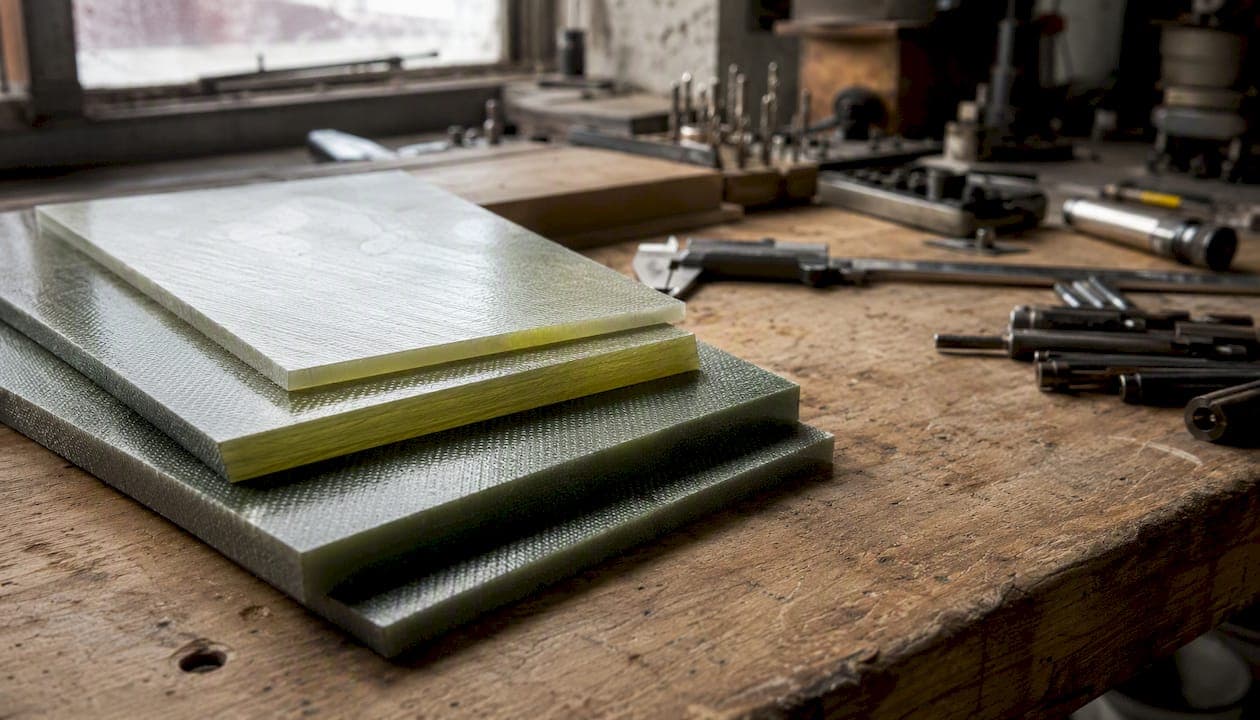
FR-4 is the flame-retardant variant of the G10 laminate family. The selection rule is simple: specify FR-4 when UL94 V-0 or formal flame certification is required; specify G10 when no flame rating is needed and you want slightly lower cost or marginally better mechanical behavior. If your application involves lead-free reflow soldering or elevated operating temperatures, step up to high-Tg FR-4 with a Tg of 150°C–180°C or higher.
- Choose FR-4 when UL94 V-0 certification, IPC compliance, or any formal flame rating appears on the drawing or spec sheet.
- Choose G10 when flame rating is not required and cost or mechanical margin is the priority.
- Choose high-Tg FR-4 when lead-free soldering or sustained elevated temperatures are part of the design requirement.
What are G10 and FR-4, and how are they related?
Both materials share the same fundamental construction: woven E-glass cloth impregnated with an epoxy resin system, laminated under heat and pressure into sheet, rod, tube, or prepreg form. The primary differentiator is the flame-retardant additive in FR-4; mechanical and dielectric properties are closely comparable across both grades.
NEMA G-10 is defined under the National Electrical Manufacturers Association laminate classification system as a continuous woven glass fabric base with an epoxy resin binder. The military equivalent is MIL-I-24768/2 (GEE). It is the baseline glass-epoxy grade, with no flame-retardant requirement.
FR-4 carries the same NEMA glass-epoxy construction but adds a flame-retardant resin package. The MIL equivalent is MIL-I-24768/27 (GEE-F). "FR" stands for flame retardant, and the grade is the dominant substrate in PCB manufacturing worldwide.
| Property | NEMA G-10 | FR-4 |
|---|---|---|
| Base construction | Woven E-glass + epoxy | Woven E-glass + epoxy |
| Flame retardancy | None (HB rating typical) | UL94 V-0 (when certified) |
| NEMA designation | G-10 | FR-4 |
| MIL spec | MIL-I-24768/2 (GEE) | MIL-I-24768/27 (GEE-F) |
| Common forms | Sheet, rod, tube | Sheet, prepreg, PCB core |
| Primary use | Machined structural parts | PCB substrates, certified assemblies |
Both grades come in standard panel sizes and a wide range of thicknesses. The practical implication for engineers: if your drawing calls out "fiberglass laminate" without a flame requirement, G10 and FR-4 are nearly interchangeable on mechanical and electrical dimensions alone.
How does FR-4's resin chemistry produce flame retardancy?
The flame-retardant performance in FR-4 comes from additives blended into the epoxy resin system before lamination. Historically, that meant brominated compounds, specifically tetrabromobisphenol-A (TBBPA), which interrupt combustion chemistry and allow the cured laminate to self-extinguish. Modern halogen-free FR-4 grades achieve the same result using phosphorus-based or nitrogen-based chemistries, which matters for RoHS compliance and certain end-of-life recycling streams.
One thing to get right early: FR-4's "FR" designation does not automatically guarantee UL94 V-0. The resin is formulated to be flame retardant, but V-0 performance must be confirmed through actual UL test reports from the specific laminate lot or product family. V-1 and HB ratings exist within the FR-4 family, and a supplier's generic "FR-4" label does not tell you which one you have.
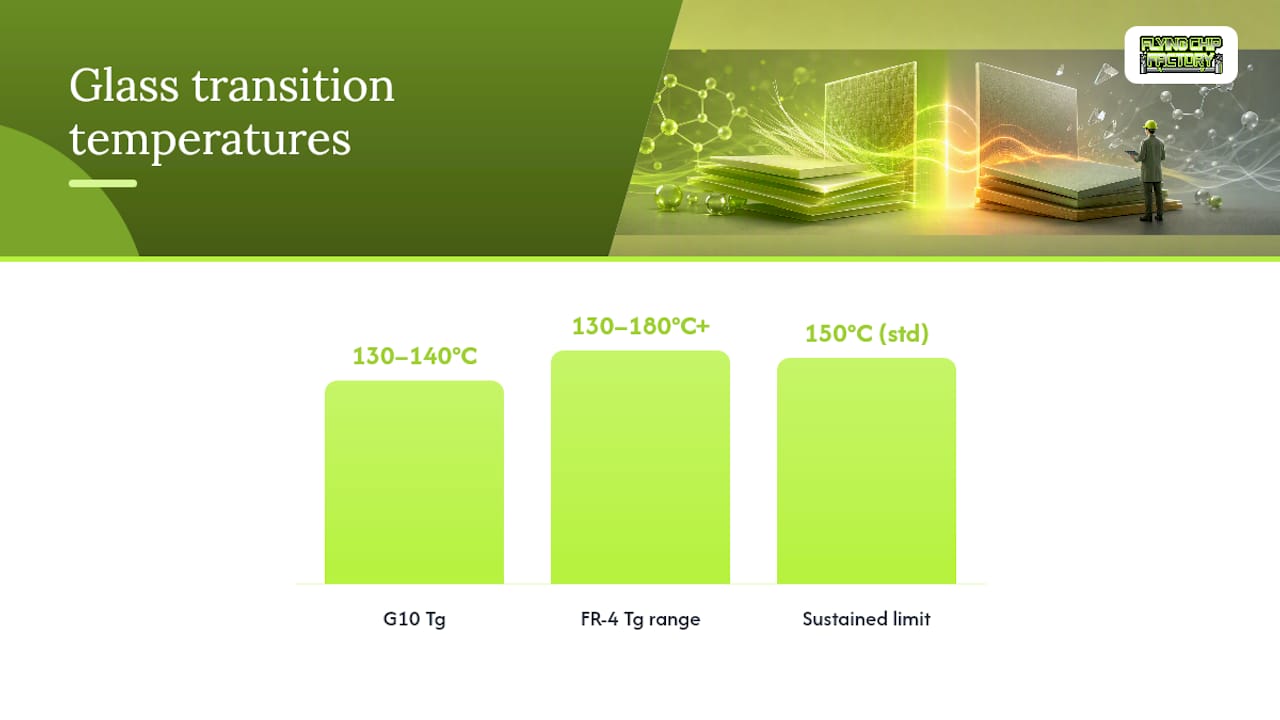
Tg is the other variable the resin chemistry controls. Standard FR-4 runs a Tg suitable for general applications. Mid-Tg grades offer improved thermal performance, and high-Tg variants provide enhanced thermal stability for demanding environments. The higher the Tg, the more thermally stable the resin network, which matters for multilayer PCBs that see repeated lead-free reflow cycles at 260°C peak.
- Mid-Tg FR-4 (Tg 150–170°C) — industrial electronics, moderate thermal cycling.
Pro Tip: When requesting FR-4 for a certified application, ask the supplier for the UL Yellow Card number and the specific test report, not just a material data sheet. The data sheet confirms formulation; the UL report confirms tested performance on that product.
Side-by-side properties: how do G10 and FR-4 actually compare?
The table below covers the properties that drive most selection decisions. Where ranges appear, they reflect the spread across standard and high-Tg FR-4 variants.
| Property | G10 | FR-4 (standard–high Tg) |
|---|---|---|
| Flame retardancy / UL rating | HB (no V-0) | UL94 V-0 (when certified) |
| Tensile strength | 45,000 psi | — |
| Glass transition temp (Tg) | 130–140°C | 130–180°C+ |
| Dielectric constant (Dk) at 1 MHz | 4.8 | 4.8 |
| Dissipation factor (Df) at 1 MHz | 0.020 | 0.020 |
| Machinability | Excellent (abrasive) | Excellent (abrasive) |
| Relative cost | Slightly lower | Slightly higher |
| Typical applications | Machined parts, fixtures | PCBs, certified assemblies |
What's practically identical: Mechanical strength, CTE, thermal conductivity, and Dk are close enough that substituting one for the other has no measurable effect on structural or basic electrical performance. For standoffs, insulating barriers, and fixture plates, the materials behave the same under load.
What's materially different: Flame retardancy is the obvious split. Tg range is the second: high-Tg FR-4 grades extend well above what G10 offers, which matters for thermal cycling. Moisture absorption can run slightly higher in some FR-4 formulations, though the gap is small in practice.
Where both materials hit their limits: FR-4's dissipation factor of approximately 0.020 causes measurable signal loss at GHz frequencies. Above roughly 1–2 GHz for controlled-impedance work, neither FR-4 nor G10 is the right substrate. Low-loss laminates such as Rogers RO4000 series or PTFE-based materials are the correct move at those frequencies. Similarly, neither material handles sustained temperatures above 150°C (standard grades) without dimensional instability, and neither is appropriate for high-power thermal management without a metal core or thermal via strategy.
For marine or salt-spray environments, some brominated FR-4 variants can degrade faster than G10 under long-term saline exposure. If the application lives in salt water or sees regular salt spray, G10 or a halogen-free FR-4 grade is the safer call.
What are the real-world applications for each material?
FR-4 typical uses:
- PCB cores and prepregs for consumer electronics, industrial controls, and medical devices where UL94 V-0 is a product safety requirement.
- High-density multilayer boards for automotive ECUs and server hardware, particularly with high-Tg grades for lead-free assembly.
- Enclosures and structural panels in assemblies where a flame rating is required by UL or IEC product standards.
- Electrical insulation barriers in switchgear and power distribution where certification documentation is required.
G10 typical uses:
- Machined structural parts: standoffs, spacers, bushings, and fixture plates where UL94 V-0 is not specified.
- Knife handles and grip scales, where G10's dimensional stability and moisture resistance outperform wood or polymer alternatives.
- 3D printer beds and tooling fixtures that need a flat, stable, machinable surface without the cost premium of certified laminate.
- Marine insulators and electrical standoffs in non-certified applications where saltwater resistance matters more than flame rating.
When neither grade is sufficient, G11 and FR-5 are the next step up. G11 offers a higher Tg than standard G10 without the FR additive; FR-5 is the flame-retardant equivalent with even better thermal performance. Polyimide laminates (such as Kapton-based systems) and aluminum-core PCBs cover the high-temperature and thermal-management cases that FR-4 cannot.
How do you decide between G10 and FR-4?
Work through this in order. The first question that produces a hard requirement ends the decision.
- Does the application require UL94 V-0 or any formal flame certification? If yes, specify FR-4 and request the UL test report. Stop here.
- What is the maximum operating temperature? If sustained temperatures exceed typical operating ranges, both standard G10 and FR-4 may be unsuitable. Specify high-Tg FR-4 (Tg 170°C+) or step up to G11/FR-5.
- Does the design operate above 1–2 GHz or require tight impedance control? If yes, neither material is appropriate. Specify a low-loss RF laminate.
- Will the part see long-term saline or salt-spray exposure? If yes, prefer G10 or specify halogen-free FR-4 explicitly.
- Is there a halogen restriction (RoHS, REACH, customer spec)? If yes, confirm halogen-free FR-4 or verify G10 resin content with the supplier.
- No flame requirement, no elevated temperature, no RF, no halogen restriction? Choose G10 for machined parts. It costs slightly less and may offer a small mechanical margin.
Quick RFQ decision bullets:
- Flame cert required → FR-4, request UL Yellow Card.
- Lead-free reflow or Tg > 150°C → high-Tg FR-4, specify Tg value on drawing.
- GHz signal integrity → low-loss laminate, not FR-4 or G10.
- Structural machined part, no cert → G10, call out NEMA G-10 on drawing.
- Marine/salt exposure → G10 or halogen-free FR-4, confirm with supplier.
Machining and prototyping G10 and FR-4: what the shop floor looks like
Both materials machine similarly because the glass fiber content drives the behavior, not the resin additive. The glass is abrasive, and that single fact shapes every tooling and process decision.
Cutting and tooling:
- Carbide tooling is non-negotiable. HSS tools dull within a few passes on G10's abrasive glass content. Use solid carbide end mills and drills with a fresh edge for production runs.
- Run higher spindle speeds and moderate feed rates. Aggressive feeds cause delamination at edges; too slow a feed generates heat that can locally soften the resin.
- Dust control matters. Glass fiber dust from machining is a respiratory hazard. Use a vacuum extraction system at the spindle, and wear a properly rated respirator (N95 minimum). Coolant mist helps suppress dust but creates a wet swarf disposal issue.
Drilling and tapping:
- Peck drilling is the standard approach for holes deeper than 2x diameter. It clears chips, reduces heat buildup, and prevents delamination on the exit side.
- For tapped holes, use a thread insert (Helicoil or similar) in any hole that will see repeated assembly. The laminate's interlaminar shear strength is lower than its in-plane strength, and direct tapping into thin sections pulls out under torque.
- Plated-through holes for PCB-style applications require a different process than machined standoffs. Mechanical drilling for plated holes follows IPC-2222 hole-size allowances; machined standoffs can hold tighter tolerances.
Edge quality and finishing:
- Climb milling on the finish pass reduces chipout on edges. A sharp tool and a light final pass (0.005–0.010 inch) produce a clean edge without fraying.
- Sanding with 220-grit or finer removes tool marks on visible faces. Avoid grinding with aluminum oxide wheels; silicon carbide or diamond abrasives cut the glass without loading.
- Laminate thickness affects deflection during thin-section cuts. Parts thinner than 0.060 inch need fixturing support close to the cut to prevent chatter.
Assembly notes:
- Mechanical fastening with through-bolts and washers distributes load better than direct screw-into-laminate. If space is tight, use thread inserts.
- Structural adhesives (epoxy-based) bond well to both G10 and FR-4 after light surface abrasion. Avoid silicone adhesives where dimensional stability matters.
Pro Tip: When sending a drawing to Flying Chip Factory or any CNC shop, call out the NEMA grade explicitly (G-10 or FR-4), the thickness tolerance, and the required surface finish on critical faces. Shops price laminate jobs partly on tooling wear, and a clear material callout with lot size lets the machinist quote accurately without padding for unknowns.
What standards and datasheet fields should you verify?
Getting the paperwork right prevents compliance failures downstream. Here is what to check before finalizing a spec.
Standards and certifications to reference:
- NEMA LI-1: the governing standard for industrial laminates, covering G-10 and FR-4 grades.
- UL94: flammability rating standard. V-0 is the most common PCB requirement; V-1 and HB are lower tiers. Confirm which tier your application requires.
- IPC-4101: specification for base materials used in rigid PCBs, including slash sheets for FR-4 variants.
- MIL-I-24768: military laminate specification covering GEE (G-10) and GEE-F (FR-4) grades.
- RoHS / REACH: halogen content declarations are required for many end markets; confirm with the supplier whether the material is halogen-free.
Datasheet fields to verify:
- Tg (and measurement method: DSC, TMA, or DMA — DSC typically reads lower than TMA for the same material).
- Dk and Df at the frequency relevant to your design (1 MHz for most structural/insulation use; 1 GHz if signal integrity matters).
- Moisture absorption (percentage by weight after 24-hour immersion).
- CTE in x/y and z axes (z-axis CTE drives plated-through-hole reliability in PCBs).
- CTI (comparative tracking index) and volume resistivity for electrical insulation applications.
- UL test report or Yellow Card number, not just a data sheet claim.
- Halogen content or RoHS declaration if your supply chain requires it.
What to request from suppliers:
- Raw sheet stock: ask for the specific product data sheet (not a generic grade sheet), batch traceability, and the UL test certificate tied to that product family.
- Prepreg for PCB stackups: request resin content, flow, and gel time data in addition to electrical properties.
- For machined parts: confirm whether the supplier stocks NEMA G-10 or FR-4 specifically, since "fiberglass sheet" from a general distributor may not carry NEMA certification.
Key Takeaways
FR-4 is G10 with a flame-retardant additive; the single deciding factor is whether UL94 V-0 or formal flame certification appears on the requirement.
| Point | Details |
|---|---|
| Flammability drives the choice | Specify FR-4 when UL94 V-0 is required; G10 when no flame rating is needed. |
| Tg determines thermal headroom | High-Tg FR-4 is required for lead-free reflow and sustained elevated temperatures. |
| FR-4 has limits above low GHz frequencies | A dissipation factor causes signal loss; use low-loss laminates for high-frequency designs. |
| Marine exposure favors G10 | Brominated FR-4 variants can degrade in saline environments; G10 or halogen-free FR-4 is safer. |
| Flying Chip Factory machines both | For prototype or short-run laminate parts, Flying Chip Factory provides direct machinist access and accurate quoting when drawings include NEMA grade and tolerance callouts. |
The view from the shop floor
There is a tendency in engineering to default to FR-4 for everything glass-epoxy, the same way engineers default to 6061 aluminum for every metal part. It is a reasonable reflex — FR-4 is everywhere, the supply chain is deep, and the certification profile covers most bases. But that default costs money when the application has no flame requirement and no PCB in sight.
A machined standoff, a fixture plate, a spacer for an electrical enclosure: none of those need a UL Yellow Card. Specifying FR-4 for them adds cost without adding function. G10 machines the same way, holds the same tolerances, and in some structural configurations actually tests slightly better in flexure.
The other thing worth saying plainly: both materials are genuinely abrasive. Shops that do not run carbide tooling on laminates will burn through HSS tooling fast and pass that cost to you. When you send a drawing to Flying Chip Factory, include the NEMA grade, the thickness, the critical tolerances, and the expected quantity. That information lets the machinist price the job honestly rather than building in a buffer for unknowns. A quick conversation before the RFQ is finalized often saves a revision cycle.
Flying Chip Factory machines G10 and FR-4 parts to print
When your design calls for machined laminate parts, the gap between a clean quote and a frustrating back-and-forth usually comes down to one thing: direct access to the person running the machine. Flying Chip Factory is a CNC job shop in Athens, Alabama, built around exactly that. No account managers in the middle, no generic online configurators that cannot handle a non-standard thickness or a tight tolerance on a drilled pattern.
For G10 and FR-4 work, the shop handles prototype quantities through short production runs, with carbide tooling, proper dust control, and the machining knowledge to hold tolerances on abrasive laminates without surprise rework charges.
- Quick quoting with direct machinist review of your drawing.
- Material sourcing guidance for NEMA G-10 and FR-4 stock.
- Prototype-to-production runs with consistent fixturing.
- Assembly-ready finishing and mechanical fastening prep.
Send your drawing to Flying Chip Factory for a quote, or reach out to talk through material selection before the RFQ is written.
Useful sources and datasheets
These references are worth bookmarking when finalizing a laminate spec or preparing an RFQ.
- High‑Tg FR4 PCB
- Technical resource on dielectric losses and high‑frequency materials
- FR4 PCB guide — material specs and usage tips
- G10 vs FR4: Differences and how to choose the right laminate
- G10 vs FR4: Which Garolite grade is right for you
- G10 vs FR4 detailed comparison of strength and durability
- FR‑4 — the essentials guide
- G10 properties — mechanical, electrical and thermal