
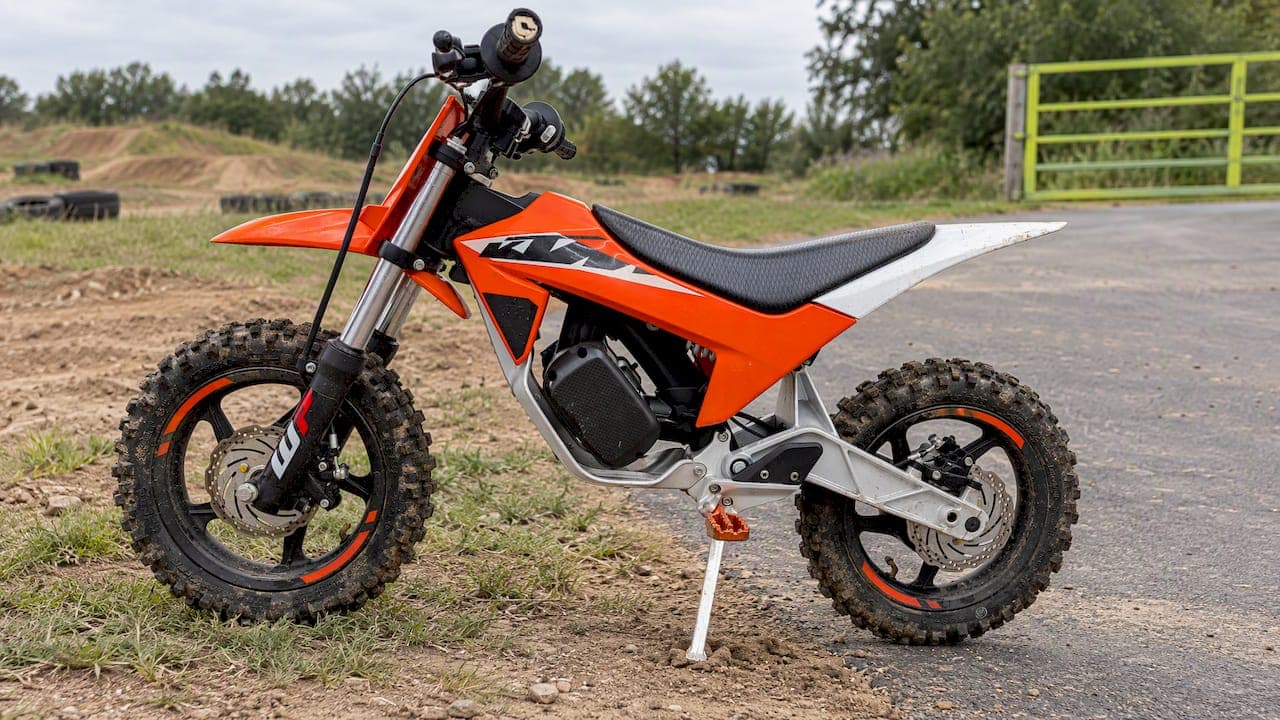
A kickstand sinks because the whole weight of the bike rests on a small patch of metal, and the ground under that patch gives way. The fix is to spread that load over a bigger area (a wider foot or a loose puck), park on firmer ground, or both. Below you will find why it happens, which fixes work, how to fit a wider foot without creating new problems, and what is different on small electric dirt bikes.
TL;DR
- Sinking is a contact-area problem: heat-softened asphalt, grass, dirt and sand all give way under a small stand foot.
- The fastest fix is a loose puck or flat object under the stand. The lasting fix is a wider foot that stays on the stand.
- A bigger foot must not weaken the stand, hang down in the stowed position or touch anything when the bike is moving.
- Park on concrete, in shade, or on a lighter patch of pavement when you can.
- Electric mini bikes with a factory triangle stand can be upgraded to a machined stand instead of patched.
Why a kickstand sinks
Think of the stand as a pencil pressing into the ground. The bike weighs the same whether it is parked on concrete or on a summer parking lot, but concrete does not move. Other surfaces do.
Hot pavement is the classic case. Asphalt is a viscoelastic material: it expands and contracts with temperature and becomes more liquid-like as it heats, which can let a typical side stand sink in. A rider-safety law firm's summer riding guide makes the same point: a stand can sink into hot asphalt and leave the bike vulnerable to tipping over.
The pressure is what does the damage. On a hot day, asphalt can soften under the weight pressing on the small spot where the stand touches, and the stand can go in far enough for the bike to fall. The same source notes that grass, dirt and sand carry the same risk.
Three things make it worse:
- Small foot area. Less area means more pounds per square inch under the foot.
- Lean angle. The stand carries part of the weight at an angle, so the foot can also slide and dig a trench rather than just push straight down.
- Time. A bike parked for five minutes may be fine. The same bike parked for two hours in afternoon sun may not be.
The quick fixes: park smarter
Before you buy anything, change where and how you park. These cost nothing.
- Choose concrete when you have the option. Parking on firmer material such as concrete is the simplest prevention.
- Look at the surface first. Check how level and clean it is before you lean the bike over. Loose gravel, sand and slope all work against you, as parking technique guidance also points out.
- Shade and color matter. Shaded asphalt, or a lighter patch, stays cooler than black pavement in direct sun, so shading the contact spot or choosing lighter patches helps.
- Turn the bike so the stand is on the high side. On a slope, park so the lean is into the hill, not away from it.
- Walk around the bike once you have parked. If the stand is already settling, you will see it in the first few seconds.
A firm, clean surface is also good for the bike in general. When you wash it, a motorcycle wash routine is a natural moment to inspect the stand foot, the spring and the pivot, because grit and old grease collect there.
The temporary fix: a puck or flat object
A stand puck is a flat piece of plastic, aluminum or wood that you put under the foot. It spreads the load over many times the original area. You carry it and drop it on the ground before you lower the stand.
If you did not bring one, improvise. A junction box cover or another flat material, even a crushed soft drink can, will spread the load. Riders also cut squares from a sheet of ABS plastic or thick plywood and keep a couple in a tank bag or tool roll.
Some practical points:
- Make it big enough that the stand foot cannot slide off the edge at your normal lean angle.
- Pick a material that does not crush or crack in heat.
- Keep it where you will remember it. The common failure is forgetting it, not the puck itself.
The downside is exactly that: it works only when you have it with you and remember to use it.
The permanent fix: a kickstand foot enlarger
A foot enlarger (also sold as a side stand foot, shoe or extension) attaches to the bottom of the stand and gives you a bigger footprint every time you park. No remembering, nothing to lose.
Typical designs fall into three types:
| Type | How it attaches | Best for | Watch for |
|---|---|---|---|
| Bolt-on plate or shoe | Fastened to the existing foot with screws or a clamp | Street and adventure bikes with a flat foot | Fit is model-specific, and loose hardware can rattle |
| Slip-on or clip-on pad | Pushes over the foot | Quick, tool-free installs | It can pop off over bumps |
| Replacement stand with a wider foot | Swaps in for the whole stand | Bikes where the factory stand is weak or too small | Must match the exact model and mounting |
Retail examples of bolt-on shoes exist for many street and adventure models. Those listings describe CNC-machined aluminum pads that roughly double the footprint of the factory foot without changing ground clearance, but the right part depends on your exact bike.
How to choose one
- Model fit. A part designed for your bike will clear the swingarm, chain, exhaust and engine cases. A universal one may not.
- Material. Aluminum or steel will not squash or deform under load. Thin plastic can flex.
- Area. More area is better only until it interferes with stowing the stand or ground clearance.
- Hardware. Use the fastener type the maker specifies. Use thread locker where the instructions call for it.
How to fit one safely
Riding-instruction material gives the key caution: add surface area, but be very careful not to reduce the stand's ability to hold the bike's weight, or to stop it folding out of the way when up. Use that as your checklist.
- Put the bike on a stable support so it cannot fall while you work.
- Clean the stand foot and the mounting face. Oil and dirt stop the new part seating.
- Fit the enlarger exactly as the maker instructs, with the correct fasteners.
- Fold the stand up. Check that nothing hangs lower than before, and that the stand still locks up against its spring.
- Look for contact with the chain, tire, exhaust, footpeg or bodywork through the full range.
- Lower the stand and put the bike's weight on it. Check that the foot sits flat and the stand does not shift.
- Re-check the fasteners after your first ride, and then periodically.
What to check so it stays secure
A wider foot is also a longer lever for anything that goes wrong. Look at it every few rides for:
- loose or missing screws,
- cracks at the weld or mounting hole,
- bent stand tubes, which change the lean angle,
- the stand spring still holding the stand up tight (a stand that drops down on bumps is a hazard in itself),
- rust or seized pivots.
If a stand is bent, cracked or weak, an enlarger is not the fix. Replace the stand. A rider who is unsure about the fit of a part on a street bike should ask a qualified motorcycle mechanic to check it.
Small electric dirt bikes are a special case
Bikes like the KTM SX-E 2, GASGAS MC-E 2 and Husqvarna EE 2 are light, but kids ride them on exactly the surfaces that sink stands: grass, packed dirt, driveways and warm pavement at a track or a neighbor's house. The factory stand is a simple triangle. It is easy to lose, easy to bend, and its small foot digs into soft ground.
On these bikes a bolt-on foot is often the wrong tool because there is little stand to add to. Replacing the whole stand with a sturdier one gives you a better shape, better material and a better foot in one step. For a bigger background on loads and materials, see our look at the engineering of a kickstand.
A parent-friendly routine helps too:
- Teach kids to put the bike on firm ground and to check it has settled before walking away.
- Keep a flat puck in the van or truck bed for grass and sand.
- Check the stand bolt and spring before each ride day.
Our perspective
We are a small CNC shop in Athens, Alabama, and we design and machine our own kickstand for these small electric bikes. We built it because riders and parents kept telling us the factory triangle stand was a weak point. A stand has a simple job and gets abused: it gets stepped on, dropped, loaded sideways and left in the sun.

Our view is that a sinking stand should be solved at the source. A puck is a good habit and we recommend you carry one. But a stand that fits the bike correctly, is machined rather than stamped, and mounts with simple hardware will serve you better than a stack of fixes on a poor stand. We also think a part should be easy to fit. If it takes a weekend and a welder, riders will not do it.
Because the person who designs the part also machines it and answers your questions, we can adjust and iterate quickly. That is also how we handle custom jobs. If you have a bracket, a foot or a fixture that does not exist off the shelf, we like to talk it through directly.
— Drake
Our E2 Kickstand
If you ride a KTM SX-E 2, GASGAS MC-E 2 or Husqvarna EE 2, take a look at our E2 Kickstand. It is a CNC-machined, bolt-on replacement for the factory triangle stand, priced at $100-$105. For one-off parts, brackets or short production runs for other bikes or projects, send us the details of your job and we will talk it through.
Putting it together
A simple order of operations works for most riders:
- Park on concrete or firm ground whenever you can.
- Carry a puck for everything else.
- If the stand is the weak link, replace it with a stronger one or add a securely fitted foot.
- Inspect the stand, spring and fasteners regularly.
If vibration and rider comfort are the next thing on your list, our guide to reducing dirt bike handlebar vibration covers it.
FAQ
Why does my kickstand sink into asphalt even when the bike is light?
Because the contact area is tiny, so the pressure under the foot is high. In heat, asphalt softens and gives way under that concentrated load. Lighter bikes sink less, but they still sink on hot days.
Is a kickstand foot enlarger safe?
It can be, when it is designed for your bike and fitted as the maker instructs. The risks are weakening the stand, letting the foot hang low when stowed, or having it touch the chain or exhaust. Check the fit through the full stand travel and re-check the fasteners after your first ride.
What can I use if I have no puck?
Any flat, rigid object that spreads the load: a junction box cover, a square of ABS or plywood, or even a flattened can. Make sure it is wide enough that the foot cannot slide off.
Does the surface matter if I have a bigger foot?
Yes. A bigger foot helps, but a firm, level, clean surface is always better. Concrete beats hot asphalt, and neither is as good as flat, solid ground when the bike is going to sit for hours.
Can I fix the stand on my electric mini bike without welding?
Yes. The E2 Kickstand is a bolt-on replacement for the KTM SX-E 2, GASGAS MC-E 2 and Husqvarna EE 2, so it does not need welding. It replaces the stand rather than modifying it.
Sources
- TEAM Arizona Riding Tip: Side Stand Puck
- 5 Tips for Riding Your Motorcycle in the Summer Heat
- Don't lose your sidestand in hot asphalt
- Parking a Motorcycle Techniques
- Sidestand Foot Enlargers